
ASVAB Subject Knowledge: Word Knowledge & Math Subtests Guide 2026 October
🟢 Free ASVAB Subject Knowledge: Word Knowledge practice test with questions and answer explanations. Prepare for the 2026 October exam with instant scoring.
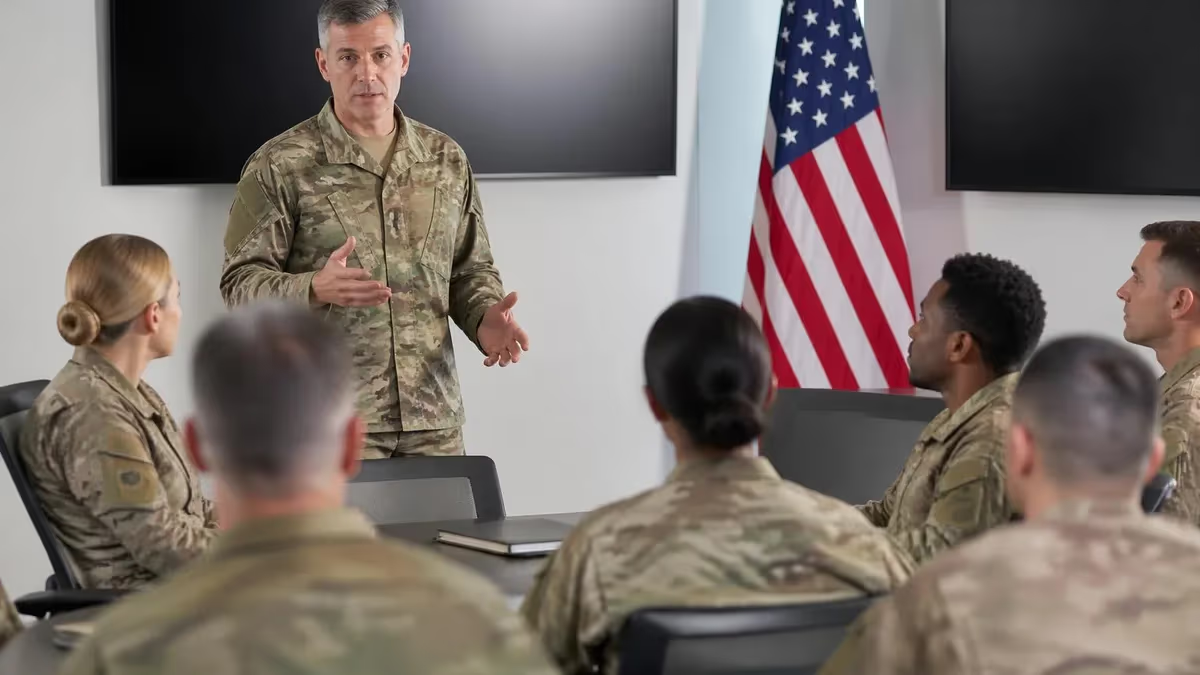
ASVAB Subject Knowledge: What You Actually Need to Know
The ASVAB measures subject knowledge across nine distinct subtests — and your performance on each one shapes your military career path. Whether you're aiming for Army infantry or an Air Force cyber specialty, understanding how these subtests work gives you a real edge. Most recruits fixate on the overall AFQT percentile. That's a mistake. The subtests behind that number matter just as much, and sometimes more.
Two subtests trip up candidates more than any others: asvab word knowledge and Mathematics Knowledge. Word knowledge asvab questions test your vocabulary through synonyms and context clues. Math Knowledge hits algebra, geometry, and number operations. Together with Arithmetic Reasoning and Paragraph Comprehension, these four subtests form your AFQT — the score that determines whether you can enlist at all.
Here's the thing most study guides won't tell you. Scoring above the minimum doesn't just get you in. It opens doors to better jobs, bigger bonuses, and technical specialties that translate directly to civilian careers after service. A 50th-percentile AFQT qualifies you for basic enlistment in every branch. An 80th-percentile score? That puts nuclear engineering, cryptology, and intelligence careers on the table. If you're going to take this test, you might as well aim high.
This guide breaks down each knowledge area, walks you through scoring, and connects you with practice tests that mirror actual ASVAB questions. You'll find specific strategies for word knowledge, math knowledge, and the technical subtests that feed into line scores for job placement.

The Nine ASVAB Subtests — And Why Each Matters
Every ASVAB subtest feeds into composite line scores that determine your job options. The word knowledge asvab section (WK) and Paragraph Comprehension (PC) combine into your Verbal Expression score. Arithmetic Reasoning (AR) and Mathematics Knowledge (MK) test your quantitative abilities. Together, VE + AR + MK produce your AFQT. That's the gatekeeper score. But the remaining five subtests — General Science, Electronics Information, Auto and Shop, Mechanical Comprehension, and Assembling Objects — aren't throwaways. Far from it.
If you want to take an word knowledge asvab practice test before your exam date, start there. Those four AFQT subtests deserve 60% of your study time. The other five subtests feed into branch-specific line scores. An Army mechanic needs strong Auto and Shop scores. A Navy nuclear technician needs top-tier math and science. Your recruiter can pull up exactly which composites your target MOS requires — ask before you start studying so you don't waste time on irrelevant material.
The CAT-ASVAB (computer version) adapts to your ability level. Get questions right, and the next ones get harder — but you earn more points per correct answer. Get them wrong, and difficulty drops. This means guessing strategically matters less than knowing the material cold. You can't skip questions or go back on the CAT version. Each answer is final. That's why a solid asvab word knowledge practice test session matters — you need to build confidence before test day, not during it.
Mastering Word Knowledge on the ASVAB
The word knowledge on asvab section is one of the most improvable subtests — if you study the right way. You'll see two question formats. Some give you a word and ask for a synonym. Others embed the word in a sentence and ask what it means in context. Both test vocabulary, but they require slightly different skills. Synonym questions reward memorization. Context questions reward reading comprehension and inference.
Start with roots. Latin and Greek roots appear in hundreds of English words. Know "bene" (good), "mal" (bad), "cred" (believe), "dict" (say), and you can decode unfamiliar vocabulary on test day. Prefixes like "anti-," "pre-," "mis-," and "un-" modify meaning predictably. Suffixes like "-tion," "-ous," and "-able" signal part of speech. This isn't guessing — it's applied word knowledge that works even when you've never seen the specific word before.
Flashcards still work. Create sets of 20 words per day from ASVAB-specific word lists. Review yesterday's set before starting today's. Spaced repetition — testing yourself at increasing intervals — beats cramming every time. Apps like Anki automate the spacing for you. Pair flashcard work with 30 minutes of daily reading (newspapers, not novels) to build contextual vocabulary naturally. Most candidates see measurable improvement within two to three weeks of consistent practice.
ASVAB Subtest Breakdown
Word Knowledge (WK): 16 questions, 8 minutes on CAT-ASVAB. Tests vocabulary through synonyms and sentence context. Feeds into Verbal Expression (VE) and AFQT.
Paragraph Comprehension (PC): 11 questions, 22 minutes. Tests reading comprehension — main ideas, supporting details, and inference from short passages. Combined with WK for VE score.
Tip: VE counts double in the AFQT formula. Improving word knowledge and reading skills has twice the impact of math improvement on your enlistment score.
Building Your ASVAB Word Knowledge List
A focused asvab word knowledge list makes study sessions efficient instead of aimless. Don't grab a random GRE word list — the ASVAB tests different vocabulary than graduate school exams. You need everyday-to-intermediate words, not obscure academic terms. Think "prudent," "candid," "obsolete," and "feasible" rather than "sesquipedalian" or "perspicacious." The test rewards practical vocabulary, the kind you'd encounter in military manuals, news articles, and workplace communication.
Some candidates search for asvab word knowledge quizlet sets, and that's a decent starting point. Quizlet's spaced repetition features mirror what research says about vocabulary retention. But don't stop at memorizing definitions. For each word, write a sentence using it. Then identify its root. Then list two synonyms. This deeper processing cements the word in long-term memory far better than reading a definition once and moving on.
Group your word list by theme: words about size (diminutive, colossal, meager), words about speed (expedite, lethargic, brisk), words about quality (mediocre, exemplary, deficient). Thematic grouping creates mental hooks that help you recall related words during the test. Aim for 200 to 300 words total — that's enough to cover the most commonly tested vocabulary without overwhelming your study schedule.
ASVAB Scores by Branch — What You're Really Competing For
Every military branch sets its own minimum AFQT for enlistment. But minimums tell a misleading story. The Army's floor is 31 for diploma holders. Sounds easy, right? Except word knowledge asvab practice test scores at that level limit you to a handful of MOS options — mostly combat arms with few transferable civilian skills. Score a 50 or above and the door swings wide open. Score 70+ and you're looking at intelligence, cyber, and signal corps specialties that pay six figures on the civilian side.
The Air Force and Space Force demand higher minimums (36 and 65 for diploma and GED holders, respectively). In practice, the average Air Force enlistee scores well above 50. Competitive asvab subjects like Electronics Information and General Science matter more for Air Force specialty codes than raw AFQT. The Navy's nuclear field program — one of the military's most prestigious enlisted tracks — requires math and science scores at the 98th percentile. Coast Guard? Minimum AFQT of 40, but it's the smallest branch with the fewest slots. You're competing against a deep applicant pool.
Here's the bottom line. Don't study to pass — study to qualify for the job you actually want. Look up the line score requirements for your target MOS or rating before you crack a book. Then word knowledge on asvab practice and math drills become purposeful instead of generic. Talk to your recruiter about which composites matter most for your specific career goals.
Strengths and Weaknesses of ASVAB Subject Testing
- +Subtests identify your strongest knowledge areas for targeted job placement
- +AFQT percentile scoring lets you compare performance against a national reference group
- +Higher scores unlock bonuses, advanced training, and technical career fields
- +VE counts double in AFQT — vocabulary improvement has outsized impact
- +CAT-ASVAB adaptive format rewards genuine knowledge with higher scaled scores
- +Score validity lasts two years, giving you flexibility on enlistment timing
- −CAT-ASVAB doesn't let you skip or revisit questions — one wrong answer can spiral
- −Line score requirements vary by branch and change without public notice
- −AFQT only uses four of nine subtests — strong technical skills don't help enlistment eligibility
- −GED holders face higher minimum AFQT requirements across all branches
- −Retesting requires a one-month wait, then six months after the third attempt
- −Score reports don't show individual question results, making targeted review harder
Pros and Cons at a Glance
| Pros | Cons |
|---|---|
| Subtests identify your strongest knowledge areas for targeted job placement | CAT-ASVAB doesn't let you skip or revisit questions — one wrong answer can spiral |
| AFQT percentile scoring lets you compare performance against a national reference group | Line score requirements vary by branch and change without public notice |
| Higher scores unlock bonuses, advanced training, and technical career fields | AFQT only uses four of nine subtests — strong technical skills don't help enlistment eligibility |
| VE counts double in AFQT — vocabulary improvement has outsized impact | GED holders face higher minimum AFQT requirements across all branches |
| CAT-ASVAB adaptive format rewards genuine knowledge with higher scaled scores | Retesting requires a one-month wait, then six months after the third attempt |
| Score validity lasts two years, giving you flexibility on enlistment timing | Score reports don't show individual question results, making targeted review harder |
How to Practice ASVAB Word Knowledge Effectively
Let's talk about what actually works for practice asvab exam word knowledge prep — not what sounds good on a study tips poster. First, ditch passive reading. Highlighting definitions in a vocabulary book doesn't build recall. Active retrieval does. Quiz yourself. Cover the definition, say it aloud, then check. Wrong? Good. That error signal strengthens the memory trace more than getting it right the first time.
Word knowledge asvab quizlet decks offer a solid foundation, but customize them. Delete words you already know cold. Add words you've missed on practice tests. A 150-word personalized deck beats a 500-word generic one every time. Study in two 15-minute sessions per day rather than one 30-minute block — the spacing effect is real and well-documented in cognitive science research.
Context matters more than definition memorization for the sentence-based questions. Read the sentence, cover the answer choices, and predict the meaning before looking at options. This trains inference skills that transfer directly to test day. If you can't predict, look at word parts — roots, prefixes, suffixes. Between active recall, spaced repetition, and root word analysis, most test-takers gain 5 to 10 raw points on Word Knowledge within three weeks. That's a meaningful AFQT bump.
ASVAB Subject Knowledge Study Checklist
- ✓Take a diagnostic ASVAB practice test to find your baseline scores
- ✓Identify your target MOS and its required line score composites
- ✓Build a 200-word ASVAB vocabulary list organized by theme
- ✓Study root words, prefixes, and suffixes for 20 minutes daily
- ✓Practice Arithmetic Reasoning word problems under timed conditions
- ✓Review algebra fundamentals: equations, inequalities, factoring
- ✓Study geometry formulas: area, perimeter, volume, angles
- ✓Take a full-length timed practice test weekly to track progress
- ✓Review every wrong answer and trace it to a specific knowledge gap
- ✓Score at least 20 points above your target branch's minimum AFQT
ASVAB Mathematics Knowledge: What the Test Actually Covers
The asvab mathematics knowledge practice test section is pure math — no word problems, no story setups. You'll see equations to solve, shapes to measure, and numbers to manipulate. Algebra dominates: solving for x, factoring quadratics, working with inequalities, and simplifying expressions. Geometry shows up as area calculations, angle relationships, and volume formulas. Number theory questions test your grasp of primes, factors, multiples, and order of operations.
Math knowledge asvab prep doesn't require advanced math. Everything on MK falls within high school math standards. If you completed Algebra I and basic Geometry, you've seen this material before. The challenge isn't complexity — it's rust. Most candidates haven't done formal math in years. A two-week algebra review can shake off that rust fast. Focus on the operations you'll actually encounter: solving linear equations, computing areas of triangles and circles, and converting between fractions, decimals, and percentages.
Don't neglect the calculator situation. You won't have one. The CAT-ASVAB provides scratch paper, and that's it. Practice doing arithmetic by hand — long division, fraction operations, basic multiplication of two-digit numbers. Candidates who rely on calculator skills during study often freeze on test day. Build the manual computation habit early. An asvab word knowledge list paired with a math formula sheet covers 80% of what you need for AFQT prep.
ASVAB Word Knowledge List PDF Resources and Study Materials
Searching for an asvab word knowledge list pdf? You'll find dozens online, but quality varies wildly. The best lists pull vocabulary from actual ASVAB practice tests and retired questions rather than generic SAT or GRE word banks. Look for lists organized by difficulty tier — start with the 100 most common ASVAB words before moving to intermediate and advanced tiers. A tiered approach ensures you lock in easy points first.
Free resources worth your time include the official ASVAB practice test on the military's March2Success platform. It's dated but functional. For word knowledge practice test drills specifically, sites with timed quizzes beat static word lists because they simulate test pressure. You need to retrieve definitions under time constraints, not just recognize them at your leisure.
Physical flashcards still outperform apps for some learners — the act of writing engages motor memory. Create index cards with the word on front, definition plus a sample sentence on back. Carry 20 cards daily and review during dead time: waiting rooms, lunch breaks, bus rides. Combine this with two to three full-length practice tests per week. Track your WK scores over time. If you're not improving after two weeks, switch strategies — try root word analysis or contextual reading instead of pure memorization.
Most study guides focus exclusively on AFQT subtests. That's fine for enlistment eligibility — but your military job depends on line scores from technical subtests like Electronics Information, Mechanical Comprehension, and General Science. If you want a specific MOS, rating, or AFSC, check its line score requirements with your recruiter before you start studying. A high AFQT with weak technical scores limits your career options more than most candidates expect.
ASVAB Math Knowledge and Arithmetic Reasoning Combined Strategy
Asvab math knowledge questions test concepts. Arithmetic Reasoning questions test application. You need both — and the study approach differs. For MK, drill formulas and procedures until they're automatic. Area of a circle? πr². Volume of a cylinder? πr²h. Pythagorean theorem? a² + b² = c². These formulas appear constantly, and hesitation costs time you don't have.
For AR, practice translating words into math. "John earns $12 per hour and works 37 hours" means 12 × 37. "A tank holds 450 gallons and drains at 15 gallons per minute" means 450 ÷ 15. The math knowledge itself is usually simple — the challenge is extracting the right operation from a paragraph of text. Read the question twice. Identify what's being asked. Set up the equation. Then solve.
Here's a strategy most prep books miss. On the CAT-ASVAB, difficulty adapts to your performance. If you nail the first few questions, the test serves harder ones — but each correct answer earns more points. Rushing through easy questions to reach hard ones backfires. Accuracy on early questions matters more than speed. Take your time on the first five math questions in each section. Build a foundation of correct answers, and the adaptive algorithm rewards you with a higher scaled score even if you miss a few hard questions later.
ASVAB Practice Test Questions
Prepare for the ASVAB - Armed Services Vocational Aptitude Battery exam with our free practice test modules. Each quiz covers key topics to help you pass on your first try.
ASVAB Arithmetic Reasoning Test
ASVAB Exam Questions covering Arithmetic Reasoning Test. Master ASVAB Test concepts for certification prep.
ASVAB Arithmetic Reasoning Word Problems
Free ASVAB Practice Test featuring Arithmetic Reasoning Word Problems. Improve your ASVAB Exam score with mock test prep.
ASVAB Assembling Objects Test
ASVAB Mock Exam on Assembling Objects Test. ASVAB Study Guide questions to pass on your first try.
ASVAB Automotive Information Test
ASVAB Test Prep for Automotive Information Test. Practice ASVAB Quiz questions and boost your score.
ASVAB Electronics Fundamentals and Circuits
ASVAB Questions and Answers on Electronics Fundamentals and Circuits. Free ASVAB practice for exam readiness.
ASVAB Electronics Practice Test
ASVAB Mock Test covering Electronics Practice Test. Online ASVAB Test practice with instant feedback.
ASVAB Electronics Practice Test 1
Free ASVAB Quiz on Electronics Practice Test 1. ASVAB Exam prep questions with detailed explanations.
ASVAB General Science Biology and Ecology
ASVAB Practice Questions for General Science Biology and Ecology. Build confidence for your ASVAB certification exam.
ASVAB General Science Practice Test
ASVAB Test Online for General Science Practice Test. Free practice with instant results and feedback.
ASVAB General Science Practice Test 1
ASVAB Study Material on General Science Practice Test 1. Prepare effectively with real exam-style questions.
ASVAB Mathematics Knowledge Test
Free ASVAB Test covering Mathematics Knowledge Test. Practice and track your ASVAB exam readiness.
ASVAB Mechanical Comprehension Principles
ASVAB Exam Questions covering Mechanical Comprehension Principles. Master ASVAB Test concepts for certification prep.
ASVAB Mechanical Comprehension Test
Free ASVAB Practice Test featuring Mechanical Comprehension Test. Improve your ASVAB Exam score with mock test prep.
ASVAB Paragraph Comprehension and Inference
ASVAB Mock Exam on Paragraph Comprehension and Inference. ASVAB Study Guide questions to pass on your first try.
ASVAB Paragraph Comprehension Test
ASVAB Test Prep for Paragraph Comprehension Test. Practice ASVAB Quiz questions and boost your score.
Beyond AFQT: Technical Subject Knowledge That Opens Doors
Mathematics knowledge and word knowledge get all the attention because they drive the AFQT. But five other subtests determine your military career trajectory. General Science (GS) covers biology, chemistry, earth science, and physics at a high school level. Electronics Information (EI) tests circuits, voltage, resistance, and Ohm's law. Mechanical Comprehension (MC) asks about gears, pulleys, levers, and fluid pressure. Auto and Shop (AS) covers tools, engines, and basic repair. Assembling Objects (AO) tests spatial reasoning with shape-matching puzzles.
These technical subtests combine into line scores with names like General Technical (GT), Electronics (EL), and Skilled Technical (ST). An Army GT score of 110+ qualifies you for Officer Candidate School. A Navy Nuclear Field composite in the 98th percentile opens the nuclear propulsion program — one of the highest-paying enlisted career paths in any branch. Arithmetic knowledge asvab performance feeds directly into these composites alongside the technical subtests.
Study technical subtests only after your AFQT prep is solid. Use the remaining weeks before your test date to target the specific subtests your MOS requires. General Science is the most "learnable" technical subtest — a basic biology and chemistry review covers most questions. Electronics Information requires either prior knowledge or focused study; if you've never worked with circuits, budget extra time. Mechanical Comprehension rewards spatial thinkers but can be improved with practice problems and visual diagrams.
Sample ASVAB - Armed Services Vocational Aptitude Battery Practice Questions
Try these questions from our free ASVAB - Armed Services Vocational Aptitude Battery practice tests. The correct answer and an explanation follow each question.
The word VERBOSE most nearly means:
- A. silent
- B. wordy
- C. brief
- D. honest
Answer: B. wordy
Verbose means using more words than are needed; long-winded.
The word TENACIOUS most nearly means:
- A. timid
- B. persistent
- C. careless
- D. generous
Answer: B. persistent
Tenacious means holding firmly to something; persistent and not giving up easily.
Choose the word most similar in meaning to IMPARTIAL.
- A. Biased
- B. Neutral
- C. Strict
- D. Kind
Answer: B. Neutral
Impartial means treating all sides equally without bias; neutral is the best synonym.
Choose the word most similar in meaning to DESOLATE.
- A. Crowded
- B. Bleak
- C. Warm
- D. Cheerful
Answer: B. Bleak
Desolate means deserted and bleak; bleak is the closest synonym.
Take the full ASVAB - Armed Services Vocational Aptitude Battery practice test
ASVAB Questions and Answers

ASVAB Exam Tips: Proven Strategies to Boost Your Score in 2026

ASVAB Career Overview: How Your Scores Open Military Job Doors

ASVAB Exam Prep: Your Study Guide for Military Enlistment
ASVAB Study Materials: Best Books, PDFs & Free Resources for 2026
ASVAB Practice Tests: Free Questions for Every Subtest
About the Author
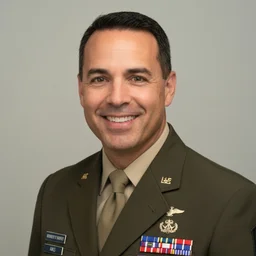
Retired Military Officer & Armed Forces Test Preparation Specialist
United States Army War CollegeColonel Steven Harris (Ret.) served 28 years in the US Army, earning a Master of Arts in Military Science from the Army War College and a Bachelor of Science in Criminal Justice. He has coached thousands of military enlistment and officer candidate program applicants through the ASVAB, AFQT, AFCT, OAR, and officer selection assessment processes across all military branches.
Join the Discussion
Connect with other students preparing for this exam. Share tips, ask questions, and get advice from people who have been there.
View discussion (5 replies)