
ASVAB Scores: Score Range, Line Scores & Branch Minimums 2026 October
Prepare for the ASVAB Scores: 📗 Score Range, Line Scores certification. Practice questions with answer explanations covering all exam domains.

Your ASVAB scores decide two things: whether you can enlist and which military jobs you're eligible for. The Armed Services Vocational Aptitude Battery measures aptitude across nine subtests, then rolls four of them into an AFQT percentile that every branch uses as a gate. Score a 31 on the AFQT and the Army might let you in. Score a 72 and suddenly hundreds of specialties open up. That spread matters more than most recruits realize.
Beyond the AFQT, line scores combine specific subtests into composites like GT, EL, and MM. Each military occupation has its own minimum line-score thresholds, so two people with the same AFQT can qualify for completely different careers. The ASVAB score range runs from 1 to 99 on the AFQT side, while individual subtest standard scores sit on a separate scale. Understanding both layers is the first real step toward picking your branch, locking in your MOS, and building the career you actually want.
This guide breaks down every piece of the scoring puzzle. You'll learn what each number means, how branches set their minimums, which line scores unlock the best jobs, and exactly what counts as a "good" result in 2026. Whether you're studying for your first attempt or retaking after a disappointing result, the information here puts you in control of the process from start to finish.

AFQT and the ASVAB Score Range
The AFQT is the gatekeeper. It pulls from four subtests -- Arithmetic Reasoning, Word Knowledge, Paragraph Comprehension, and Mathematics Knowledge -- and converts your raw performance into a percentile. That percentile is your ASVAB score range position, measured against a nationally representative sample of 18- to 23-year-olds. A 60 means you outperformed 60 percent of that group. Simple as that.
Each branch slots AFQT results into categories. Category I covers 93-99, Category II spans 65-92, and Category IIIA sits at 50-64. Most recruits land in Category IIIB (31-49), which still meets Army and Marine Corps minimums. Below 31 is Category IV, and branches rarely accept applicants there without special waivers. Your ASVAB score category shapes not just eligibility but also enlistment bonuses and job-slot availability.
Don't confuse the AFQT with a raw percentage. You can't "get a 100" because the scale tops out at 99. And because it's norm-referenced, the difficulty of earning a high percentile depends partly on how everyone else performs. What stays constant is the math: four subtests, one composite, one percentile. Nail those four areas and the rest of the ASVAB still matters for line scores, but your enlistment ticket is punched.
What Is a Good ASVAB Score?
Ask five recruiters and you'll get five answers -- but the data tells a clear story. An ASVAB score of 50 is dead average. That's not bad; it means half the reference population scored lower than you. Plenty of solid careers open at that level, including infantry, logistics, and several maintenance fields. But if you're chasing intelligence analyst slots, cyber operations, or nuclear-trained ratings, you'll need to climb into the 70s or higher.
The real question is: what is a good ASVAB score for YOUR goals? Check the average ASVAB score requirements for the specific MOS or rating you want. Some Army combat jobs only need a GT of 80. Navy nuclear roles demand AR+MK composites above 220. Air Force cyber careers require high General and Electronics scores. A "good" result is one that clears every threshold for the job you actually want, with enough margin that a bad day won't knock you out.
Here's a rough breakdown. Scoring 31-49 gets you through the door at most branches. A range of 50-64 qualifies you for the majority of available jobs. Hit 65-79 and you're competitive for technical specialties. Score 80+ and recruiters start calling you -- not the other way around. The ASVAB score chart below each branch's tab will show exact line-score cutoffs for popular career fields.
Branch Minimum ASVAB Scores
Army ASVAB Scores -- The Army requires a minimum AFQT of 31 with a high school diploma. GED holders typically need a 50. Scores for ASVAB Army jobs vary widely: infantry needs a CO of 87, while signals intelligence demands a ST of 101. Army ASVAB scores above 50 unlock most MOSs, and anything past 70 puts enlistment bonuses on the table.
Highest ASVAB Score and Score Tiers
The highest ASVAB score on the AFQT scale is 99. That's not a perfect raw score -- it's a percentile, meaning you outperformed 99 percent of the norming group. Earning a 99 puts you in Category I, a tier that makes up roughly 4 percent of all test-takers. At that level, every single MOS, rating, and AFSC across every branch is on the table.
Below that, Category II (65-92) is where most high performers land. You'll qualify for intelligence, technical, and medical jobs without issue. Category IIIA (50-64) covers the average range. What is a good ASVAB score in practice? Anything 50 or above puts you ahead of half the field, and that's enough for solid careers in maintenance, logistics, and many combat-support roles.
Subtest standard scores use a different scale entirely. Each subtest converts raw answers to a standard score with a mean of 50 and standard deviation of 10. These feed into line-score composites. So when someone says their "ASVAB score" is 110, they're probably quoting a GT line score, not their AFQT. Keeping these scales straight matters because recruiters juggle both when matching you to jobs.
ASVAB Test Scores and Branch Requirements
Your ASVAB test scores split into two buckets that serve different purposes. The AFQT handles enlistment eligibility -- can you join? Line scores handle job placement -- what can you do once you're in? Every branch publishes its own composite formulas, so identical subtest results produce different line scores depending on whether the Army, Navy, or Air Force is running the calculation.
For the Army, key composites include CO (Combat Operations), FA (Field Artillery), and ST (Skilled Technical). The average ASVAB score needed for an Army combat MOS hovers around CO 87-90, while signals and cyber jobs push ST above 100. Marines use a similar structure but with fewer composite categories. The ASVAB score for Air Force career fields leans heavily on Mechanical (M), Administrative (A), General (G), and Electronics (E) composites.
Navy ratings throw another wrinkle in. They combine subtests into unique composites and sometimes add minimum individual-subtest floors. A prospective nuclear machinist mate doesn't just need a high AR+MK sum -- they also need to clear individual thresholds on each subtest. Coast Guard requirements mirror the Navy in many areas, though the minimum AFQT climbs to 40. Understanding these branch-specific layers keeps you from assuming one score fits all.
Pros and Cons of High ASVAB Scores
- +Qualify for virtually every MOS, rating, and AFSC across all branches
- +Unlock enlistment bonuses that can reach $50,000 for in-demand specialties
- +Pick your duty station before shipping -- high scorers get first choice
- +Access accelerated promotion tracks and advanced training pipelines
- +Stronger negotiating position with recruiters on contract terms
- +Transfer to competitive inter-service programs like Officer Candidate School
- −Recruiters may pressure you into jobs the branch needs filled, not what you want
- −Higher-scoring roles often demand longer initial-training commitments
- −Some technical specialties require extended service obligations of 5-6 years
- −Pressure to maintain performance can increase stress during early service
- −Overqualification for some roles may lead to boredom or dissatisfaction
- −Retesting to chase a higher score means waiting one to six months
Pros and Cons at a Glance
| Pros | Cons |
|---|---|
| Qualify for virtually every MOS, rating, and AFSC across all branches | Recruiters may pressure you into jobs the branch needs filled, not what you want |
| Pick your duty station before shipping -- high scorers get first choice | Higher-scoring roles often demand longer initial-training commitments |
| Access accelerated promotion tracks and advanced training pipelines | Pressure to maintain performance can increase stress during early service |
| Stronger negotiating position with recruiters on contract terms | Overqualification for some roles may lead to boredom or dissatisfaction |
| Transfer to competitive inter-service programs like Officer Candidate School | Retesting to chase a higher score means waiting one to six months |
How ASVAB Scores Are Calculated
People search "ASVAB scores how to calculate based on" their subtest results, and the answer is more layered than a single formula. Your AFQT uses a two-step process. First, the verbal composite adds your Word Knowledge and Paragraph Comprehension raw scores. Second, that verbal composite joins Arithmetic Reasoning and Mathematics Knowledge raw scores. The military applies its own conversion table to turn your combined raw score into a percentile -- and that table isn't public, so you can't replicate it exactly at home.
Line scores work differently. Each composite grabs two or three subtest standard scores and adds them. The Air Force ASVAB score composites use categories labeled M, A, G, and E. The Army uses GT, CL, CO, EL, FA, MM, OF, SC, and ST. Same subtests, different groupings, different totals. That's why an air force score for ASVAB job qualification can look nothing like an Army composite even when the underlying performance is identical.
Standard scores for each subtest have a mean of 50 and a standard deviation of 10. If you scored a 62 on Arithmetic Reasoning, you're about 1.2 standard deviations above the mean -- solid, but not exceptional. Plug that into the GT formula alongside your WK and PC scores and you might land a GT of 115, which clears the threshold for most intel and admin jobs. The math isn't mysterious; it's just scattered across nine subtests and dozens of branch-specific formulas.
ASVAB Score Preparation Checklist
- ✓Identify the AFQT minimum for your target branch and education level
- ✓Look up line-score requirements for your top three desired MOSs or ratings
- ✓Take a full-length diagnostic practice test under timed conditions
- ✓Score the diagnostic and rank your subtests from weakest to strongest
- ✓Spend 60 percent of study time on your two weakest subtests
- ✓Review arithmetic fundamentals: fractions, percentages, and ratios
- ✓Build vocabulary with 20 new words daily for Word Knowledge improvement
- ✓Practice reading-comprehension passages with a strict two-minute timer
- ✓Complete at least one full practice test per week during your study block
- ✓Schedule your test date with enough buffer for one potential retake
Air Force, Army, and Navy ASVAB Score Breakdowns
The air force score for ASVAB enlistment sits at 36 AFQT -- highest baseline of any branch. But that's just the door. Inside, career fields like Cyber Surety need a General composite of 64, and Pararescue requires a combination of Physical Ability and General scores that most applicants miss on the first try. If the Air Force is your goal, study the Electronic (E) and General (G) composites hardest because they gate the most popular AFSCs.
Scores for ASVAB Army jobs follow a different pattern. The Army accepts a 31 AFQT with a diploma, which is the lowest published minimum among all branches. But don't confuse "easy to join" with "easy to get the job you want." An ASVAB score chart for Army MOSs shows that 68W (Combat Medic) needs a ST of 101, 35F (Intelligence Analyst) demands a ST of 101 as well, and 25B (IT Specialist) requires a ST of 95. Those line scores translate to strong Arithmetic Reasoning and General Science subtest results.
Navy and Coast Guard requirements add even more complexity. A Navy ASVAB score of 31 AFQT gets you to MEPS, but ratings like CTN (Cryptologic Technician Networks) require an AR+MK+EI+GS composite above 222. Coast Guard raises the AFQT floor to 40 and tends to have fewer available slots, making competition stiffer even at moderate score levels. Across every branch, the takeaway is the same: the higher your scores, the more control you have.
Navy ASVAB Score vs. Army ASVAB Scores
Comparing a Navy ASVAB score to Army ASVAB scores isn't as simple as lining up two numbers. The branches define their composites differently, weighting subtests in ways that favor their operational needs. The Navy leans heavily on electronics and mechanical composites for its fleet-maintenance ratings, while the Army spreads requirements more evenly across combat, technical, and administrative composites.
For the Army, the GT line score dominates. It's required for the widest range of MOSs, and a GT above 110 is the unofficial threshold for "competitive." Navy equivalents split across more composites -- a prospective sonar technician needs different subtest strengths than a hospital corpsman. ASVAB scoring works the same way mechanically, but branch policies make the outputs feel like different tests entirely.
Here's a practical comparison. An applicant with strong Arithmetic Reasoning and Mathematics Knowledge scores will see high ST and GT composites for the Army and strong nuclear-pipeline eligibility for the Navy. An applicant who crushes Auto and Shop Information plus Mechanical Comprehension will score well on Army MM and Navy engineering ratings but might struggle with Air Force General composites. Know your subtest profile and match it to the branch that values your strengths -- that's how you turn raw scores into the career you want.
You can retake the ASVAB, but timing matters. After your first attempt, wait one calendar month. After the second attempt, wait another month. Every retake after that requires a six-month gap. Your most recent score is the one that counts -- not an average and not your highest. Plan your study schedule around these windows so you're fully prepared before sitting down again.
ASVAB Scoring: What Every Recruit Needs to Know
ASVAB scoring breaks into three layers, and conflating them is the most common mistake recruits make. Layer one is raw scores -- the number of questions you answered correctly on each subtest. Layer two is standard scores -- your raw converted to a scale with a mean of 50. Layer three is composites -- groups of standard scores that branches use for job qualification. Your AFQT is a special composite turned into a percentile. Everything else is a line score.
So whats a good ASVAB score when you account for all three layers? Start with the AFQT: 50+ is average, 65+ is above average, 80+ is exceptional. Then check your line scores against the jobs you want. A high AFQT with low line scores means you can enlist but might not land your preferred MOS. A moderate AFQT with sky-high line scores in one area could lock you into a niche specialty -- which might be exactly what you're after.
The test itself takes about three hours and covers nine subtests on the computer-adaptive version (CAT-ASVAB) or ten on the paper-and-pencil version. Computer-adaptive tests adjust difficulty based on your answers, so two people can see completely different questions yet earn the same standard score. That's by design. The system is built to measure aptitude accurately regardless of the specific questions you see. Trust the process, focus on the subtests that feed your target composites, and let the math do its job.
ASVAB Practice Test Questions
Prepare for the ASVAB - Armed Services Vocational Aptitude Battery exam with our free practice test modules. Each quiz covers key topics to help you pass on your first try.
ASVAB Arithmetic Reasoning Test
ASVAB Exam Questions covering Arithmetic Reasoning Test. Master ASVAB Test concepts for certification prep.
ASVAB Arithmetic Reasoning Word Problems
Free ASVAB Practice Test featuring Arithmetic Reasoning Word Problems. Improve your ASVAB Exam score with mock test prep.
ASVAB Assembling Objects Test
ASVAB Mock Exam on Assembling Objects Test. ASVAB Study Guide questions to pass on your first try.
ASVAB Automotive Information Test
ASVAB Test Prep for Automotive Information Test. Practice ASVAB Quiz questions and boost your score.
ASVAB Electronics Fundamentals and Circuits
ASVAB Questions and Answers on Electronics Fundamentals and Circuits. Free ASVAB practice for exam readiness.
ASVAB Electronics Practice Test
ASVAB Mock Test covering Electronics Practice Test. Online ASVAB Test practice with instant feedback.
ASVAB Electronics Practice Test 1
Free ASVAB Quiz on Electronics Practice Test 1. ASVAB Exam prep questions with detailed explanations.
ASVAB General Science Biology and Ecology
ASVAB Practice Questions for General Science Biology and Ecology. Build confidence for your ASVAB certification exam.
ASVAB General Science Practice Test
ASVAB Test Online for General Science Practice Test. Free practice with instant results and feedback.
ASVAB General Science Practice Test 1
ASVAB Study Material on General Science Practice Test 1. Prepare effectively with real exam-style questions.
ASVAB Mathematics Knowledge Test
Free ASVAB Test covering Mathematics Knowledge Test. Practice and track your ASVAB exam readiness.
ASVAB Mechanical Comprehension Principles
ASVAB Exam Questions covering Mechanical Comprehension Principles. Master ASVAB Test concepts for certification prep.
ASVAB Mechanical Comprehension Test
Free ASVAB Practice Test featuring Mechanical Comprehension Test. Improve your ASVAB Exam score with mock test prep.
ASVAB Paragraph Comprehension and Inference
ASVAB Mock Exam on Paragraph Comprehension and Inference. ASVAB Study Guide questions to pass on your first try.
ASVAB Paragraph Comprehension Test
ASVAB Test Prep for Paragraph Comprehension Test. Practice ASVAB Quiz questions and boost your score.
ASVAB Exam Scores: How to Raise Them
Improving your ASVAB exam scores starts with an honest diagnostic. Take a full-length practice test, score it subtest by subtest, and rank your results. The subtests feeding your AFQT -- Arithmetic Reasoning, Word Knowledge, Paragraph Comprehension, Mathematics Knowledge -- deserve priority because they control enlistment eligibility. After that, focus on whatever feeds the line score your target job requires.
Vocabulary is the fastest area to improve. Studying 20 new words per day for four weeks adds roughly 500 words to your working vocabulary, which directly boosts Word Knowledge and indirectly helps Paragraph Comprehension. Math takes longer but responds well to drilling fundamentals: fractions, ratios, percentages, and basic algebra. If you haven't touched algebra since tenth grade, start there. The ASVAB highest score you can realistically achieve depends on closing gaps in these foundational skills.
Time management during the test matters just as much as knowledge. The CAT-ASVAB doesn't let you skip and return to questions, so dwelling on a tough item costs you time on easier ones you'd otherwise nail. Practice with strict per-question time limits -- roughly one minute for math items, 30 seconds for vocabulary. That cadence builds the muscle memory you need so test day feels familiar instead of frantic. Combine targeted study, timed practice, and honest self-assessment, and your scores will climb.
Sample ASVAB - Armed Services Vocational Aptitude Battery Practice Questions
Try these questions from our free ASVAB - Armed Services Vocational Aptitude Battery practice tests. The correct answer and an explanation follow each question.
Line l passes through the point (−1, 2). Which of the following CANNOT be the equation of line l?
- A. y = 1 − x
- B. y = x + 1
- C. x = −1
- D. y = x + 3
Answer: B. y = x + 1
To determine if a line passes through a point, substitute the x and y coordinates of the point into the equation. For the point (-1, 2) and the equation y = x + 1, substituting gives 2 = (-1) + 1, which simplifies to 2 = 0. Since this statement is false, the line y = x + 1 cannot pass through the point (-1, 2).
An AO question shows a connector line that exits piece A from the right side midpoint and enters piece B at the left side midpoint. The line itself is shown as straight. The assembled image should show:
- A. A on the left, B on the right, connected by a horizontal straight line
- B. A above B with a vertical line
- C. A and B at 45° angles joined diagonally
- D. A and B with the line bent at a right angle between them
Answer: A. A on the left, B on the right, connected by a horizontal straight line
Right midpoint of A to left midpoint of B with a straight line places A and B side by side horizontally.
In a connector problem, a curved line connects piece A (a circle) to piece B (a square). The dot on the circle is at the 3 o'clock position and the dot on the square is at its top-left corner. The assembled image shows:
- A. The circle to the left of the square, connected at the square's top-left corner
- B. The circle to the right of the square, touching its top-left corner via the curved line
- C. The circle centered above the square
- D. The square inside the circle
Answer: B. The circle to the right of the square, touching its top-left corner via the curved line
The 3 o'clock dot (rightmost point) of the circle connects to the top-left corner of the square, placing the circle to the square's right.
A flat shape is folded along a dashed center line so that the left half lands exactly on the right half. The result is a shape half the width of the original. If the original was a rectangle 8 cm wide and 5 cm tall, what are the dimensions of the folded shape?
- A. 4 cm wide and 5 cm tall
- B. 8 cm wide and 2.5 cm tall
- C. 4 cm wide and 10 cm tall
- D. 2 cm wide and 5 cm tall
Answer: A. 4 cm wide and 5 cm tall
Folding along the vertical center halves the width (8÷2=4 cm) while the height stays the same at 5 cm.
Take the full ASVAB - Armed Services Vocational Aptitude Battery practice test
ASVAB Questions and Answers

ASVAB Exam Tips: Proven Strategies to Boost Your Score in 2026

ASVAB Career Overview: How Your Scores Open Military Job Doors

ASVAB Subject Knowledge: Word Knowledge & Math Subtests Guide

ASVAB Exam Prep: Your Study Guide for Military Enlistment
ASVAB Study Materials: Best Books, PDFs & Free Resources for 2026
About the Author
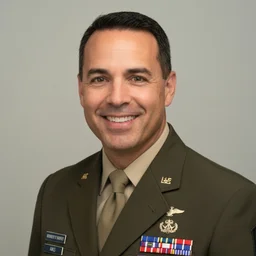
Retired Military Officer & Armed Forces Test Preparation Specialist
United States Army War CollegeColonel Steven Harris (Ret.) served 28 years in the US Army, earning a Master of Arts in Military Science from the Army War College and a Bachelor of Science in Criminal Justice. He has coached thousands of military enlistment and officer candidate program applicants through the ASVAB, AFQT, AFCT, OAR, and officer selection assessment processes across all military branches.
Join the Discussion
Connect with other students preparing for this exam. Share tips, ask questions, and get advice from people who have been there.
View discussion (5 replies)