
Free Prometric CNA Practice Test with Answers: 2026 October Guide
Pass the Free Prometric CNA exam with confidence. 🆕 Practice questions with detailed explanations and instant feedback on every answer.

What changed for the Prometric CNA exam in 2026
- As of September 2026 Prometric runs nurse aide testing for ten state programs — Alabama, Connecticut, Delaware, Florida, Hawaii, Idaho, Louisiana, New York, Oklahoma and Texas — each with its own candidate page at prometric.com/exams/nurseaide-xx. (source)
- The written test is 90 minutes in every Prometric state bulletin; it has 60 multiple-choice questions in New York, Florida, Texas, Connecticut, Delaware and Idaho, and 55 in Alabama and Oklahoma. (source) (source) (source) (source) (source)
- The clinical skills test scores five skills — three assigned by computer plus handwashing and indirect care — in 31 to 40 minutes, and you must pass all five. (source) (source)
- 2026 first-time fees for written plus skills: $115 in New York (revised bulletin 11/2025) and Delaware, $125 in Connecticut, $155 in Florida; Texas charges $31 written / $41 oral / $89 skills; Alabama $40 written + $45 skills + $40 site fee; Idaho $34 plus site fees for the written test. (source) (source) (source) (source) (source) (source) (source)
- Rescheduling is a five-business-day rule, not 24 hours: inside five business days (or if late or absent) the full fee is forfeited. Outside it, rescheduling is free in New York, $25 in Connecticut and Delaware, $30 in Florida, and in Texas free 30+ days out or $25 for 5 to 29 days out. (source) (source) (source) (source)
- An oral (read-aloud) version of the written test must be requested at registration, not on test day; in New York and Texas it adds a separate reading-comprehension section (16 questions and 30 extra minutes in New York, about 15 questions in Texas). Federal rule 42 CFR 483.154 requires every state to offer an oral option. (source) (source) (source)
- Results: the computer-based written test prints a pass/fail score report at the test site (Texas emails both reports the next day); Prometric reports passes to the state registry within two business days in Oklahoma and Idaho and within about 48 hours in Connecticut. (source) (source) (source) (source)
- Effective August 1, 2026 New York no longer issues paper CNA certificates — facilities must verify certification on the NYS Nurse Aide Registry. Prometric's nurse aide mailing address moved on November 1, 2025 to 6211 Greenleigh Avenue, Suite 400, Middle River, MD 21220; candidate phone numbers are state-specific (NY 800.805.9128, FL 888.277.3500, TX 800.488.5787, OK 866.241.3120, AL 800.899.3978). (source) (source)
Last verified: September 18, 2026 against Prometric state candidate information bulletins (NY, FL, TX, CT, DE, OK, AL, ID) and the Prometric nurse aide exam hub.
Free Prometric CNA Practice Test with Answers
What Is the Prometric CNA Exam — and Why Does It Matter?
The Prometric CNA exam isn't just a formality. It's the gate between completing your training and becoming a licensed Certified Nursing Assistant, and every state that uses Prometric requires you to pass both parts before your name appears on the state cna registry. No registry listing — no legal authority to work as a CNA. That's the stakes.
Prometric administers the written knowledge test on behalf of state nursing boards, typically as a computer-based exam at one of their testing centers. You'll see 55 to 60 multiple-choice questions pulled from five content domains (60 in New York, Florida, Texas, Connecticut, Delaware and Idaho; 55 in Alabama and Oklahoma) — and every Prometric state bulletin gives you 90 minutes to finish. Most questions describe a clinical situation and ask what the CNA should do. They're not trivia. They test judgment. That's exactly why a Prometric exam practice test built around scenarios — not definitions — is the most useful prep tool you can pick up, and why every Prometric CNA practice exam free on this page uses that same format.
Here's the thing: the Prometric CNA written test is separate from the clinical skills evaluation. Even if you ace the written portion, you are still scored on five hands-on skills in front of a Nurse Aide Evaluator — three assigned skills plus handwashing and indirect care — in a timed 31-to-40-minute session. Both components must be passed, though not necessarily on the same day. Some states let you take them in separate sessions.
State-specific rules vary more than most people expect. As of September 2026 Prometric lists ten nurse aide programs: Alabama, Connecticut, Delaware, Florida, Hawaii, Idaho, Louisiana, New York, Oklahoma and Texas. California (verify cna certification california) and Illinois (illinois cna registry) are not Prometric states — they test through a different vendor, so their fees and skill lists differ from everything on this page. Even inside the Prometric group, Texas and Florida use different fee tables, reschedule rules and score-report timing. Before you book anything, check your state board of nursing website — or call the candidate-services number printed in your state bulletin (800.805.9128 in New York, 888.277.3500 in Florida, 800.488.5787 in Texas) — to confirm the exact format for your state.
Passing scores are set by each state, and Prometric's bulletins do not publish them as a percentage: you pass the written test by reaching an overall number of correct answers, and you do not have to pass every content area separately. Because the cut score is not printed, aim for 80% or better on practice tests so the real threshold sits comfortably below you.
How to Schedule Your Prometric CNA Test
Scheduling through Prometric is straightforward — but you can't do it until your training program submits your eligibility to the state board. That part happens automatically after you complete your CNA course hours, but it can take a week or two for your name to appear in the Prometric system. Don't try to book before then. It won't work.
Once you're eligible, go to your state's Prometric nurse aide page — the address pattern is prometric.com/exams/nurseaide-xx, for example nurseaide-ny or nurseaide-fl — and open the scheduling link. You'll see available test centers, dates, and times. Most urban areas have multiple testing locations with availability within two to four weeks. Rural areas can be tighter — sometimes you're looking at a six-week wait. Book early. Don't assume you can walk in whenever you're ready.
The written and clinical skills exams can often be scheduled together or on separate days, depending on what your state allows. If you're confident in your written test performance, you might want to schedule skills on the same week so you can finish both halves quickly. If you're not sure yet, schedule the written first and come back to book skills once you've passed.
You'll need to pay when you register. Fees are set state by state in the candidate information bulletin: written plus clinical skills for a first-time tester costs $115 in New York and Delaware, $125 in Connecticut and $155 in Florida; Texas charges $31 for the written test and $89 for the skills test; Alabama charges $40 for the written test, $45 for the skills test and a $40 test-site administration fee; Idaho's Prometric written exam is $34 plus testing-site fees. Retests are cheaper than first attempts in every bulletin. Rescheduling is not a 24-hour rule: every Prometric state uses a five-business-day window. Reschedule at least five full business days before your appointment (free in New York and Idaho, a $25 fee in Connecticut and Delaware, $30 in Florida; Texas is free 30 or more days out and $25 for 5 to 29 days out). Inside five business days — or if you are late or absent — the full exam fee is forfeited and you pay again to rebook.
Bring two forms of ID on test day. One must be government-issued with a photo (driver's license, passport). The name on your ID must match exactly what you entered when you registered. A middle name mismatch has turned people away at the door — not a situation you want to deal with.
One often-overlooked tip: check whether your state offers any testing fee assistance cna programs. Some states partner with workforce development agencies or community colleges to subsidize CNA exam fees for income-eligible candidates. It won't be advertised prominently on the Prometric site — you have to ask your training program or the state board directly. Worth a five-minute phone call if finances are tight.
The Five Clinical Skills — What Prometric Evaluators Watch For
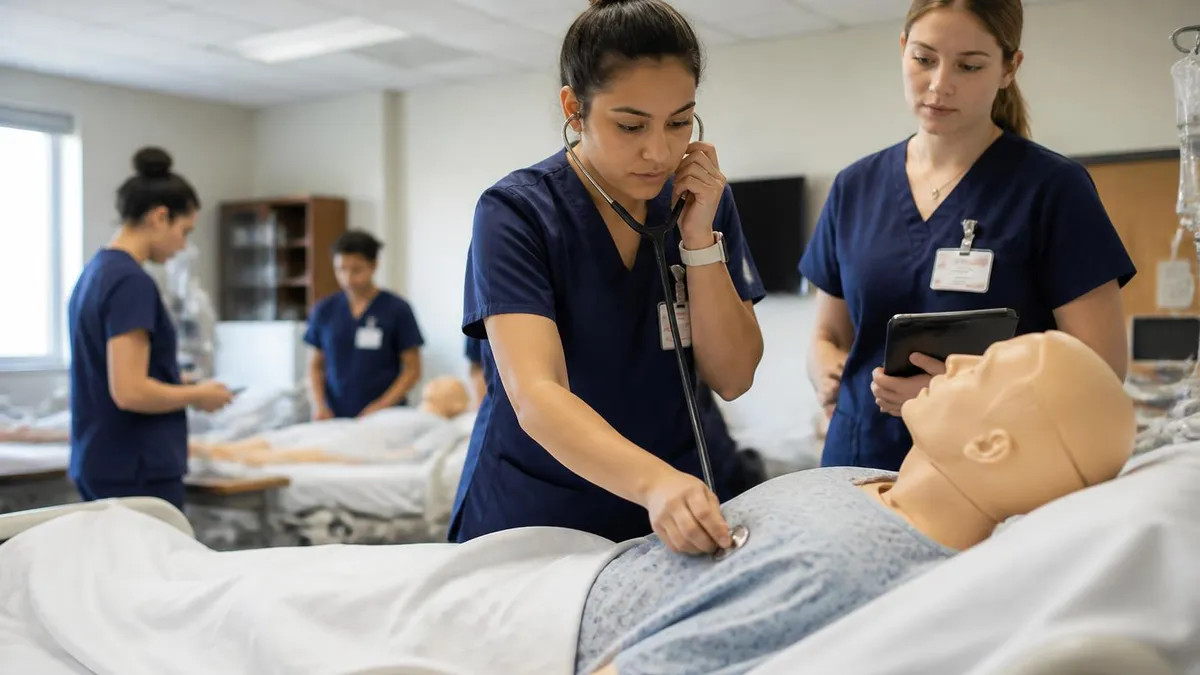
The clinical skills evaluation is the second half of the Prometric CNA exam. You're not taking a test in a quiet room — you're performing skills on a mannequin or volunteer resident while a certified evaluator scores every step on a standardized checklist. Miss a critical step and you fail that skill. You must pass all five skills to pass the evaluation — one failed skill fails the whole test.
Every Prometric state bulletin scores you on five skills: three assigned by computer when your appointment is scheduled, plus handwashing and indirect care, which are scored throughout. The whole session is timed at 31 to 40 minutes depending on which skills you draw. You don't know which three you'll get until you arrive. That means you must be prepared for every skill on the list — not just your favorites. The evaluator can't help you, prompt you, or answer questions once the skill begins. You're on your own.
Hand hygiene is non-negotiable. Every skill starts and ends with proper hand-washing or hand sanitizing using correct technique. Skipping or rushing this step — even if you do everything else perfectly — can cause you to fail the entire skill. Evaluators are specifically watching for: turning off the faucet with a paper towel, washing for at least 15 seconds, and avoiding re-contaminating your hands before moving on.
Communication with the resident (real person or mannequin) is scored throughout. You're expected to explain what you're doing before you do it, provide privacy, maintain dignity, and check for comfort. CNAs who charge through a skill without speaking to the resident lose points — even if the technique is flawless. The evaluator wants to see the whole package: clinical skill AND interpersonal skill.
If you fail a skill, don't panic mid-evaluation. Keep going. If you fail the clinical skills test you retake the whole skills test, not a single skill — but you do not have to repeat a written test you already passed, and Prometric states give you three attempts at each part within your eligibility period (two years in New York, Oklahoma and Texas). Know your state's policy before test day so you're not blindsided.
Clinical Skills Evaluation Checklist
- ✓Wash hands at start and end of every skill — correct technique, 15+ seconds, faucet off with paper towel
- ✓Introduce yourself and explain the procedure to the resident before beginning
- ✓Ensure privacy: close curtain or door before personal care
- ✓Maintain safety throughout — side rails up when not actively providing care, call light within reach
- ✓Check resident comfort and ask about pain or discomfort at key intervals
- ✓Document (verbally state) completion to evaluator after each skill
- ✓Position resident safely and comfortably before leaving — do not leave in a compromised position
How to Use Practice Tests to Prepare for the Prometric Written Exam
The written test requires you to recall specific procedures and policies under timed conditions. A CNA written exam practice test helps with two things: content retention and pacing. Without practice under a time constraint, you don't know whether you'll finish 60 questions in 90 minutes. Most people can — but anxiety slows you down.
Start with domain-specific practice. The infection control and patient rights domains are high-yield on the Prometric CNA exam — together they make up about 29% of your score. Nail those first. free CNA practice test resources let you drill by domain rather than doing random full-length tests before you're ready. If you want a free Prometric CNA written practice test that mirrors the real domain weighting, start with the quiz tiles further down this page — each set is scored instantly.
After two or three weeks of domain-targeted practice, shift to full-length timed simulations. Set a 90-minute timer for 60 questions — that's the standard Prometric time allotment, so this Prometric CNA test practice should feel like the real thing rather than a relaxed run-through. If you can finish 60 questions with detailed reasoning in 90 minutes at home, the real 90-minute clock on test day will feel comfortable.
Read every answer explanation, not just the correct answer. The best CNA Prometric practice questions come with a rationale for every option, and that rationale is where the learning happens. The Prometric CNA written test is heavy on situational questions where two answers look almost identical. Understanding why one answer is better — and why the close wrong answer is wrong — is more valuable than memorizing facts. That's the difference between a 70% score and a 90% score.
Review your weakest domains two days before the exam. Don't try to learn new material the day before. At that point, you're reviewing, not studying. Get rest the night before, eat something substantial that morning, and arrive early enough that you're not rushed. Stress kills performance on a test where judgment is everything.
Flashcards work well for the factual parts of the exam — infection control protocols, resident rights language, and safety procedure steps. But don't stop at flashcards. The Prometric CNA written test rarely asks "what is the correct hand-washing technique?" in isolation. It asks: "A resident refuses to let you wash their hands before a meal. What should you do?" The question tests decision-making, not just memory. Practice tests train that decision-making. Flashcards alone don't.
Also consider studying with someone from your CNA training cohort. Explaining why an answer is correct — out loud, to another person — deepens retention faster than silent reviewing. Quiz each other on scenarios. Argue over close answer choices. If you can defend the correct answer out loud, you'll recognize it confidently on the actual exam. That kind of active recall is what turns a borderline 68% into a comfortable 82%.
Prometric CNA Written Exam Practice Test: What the Real Test Looks Like
A useful Prometric CNA written exam practice test should copy the real structure, so here is what that structure is. In most Prometric states the written knowledge test is 60 multiple-choice questions (55 in Alabama and Oklahoma), and several states add roughly 10 unscored pretest questions that Prometric uses to trial new items — you won't know which ones they are, so answer every question as if it counts. The standard time allotment is 90 minutes. Some states give longer, but if you can finish 60 scenario questions in 90 minutes on a practice test, the real clock will not be your problem.
Federal rules (42 CFR 483.154) require every state to offer an oral version of the exam: the same questions read aloud through headphones, chosen at registration. If reading speed is your weak point, this is worth knowing before you book — it is a standard accommodation, not a special request, and the oral exam is scored the same way.
Every question maps to one of the five content domains: Physical Care Skills, Safety and Emergency Procedures, Infection Control, Psychosocial Care Skills, and Role of the Nurse Aide. Physical Care Skills carries the most weight, so a practice set that skimps on activities of daily living, mobility, and nutrition is not an accurate rehearsal. Prometric reports your result as pass/fail with a domain breakdown rather than a single percentage on the score report in many states, which is why domain-by-domain practice — and reading the explanation for every miss — is the fastest route from a borderline score to a comfortable pass.
Prometric CNA Study Plan by Week
Foundation building: Work through Physical Care Skills (40% of the exam). Study bed baths, positioning, ambulation, nutrition, and elimination. Do 20 domain-specific practice questions per day. Review any wrong answers before moving on. Spend Week 2 on Safety, Infection Control, and PPE procedures.
CNA Practice Test Questions
Prepare for the CNA - Certified Nursing Assistant exam with our free practice test modules. Each quiz covers key topics to help you pass on your first try.
CNA Activities of Daily Living
CNA Exam Questions covering Activities of Daily Living. Master CNA Test concepts for certification prep.
CNA Aging Process
Free CNA Practice Test featuring Aging Process. Improve your CNA Exam score with mock test prep.
CNA Anatomy and Physiology Basics
CNA Mock Exam on Anatomy and Physiology Basics. CNA Study Guide questions to pass on your first try.
CNA Assisting with Daily Living
CNA Test Prep for Assisting with Daily Living. Practice CNA Quiz questions and boost your score.
CNA Assisting with Range of Motion Exercises
CNA Questions and Answers on Assisting with Range of Motion Exercises. Free CNA practice for exam readiness.
CNA Basic Human Anatomy and Age-Related Ch...
CNA Mock Test covering Basic Human Anatomy and Age-Related Changes. Online CNA Test practice with instant feedback.
CNA Basic Nursing Skills
Free CNA Quiz on Basic Nursing Skills. CNA Exam prep questions with detailed explanations.
CNA Basic Nursing Skills 10
CNA Practice Questions for Basic Nursing Skills 10. Build confidence for your CNA certification exam.
CNA Basic Nursing Skills 11
CNA Test Online for Basic Nursing Skills 11. Free practice with instant results and feedback.
CNA Basic Nursing Skills 1
CNA Study Material on Basic Nursing Skills 1. Prepare effectively with real exam-style questions.
CNA Basic Nursing Skills 12
Free CNA Test covering Basic Nursing Skills 12. Practice and track your CNA exam readiness.
CNA Basic Nursing Skills 13
CNA Exam Questions covering Basic Nursing Skills 13. Master CNA Test concepts for certification prep.
CNA Basic Nursing Skills 14
Free CNA Practice Test featuring Basic Nursing Skills 14. Improve your CNA Exam score with mock test prep.
CNA Basic Nursing Skills 15
CNA Mock Exam on Basic Nursing Skills 15. CNA Study Guide questions to pass on your first try.
CNA Basic Nursing Skills 16
CNA Test Prep for Basic Nursing Skills 16. Practice CNA Quiz questions and boost your score.
CNA Basic Nursing Skills 17
CNA Questions and Answers on Basic Nursing Skills 17. Free CNA practice for exam readiness.
CNA Basic Nursing Skills 18
CNA Mock Test covering Basic Nursing Skills 18. Online CNA Test practice with instant feedback.
CNA Basic Nursing Skills 19
Free CNA Quiz on Basic Nursing Skills 19. CNA Exam prep questions with detailed explanations.
CNA Basic Nursing Skills 20
CNA Practice Questions for Basic Nursing Skills 20. Build confidence for your CNA certification exam.
CNA Basic Nursing Skills 21
CNA Test Online for Basic Nursing Skills 21. Free practice with instant results and feedback.
CNA Basic Nursing Skills 2
CNA Study Material on Basic Nursing Skills 2. Prepare effectively with real exam-style questions.
CNA Basic Nursing Skills 3
Free CNA Test covering Basic Nursing Skills 3. Practice and track your CNA exam readiness.
CNA Basic Nursing Skills 4
CNA Exam Questions covering Basic Nursing Skills 4. Master CNA Test concepts for certification prep.
CNA Basic Nursing Skills 5
Free CNA Practice Test featuring Basic Nursing Skills 5. Improve your CNA Exam score with mock test prep.
CNA Basic Nursing Skills 6
CNA Mock Exam on Basic Nursing Skills 6. CNA Study Guide questions to pass on your first try.
CNA Basic Nursing Skills 7
CNA Test Prep for Basic Nursing Skills 7. Practice CNA Quiz questions and boost your score.
CNA Basic Nursing Skills 8
CNA Questions and Answers on Basic Nursing Skills 8. Free CNA practice for exam readiness.
CNA Basic Nursing Skills 9
CNA Mock Test covering Basic Nursing Skills 9. Online CNA Test practice with instant feedback.
CNA Basic Restorative Services
Free CNA Quiz on Basic Restorative Services. CNA Exam prep questions with detailed explanations.
CNA Basic Restorative Services 1
CNA Practice Questions for Basic Restorative Services 1. Build confidence for your CNA certification exam.
CNA Bathing and Dressing
CNA Test Online for Bathing and Dressing. Free practice with instant results and feedback.
CNA Body Mechanics
CNA Study Material on Body Mechanics. Prepare effectively with real exam-style questions.
CNA Career Advancement and Opportunities
Free CNA Test covering Career Advancement and Opportunities. Practice and track your CNA exam readiness.
CNA Career Opportunities and Benefits
CNA Exam Questions covering Career Opportunities and Benefits. Master CNA Test concepts for certification prep.
CNA Care for Residents with Cognitive Impa...
Free CNA Practice Test featuring Care for Residents with Cognitive Impairment. Improve your CNA Exam score with mock test prep.
CNA Care of Cognitively Impaired Residents
CNA Mock Exam on Care of Cognitively Impaired Residents. CNA Study Guide questions to pass on your first try.
CNA Care of Cognitively Impaired Residents 1
CNA Test Prep for Care of Cognitively Impaired Residents 1. Practice CNA Quiz questions and boost your score.
CNA Care Of Cognitively Impaired Residents 4
CNA Questions and Answers on Care Of Cognitively Impaired Residents 4. Free CNA practice for exam readiness.
CNA Common Medical Terms and Abbreviations
CNA Mock Test covering Common Medical Terms and Abbreviations. Online CNA Test practice with instant feedback.
CNA Communication and Interpersonal Skills
Free CNA Quiz on Communication and Interpersonal Skills. CNA Exam prep questions with detailed explanations.
CNA Communication and Interpersonal Skills 1
CNA Practice Questions for Communication and Interpersonal Skills 1. Build confidence for your CNA certification exam.
CNA Communication And Interpersonal Skills 4
CNA Test Online for Communication And Interpersonal Skills 4. Free practice with instant results and feedback.
CNA Eligibility and Qualifications
CNA Study Material on Eligibility and Qualifications. Prepare effectively with real exam-style questions.
CNA Emergency Procedure
Free CNA Test covering Emergency Procedure. Practice and track your CNA exam readiness.
CNA Ethics and Professionalism
CNA Exam Questions covering Ethics and Professionalism. Master CNA Test concepts for certification prep.
CNA Exam Structure and Content
Free CNA Practice Test featuring Exam Structure and Content. Improve your CNA Exam score with mock test prep.
CNA Feeding and Hydration
CNA Mock Exam on Feeding and Hydration. CNA Study Guide questions to pass on your first try.
CNA Infection Control
CNA Test Prep for Infection Control. Practice CNA Quiz questions and boost your score.
CNA Infection Control and Safety
CNA Questions and Answers on Infection Control and Safety. Free CNA practice for exam readiness.
CNA Isolation Precautions
CNA Mock Test covering Isolation Precautions. Online CNA Test practice with instant feedback.
CNA Legal & Ethical Behaviours
Free CNA Quiz on Legal & Ethical Behaviours. CNA Exam prep questions with detailed explanations.
CNA Legal & Ethical Behaviours 1
CNA Practice Questions for Legal & Ethical Behaviours 1. Build confidence for your CNA certification exam.
CNA Legal & Ethical Behaviours 4
CNA Test Online for Legal & Ethical Behaviours 4. Free practice with instant results and feedback.
CNA Mental Health and Social Services Needs
CNA Study Material on Mental Health and Social Services Needs. Prepare effectively with real exam-style questions.
CNA Mental Health and Social Services Needs 1
Free CNA Test covering Mental Health and Social Services Needs 1. Practice and track your CNA exam readiness.
CNA Mental Health And Social Services Needs 4
CNA Exam Questions covering Mental Health And Social Services Needs 4. Master CNA Test concepts for certification prep.
CNA Nutrition and Hydration Management
Free CNA Practice Test featuring Nutrition and Hydration Management. Improve your CNA Exam score with mock test prep.
CNA Patient Care Procedure
CNA Mock Exam on Patient Care Procedure. CNA Study Guide questions to pass on your first try.
CNA Personal Care Skills
CNA Test Prep for Personal Care Skills. Practice CNA Quiz questions and boost your score.
CNA Personal Care Skills 1
CNA Questions and Answers on Personal Care Skills 1. Free CNA practice for exam readiness.
CNA Personal Care Skills 4
CNA Mock Test covering Personal Care Skills 4. Online CNA Test practice with instant feedback.
CNA Personal Care Skills 5
Free CNA Quiz on Personal Care Skills 5. CNA Exam prep questions with detailed explanations.
CNA Personal Hygiene and Grooming
CNA Practice Questions for Personal Hygiene and Grooming. Build confidence for your CNA certification exam.
CNA Practice Test - Basic Nursing Skills #2
CNA Test Online for Practice Test - Basic Nursing Skills #2. Free practice with instant results and feedback.
CNA Practice Test - Basic Nursing Skills #2 1
CNA Study Material on Practice Test - Basic Nursing Skills #2 1. Prepare effectively with real exam-style questions.
CNA Preventing Patient Falls and Injuries
Free CNA Test covering Preventing Patient Falls and Injuries. Practice and track your CNA exam readiness.
CNA Promoting Resident Independence and Ch...
CNA Exam Questions covering Promoting Resident Independence and Choice. Master CNA Test concepts for certification prep.
CNA Proper Hand Hygiene and PPE Usage
Free CNA Practice Test featuring Proper Hand Hygiene and PPE Usage. Improve your CNA Exam score with mock test prep.
CNA Resident Rights and Communication
CNA Mock Exam on Resident Rights and Communication. CNA Study Guide questions to pass on your first try.
CNA Resident’s Rights
CNA Test Prep for Resident’s Rights. Practice CNA Quiz questions and boost your score.
CNA Resident's Rights 1
CNA Questions and Answers on Resident's Rights 1. Free CNA practice for exam readiness.
CNA Resident's Rights 4
CNA Mock Test covering Resident's Rights 4. Online CNA Test practice with instant feedback.
CNA Roles and Responsibilities
Free CNA Quiz on Roles and Responsibilities. CNA Exam prep questions with detailed explanations.
CNA Safety and Emergency Procedures
CNA Practice Questions for Safety and Emergency Procedures. Build confidence for your CNA certification exam.
CNA Safety and Emergency Procedures 1
CNA Test Online for Safety and Emergency Procedures 1. Free practice with instant results and feedback.
CNA Safety And Emergency Procedures 4
CNA Study Material on Safety And Emergency Procedures 4. Prepare effectively with real exam-style questions.
CNA Safety and Infection Control
Free CNA Test covering Safety and Infection Control. Practice and track your CNA exam readiness.
CNA Scope of Practice
CNA Exam Questions covering Scope of Practice. Master CNA Test concepts for certification prep.
CNA Skills and Competencies
Free CNA Practice Test featuring Skills and Competencies. Improve your CNA Exam score with mock test prep.
CNA Supporting Rehabilitation Activities
CNA Mock Exam on Supporting Rehabilitation Activities. CNA Study Guide questions to pass on your first try.
CNA The Nurse Aide's Role and Responsibili...
CNA Test Prep for The Nurse Aide's Role and Responsibilities. Practice CNA Quiz questions and boost your score.
CNA Time Management and Prioritization
CNA Questions and Answers on Time Management and Prioritization. Free CNA practice for exam readiness.
CNA Toileting and Elimination
CNA Mock Test covering Toileting and Elimination. Online CNA Test practice with instant feedback.
CNA Using Adaptive Devices
CNA Practice Questions for Using Adaptive Devices. Build confidence for your CNA certification exam.
State-Specific Prometric CNA Requirements Worth Knowing
Not every state uses Prometric at all, and the ones that do don't share one rulebook. As of September 2026 Prometric's nurse aide hub lists ten state programs: Alabama, Connecticut, Delaware, Florida, Hawaii, Idaho, Louisiana, New York, Oklahoma and Texas. Michigan (Prometric CNA exam searches often start there) is not on that list. The NNAAP (National Nurse Aide Assessment Program) is a different vendor's exam; Prometric states use Prometric's own Nurse Aide Competency Examination, and each state board sets its own skill list, cut score, fees and number of retake attempts.
California is the most common mix-up. The CDPH (verify cna certification california Department of Public Health) does not test through Prometric, so California candidates should ignore the Prometric fee tables and reschedule rules on this page and follow the vendor named on the CDPH site. The practice questions still apply — the federal content domains are the same everywhere.
Texas is a Prometric state: HHSC approves your training in TULIP, then you pay Prometric $31 for the written test (or $41 for the oral test, which adds a reading-comprehension section of about 15 questions) and $89 for the skills test, and score reports are emailed the next day. Florida is also Prometric: $155 for written plus skills, 60 questions in 90 minutes, the written test available in English or Spanish, and a $30 reschedule fee outside five working days. Illinois is not a Prometric state — the illinois cna registry is run through the state health department with a different testing vendor. These distinctions matter. Don't assume your state works like a neighboring state's process.
If you took CNA training through a nursing home and the facility was cited for a deficiency during your training period, your eligibility can be complicated. Federal law prohibits graduates of certain cna programs from testing until the deficiency is resolved. This catches people off guard. Check your program's status if there's any doubt.
Reciprocity — using your CNA certification from one state in another — goes through the state cna registry, not through Prometric. If you're a certified CNA moving states, you apply for endorsement directly with the new state board. No retest required in most cases, as long as your current certification is active and in good standing on the state registry.
New York is another state worth calling out. New York candidates apply to Prometric with the exam fee ($115 for written plus skills, $135 with the oral exam; personal checks and cash are not accepted), and facilities testing on site must send applications 10 business days before the test date. Reschedule at least five full business days ahead or the fee is forfeited. From August 1, 2026 New York no longer issues paper certificates — employers verify you on the state Nurse Aide Registry instead, where successful candidates usually appear a few days after passing.
Prometric vs. Pearson VUE for CNA Testing
- +In-facility test sites at nursing homes plus regional sites — you can often test where you trained
- +Computer-based written test prints a pass/fail score report at the test site in most states (Texas emails it the next day)
- +Standardized scoring ensures consistent evaluation across test centers
- +Can often schedule written and clinical on the same day or week
- −Center availability varies — rural candidates may face 4–6 week waits
- −No personal items allowed — phone storage required outside testing room
- −Technical issues at the testing center are Prometric's responsibility to resolve, which takes time
- −Fees are forfeited if you reschedule inside five business days (or arrive late)
Pros and Cons at a Glance
| Pros | Cons |
|---|---|
| In-facility test sites at nursing homes plus regional sites — you can often test where you trained | No personal items allowed — phone storage required outside testing room |
| Computer-based written test prints a pass/fail score report at the test site in most states (Texas emails it the next day) | Technical issues at the testing center are Prometric's responsibility to resolve, which takes time |
| Standardized scoring ensures consistent evaluation across test centers | Fees are forfeited if you reschedule inside five business days (or arrive late) |
What Happens After You Pass — and What to Do If You Fail
Pass both parts — written and clinical — and Prometric reports your results to the state nursing board. Prometric sends your pass to the state CNA registry within two business days in Oklahoma and Idaho, within about 48 hours in Connecticut, and New York candidates usually appear on the registry several days before the wallet card arrives (about 10 business days). That's the moment you're legally authorized to work as a CNA. Some employers want to see your registry listing before your first shift, so check online — most state registries are searchable by name.
Your CNA certification doesn't last forever. Most states require renewal every two years, and renewal requires documented work hours (typically 8 hours of paid CNA work per renewal period in most states). If you let your certification lapse, you may need to retake the full Prometric exam to reinstate it. Keeping your hours current is much easier than starting over.
If you fail either part, you get three attempts at that part within your eligibility window (two years in New York, Oklahoma and Texas) before you must repeat the training program, and you only retake the part you failed. Don't burn attempts carelessly — use the time between retakes to identify exactly what went wrong. Prometric provides a score breakdown showing which domains you passed and failed on the written test. Use that report. It's the most specific feedback you'll get about where to focus.
Looking for cna license verification after passing? Most state registries are publicly searchable. Your listing confirms your certification is active and in good standing — something employers, patients, and licensing boards can check at any time. Keep that record clean.
Many CNAs who pass the Prometric exam immediately begin the job application process — and the market is strong right now. Nursing facilities, hospitals, home health agencies, and assisted living communities are all hiring actively. Your CNA certification is recognized by these employers as proof that you can perform essential care tasks safely. Some facilities offer hiring bonuses for new CNAs, which can offset the cost of your exam and any prep materials.
If you failed one part of the exam, don't spiral. Most people who retake pass on the second attempt. The key is targeted preparation — not more of the same studying. Review the domain breakdown Prometric provides, figure out exactly where you lost points, and spend your prep time there exclusively.
If you failed clinical, watch video demonstrations of the specific skills that tripped you up and practice hands-on with a training partner. If you failed written, use cna exam practice sets focused on the domains that scored lowest — any free CNA practice test Prometric-style set that reports a per-domain score will do the job. Retesting usually takes two to three weeks to schedule — use that time well.
Sample CNA Practice Questions
Try these questions from our free CNA practice tests. The correct answer and an explanation follow each question.
A resident with a hip replacement should be positioned with the operative leg:
- A. Crossed over the non-operative leg
- B. In adduction past the midline
- C. In abduction using a wedge pillow
- D. Flexed more than 90° at the hip
Answer: C. In abduction using a wedge pillow
An abduction pillow keeps the hip in alignment and prevents dislocation after total hip replacement.
When assisting a resident with a cane, the CNA should position themselves on which side?
- A. The stronger side
- B. The weaker side
- C. Directly behind the resident
- D. Directly in front of the resident
Answer: B. The weaker side
The CNA stands on the resident's weaker side to provide support where the resident is least stable.
When assisting a resident with range-of-motion exercises, the CNA should move each joint until the resident reports:
- A. Severe pain
- B. Mild discomfort or resistance
- C. No sensation at all
- D. A popping sound
Answer: B. Mild discomfort or resistance
Range-of-motion exercises should be performed to the point of mild resistance or slight discomfort, never forcing the joint past that point to avoid injury.
A resident returns from surgery with an order for incentive spirometry every hour while awake. What is the CNA's role?
- A. Perform deep suctioning if the resident cannot use the spirometer
- B. Coach and encourage the resident to use the device and report difficulty to the nurse
- C. Perform the spirometry for the resident if they are too weak
- D. Discontinue the spirometry if the resident finds it uncomfortable
Answer: B. Coach and encourage the resident to use the device and report difficulty to the nurse
The CNA's role is to encourage and coach the resident in using the incentive spirometer and report any inability or distress to the nurse.
CNA Practice Test Questions and Answers
Official Resources
- Prometric Nurse Aide (New York) exam page — Prometric's own candidate hub with the candidate information bulletin, scheduling, and registry services for a state it administers directly.
- Maryland Board of Nursing — Nursing Assistant Certification — Maryland Board of Nursing CNA and registry information; Maryland is not among Prometric's listed nurse aide programs, so check your own state board for your testing vendor.
- 42 CFR 483.154 — Nurse aide competency evaluation (eCFR) — the federal regulation that requires a written-or-oral exam plus a randomly selected skills demonstration in every state.



About the Author

Registered Nurse & Healthcare Educator
Johns Hopkins University School of NursingDr. Sarah Mitchell is a board-certified registered nurse with over 15 years of clinical and academic experience. She completed her PhD in Nursing Science at Johns Hopkins University and has taught NCLEX preparation and clinical skills courses for nursing students across the United States. Her research focuses on evidence-based exam preparation strategies for healthcare certification candidates.
Join the Discussion
Connect with other students preparing for this exam. Share tips, ask questions, and get advice from people who have been there.
View discussion (8 replies)