
Class B CDL Certification: Requirements, Training, and How to Get Licensed
🔎 Pass the Class B CDL Certification: exam with confidence. Practice questions with detailed explanations and instant feedback on every answer.
A class b cdl certification opens the door to driving straight trucks, large buses, segmented buses, and box trucks over 26,001 pounds — without needing to tow heavy trailers. It's one of the most accessible commercial licenses you can earn, and thousands of drivers pick it up every year to launch careers in delivery, transit, and waste management.
If you're researching cdl certification classes in your area, you've probably noticed there's a lot of conflicting information online. Some sites mix up Class A and Class B requirements. Others skip over the medical exam or endorsement details entirely. This page cuts through the noise and gives you a step-by-step breakdown of what the certification actually involves — from eligibility requirements and training program selection all the way through to test day and your first driving job.
Whether you're switching careers, upgrading from a regular license, or just exploring options, understanding the full Class B CDL certification process saves you time, money, and frustration. We'll cover state-specific quirks, training costs, the skills test format, and common mistakes that trip up first-time applicants. You'll also find practice quizzes below to help you prepare for the written knowledge exam.
The demand for Class B drivers has grown steadily over the past decade, fueled by e-commerce expansion and aging workforce demographics. The Bureau of Labor Statistics projects 4% growth through 2032 for heavy and tractor-trailer truck drivers — and Class B roles in delivery and transit are growing even faster in many metro areas. Getting certified now positions you well for a labor market that's hungry for qualified commercial drivers. Starting salaries have climbed noticeably in recent years as companies compete for a shrinking pool of licensed professionals.
Signing up for cdl certification classes is the first real step most people take after deciding to pursue a Class B license. Programs vary widely — community colleges typically run 4 to 8 weeks, while private truck driving schools sometimes compress everything into 3 weeks of intensive training. Either way, you'll spend roughly half your time in a classroom and half behind the wheel.
The class b cdl certification requirements california are a useful reference point because California's standards tend to be among the strictest. You'll need to be at least 18 for intrastate driving (21 for interstate), pass a DOT physical, and obtain a Commercial Learner's Permit before starting behind-the-wheel training. Most states follow similar patterns, though testing fees and mandatory training hours differ.
Budget matters here. Some employers — especially transit agencies and waste haulers — sponsor training entirely, meaning you pay nothing upfront. Others offer tuition reimbursement after you've driven for them a set period. If you're paying out of pocket, look into WIOA grants or GI Bill benefits, both of which cover CDL training at approved schools. State workforce development boards sometimes maintain lists of approved training providers and can connect you with local funding sources that aren't advertised widely online.
Understanding the difference between a cdl class a certification and a cdl class b certification matters more than most people realize. Class A lets you operate combination vehicles — think tractor-trailers and doubles. Class B restricts you to single vehicles (or combinations where the towed unit is under 10,000 lbs). The written tests overlap significantly, but the skills test is completely different.
Here's the thing most guides won't tell you: earning a Class B first doesn't lock you out of Class A later. Many drivers start with Class B, build experience and confidence in straight trucks or buses over a year or two, then upgrade when they're ready for bigger rigs. The upgrade process is faster because you've already passed the general knowledge exam. You'll just need additional behind-the-wheel training and a Class A skills test. If you want to search interesting things about: class b cdl certification, the endorsement stacking strategy is worth exploring.
Endorsements add earning power regardless of which class you hold. A Passenger (P) endorsement opens transit and school bus jobs. Hazmat (H) unlocks fuel delivery. Air brakes — technically a restriction removal rather than an endorsement — is practically mandatory since most Class B vehicles use air brake systems.
CDL Training Formats Compared
Duration: 4–8 weeks full-time, up to 16 weeks part-time.
Cost: $1,500–$4,000 (often eligible for financial aid).
Pros: Lower tuition, accredited programs, WIOA grant eligible. You'll get a mix of classroom theory and yard practice before hitting public roads.
Cons: Slower pace, less flexible scheduling, may have waitlists. Not ideal if you need to start driving ASAP.
When you search interesting things about: class b cdl certification, the topic of reciprocity between states comes up frequently. Your CDL is technically issued by one state, but it's valid nationwide — there's no such thing as a state-only commercial license. However, if you move to a new state, you'll need to transfer your CDL within 30 days and may face additional testing.
The ELDT (Entry-Level Driver Training) requirement changed the game in February 2022. Before that date, some states let you take the skills test without formal training. Now, every first-time CDL applicant must complete training at an FMCSA-registered school, and that training gets logged in the Training Provider Registry. No shortcuts, no exceptions — even experienced drivers switching from another vehicle class must go through the process.
Medical certification is another piece that catches people off guard. You don't just pass a physical once — you'll need to recertify every two years (annually if you have certain conditions like diabetes or hypertension). Your medical card must stay current, or your CDL downgrades automatically. Vision requirements are specific too: you need at least 20/40 acuity in each eye (corrected is fine), plus a 70-degree field of vision and the ability to distinguish traffic signal colors. Hearing requirements apply too — you must perceive a forced whisper at five feet, with or without hearing aids.
People who search interesting things about: class b cdl certification often want to know about the actual test-day experience. Here's what to expect: you'll arrive at the testing site with your CLP, medical card, and the vehicle you're testing in. Yes — in most states, you provide the vehicle. Training schools typically let students use their trucks for testing, but if you're going through an employer, confirm vehicle availability well in advance — showing up without a valid test vehicle means rescheduling and potentially waiting weeks for another slot.
The pre-trip inspection portion takes 30–45 minutes. The examiner gives you a random starting point on the vehicle, and you walk around explaining what you're checking and why. This isn't about memorizing a script — examiners can tell when you're reciting versus understanding. Practice on an actual truck, not just flashcards — the tactile experience of touching components while naming them builds muscle memory the examiner can see.
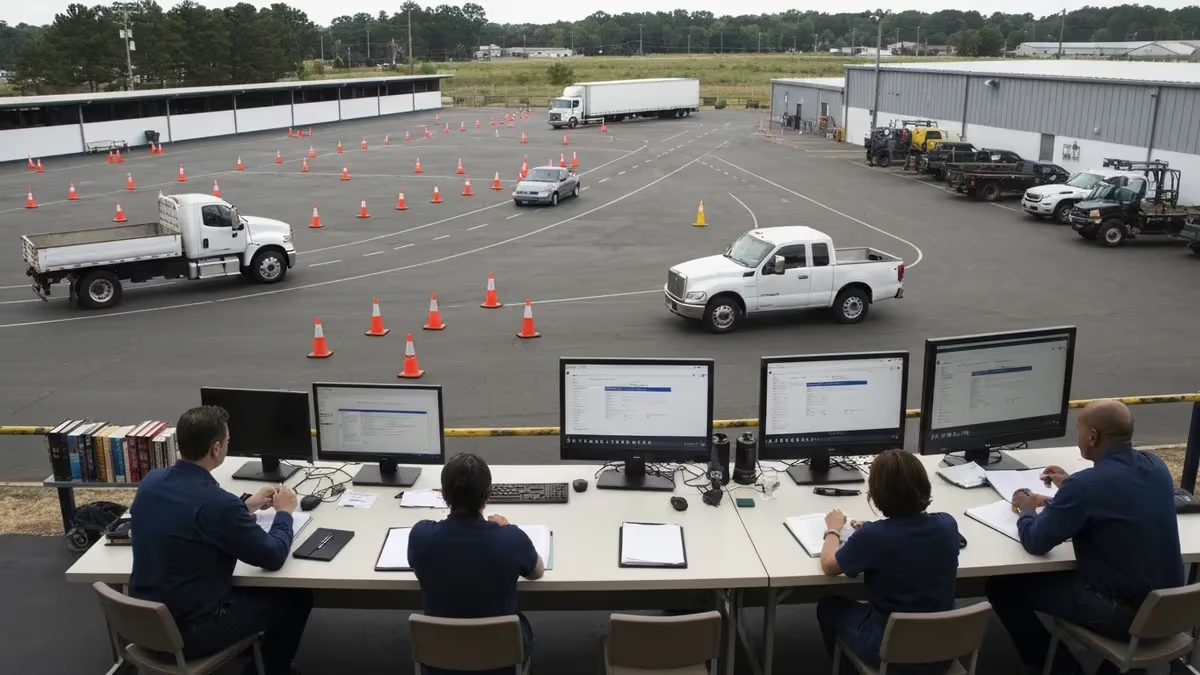
Basic controls happen in a closed course. You'll do straight-line backing (usually about 100 feet), offset backing (alley dock), and sometimes parallel parking. Scoring is based on pull-ups, encroachments, and final position. The road test lasts 30–60 minutes through a mix of city streets and highways. Examiners look for proper lane changes, mirror usage, speed management on curves, and railroad crossing procedures — these details trip up more candidates than the backing maneuvers do.
Pros and Cons of Class B CDL Certification
- +CDL certification is recognized by employers as verified competency across all 50 states
- +Class B training is shorter and cheaper than Class A — you're driving sooner
- +Certified Class B drivers report 10–20% higher wages than non-CDL counterparts
- +Bus and delivery jobs offer local routes — you're home every night unlike long-haul trucking
- +Endorsement stacking (passenger, hazmat, tanker) multiplies your job options without a new license
- +Upgrading to Class A later is faster since general knowledge carries over
- −Certification fees, training, and medical exams cost $1,500–$8,000 depending on your path
- −DOT physicals every 1–2 years add ongoing cost and time commitments
- −Salary ceiling is lower than Class A — long-haul and specialized hauling pay more
- −CDL holders face stricter DUI thresholds (0.04 BAC) even in personal vehicles in some states
- −Job market competition is high in metro areas where many drivers hold Class B already
- −ELDT mandate means you can't self-study and test anymore — formal training is required
Pros and Cons at a Glance
| Pros | Cons |
|---|---|
| Class B training is shorter and cheaper than Class A — you're driving sooner | Salary ceiling is lower than Class A — long-haul and specialized hauling pay more |
| Bus and delivery jobs offer local routes — you're home every night unlike long-haul trucking | Job market competition is high in metro areas where many drivers hold Class B already |
| Endorsement stacking (passenger, hazmat, tanker) multiplies your job options without a new license | ELDT mandate means you can't self-study and test anymore — formal training is required |
Cost is the factor most people search interesting things about: class b cdl certification to figure out first. Training programs range from free (employer-sponsored) to around $8,000 (premium private schools). On top of tuition, budget for the CLP fee ($10–$50), skills test fee ($50–$200), DOT physical ($80–$180), and your actual CDL issuance fee ($30–$75). These smaller costs add up quickly, especially if you need multiple attempts at any stage.
Financial assistance is more available than most people think. Workforce Innovation and Opportunity Act (WIOA) grants cover CDL training for qualifying applicants — typically those who are unemployed, underemployed, or transitioning careers. Veterans can use the GI Bill or VET TEC programs. Some states have specific commercial driving workforce grants that cover everything.
Return on investment matters. The median salary for a Class B CDL driver sits around $45,000–$55,000 annually, with transit bus drivers and specialized delivery positions pushing past $60,000 in high-cost-of-living areas. Even at the top end of training costs, you'll recoup your investment within the first few months of full-time driving. Overtime opportunities push total compensation even higher — many transit agencies and delivery companies offer time-and-a-half for anything over 40 hours, and extra shifts are almost always available.
Class B CDL Application Checklist
- ✓Confirm you meet the minimum age requirement (18 intrastate, 21 interstate)
- ✓Schedule and pass your DOT physical exam — keep the medical card handy
- ✓Gather identity documents: birth certificate or passport, Social Security card, two proofs of residency
- ✓Study for the written knowledge tests using official CDL manuals and practice tests
- ✓Visit the DMV to take the CLP exam (general knowledge + endorsement tests)
- ✓Hold your CLP for at least 14 days before scheduling the skills test
- ✓Enroll in an FMCSA-registered ELDT program and complete all required hours
- ✓Verify your training completion appears in the FMCSA Training Provider Registry
- ✓Schedule your three-part skills test at a DMV-approved location
- ✓Bring your CLP, medical card, and test vehicle to the skills test appointment
One thing drivers frequently search interesting things about: class b cdl certification relates to disqualifying conditions. A valid CDL requires a clean driving record in specific ways. Two serious traffic violations in three years triggers a 60-day disqualification. A DUI — even in your personal vehicle — means a one-year CDL disqualification (three years if you were hauling hazmat). These aren't just theoretical penalties; the FMCSA database tracks everything.
Drug and alcohol testing is non-negotiable. You'll take a pre-employment test, then face random testing throughout your career. A positive result or refusal to test goes into the FMCSA Clearinghouse, where every future employer checks before hiring. There's a return-to-duty process, but it's expensive and time-consuming — prevention is the only smart strategy for protecting your career and your livelihood.
The Clearinghouse itself launched in January 2020 and fundamentally changed enforcement. Before it existed, a driver could test positive with one company and get hired by another without anyone knowing. Now every violation follows you nationally. Employers must query the database annually for every CDL employee, and prospective hires must consent to a full-query check before onboarding.
Endorsements are worth a deeper look when you search interesting things about: class b cdl certification and career planning. The Passenger (P) endorsement requires a written test plus a skills test in an actual bus. School Bus (S) adds another written exam on top of P. Hazmat (H) involves a written test plus a TSA background check that takes 60–90 days — start early if you need it.
Air brakes deserve special attention. Most Class B vehicles — buses, straight trucks, cement mixers — use air brake systems. If you take your skills test in a vehicle without air brakes, you'll get an air brake restriction on your CDL, which severely limits the vehicles you can drive commercially. Always test in a vehicle with air brakes unless you're certain your career won't require them.
Tanker (N) and Doubles/Triples (T) endorsements are less common for Class B drivers but not irrelevant. Tanker applies if you're hauling liquid loads in straight trucks — think fuel delivery or water transport. Each endorsement is a separate written test, typically 20–30 questions with the same 80% passing threshold. The more endorsements you stack on your CDL, the broader your job options become — and some drivers collect all available endorsements just to maximize flexibility when applying.
As of February 7, 2022, all first-time CDL applicants must complete Entry-Level Driver Training at an FMCSA-registered provider. Your training school must report completion to the federal Training Provider Registry before you can schedule a skills test. Self-study and direct testing are no longer permitted in any state. Verify your school's FMCSA registration number before enrolling.
Job placement after earning your class b cdl certification is strong across most regions. When you search interesting things about: class b cdl certification career paths, three sectors dominate: public transit (city buses, paratransit), delivery and logistics (box trucks, beverage distribution), and waste management (refuse trucks, recycling haulers). Each sector has distinct schedules and pay structures.
Transit positions typically offer the best benefits — pension plans, health insurance, and union representation are standard at most public agencies. Starting pay ranges from $18–$25 per hour, with senior drivers earning $28–$35 in major metro areas. The tradeoff is dealing with passengers and fixed routes — not every driver enjoys that dynamic.
Delivery and logistics offer more variety. You might drive the same route daily or cover different zones each week. Companies like FedEx Freight, Sysco, and local distributors all need Class B drivers. Waste management pays surprisingly well — $50,000–$70,000 annually isn't unusual — but the physical demands and early morning start times (often 4:00 AM) aren't for everyone.
Some drivers rotate between sectors throughout their careers, using their Class B certification as a portable credential that travels with them from one employer to the next. The versatility is one of the biggest advantages of holding a commercial license — you're never locked into a single industry or role.
CDL Practice Test Questions
Prepare for the CDL - Commercial Driver's License exam with our free practice test modules. Each quiz covers key topics to help you pass on your first try.
CDL Alabama CDL Combination Vehicles Pract...
CDL Exam Questions covering Alabama CDL Combination Vehicles Practice Test. Master CDL Test concepts for certification prep.
CDL Alabama CDL General Knowledge Practice...
Free CDL Practice Test featuring Alabama CDL General Knowledge Practice Test #. Improve your CDL Exam score with mock test prep.
CDL Alabama General Knowledge CDL Practice...
CDL Mock Exam on Alabama General Knowledge CDL Practice Test. CDL Study Guide questions to pass on your first try.
CDL Airbrakes Practice Test
CDL Test Prep for Airbrakes Practice Test. Practice CDL Quiz questions and boost your score.
CDL Air Brakes Practice Test
CDL Questions and Answers on Air Brakes Practice Test. Free CDL practice for exam readiness.
CDL CLASS A COMMERCIAL DRIVER'S LICENSE PR...
CDL Mock Test covering CLASS A COMMERCIAL DRIVER'S LICENSE PRACTICE TEST. Online CDL Test practice with instant feedback.
CDL Class B Commercial Driver's License Pr...
Free CDL Quiz on Class B Commercial Driver's License Practice Test. CDL Exam prep questions with detailed explanations.
CDL Combination Vehicles Practice Test
CDL Practice Questions for Combination Vehicles Practice Test. Build confidence for your CDL certification exam.
CDL Doubles and Triples Practice Test
CDL Test Online for Doubles and Triples Practice Test. Free practice with instant results and feedback.
CDL Doubles Triples Practice Test
CDL Study Material on Doubles Triples Practice Test. Prepare effectively with real exam-style questions.
CDL General Knowledge Practice Test
Free CDL Test covering General Knowledge Practice Test. Practice and track your CDL exam readiness.
CDL General Knowledge Practice Test1
CDL Exam Questions covering General Knowledge Practice Test1. Master CDL Test concepts for certification prep.
CDL Hazardous Materials (Hazmat) Practice ...
Free CDL Practice Test featuring Hazardous Materials (Hazmat) Practice Test. Improve your CDL Exam score with mock test prep.
CDL Hazardous Materials Hazmat Practice Test
CDL Mock Exam on Hazardous Materials Hazmat Practice Test. CDL Study Guide questions to pass on your first try.
CDL Hazmat Practice Test
CDL Test Prep for Hazmat Practice Test. Practice CDL Quiz questions and boost your score.
CDL Passenger Transport Practice Test
CDL Questions and Answers on Passenger Transport Practice Test. Free CDL practice for exam readiness.
CDL Road Signs and Signals Practice Test
CDL Mock Test covering Road Signs and Signals Practice Test. Online CDL Test practice with instant feedback.
CDL School Bus Endorsement Practice Test
Free CDL Quiz on School Bus Endorsement Practice Test. CDL Exam prep questions with detailed explanations.
CDL School Bus Endorsement S Practice Test
CDL Practice Questions for School Bus Endorsement S Practice Test. Build confidence for your CDL certification exam.
CDL Tanker Practice Test
CDL Test Online for Tanker Practice Test. Free practice with instant results and feedback.
CDL Class A Commercial Driver's License Pr...
CDL Study Material on Class A Commercial Driver's License Practice Test -1. Prepare effectively with real exam-style questions.
CDL Class A Driver's License Practice Test -2
Free CDL Test covering Class A Driver's License Practice Test -2. Practice and track your CDL exam readiness.
CDL Class A Driver's License Practice Test -3
CDL Exam Questions covering Class A Driver's License Practice Test -3. Master CDL Test concepts for certification prep.
CDL Class A Driver's License Practice Test -5
Free CDL Practice Test featuring Class A Driver's License Practice Test -5. Improve your CDL Exam score with mock test prep.
CDL Class B Commercial Driver's License Pr...
CDL Mock Exam on Class B Commercial Driver's License Practice Test -2. CDL Study Guide questions to pass on your first try.
CDL Class C CDL with Hazmat Endorsement Pr...
CDL Test Prep for Class C CDL with Hazmat Endorsement Practice Test. Practice CDL Quiz questions and boost your score.
CDL Class C CDL with Hazmat Endorsement Pr...
CDL Questions and Answers on Class C CDL with Hazmat Endorsement Practice Test -2. Free CDL practice for exam readiness.
CDL Class C CDL with Hazmat Endorsement Pr...
CDL Mock Test covering Class C CDL with Hazmat Endorsement Practice Test -3. Online CDL Test practice with instant feedback.
Renewal and maintenance of your Class B CDL is something many new drivers overlook. When you search interesting things about: class b cdl certification long-term, license renewal cycles vary by state — typically every 4 to 8 years. But your medical certificate renewal happens on a separate, shorter cycle (every 2 years for most drivers, annually for some medical conditions).
Hazmat endorsements require renewal every 5 years with a fresh TSA background check. If you let it lapse, you'll need to reapply from scratch — including paying the full background check fee again. Set calendar reminders at least 90 days before any expiration date. The FMCSA doesn't send courtesy reminders, and driving with an expired endorsement is a federal violation.
Continuing education isn't formally required for CDL holders the way it is for some professional licenses, but smart drivers invest in it anyway. Defensive driving courses, Smith System training, and endorsement additions all make your resume stronger and may qualify you for insurance discounts through your employer. The industry rewards drivers who keep learning — pay increases and route preferences often go to those with the most endorsements and cleanest records.
Many agencies also offer tuition assistance for drivers pursuing additional certifications or management training, creating a clear advancement path from behind the wheel into supervisory or training roles. Safety bonuses and longevity pay are common too — the longer you drive clean, the more you earn.
Sample CDL Practice Questions
Try these questions from our free CDL practice tests. The correct answer and an explanation follow each question.
Bus drivers cannot carry more than _______ lbs. of solid Class 6 poisons.
- A. 25
- B. 75
- C. 15
- D. 100
- E. 50
Answer: D. 100
Federal regulations specifically limit the amount of certain hazardous materials that can be transported on a passenger-carrying vehicle like a bus. For solid Class 6 poisons, bus drivers are restricted to carrying no more than 100 pounds. This regulation is in place to minimize the risk to passengers and the public in the event of an incident involving these dangerous substances.
Which of the following correctly describes a vehicle that requires a Class A CDL rather than a Class B CDL?
- A. A single straight truck with a GVWR of 33,000 lbs
- B. A bus designed to transport 24 passengers
- C. A tractor-trailer combination with a combined GVWR of 80,000 lbs where the trailer GVWR exceeds 10,000 lbs
- D. A straight truck towing a trailer with a combined GVWR of 24,000 lbs
Answer: C. A tractor-trailer combination with a combined GVWR of 80,000 lbs where the trailer GVWR exceeds 10,000 lbs
Class A is defined by a combination vehicle where the total GVWR is 26,001 lbs or more AND the towed unit exceeds 10,000 lbs. A tractor-trailer at 80,000 lbs combined clearly meets both criteria. A single heavy straight truck (no towed unit exceeding 10,000 lbs) falls under Class B.
Which of the following is NOT included on a Class A Pre-trip inspection test?
- A. An inspection of the coupling system.
- B. All of the listed answers are included on a Class A Pre-trip Inspection Test.
- C. An in-cab inspection.
- D. An engine start.
Answer: B. All of the listed answers are included on a Class A Pre-trip Inspection Test.
A Class A Pre-trip Inspection Test is comprehensive and covers all critical components of a combination vehicle. This includes a detailed inspection of the coupling system (for trailers), a thorough in-cab inspection of controls and gauges, and an engine start to check for proper operation and air system build-up. Therefore, all the listed items are essential parts of the required inspection.
A Class A CDL is required to operate any combination of vehicles with a gross vehicle weight rating (GVWR) of _____ or more, provided the towed unit has a GVWR exceeding 10,000 pounds.
- A. 16,001 lbs
- B. 26,001 lbs
- C. 33,001 lbs
- D. 10,001 lbs
Answer: B. 26,001 lbs
Federal regulations define a Class A vehicle as any combination with a combined GVWR of 26,001 lbs or more, where the towed vehicle(s) exceed 10,000 lbs GVWR. This threshold distinguishes Class A from Class B and C requirements.
CDL Questions and Answers
About the Author

Attorney & Bar Exam Preparation Specialist
Yale Law SchoolJames R. Hargrove is a practicing attorney and legal educator with a Juris Doctor from Yale Law School and an LLM in Constitutional Law. With over a decade of experience coaching bar exam candidates across multiple jurisdictions, he specializes in MBE strategy, state-specific essay preparation, and multistate performance test techniques.
Join the Discussion
Connect with other students preparing for this exam. Share tips, ask questions, and get advice from people who have been there.
View discussion (7 replies)