
NYPD Exam — Complete Guide 2026 July
💡 Pass your NYPD exam on the first attempt. Practice questions with detailed answer explanations, hints, and instant scoring.
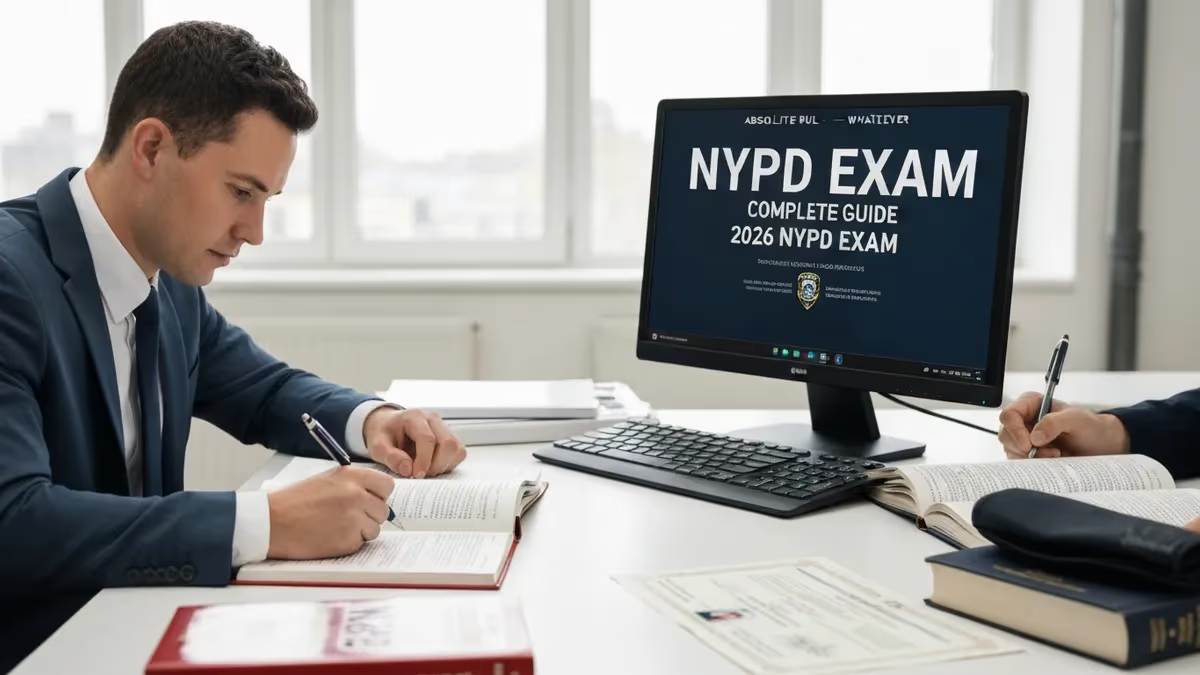
What Is the NYPD Police Officer Exam?
The NYPD Police Officer Exam is a New York City civil service examination that is the first step in the NYPD hiring process. It is administered by the NYC Department of Citywide Administrative Services (DCAS) on behalf of the NYPD. Candidates who pass the exam and complete all subsequent requirements are placed on an eligibility list and hired in score order as positions become available.
Key facts about the NYPD exam:
- Administered periodically — check the DCAS website for current exam openings (Exam No. 2000 series)
- $47 application fee (subject to change)
- Open to US citizens, at least 17.5 years old at application, meeting education and character requirements
- The written test is the first of a multi-stage process that also includes a physical agility test, medical examination, psychological evaluation, and character investigation
- Starting salary for NYPD Police Officers is among the highest for entry-level police in the US
Practice with our nypd exam preparation resources aligned to the NYC civil service police officer exam format.
NYPD Written Exam — Format and Topics
The NYPD Police Officer written exam has 85 multiple choice questions and a 3.5-hour time limit. Based on historical exam announcements, the exam covers these cognitive ability areas:
1. Reading Comprehension:
You are given written passages — similar to police reports, regulations, or procedural guidelines — and asked to answer questions based solely on the content of the passage. This tests your ability to accurately read and understand written information — a core police officer competency for following orders, completing reports, and understanding laws and procedures.
2. Memory and Observation:
A distinctive section of most NYC police officer exams. You are shown a set of materials (often a photograph of a street scene, a written description, or a set of facts) and later tested on what you remember. You must recall specific details — people, vehicles, locations, sequences of events — without being able to refer back to the original material. Practice is essential: most candidates significantly underperform this section without specific preparation.
3. Written Expression:
Questions testing grammar, word choice, and the ability to communicate clearly in writing — skills critical for writing accurate police reports. You may be asked to identify the clearest or most accurate way to express information.
4. Problem Sensitivity and Police Judgment:
Scenario-based questions testing your ability to identify relevant problems, apply police procedures correctly, and make sound judgments in realistic patrol and investigative scenarios. For comprehensive practice, use our nypd exam preparation resources and our civil service practice test guide.
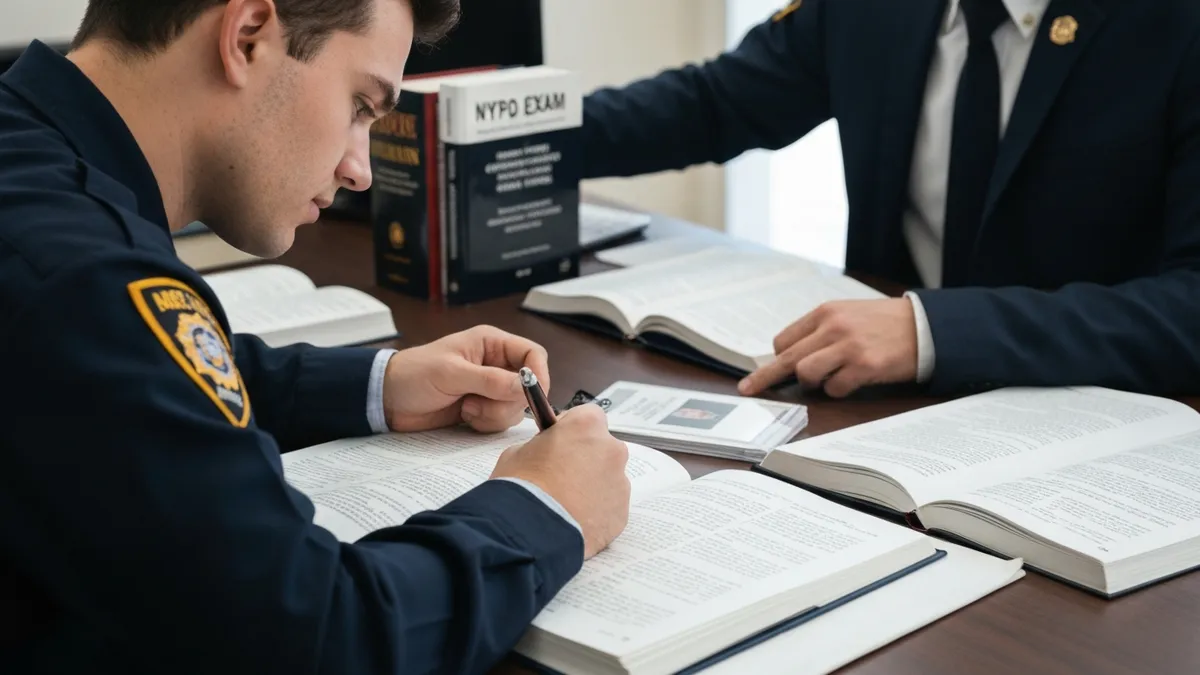
NYPD Exam Preparation Checklist
- ✓Check the DCAS website (nyc.gov/dcas) for current NYPD Police Officer exam openings and application deadlines
- ✓Practice reading comprehension with complex written passages — answer only from what the text states
- ✓Train your memory and observation skills: study a description or scene for 2–3 minutes, cover it, then answer questions from recall
- ✓Practice grammar and written expression: identify clear, accurate writing vs. ambiguous or incorrect alternatives
- ✓Study NYC police procedures and situational judgment scenarios relevant to patrol officer roles
- ✓Take full 85-question timed practice exams under realistic conditions — the 3.5-hour format requires stamina
- ✓Aim for 85+ on practice tests — the eligibility list ranks by score, and higher scores mean earlier appointment
- ✓Review physical fitness requirements for the POPAT (Physical Agility Test) — begin conditioning early
NYPD Key Concepts
What is the passing score for the NYPD exam?
Most NYPD exams require 70-75% to pass. Check the official exam guide for exact requirements.
How long is the NYPD exam?
The NYPD exam typically allows 2-3 hours. Time management is critical for success.
How should I prepare for the NYPD exam?
Start with a diagnostic test, create a 4-8 week study plan, and take at least 3 full practice exams.
What topics does the NYPD exam cover?
The NYPD exam covers multiple domains. Review the official content outline for the complete list.
NYPD Pros and Cons
- +NYPD has a defined, publicly available content blueprint — candidates know exactly what to prepare for
- +Multiple preparation pathways (self-study, courses, coaching) accommodate different learning styles and schedules
- +A growing ecosystem of study resources means candidates at any budget level can access quality preparation materials
- +Clear score reporting allows candidates to identify specific strengths and weaknesses for targeted remediation
- +Professional recognition associated with strong performance provides tangible career and academic benefits
- −The scope of tested content requires substantial preparation time that competes with existing professional or academic commitments
- −No single resource covers the full content scope — candidates typically need multiple study tools for comprehensive preparation
- −Test anxiety and exam-day performance variability mean preparation effort does not always translate linearly to scores
- −Registration, preparation, and potential retake costs accumulate into a significant financial investment
- −Content and format can change between exam versions, making older preparation materials less reliable
NYPD Exam Questions and Answers
More Law Enforcement Exam Resources

About the Author
Educational Psychologist & Academic Test Preparation Expert
Columbia University Teachers CollegeDr. Lisa Patel holds a Doctorate in Education from Columbia University Teachers College and has spent 17 years researching standardized test design and academic assessment. She has developed preparation programs for SAT, ACT, GRE, LSAT, UCAT, and numerous professional licensing exams, helping students of all backgrounds achieve their target scores.
Join the Discussion
Connect with other students preparing for this exam. Share tips, ask questions, and get advice from people who have been there.
View discussion (6 replies)