
NYS Court Officer Exam — Complete Guide 2026 October
Get ready for your NYS Court Officer certification. 📚 Practice questions with step-by-step answer explanations and instant scoring.
What Is the NYS Court Officer Exam?
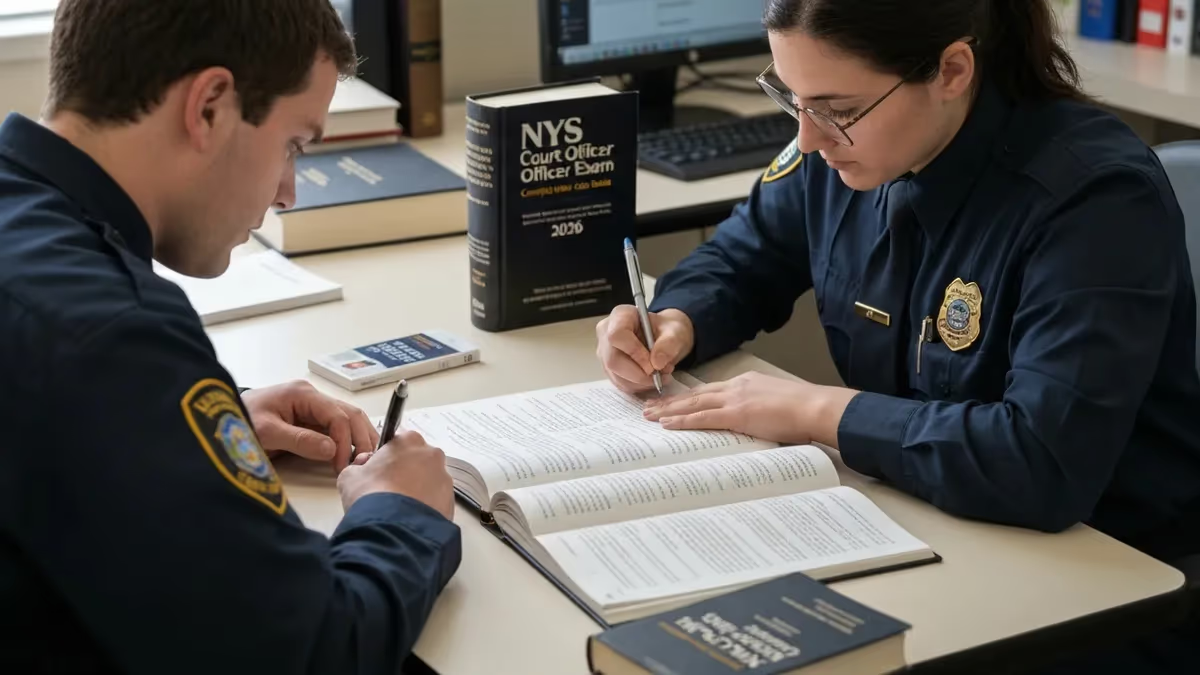
The New York State Court Officer Exam is a civil service exam administered by the New York State Office of Court Administration (OCA) to establish an eligibility list for Court Officer Trainee positions in the NYS Unified Court System. Court Officers are uniformed law enforcement officers responsible for maintaining security, order, and decorum in New York State courthouses — including Supreme Courts, Family Courts, Criminal Courts, and surrogate and civil courts throughout the state.
Key facts about the NYS Court Officer role:
- Court Officers are peace officers with law enforcement powers within their jurisdiction
- Responsible for courtroom security, prisoner escort, and courthouse access control
- Starting salary typically in the $50,000–$60,000 range with strong advancement potential
- New York City Civil Court positions carry a separate, higher salary scale
- Full state benefits package: pension (NYSLRS), health insurance, paid leave
The written exam is the first step in a multi-stage hiring process. Practice with our nys court officer exam preparation materials to maximize your written test score.
NYS Court Officer Exam — Format and Tested Topics
The NYS Court Officer written exam tests cognitive abilities relevant to the court officer role. Based on past exam announcements, the test covers these primary areas:
1. Reading Comprehension:
You will be given written passages (such as court procedures, regulations, or scenario descriptions) and asked to answer questions based solely on the written material. This tests your ability to read and understand complex written information accurately — a critical skill for following court rules and procedures.
2. Memory and Observation:
You will be shown a set of materials (descriptions of people, scenes, or written information) and later tested on what you observed and remembered. This is a unique feature of law enforcement civil service exams and requires specific preparation — practice recalling details from descriptions you study briefly.
3. Applying Written Information to Situations:
You will be given rules, regulations, or procedures in writing and then presented with situations where you must apply the correct rule. This tests your ability to follow written guidelines and exercise sound judgment — key skills for a court officer managing courthouse scenarios.
4. Spatial/Directional Reasoning:
Some NYS Court Officer exams include questions testing your ability to understand maps, floor plans, or spatial descriptions — relevant to directing people in a courthouse or responding to security situations.
5. Mathematics:
Basic arithmetic, reading data from tables, and applied math problems. This section is typically less weighted than reading comprehension and memory sections.
For comprehensive practice, use our nys court officer exam preparation resources and our civil service practice test guide for all civil service exam sections.
For a fuller set of questions on this topic, see our nys court officer practice exam resource.
For a fuller set of questions on this topic, see our court officer practice exam resource.
NYS Court Officer Exam Preparation Checklist
- ✓Check the OCA website for the current exam announcement — exam dates, application requirements, and testing locations
- ✓Practice reading comprehension with complex written passages — answer questions based only on what is stated, not outside knowledge
- ✓Train your memory and observation skills: study a description for 2 minutes, cover it, then answer questions from recall
- ✓Practice applying written rules to scenarios — read a rule, then apply it to a specific situation
- ✓Review basic math: arithmetic, percentages, reading data from tables and charts
- ✓Maintain physical fitness throughout the process — push-ups, sit-ups, and 1.5-mile run are all required at the PFT stage
- ✓Study using civil service exam prep materials that include memory/observation sections
- ✓Know the NYS residency requirements for the Court Officer Trainee position before applying
NYS Pros and Cons
- +NYS has a defined, publicly available content blueprint — candidates know exactly what to prepare for
- +Multiple preparation pathways (self-study, courses, coaching) accommodate different learning styles and schedules
- +A growing ecosystem of study resources means candidates at any budget level can access quality preparation materials
- +Clear score reporting allows candidates to identify specific strengths and weaknesses for targeted remediation
- +Professional recognition associated with strong performance provides tangible career and academic benefits
- −The scope of tested content requires substantial preparation time that competes with existing professional or academic commitments
- −No single resource covers the full content scope — candidates typically need multiple study tools for comprehensive preparation
- −Test anxiety and exam-day performance variability mean preparation effort does not always translate linearly to scores
- −Registration, preparation, and potential retake costs accumulate into a significant financial investment
- −Content and format can change between exam versions, making older preparation materials less reliable
Pros and Cons at a Glance
| Pros | Cons |
|---|---|
| NYS has a defined, publicly available content blueprint — candidates know exactly what to prepare for | The scope of tested content requires substantial preparation time that competes with existing professional or academic commitments |
| Multiple preparation pathways (self-study, courses, coaching) accommodate different learning styles and schedules | No single resource covers the full content scope — candidates typically need multiple study tools for comprehensive preparation |
| A growing ecosystem of study resources means candidates at any budget level can access quality preparation materials | Test anxiety and exam-day performance variability mean preparation effort does not always translate linearly to scores |
| Clear score reporting allows candidates to identify specific strengths and weaknesses for targeted remediation | Registration, preparation, and potential retake costs accumulate into a significant financial investment |
| Professional recognition associated with strong performance provides tangible career and academic benefits | Content and format can change between exam versions, making older preparation materials less reliable |
Sample NYS - Court Officer Exam Practice Questions
Try these questions from our free NYS - Court Officer Exam practice tests. The correct answer and an explanation follow each question.
Court procedure requires that a body receipt be obtained and logged whenever a prisoner is transferred from the court's custody to another agency. Court Officer Wade transfers a prisoner to a county correction officer. The correction officer says he forgot his paperwork and will send it later. Officer Wade should:
- A. Release the prisoner since the correction officer is clearly authorized
- B. Refuse the transfer until the body receipt is provided and properly executed
- C. Complete the transfer and follow up by email to get the receipt later
- D. Call a supervisor and transfer the prisoner while waiting for guidance
Answer: B. Refuse the transfer until the body receipt is provided and properly executed
The body receipt is a mandatory prerequisite for transfer; the prisoner cannot be released without it regardless of the receiving officer's apparent authority.
Court policy states that jurors must be escorted by a court officer whenever they leave the jury deliberation room. A juror tells Court Officer Thompson he needs to use the restroom urgently and asks to go alone since it's just down the hall. Officer Thompson should:
- A. Allow the juror to go alone since the restroom is nearby
- B. Escort the juror as required by policy
- C. Tell the juror to wait until deliberations are over
- D. Radio the bailiff and let them decide
Answer: B. Escort the juror as required by policy
The escort policy applies at all times the juror leaves the deliberation room, with no exception for short distances.
Court policy requires that a court officer be present whenever a judge speaks with jurors outside the courtroom. A judge steps into the hallway and begins informally chatting with two jurors. Court Officer Caldwell is nearby. She should:
- A. Remain where she is since the conversation appears casual and harmless
- B. Position herself nearby and remain present for the conversation per policy
- C. Interrupt the conversation and remind the judge the meeting must occur in the courtroom
- D. Notify a supervisor and wait for instructions before acting
Answer: B. Position herself nearby and remain present for the conversation per policy
The policy requires officer presence whenever a judge speaks with jurors outside the courtroom, regardless of the conversation's apparent nature.
A court rule states that weapons may only be stored in the secure weapons locker on the first floor. An off-duty police officer attending a proceeding asks Court Officer Walsh if she can store her firearm in the back office for convenience. Officer Walsh should:
- A. Allow it since the back office is also secure
- B. Direct the officer to the designated first-floor locker per policy
- C. Allow it as a professional courtesy to law enforcement
- D. Tell her she cannot bring the weapon into the building at all
Answer: B. Direct the officer to the designated first-floor locker per policy
The rule designates a specific storage location; convenience does not justify using an alternative location.
NYS Court Officer Exam Questions and Answers
More Law Enforcement and Civil Service Resources



About the Author

Educational Psychologist & Academic Test Preparation Expert
Columbia University Teachers CollegeDr. Lisa Patel holds a Doctorate in Education from Columbia University Teachers College and has spent 17 years researching standardized test design and academic assessment. She has developed preparation programs for SAT, ACT, GRE, LSAT, UCAT, and numerous professional licensing exams, helping students of all backgrounds achieve their target scores.
Join the Discussion
Connect with other students preparing for this exam. Share tips, ask questions, and get advice from people who have been there.
View discussion (8 replies)