
Free ExCPT Pharmacy Law and Regulations Questions & Answers 2026 July
⏳ Free excpt pharmacy law and regulations questions and answers — DEA schedules, controlled substances, prescription rules, and full ExCPT exam prep.
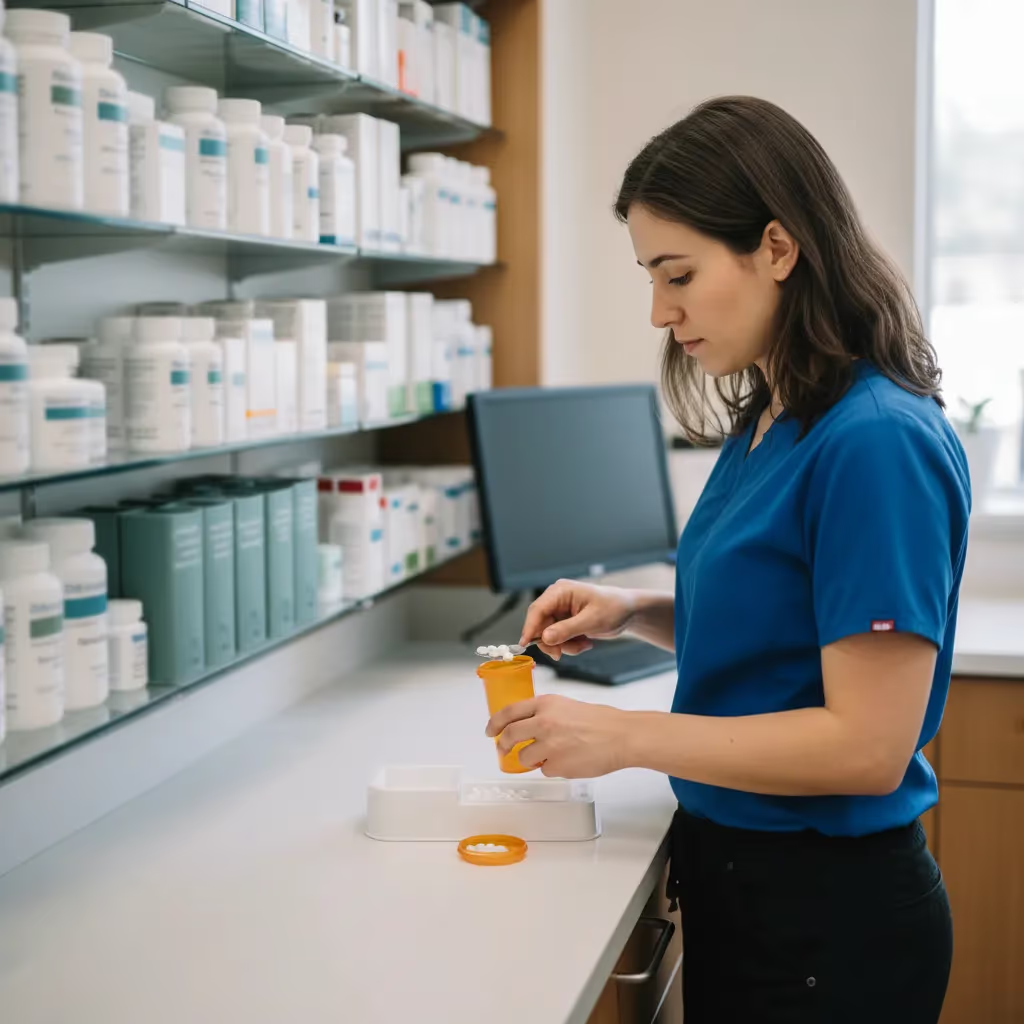
Looking for free excpt pharmacy law and regulations questions and answers to prep the law domain before exam day? Pharmacy law is one of the most heavily weighted sections on the excpt — DEA controlled substance scheduling, prescription requirements, refill rules, recordkeeping, and federal vs state regulatory authority. Many candidates underestimate this domain because the math feels harder, but law questions consistently catch unprepared test-takers off guard with specific numerical limits and time windows. A focused excpt practice test routine covering law alongside calculations and pharmacology is the difference between passing on first attempt and scheduling a 60-day retake.
The Exam for the Certification of Pharmacy Technicians is administered by the National Healthcareer Association (NHA), and law questions test your knowledge of federal frameworks (Controlled Substances Act, BSA, FDA, DEA Form 222), state-level regulations (vary by state), and pharmacy-specific compliance (Schedule II refill rules, partial fills, emergency supplies, recordkeeping retention). Roughly 15-20% of exam questions cover law and regulations directly. Memorizing the specific rules makes this domain straightforward — the questions test recall of established rules rather than open-ended judgment.
This guide walks through every major law topic on the ExCPT exam, free practice questions across the seven content domains, and a 6-week prep routine that puts you in confident territory by test day.
ExCPT Exam by the Numbers
An excpt practice test on pharmacy law should cover federal regulations (Controlled Substances Act, FDA's Federal Food, Drug, and Cosmetic Act, OBRA-90), DEA schedules and prescriber requirements, prescription element rules (date, prescriber DEA, signature, quantity in numbers and words for CII, refill information), inventory and recordkeeping (Form 222 for CII orders, biennial inventories, 2-year minimum recordkeeping), and patient counseling requirements. The excpt exam tests these rules through scenario questions — recognizing what's missing from a prescription, identifying which schedule a drug belongs to, and knowing the correct response to a refill request.
Federal law sets the floor; states often impose stricter requirements (PDMP queries, controlled substance limits, mandatory ID checks for Schedule II purchases). Some questions test knowledge of state-specific rules; most test federal frameworks that apply nationwide. Memorize the federal rules cold, then layer state-specific knowledge for your jurisdiction afterward.
The Pharmacy Law domain rewards systematic memorization more than any other ExCPT section — invest study time here for the highest score gains per hour.
Many state boards publish summarized federal-vs-state comparison charts on their websites. Print one for your state and keep it as a quick-reference during prep — comparing federal floors to state ceilings reinforces both layers simultaneously.
When candidates ask about the excpt exam, the next question is often excpt vs ptcb. Both produce the identical CPhT credential and are accepted by every state board, but they differ in fee, testing center network, and minor question style. The ExCPT places slightly more emphasis on practical workflow scenarios; the PTCE leans into pharmacology depth. Neither is easier — both test similar competencies through different question formats. The excpt examination includes pharmacy law as one of the seven major content domains, weighted at roughly 15% of total questions.
Both exams cover the Controlled Substances Act extensively. Memorize the schedule classifications: Schedule I (no accepted medical use, high abuse), Schedule II (high abuse, accepted use, no refills, written prescription required), Schedule III (moderate abuse, refillable up to 5 times within 6 months), Schedule IV (lower abuse, same refill rules as CIII), Schedule V (lowest abuse, may be sold OTC in some states with restrictions). Schedule II refill restrictions are the most heavily tested — written prescription only, no refills, partial fill rules, 21-day fill window for partial fills.
Schedule II rules apply differently for terminally ill or LTCF patients — partial fills can be made in 60-day windows. Memorize these exceptions for exam day.
Watch for emergency rules and DEA enforcement actions during your study period. Recent updates around tele-prescribing of controlled substances (post-COVID public health emergency rules) appear regularly on current exam cycles.
EXCPT Practice Test Questions
Prepare for the ExCPT Test exam with our free practice test modules. Each quiz covers key topics to help you pass on your first try.
EXCPT Medication Safety
EXCPT Exam Questions covering Medication Safety. Master EXCPT Test concepts for certification prep.
EXCPT Medication Safety and Errors
Free EXCPT Practice Test featuring Medication Safety and Errors. Improve your EXCPT Exam score with mock test prep.
EXCPT Pharmacology
EXCPT Mock Exam on Pharmacology. EXCPT Study Guide questions to pass on your first try.
EXCPT Pharmacology for Technicians
EXCPT Test Prep for Pharmacology for Technicians. Practice EXCPT Quiz questions and boost your score.
EXCPT Pharmacology MCQ
EXCPT Questions and Answers on Pharmacology MCQ. Free EXCPT practice for exam readiness.
EXCPT Pharmacy Law and Regulations
EXCPT Mock Test covering Pharmacy Law and Regulations. Online EXCPT Test practice with instant feedback.
EXCPT Pharmacy Operations
Free EXCPT Quiz on Pharmacy Operations. EXCPT Exam prep questions with detailed explanations.
EXCPT Prescription Dispensing Process
EXCPT Practice Questions for Prescription Dispensing Process. Build confidence for your EXCPT certification exam.
EXCPT Sterile and Non-Sterile Compounding
EXCPT Test Online for Sterile and Non-Sterile Compounding. Free practice with instant results and feedback.
EXCPT Test ExCPT Drug Storage and Inventor...
EXCPT Study Material on Test ExCPT Drug Storage and Inventory Management. Prepare effectively with real exam-style questions.
EXCPT Test ExCPT Pharmacy Calculations
Free EXCPT Test covering Test ExCPT Pharmacy Calculations. Practice and track your EXCPT exam readiness.
EXCPT Test Medication Safety
EXCPT Exam Questions covering Test Medication Safety. Master EXCPT Test concepts for certification prep.
EXCPT Test Pharmacology
Free EXCPT Practice Test featuring Test Pharmacology. Improve your EXCPT Exam score with mock test prep.
EXCPT Test Pharmacy Law and Regulations
EXCPT Mock Exam on Test Pharmacy Law and Regulations. EXCPT Study Guide questions to pass on your first try.
EXCPT Test Pharmacy Operations
EXCPT Test Prep for Test Pharmacy Operations. Practice EXCPT Quiz questions and boost your score.
EXCPT Test Prescription Dispensing Process
EXCPT Questions and Answers on Test Prescription Dispensing Process. Free EXCPT practice for exam readiness.
ExCPT Pharmacy Law Question Categories
DEA schedule questions are the most heavily tested. Schedule II (oxycodone, fentanyl, morphine, Adderall, Ritalin) requires written prescription, no refills, DEA Form 222 for ordering, partial fills with 21-day window. Schedule III (codeine combinations, ketamine, anabolic steroids) allows up to 5 refills within 6 months, written or oral prescription. Schedule IV (diazepam, alprazolam, tramadol, zolpidem) follows CIII refill rules. Schedule V (cough suppressants with codeine, Lomotil) — limited OTC sales in some states.
A targeted excpt exam practice test regimen builds the breadth of preparation needed for the seven content domains. Don't over-focus on calculations; pharmacy law and pharmacology together account for roughly 40% of the test, while calculations are 20%. The excpt test blueprint published by NHA spells out exact domain weights — calibrate your study time accordingly. Most candidates who fail did so because of weak law and pharmacology preparation, not weak math. The four-week-out point is a good time for a full diagnostic practice exam to identify domains stuck below 70%.
The exam is multiple-choice, four answer options per question, no penalty for guessing. Answer every question even if you have to make an educated guess. The exam is administered on computer at PSI testing centers; you'll see your unofficial pass/fail result on screen immediately, with the official scaled score and certification within 1-2 business days. Bring two forms of ID and arrive 30 minutes early to handle check-in without rushing.
Build a question rhythm — 25 questions, then 30 minutes review of every wrong answer, then a short break. Repeat 3-4 times per session. Quality of review matters more than question volume.
Build a one-page summary card listing all five DEA schedules with example drugs, refill rules, and special restrictions. Photograph it and keep it on your phone for quick reference review during commutes or breaks.
4 ExCPT Pharmacy Law Strategies
Schedule I-V drug examples, refill rules, prescription format requirements, and partial fill windows. These appear in almost every law section question. Build flashcards for Schedule II drugs (oxycodone, fentanyl, morphine, Adderall) and Schedule III-IV examples (codeine combinations, alprazolam, tramadol). Recognition speed pays off significantly.
Memorize what a valid prescription must contain — patient name and address, date, prescriber DEA, drug name and strength, quantity (numbers and words for CII), directions, refills, signature. Exam scenarios often present incomplete prescriptions and ask what's missing. This is high-value memorization with predictable exam returns.
DEA Form 222 (Schedule II ordering, single-purpose record retention 2 years). DEA Form 106 (theft/loss reporting, file within 1 business day). DEA Form 41 (controlled substance destruction). DEA Form 224 (initial registration). Knowing which form serves which purpose appears regularly in scenario questions.
Federal law sets the floor; states often impose stricter rules. Know that PDMP queries are required in most states, that some states require ID for Schedule II purchases, and that pharmacist counseling rules vary widely. Focus on federal first since it dominates exam questions, then layer state knowledge for your specific jurisdiction.
The excpt vs ptcb debate touches every pharmacy technician choosing a certification path. The exam for the certification of pharmacy technicians is the formal name for the ExCPT — the credential ICPT (now NHA) developed for retail and institutional pharmacy technicians. Both ExCPT and PTCE result in the CPhT designation, both accepted by every state board, both require 2-year recertification with 20 hours CE including 1 hour pharmacy law and 1 hour patient safety. The ptcb vs excpt comparison usually comes down to logistics: testing center proximity, fee, and your employer's preference. The credential outcome is identical.
Pharmacy law CE is mandatory for recertification because federal regulations evolve — new DEA rules, FDA enforcement priorities, and state board updates all require ongoing learning. Many states also have additional CE requirements specific to controlled substance dispensing or sterile compounding. Track your CE credits in the NHA portal throughout the cycle to avoid scrambling near recertification time.
Choose the path with fewer logistical obstacles and put your prep energy into mastering the content rather than agonizing over the exam choice.
Practice scenario questions specifically — the exam tests application of rules to specific fact patterns, not pure memorization. Knowing the rule isn't enough if you can't apply it to the prescription scenario being shown.
ExCPT Pharmacy Law Mastery: Pros and Cons
- +Law domain rewards memorization — clear right/wrong answers without judgment ambiguity
- +Federal rules apply nationwide — a single set of rules covers most exam questions
- +Score gains per study hour are higher in law than in pharmacology or calculations
- +Strong law knowledge translates directly to safer real-world dispensing practices
- +Exam questions are predictable — same rules tested year after year
- +DEA, FDA, and CSA frameworks rarely change dramatically between exam cycles
- −Volume of specific rules and numerical limits requires sustained memorization effort
- −State law overlay adds complexity beyond federal foundation
- −Some rules have exceptions (LTCF partial fills, terminally ill exceptions) that confuse
- −Lesser-known DEA forms (106, 41) can appear unexpectedly in scenario questions
- −Schedule placement of unfamiliar drugs requires drug class knowledge, not just memorization
- −Federal updates (e.g., e-prescribing rules) require staying current beyond textbook materials
An excpt practice exam covering all seven domains — pharmacology (~25%), calculations (~20%), pharmacy law (~15%), dispensing (~15%), patient safety (~10%), sterile/non-sterile compounding (~10%), inventory management (~5%) — gives the most accurate readiness measurement. Don't rely on single-domain quizzes; the real exam mixes domains randomly. Excpt certification requires consistent breadth, not just depth in one or two areas. A weak score in any one domain can drop your scaled score below the 390 passing threshold even with strong performance in others.
Time management on the actual exam matters as much as content mastery. You have 130 minutes for 100 questions — that's 78 seconds per question. Most candidates finish with 15-20 minutes to spare if they keep moving. Mark questions you're unsure of with the testing software's flag tool and return to them after answering everything you know. Don't burn 4 minutes on a single law question during the first pass.
The NHA scaled scoring means raw points are converted into a 200-500 scale where 390 is the cut score. Focus on getting every question right that you confidently can; use educated guesses on the rest.
Don't neglect inventory management questions even though it's only 5% of the exam — these questions are usually straightforward and represent free points if you've reviewed the basic rules around perpetual inventory, biennial counts, and reorder points.
ExCPT Pharmacy Law Study Checklist
- ✓Memorize DEA Schedule I-V drug examples and refill rules
- ✓Drill prescription element requirements (especially CII format)
- ✓Know DEA Forms 222, 106, 41, and 224 and their purposes
- ✓Understand partial fill rules (21-day window, LTCF exceptions)
- ✓Memorize biennial inventory and 2-year recordkeeping requirements
- ✓Practice state vs federal regulation distinctions
- ✓Drill emergency CII oral prescription rules (7-day written follow-up)
- ✓Know HIPAA basics and patient counseling (OBRA-90) requirements
- ✓Take 3+ full-length timed practice exams in final 2 weeks
- ✓Bring two forms of ID and arrive 30 minutes early to PSI testing center
Searching nha excpt resources should lead you to NHA's official prep materials and the candidate portal at nhanow.com. NHA acquired ICPT (the original ExCPT creator) in 2018, and now administers the credential alongside its other allied health certifications (CCMA, CET, CMAA). NHA's continuing education portal is well-organized — you can complete required CE hours online and recertify without paperwork friction.
As an excpt examination candidate, the official NHA materials are calibrated to the real exam and represent your best prep investment beyond free practice tests like those linked throughout this guide. Excpt pharmacy technician candidates working full-time in pharmacy settings often have an advantage on workflow and law questions because their daily dispensing activities reinforce many of the regulations being tested.
If you're working as a tech without ExCPT certification, your daily prescription processing builds informal knowledge that maps directly to exam content. Use that advantage — when you encounter an unusual scenario at work (a Schedule II partial fill, an emergency oral CII prescription, a mandatory PDMP check), look up the relevant federal and state rule that evening. This converts work hours into study time without adding extra commitment.
Working pharmacy techs often need only 4-6 weeks of formal prep versus 6-8 for those without prior pharmacy experience.
Track the time you spend on each domain during practice exams. If you're consistently spending longer than average on law questions, drill rule recall speed before exam day. Slow law recall costs time you need for harder pharmacology and calculation questions.
Passing Score: 390 on a Scaled 200-500 Range
The ExCPT uses a scaled scoring system where raw correct answers are converted to a 200-500 scale. The passing score is 390. You'll see your unofficial pass/fail result on screen immediately after submitting, with your official scaled score and certification status delivered within 1-2 business days if you pass. Most successful candidates score in the 410-450 range. If you fail, you can retake after a 60-day waiting period — use that time to drill the specific domains your score report flags as weak areas, especially pharmacy law if that was your weakness.
An excpt study guide built around the official NHA blueprint should cover all seven content domains with structured chapters and end-of-chapter practice questions. Look for guides published in 2024 or later — older editions may include outdated drug schedules, recall procedures, or USP 797/800 sterile compounding standards.
Quality guides include calculation drills, full-length practice exams, and detailed pharmacy law sections covering federal frameworks (CSA, FDA, BSA) and state-level overlays. A free excpt practice test bank covering all seven domains lets you take diagnostic readings before paying for paid prep materials. Aim for 75%+ across all domains on practice tests before scheduling your official exam date.
Free practice questions are widely available online — including this site's free quizzes covering medication safety, pharmacology, pharmacy law, dispensing, and pharmacy operations. Combine free practice with at least one paid full-length mock exam in the final two weeks before test day. Free question quality varies widely, so cross-reference difficult ones against your study guide before locking in the answer logic.
Most candidates pass on first attempt with 6-8 weeks of structured prep including weekly mock exams.
If you fail on first attempt, request the score breakdown by domain from NHA before scheduling your retake. Knowing exactly which domains scored lowest lets you focus the 60-day waiting period on targeted weak-area drilling rather than re-studying everything.
Schedule II controlled substances cannot be refilled under any circumstance. Each new dispensing requires a new written prescription. Partial fills are allowed within a 21-day window of original date (60 days for terminally ill or LTCF patients), but partial fills are not refills — they're completing the original prescription quantity. Confusing partial fills with refills is a common exam trap. Memorize: Schedule II = zero refills, period. Schedule III-IV = up to 5 refills within 6 months. Schedule V = follows state rules, often 5 refills within 6 months as well.
The ptcb or excpt certification question often has a practical answer: choose the one your employer prefers, your testing center is closer to, or that has more available exam slots in your area. Both produce the identical CPhT credential. Both are valid for 2 years and require 20 CE hours including 1 hour each in pharmacy law and patient safety.
Choose based on logistics, not credential prestige — the credential outcome is identical. An nha excpt practice test aligned to the current 2024-2026 blueprint is the single most reliable predictor of your real-exam performance. Look for question banks that mirror the seven content-domain weights.
Studying to those domain weight percentages keeps your prep proportional to what's tested. Don't over-prepare for calculations at the expense of pharmacy law — the law domain catches more candidates than the math does. Many techs underestimate law because the rules feel boring; on the exam, those memorized rules show up as the easy points that protect your overall score.
Pharmacy law mastery isn't optional for ExCPT success — it's the foundation that makes the other domains easier to pass.
NHA also publishes free webinars and study tips on its candidate portal. These supplemental resources are no-cost and often address specific exam content updates that don't appear in official prep materials yet.
If you're searching excpt verification options, the NHA candidate portal is the official source. After passing the exam, your CPhT credential is searchable in the NHA verification database — employers and state boards use it to confirm active status. Keep your account credentials secure; you'll log in to upload CE credits, renew your certification, and download official transcripts whenever an employer or state board requests verification. An excpt practice exam free resource — like the one on this site — provides baseline diagnostic readings on your readiness.
Take a full 100-question practice exam two weeks before your scheduled test date. If you score above 75%, you're on track. Below 60% means you need more weeks of preparation, or you should reschedule. Between 60-75%, focus on your weakest two content domains and re-test in 7-10 days. Don't sit the official ExCPT until your practice scores stabilize above 70%.
The ExCPT is a passable exam with disciplined preparation — most candidates following a 6-8 week structured plan with weekly practice testing pass on first attempt. Pharmacy law is the foundation; build it well and the rest of the exam becomes manageable.
Plan a backup test date when scheduling your initial exam. Booking flexibility provides insurance against unexpected illness, work conflicts, or last-minute prep gaps in the final week before your originally planned date.
Excpt Questions and Answers
About the Author
Clinical Pharmacist & Pharmacy Licensing Exam Specialist
USC Alfred E. Mann School of PharmacyDr. Lisa Nguyen holds a Doctor of Pharmacy and a PhD in Pharmaceutical Sciences from the University of Southern California School of Pharmacy. She is a licensed pharmacist with 14 years of clinical practice in hospital and community settings, and coaches pharmacy graduates and technicians through NAPLEX, MPJE, PTCE, ExCPT, and state pharmacy licensing examinations.