
Free ExCPT Pharmaceutical Fundamentals MCQ Questions and Answers 2026 July
Free ExCPT pharmaceutical fundamentals MCQ questions and answers — pharmacy technician exam prep, drug calculations, dispensing, and pharmacy law. 🔎
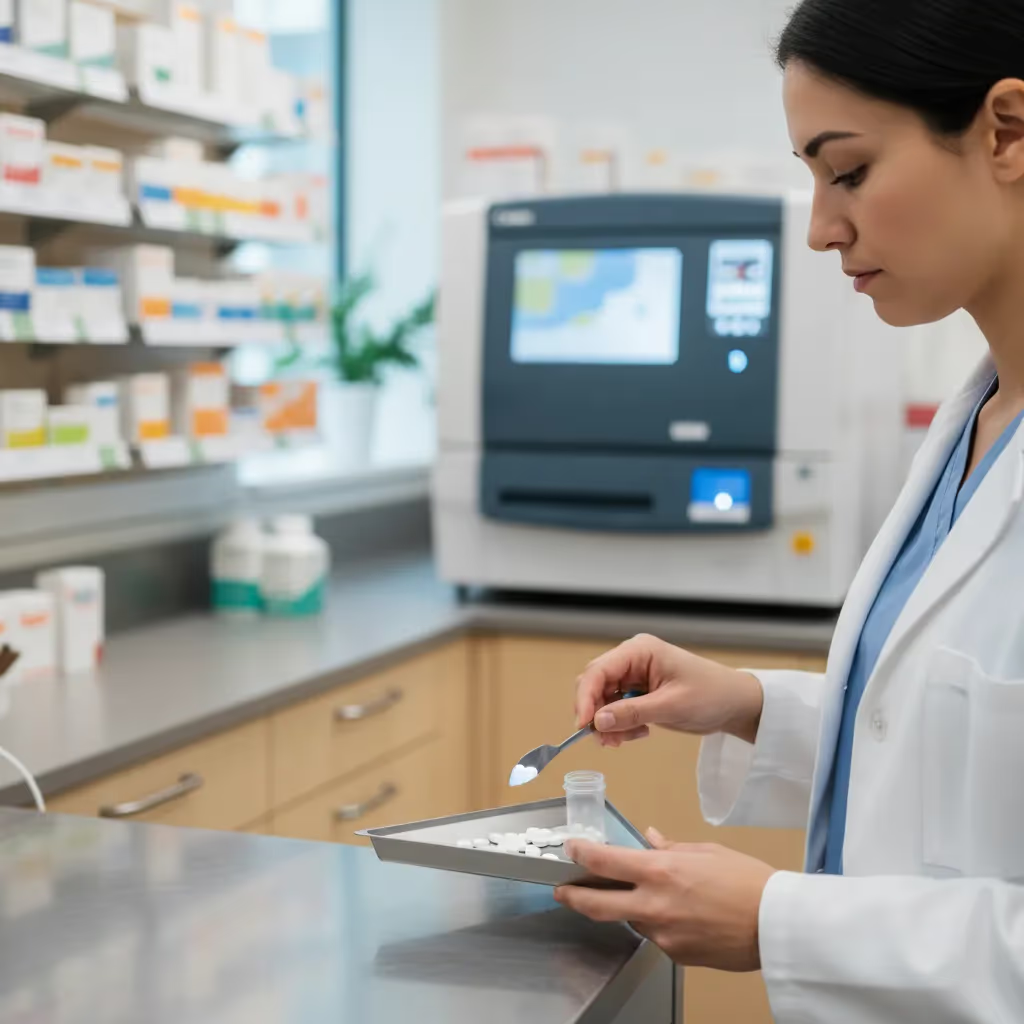
Looking for free excpt pharmaceutical fundamentals mcq questions and answers to drill before exam day? Pharmaceutical fundamentals — drug categories, dosage forms, brand-generic matching, drug interactions, and pharmacology basics — appear across multiple ExCPT exam content domains. The excpt assesses pharmacy technician competency for the CPhT credential. A focused excpt practice test routine covering pharmaceutical fundamentals alongside calculations and law builds the breadth needed for first-attempt success.
The Exam for the Certification of Pharmacy Technicians is administered by the National Healthcareer Association (NHA) and produces the Certified Pharmacy Technician (CPhT) credential. Pharmaceutical fundamentals coverage on ExCPT includes brand-generic drug name matching (top 200 drugs), dosage forms (tablets, capsules, suspensions, suppositories, injections, transdermal), drug class identification, common drug interactions, drug administration routes, and basic pharmacology principles relevant to pharmacy technician work.
This guide walks through every pharmaceutical fundamentals topic covered on the ExCPT exam, free practice questions across the seven content domains, and prep strategies for first-attempt CPhT certification success. Most candidates pass with 6-8 weeks of structured prep including weekly mock testing.
ExCPT Exam by the Numbers
A focused excpt practice test on pharmaceutical fundamentals should cover drug name recognition, drug classifications, dosage forms, administration routes, and basic pharmacology. The excpt exam includes pharmacology questions across multiple content domains — sometimes as standalone questions, sometimes integrated with dispensing, calculations, or patient safety scenarios. Strong pharmaceutical fundamentals support performance across the broader exam, not just standalone pharmacology questions.
Memorize the top 200 drugs (brand and generic names) commonly tested on ExCPT. Drug categories include cardiovascular (ACE inhibitors, beta blockers, statins, antihypertensives), endocrine (insulin, oral diabetes meds, thyroid medications), antimicrobials (antibiotics, antivirals, antifungals), CNS (analgesics, antidepressants, anxiolytics, anticonvulsants), respiratory (bronchodilators, inhaled corticosteroids), and others. Build flashcards systematically across drug classes during prep. Daily 15-30 minute drug name drilling produces measurable improvements over 6-8 weeks.
Drug name recognition speed matters during the timed exam — fluency reduces cognitive load on harder questions later in the exam.
Many pharmacy technician training programs partner with local pharmacies for clinical rotations. Use these rotations strategically to observe diverse pharmacy operations (retail, hospital, compounding) and build the broad pharmacy exposure ExCPT exam questions test.
Network with current CPhT-certified pharmacy technicians during your prep window. Recent test takers know which content areas to emphasize and which prep resources actually helped versus those that wasted time.
A targeted excpt exam approach should integrate pharmaceutical fundamentals with broader exam content. The excpt examination tests scenarios where pharmacology knowledge supports correct answer selection on dispensing, calculations, and safety questions. The excpt vs ptcb comparison comes up regularly in pharmacy technician circles — both produce the identical CPhT credential accepted by every U.S. state board of pharmacy. Choose based on logistics (testing center proximity, fee, employer preference) rather than perceived prestige differences.
Both ExCPT and PTCE require pharmacology knowledge across the same drug categories. Pharmacology questions test brand-generic matching, drug class identification, common indications, and contraindications relevant to pharmacy technician dispensing work. The exam doesn't test deep clinical pharmacology (that's pharmacist-level knowledge) but does require sufficient familiarity with common medications to support safe dispensing practice.
Build pharmacology fluency systematically across the 6-8 week prep window — it underpins success across multiple exam content areas.
Track your weekly practice scores by content domain in a simple spreadsheet. Watching the trend across study weeks builds confidence and identifies plateau points needing study approach changes.
If your formal coursework didn't include extensive pharmacology, prioritize that domain in your independent study window. Build foundational drug knowledge using free YouTube pharmacology overview videos before drilling exam-specific practice questions.
EXCPT Practice Test Questions
Prepare for the ExCPT Test exam with our free practice test modules. Each quiz covers key topics to help you pass on your first try.
EXCPT Medication Safety
EXCPT Exam Questions covering Medication Safety. Master EXCPT Test concepts for certification prep.
EXCPT Medication Safety and Errors
Free EXCPT Practice Test featuring Medication Safety and Errors. Improve your EXCPT Exam score with mock test prep.
EXCPT Pharmacology
EXCPT Mock Exam on Pharmacology. EXCPT Study Guide questions to pass on your first try.
EXCPT Pharmacology for Technicians
EXCPT Test Prep for Pharmacology for Technicians. Practice EXCPT Quiz questions and boost your score.
EXCPT Pharmacology MCQ
EXCPT Questions and Answers on Pharmacology MCQ. Free EXCPT practice for exam readiness.
EXCPT Pharmacy Law and Regulations
EXCPT Mock Test covering Pharmacy Law and Regulations. Online EXCPT Test practice with instant feedback.
EXCPT Pharmacy Operations
Free EXCPT Quiz on Pharmacy Operations. EXCPT Exam prep questions with detailed explanations.
EXCPT Prescription Dispensing Process
EXCPT Practice Questions for Prescription Dispensing Process. Build confidence for your EXCPT certification exam.
EXCPT Sterile and Non-Sterile Compounding
EXCPT Test Online for Sterile and Non-Sterile Compounding. Free practice with instant results and feedback.
EXCPT Test ExCPT Drug Storage and Inventor...
EXCPT Study Material on Test ExCPT Drug Storage and Inventory Management. Prepare effectively with real exam-style questions.
EXCPT Test ExCPT Pharmacy Calculations
Free EXCPT Test covering Test ExCPT Pharmacy Calculations. Practice and track your EXCPT exam readiness.
EXCPT Test Medication Safety
EXCPT Exam Questions covering Test Medication Safety. Master EXCPT Test concepts for certification prep.
EXCPT Test Pharmacology
Free EXCPT Practice Test featuring Test Pharmacology. Improve your EXCPT Exam score with mock test prep.
EXCPT Test Pharmacy Law and Regulations
EXCPT Mock Exam on Test Pharmacy Law and Regulations. EXCPT Study Guide questions to pass on your first try.
EXCPT Test Pharmacy Operations
EXCPT Test Prep for Test Pharmacy Operations. Practice EXCPT Quiz questions and boost your score.
EXCPT Test Prescription Dispensing Process
EXCPT Questions and Answers on Test Prescription Dispensing Process. Free EXCPT practice for exam readiness.
ExCPT Pharmaceutical Topics
Cardiovascular drugs include ACE inhibitors (lisinopril, enalapril, ramipril), ARBs (losartan, valsartan), beta blockers (metoprolol, atenolol, carvedilol), calcium channel blockers (amlodipine, diltiazem), statins (atorvastatin, simvastatin, rosuvastatin), and diuretics (furosemide, hydrochlorothiazide). Endocrine drugs include insulin types (rapid, short, intermediate, long-acting), oral diabetes meds (metformin, sulfonylureas, DPP-4 inhibitors, SGLT2 inhibitors, GLP-1 agonists), and thyroid medications (levothyroxine).
An effective excpt exam practice test regimen should drill pharmaceutical fundamentals weekly throughout the 6-8 week prep window. Free practice tests covering medication safety, pharmacology, and dispensing process let you assess pharmaceutical fundamentals readiness across multiple exam contexts. The excpt test blueprint published by NHA specifies exact domain weights — pharmacology is approximately 25% of the exam, making it the largest single content area. Calibrate your study time accordingly with extra emphasis on pharmacology beyond uniform distribution across all seven domains.
The exam is computer-administered at PSI testing centers worldwide with multiple-choice questions and immediate result delivery. Most candidates complete the exam within 90-120 minutes; the 130-minute time limit provides accommodation for candidates needing extra time. Mark questions you're unsure of with the testing software's flag tool and return to them after answering everything you know. Don't burn time on single difficult questions during the first pass — flag and move forward.
Schedule for your peak focus hours when concentration is sharpest for the 130-minute exam session.
Pharmacy automation manufacturer training programs (BD Rowa, Parata, Omnicell, Pyxis) often offer free educational sessions covering specific equipment types. Take advantage of vendor-sponsored education during prep — practical equipment knowledge transfers directly to ExCPT exam performance.
Attend pharmacy technician conferences during prep if possible. The American Society of Health-System Pharmacists (ASHP) Annual Meeting includes technician-focused sessions that reinforce ExCPT content while providing CE credits for after certification.
4 ExCPT Pharmacology Strategies
Build flashcards for the top 200 most-prescribed drugs (brand and generic names). Drug name fluency reduces cognitive load on the exam — recognition speed matters when scenario questions present multiple drug options under time pressure. Daily 15-30 minute drug name drilling produces measurable improvements over 6-8 weeks of consistent practice.
Memorize drugs by class rather than individually. ACE inhibitors all end in -pril, ARBs end in -sartan, beta blockers end in -olol, statins end in -statin. Suffix patterns help recognition speed and reduce memorization burden. Build flashcards organized by drug class for the most efficient pharmacological knowledge structure.
Memorize dosage form types (tablet, capsule, suspension, suppository, injection, transdermal) with specific characteristics, administration considerations, and patient counseling points. Dosage form questions appear regularly across multiple exam contexts — pharmacology, dispensing, and patient safety questions all incorporate dosage form considerations.
Take a full-length ExCPT practice test weekly during your final 4-6 weeks of prep. Mock test analysis reveals weak content domains and builds the timing discipline needed for the 130-minute real exam. Most candidates who pass on first attempt completed 5-8 full practice tests with detailed review of every wrong answer.
The excpt examination result determines your CPhT certification eligibility for pharmacy technician employment. Ptcb vs excpt credential outcomes are identical — both produce the CPhT credential accepted by every state board of pharmacy. Choose based on logistics rather than perceived prestige. The excpt practice exam sessions through NHA-published prep materials provide the most authentic prep matching actual exam difficulty. Combine NHA materials with free practice tests on this site and other reputable sources for breadth and depth across the seven content domains.
CPhT-certified pharmacy technicians earn median wages of $36,000-45,000 nationally with significant variation by region, employer, and experience. Hospital pharmacy and specialty pharmacy positions typically pay above retail community pharmacy rates. Lead pharmacy technician positions command higher wages with the credential plus 3-5 years of experience. The CPhT credential is the entry point for pharmacy technician career advancement across diverse pharmacy settings.
Build the credential as the foundation for your pharmacy technician career trajectory.
Build a rotation of dosage form review during commutes — flashcard apps on your phone make 10-15 minute dosage form practice sessions accessible throughout the day. Small frequent exposure compounds across weeks of prep.
Review controlled substance scheduling specifically. DEA Schedule I-V drug classifications appear regularly across multiple ExCPT content domains beyond just standalone pharmacy law questions.
ExCPT Pharmacy Technician Certification: Pros and Cons
- +Identical CPhT credential as PTCB — accepted by every U.S. state board of pharmacy
- +Lower exam fee than PTCE — typically $117 versus $129
- +Administered at PSI testing centers, often more available than Pearson VUE in rural areas
- +Slightly more practical workflow emphasis than PTCE
- +Free practice tests and study materials widely available online
- +Same 2-year recertification cycle and CE requirements as PTCB pathway
- −Less name recognition with some employers compared to PTCB
- −Fewer official prep books published versus the larger PTCB prep market
- −Pharmacology questions challenge candidates without prior pharmacy experience
- −Score reports give less detail than PTCE breakdowns by domain
- −Some employers explicitly require PTCB certification regardless of equivalence
- −Pharmacy technician compensation modest compared to other healthcare careers
An effective excpt certification prep approach combines NHA-published study materials with free practice tests across all seven content domains. Excpt pharmacy technician candidates working full-time in pharmacy settings often have an advantage on workflow and pharmacology questions because their daily dispensing activities reinforce many of the regulations and drug knowledge being tested. Use that advantage by treating each prescription you process at work as study reinforcement — review the drug class, indication, and common side effects of unfamiliar medications during your shifts and on study breaks.
If you're studying without prior pharmacy experience, plan extended prep time (8-12 weeks) for adequate pharmacology familiarity. Watch pharmacology overview videos on YouTube (Picmonic, Khan Academy Health) and read pharmacy technician textbook chapters covering pharmacology basics. Build foundational drug knowledge before drilling exam-specific practice questions. Without prior pharmacy exposure, pure practice testing won't produce sufficient pharmacology familiarity for first-attempt passing.
Working pharmacy technicians often need only 4-6 weeks; non-experienced candidates need 8-12 weeks of structured prep.
Don't overlook compounding content even if your work focuses on retail pharmacy. The exam tests basic non-sterile compounding (creams, ointments, capsules, suspensions) and sterile compounding overview (USP 797, 800 standards). Memorize beyond-use dating principles and aseptic technique basics.
If your practice doesn't include compounding, observe at a local compounding pharmacy if possible. Hands-on observation builds the contextual understanding textbook study can't replicate.
Some pharmacy chains offer paid pharmacy technician training programs that combine on-the-job experience with structured ExCPT prep. CVS Pharmacy Technician Apprenticeship and Walgreens Pharmacy Technician Training Program are examples of employer-sponsored career pathways into pharmacy technician work.
ExCPT Pharmaceutical Fundamentals Checklist
- ✓Build flashcards for top 200 most-prescribed drugs (brand and generic)
- ✓Group drugs by drug class using suffix patterns (-pril, -sartan, -olol, -statin)
- ✓Memorize dosage form types and administration considerations
- ✓Drill drug administration routes (PO, SL, IV, IM, SC, transdermal, inhalation)
- ✓Practice with free ExCPT pharmaceutical fundamentals MCQ tests
- ✓Take 5-8 full-length ExCPT practice exams in final 4-6 weeks
- ✓Review pharmacology weekly to maintain currency throughout prep window
- ✓Build pharmacology integration with dispensing and calculations practice
- ✓Schedule ExCPT at PSI testing center 4-6 weeks ahead
- ✓Bring two forms of ID and arrive 30 minutes early to your testing center
The excpt vs ptcb question often comes up among prospective pharmacy technicians. Both certifications produce identical CPhT credentials. Choose ExCPT if your testing center is closer or your employer specifies ExCPT preference. Choose PTCE if your employer specifies PTCB preference or PTCB testing centers are more accessible in your area. The nha excpt partnership administers the ExCPT credential after NHA acquired ICPT in 2018. NHA's continuing education portal supports recertification through online courses, conferences, and approved publications across the 2-year renewal cycle.
An excpt study guide from NHA-approved publishers provides the most authoritative prep content. Mosby, Elsevier, and other major pharmacy technician textbook publishers offer ExCPT-specific study guides aligned with current exam content. Combine the official guide with practice tests for the most comprehensive prep approach. Most candidates use 2-3 different prep sources during their 6-8 week prep window.
Build the credential and treat it as the foundation for ongoing pharmacy technician career advancement.
Build a study buddy partnership with another ExCPT candidate during prep. Quiz each other on drug names and pharmacology classifications — teaching reinforces your own learning while supporting your peer's preparation simultaneously.
Passing Score: 390 on a Scaled 200-500 Range
The ExCPT uses scaled scoring from 200-500 with passing at 390. Raw correct answers are converted using statistical models accounting for question difficulty differences across exam forms. You'll see your unofficial pass/fail result immediately after submitting; official scaled score and CPhT certification follow within 1-2 business days via the NHA candidate portal. Most successful candidates score in the 410-450 range. If you fail, you can retake after a 60-day waiting period with focused weak-area drilling.
The free excpt practice test resources widely available online support diverse prep approaches. This site's free quizzes cover medication safety, pharmacology, pharmacy law, dispensing process, and pharmacy operations — all major ExCPT content domains. The ptcb or excpt certification decision is binary — choose one pathway and follow through with focused prep rather than splitting attention across both. Both produce identical CPhT credentials so the choice doesn't significantly affect your career trajectory beyond logistics during certification testing.
If you've already decided on ExCPT specifically, the prep materials and practice questions in this guide apply directly to your certification journey. Build flashcards systematically across pharmacology, drill calculation problems daily, study pharmacy law sections (DEA schedules, prescription requirements, refill rules), and take weekly mock exams across the 6-8 week prep window. The combined prep approach produces consistent first-attempt CPhT certification success.
Trust the systematic prep approach and walk into the testing center with confidence on exam day.
Plan continuing education across the 2-year cycle rather than scrambling near recertification time. Steady CE accumulation through monthly webinars and quarterly conferences makes recertification painless.
Pharmacy technician career advancement opportunities include lead pharmacy technician, pharmacy technician supervisor, pharmacy operations manager, and specialty area roles (compounding, nuclear pharmacy, oncology, infusion, mail-order operations).
Top 200 drug name recognition (brand and generic matching) underpins success across multiple ExCPT content domains — not just standalone pharmacology questions. Dispensing scenarios, drug interaction questions, calculation problems, and patient safety scenarios all assume drug name fluency. Build drug name flashcards systematically and review daily during prep. Use suffix patterns (-pril, -sartan, -olol, -statin) to accelerate recognition speed and reduce memorization burden through class-based grouping.
An nha excpt practice test aligned to current 2024-2026 blueprint provides the most reliable predictor of real exam performance. NHA-published practice exams calibrate to actual ExCPT difficulty better than third-party-only practice tests. Combine NHA-published official mocks with free practice tests for breadth and difficulty validation across your prep window. Excpt verification through the NHA candidate portal lets employers and state boards confirm your active CPhT certification status. Keep your NHA account credentials secure throughout your career — same account serves CE tracking, recertification, and employment verification across decades of pharmacy technician practice.
NHA's continuing education portal makes CPhT recertification straightforward. The 2-year cycle requires 20 hours CE including 1 hour pharmacy law and 1 hour patient safety. Most CE providers indicate NHA approval status on their materials. Track your CE credits annually rather than scrambling near recertification time. Steady credit accumulation through monthly webinars and quarterly conferences makes renewal painless.
Treat the CPhT credential as the long-term professional asset it is across decades of pharmacy technician career advancement.
If your employer covers ExCPT certification fees, request approval early in your prep cycle — many pharmacy operations include certification advancement in professional development budgets but require advance authorization. Early submission prevents reimbursement delays.
Many states also require state-level pharmacy technician registration alongside CPhT certification. State registration requirements vary — some states require CPhT certification for state registration; others have separate registration processes. Confirm state requirements through your state Board of Pharmacy.
An excpt practice exam free resource combined with NHA-published official prep materials provides the breadth needed for first-attempt success. The ptcb or excpt decision is binary — but once made, focus your prep entirely on one pathway. Don't split attention between two essentially-identical certification pathways. Most successful candidates report 6-8 weeks of structured prep produces consistent first-attempt CPhT certification regardless of which pathway (ExCPT or PTCE) they chose.
The pharmacy technician career offers stable employment with strong job growth through 2030+ as healthcare demand expands. CPhT certification opens employment at retail community pharmacies (CVS, Walgreens, Rite Aid, independent pharmacies), hospital pharmacies, mail-order pharmacy operations, specialty pharmacy companies (compounding, infusion, oncology), pharmaceutical company customer service roles, and other healthcare-adjacent positions. Build the credential strategically and use it as the foundation for diverse pharmacy technician career advancement opportunities.
The CPhT pays back across multi-decade pharmacy technician career trajectories.
The combination of pharmacology fluency, dosage form mastery, calculations practice, and weekly mock testing produces consistent first-attempt CPhT certification success across the seven ExCPT content domains.
Build the credential strategically and treat the CPhT as the foundation for ongoing pharmacy technician career advancement across diverse pharmacy practice settings — retail, hospital, mail-order, specialty, and pharmaceutical industry positions.
Stay engaged with pharmacy technician professional associations throughout your career. AAPT (American Association of Pharmacy Technicians) and NPTA (National Pharmacy Technician Association) provide continuing education, networking, and advocacy for pharmacy technician career advancement.
Build the ExCPT credential as a foundation and the broader pharmacy technician career follows naturally across decades of practice.
Track CE credits annually for renewal preparation across the credential cycle.
Stay engaged with pharmacy technician communities throughout your career.
Excpt Questions and Answers
About the Author
Clinical Pharmacist & Pharmacy Licensing Exam Specialist
USC Alfred E. Mann School of PharmacyDr. Lisa Nguyen holds a Doctor of Pharmacy and a PhD in Pharmaceutical Sciences from the University of Southern California School of Pharmacy. She is a licensed pharmacist with 14 years of clinical practice in hospital and community settings, and coaches pharmacy graduates and technicians through NAPLEX, MPJE, PTCE, ExCPT, and state pharmacy licensing examinations.