

EMR Practice Test
Updated for October 2026The NREMT EMR practice test mirrors the cognitive demands of the real exam. Candidates must demonstrate proficiency in both the cognitive computer-based test and the psychomotor skills assessment to earn their National Registry EMR certification.
EMR Practice Test Questions
Prepare for the EMR - Emergency Medical Responder exam with our free practice test modules. Each quiz covers key topics to help you pass on your first try.
EMR - Emergency Medical Responder Care Fun...
Free EMR Practice Test featuring - Emergency Medical Responder Care Fundamentals. Improve your EMR Exam score with mock test prep.
EMR - Emergency Medical Responder First Re...
EMR Mock Exam on - Emergency Medical Responder First Responder Principles. EMR Study Guide questions to pass on your first try.
EMR - Emergency Medical Responder Primary ...
EMR Test Prep for - Emergency Medical Responder Primary Patient Assessment Questions and Answers. Practice EMR Quiz questions and boost your score.
EMR Care Fundamentals
EMR Questions and Answers on EMR Care Fundamentals. Free EMR practice for exam readiness.
EMR Environmental Emergencies and Hazmat A...
EMR Mock Test covering EMR Environmental Emergencies and Hazmat Awareness. Online EMR Test practice with instant feedback.
EMR Medical Emergencies and Special Popula...
Free EMR Quiz on EMR Medical Emergencies and Special Populations. EMR Exam prep questions with detailed explanations.
EMR First Responder
EMR Practice Questions for First Responder. Build confidence for your EMR certification exam.
EMR First Responder Principles
EMR Test Online for First Responder Principles. Free practice with instant results and feedback.
EMR Musculoskeletal Injuries and Splinting
EMR Study Material on Musculoskeletal Injuries and Splinting. Prepare effectively with real exam-style questions.
EMR Primary Patient Assessment
Free EMR Test covering Primary Patient Assessment. Practice and track your EMR exam readiness.
EMR Cardiology, Airway, and Ventilation Test
EMR Exam Questions covering Cardiology, Airway, and Ventilation Test. Master EMR Test concepts for certification prep.
EMR Test Prep Flashcards
Quick review for the EMR National Registry exam
🫁What is the normal respiratory rate for an adult?
The normal adult respiratory rate is 12 to 20 breaths per minute. Rates outside this range may indicate respiratory distress.
START EMR PRACTICE TEST🩸What is the first step in controlling external bleeding?
Apply direct pressure to the wound with a gloved hand or sterile dressing. This is the most effective initial method for hemorrhage control.
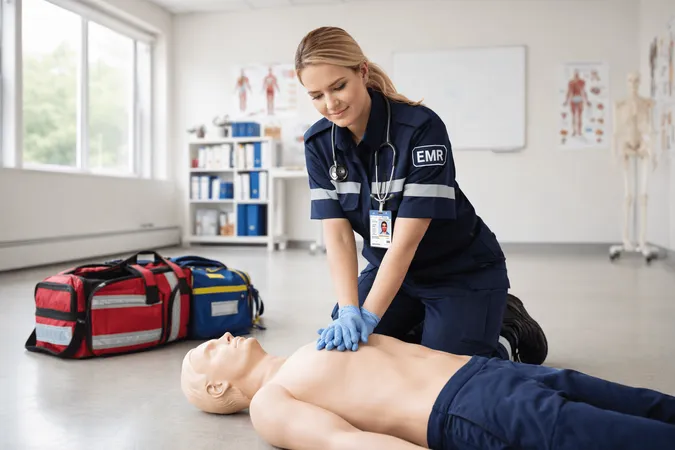
REVIEW EMR QUESTIONS💓What compression-to-breath ratio is used for adult CPR?
The correct ratio for adult CPR is 30 compressions to 2 breaths, performed at a rate of 100-120 compressions per minute.
🧠What does the acronym AVPU stand for?
Alert, Verbal, Painful, Unresponsive. This scale is used to rapidly assess a patient's level of consciousness during the primary assessment.
TRY EMR MOCK EXAM👶What is a key sign of respiratory distress in an infant?
Nasal flaring and retractions (sucking in of the skin between ribs) are common signs of respiratory distress in infants.
ACCESS EMR STUDY GUIDE🦴When should you splint a suspected fracture?
Splint a fracture only if the patient is stable and you have the resources. Always address life threats before splinting extremity injuries.
PRACTICE EMR TEST NOWEMR Exam Study Guide
This EMR test study guide breaks down the essential information you need to know about the EMR national registry practice test process. From the format of the emr certification test to scoring and registration, we cover the basics to help you prepare.
- Topics: Cardiac arrest, chest compressions
- Questions: Approx. 18-26 questions
EMR Score Calculator
Total Scored Questions
150
105 out of 150 correct
70%
Required to Pass: ~70% (Estimated)
Expect to invest between $500 and $1,400 total to become a certified Emergency Medical Responder. Volunteer agencies often sponsor training costs in exchange for service commitments.
EMR Career Opportunities
Diverse roles available for certified EMRs
Firefighter EMR
Many fire departments require EMR certification as a minimum medical standard for firefighters.
Law Enforcement
Police officers often obtain EMR certification to provide immediate care at crime scenes and accidents.
Industrial EMR
Work in factories, oil rigs, or construction sites providing on-site first aid and emergency response.
Rural/Volunteer
Serve in rural communities or volunteer ambulance services where resources are limited.
Event Medical
Provide standby medical coverage at concerts, sports events, and festivals as part of a medical team.
EMR Test Day Checklist
- ✓Two forms of valid ID
- ✓ATT Letter (Printed/Digital)
- ✓Arrive 30 mins early
- ✓Review travel route
- ✓Leave electronics in car
- ✓Light jacket (centers are cold)
- ✓Review EMR practice test
- ✓Rest well the night before
Ready to Pass the EMR Exam?
Join thousands of students who have passed their National Registry EMR exam using our free practice tests and study guides.
EMR Certification Renewal
CE Hours
16 Hours
Cycle
2 Years
Keep your BLS (CPR) certification active, as it is a prerequisite for EMR recertification. Submit your renewal application early to avoid lapsing.
EMR: Pros and Cons
- +EMR exam preparation strengthens your knowledge across all domains
- +Passing the exam proves competency to employers and clients
- +Study materials and practice tests are widely available
- +Exam-based credentials are portable across states and employers
- +Clear exam objectives help focus your study plan effectively
- −Exam anxiety can affect performance — practice tests help reduce it
- −Registration fees are non-refundable if you miss your test date
- −Limited retake opportunities may apply with waiting periods
- −Exam content updates periodically — use current study materials
- −Testing center availability may require advance scheduling
Pros and Cons at a Glance
| Pros | Cons |
|---|---|
| EMR exam preparation strengthens your knowledge across all domains | Exam anxiety can affect performance — practice tests help reduce it |
| Passing the exam proves competency to employers and clients | Registration fees are non-refundable if you miss your test date |
| Study materials and practice tests are widely available | Limited retake opportunities may apply with waiting periods |
| Exam-based credentials are portable across states and employers | Exam content updates periodically — use current study materials |
| Clear exam objectives help focus your study plan effectively | Testing center availability may require advance scheduling |
Sample EMR - Emergency Medical Responder Practice Questions
Try these questions from our free EMR - Emergency Medical Responder practice tests. The correct answer and an explanation follow each question.
A patient is bleeding from a wound on the scalp. Which characteristic of scalp wounds should the EMR be aware of?
- A. They rarely bleed significantly due to limited vascularity
- B. They tend to bleed profusely even from minor injuries
- C. They always indicate skull fracture
- D. They are best treated with a tourniquet
Answer: B. They tend to bleed profusely even from minor injuries
The scalp is highly vascular and tends to bleed heavily even from minor lacerations, which can be alarming but is usually manageable with direct pressure.
All of the following are upper airway structures, except the:
- A. larynx
- B. pharynx
- C. epiglottis
- D. alveoli
Answer: D. alveoli
The upper airway structures include the nasopharynx, oropharynx, larynx, and epiglottis, all of which are involved in conducting air to the lungs. The alveoli, however, are tiny air sacs located deep within the lungs, specifically in the lower respiratory tract. Their primary function is gas exchange, making them a part of the lower airway, not the upper airway.
Which document establishes a patient's right to refuse resuscitation in the out-of-hospital setting?
- A. A living will alone is sufficient to stop CPR
- B. A Do Not Resuscitate (DNR) order or POLST form signed by a physician
- C. A family member's verbal statement that the patient did not want CPR
- D. Any written note from the patient indicating their wishes
Answer: B. A Do Not Resuscitate (DNR) order or POLST form signed by a physician
A valid DNR order or Physician Orders for Life-Sustaining Treatment (POLST) signed by a licensed physician is the legally recognized document that allows EMS providers to withhold resuscitation in the field.
A patient is found with gurgling respirations and an altered mental status. The FIRST priority airway intervention is:
- A. Insert a nasopharyngeal airway
- B. Suction the oropharynx
- C. Perform endotracheal intubation
- D. Deliver oxygen via non-rebreather mask
Answer: B. Suction the oropharynx
Gurgling indicates fluid in the airway; suctioning is the immediate priority to clear the airway before other interventions.
Take the full EMR - Emergency Medical Responder practice test
EMR Exam Questions and Answers
About the Author

Paramedic & Emergency Services Certification Trainer
George Washington UniversityCaptain Ryan O'Brien is a licensed paramedic and NREMT-certified emergency medical professional with a Bachelor of Science in Emergency Medical Services from George Washington University. He has 15 years of field experience as a paramedic and firefighter, and has coached hundreds of EMT and paramedic candidates through their NREMT written and psychomotor licensing examinations.