
CNA in Montana 2026 October: Training, Certification, Salary, and Requirements
Get ready for your CNA in Montana 2026 October: Training, certification. Practice questions with step-by-step answer explanations and instant scoring. ⏳
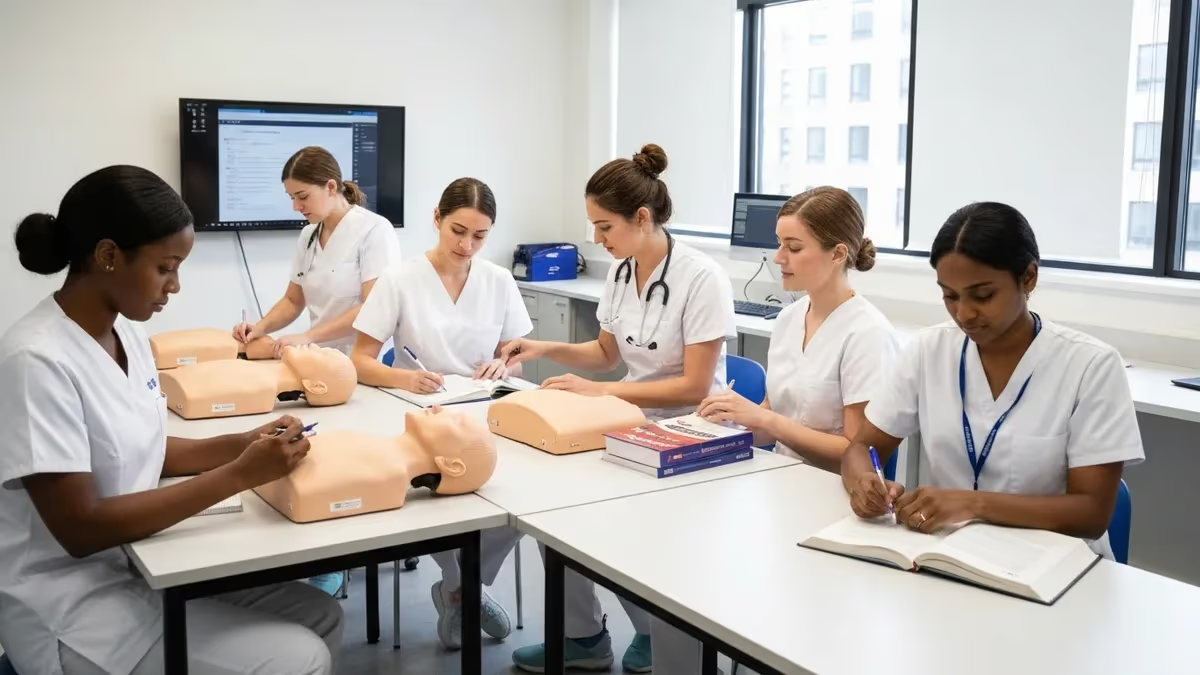

Billings is Montana's largest city and its dominant CNA job market. Billings Clinic, Montana's largest physician-led health system and Level II trauma center, is the region's most significant CNA employer — offering competitive wages, comprehensive benefits, and clear career advancement pathways from CNA to LPN to RN. SCL Health (now Intermountain Health) St. Vincent Healthcare, a major Catholic health system hospital in Billings, employs hundreds of CNAs across inpatient and long-term care settings. Riverstone Health (the public health authority for Yellowstone County) and numerous skilled nursing facilities, assisted living communities, and home health agencies round out Billings' CNA market. City College at MSU Billings offers one of the most accessible DPHHS-approved CNA programs in Eastern Montana, with affordable community college tuition and multiple start dates. The American Red Cross — Montana Chapter also runs CNA training courses in Billings. CNA wages in Billings average $14–$17/hour, with Billings Clinic and Intermountain offering the highest rates at $16–$20/hour. Eastern Montana outside Billings — including Miles City, Glendive, Sidney, and Wolf Point — has smaller but high-demand CNA markets, particularly in rural critical access hospitals and Indian Health Service facilities on the Fort Peck, Fort Belknap, and Crow reservations. Rural CNA positions often include housing stipends or relocation assistance due to severe staffing shortages in these communities.
Montana Essential Checklist
- ✓Be at least 16 years old (verify minimum age with your specific DPHHS-approved program)
- ✓Provide valid government-issued photo ID (MT driver's license, passport, or state ID)
- ✓Complete a criminal background check through Montana DPHHS
- ✓Obtain negative TB test within the past 12 months (Mantoux PPD or QuantiFERON Gold)
- ✓Pass a physical examination by a licensed physician, APRN, or PA
- ✓Obtain current CPR/BLS certification (American Heart Association or American Red Cross)
- ✓Complete required immunizations (Hep B series, MMR, Varicella, Tdap, annual Flu)
- ✓Pass pre-enrollment drug screen if required by your specific program or clinical site
- ✓Enroll in and complete a DPHHS-approved 75-hour CNA training program
- ✓Complete minimum 16 hours of supervised clinical practice at a licensed MT facility
- ✓Receive program completion certificate from your DPHHS-approved training provider
- ✓Register for both D&S Diversified exam sections (written + clinical skills) in Montana
- ✓Pass written knowledge exam (70 questions, 70% minimum passing score, 105 minutes)
- ✓Pass clinical skills evaluation (5 randomly selected skills, all must be passed)
- ✓Wait for Montana DPHHS Nurse Aide Registry placement (2–4 weeks after exam passage)
- ✓Verify your active registry status online through the Montana DPHHS website
- ✓Renew every 2 years: provide proof of 8 hours paid nursing service within the renewal period
- ✓If applying to tribal/IHS facilities: confirm tribal enrollment or hiring preferences with specific facility HR

Montana Advantages and Disadvantages
- +Only 75 hours required — the federal minimum and one of the shortest CNA training requirements in the US; fastest path to certification
- +Montana DPHHS registry is straightforward to navigate online — lookups and status verification are accessible
- +D&S Diversified exam (same vendor as Kansas, Missouri, Arizona, Georgia) — extensive national prep resources match the MT exam format
- +Severe rural healthcare shortages create strong demand statewide — CNAs are actively recruited with bonuses and housing stipends
- +Tribal health and IHS positions offer federal-level benefits, loan repayment, and competitive wages rarely found in rural healthcare
- +Bozeman's rapid growth has pushed CNA wages above $15–$19/hour — Montana's fastest-growing and highest-paying non-hospital CNA market
- +Low cost of living — CNA salary of $28K–$34K goes further in Montana compared to coastal markets, especially outside Bozeman
- +Montana's scenic beauty and outdoor recreation culture appeal strongly to CNAs seeking work-life balance outside urban environments
- +Strong reciprocity framework — active MT CNA certification transfers easily to most states via DPHHS, expanding career mobility
- −Salaries ($28K–$34K) are at the lower end nationally — Billings and Bozeman pay better but still below coastal markets by $8,000–$15,000/year
- −Only 75 hours required — meets federal minimum only, which is the bare floor; some states require 120–175 hours for better preparation
- −Rural Montana counties have extremely limited CNA training programs and significantly lower wages ($12–$14/hour) in remote areas
- −Harsh winters and geographic isolation in much of the state create transportation challenges for clinical training and employment
- −Montana has limited public transit — CNAs almost universally need a personal vehicle, especially for rural or tribal health positions
- −D&S Diversified exam (not Prometric) — must use D&S-specific practice resources; many generic national CNA prep materials reference Prometric
- −DPHHS registry (not Board of Nursing) — candidates must navigate a less familiar agency than most national certification resources reference
Pros and Cons at a Glance
| Pros | Cons |
|---|---|
| Montana DPHHS registry is straightforward to navigate online — lookups and status verification are accessible | Harsh winters and geographic isolation in much of the state create transportation challenges for clinical training and employment |
| D&S Diversified exam (same vendor as Kansas, Missouri, Arizona, Georgia) — extensive national prep resources match the MT exam format | Montana has limited public transit — CNAs almost universally need a personal vehicle, especially for rural or tribal health positions |
| Severe rural healthcare shortages create strong demand statewide — CNAs are actively recruited with bonuses and housing stipends | D&S Diversified exam (not Prometric) — must use D&S-specific practice resources; many generic national CNA prep materials reference Prometric |
| Tribal health and IHS positions offer federal-level benefits, loan repayment, and competitive wages rarely found in rural healthcare | DPHHS registry (not Board of Nursing) — candidates must navigate a less familiar agency than most national certification resources reference |
Sample CNA Practice Questions
Try these questions from our free CNA practice tests. The correct answer and an explanation follow each question.
A CNA's certification in Florida became null and void 3 years ago after they failed to meet renewal requirements. To regain active status, what must the individual do?
- A. Complete 48 hours of continuing education and pay a reactivation fee.
- B. Take a refresher course and pass the skills portion of the competency exam.
- C. Work 100 hours under the direct supervision of a Registered Nurse.
- D. Reapply for licensure and meet all current initial application requirements.
Answer: D. Reapply for licensure and meet all current initial application requirements.
According to the Florida Board of Nursing, once a CNA license becomes 'Null and Void,' it cannot be reactivated or renewed. The individual must start the process over by reapplying for licensure and complying with all laws and rules that are current at the time of the new application.
Which of the following is a core competency area covered in federally mandated CNA training programs?
- A. Pharmacology and drug administration
- B. Infection control and prevention
- C. Surgical wound closure
- D. Anesthesia monitoring
Answer: B. Infection control and prevention
Federal regulations require CNA training to include infection control as one of the core competency areas.
A resident on a bowel training program should be offered toileting assistance at which time?
- A. Only when the resident specifically requests it
- B. At the same scheduled times each day, especially after meals
- C. Randomly throughout the shift to prevent accidents
- D. Only at bedtime to establish a nighttime routine
Answer: B. At the same scheduled times each day, especially after meals
Bowel training programs rely on consistent, scheduled toileting — particularly after meals when the gastrocolic reflex is active.
A CNA is working in a state where, with additional certification and under specific circumstances, they are permitted to perform certain advanced tasks. Which of these tasks would most likely require this type of special certification?
- A. Performing range-of-motion exercises on a post-stroke resident.
- B. Discontinuing a resident's indwelling urinary catheter.
- C. Assisting a resident with using a metered-dose inhaler.
- D. Documenting a resident's fluid intake and output.
Answer: B. Discontinuing a resident's indwelling urinary catheter.
While specific regulations vary by state, discontinuing (removing) an indwelling urinary catheter is an invasive procedure that is generally outside the standard CNA scope. Some states or facilities may allow a specially trained CNA to perform this task. The other tasks, such as assisting with inhalers (but not administering the medication independently), performing restorative exercises, and documenting I&O, are more commonly within the standard CNA role.
Take the full CNA practice test
For a fuller set of questions on this topic, see our cna test practice resource.
For a fuller set of questions on this topic, see our free printable cna practice exam resource.
For more details, see our CNA Practice Test 2026 - Certified Nursing Assistant Training guide. For more details, see our cna classes near me guide. For more details, see our wisconsin nursing license lookup guide. For more details, see our certified nursing assistant salary guide. For more details, see our prometric cna sample test guide. For more details, see our CNA Certifications guide. For more details, see our CNA Jobs guide. For more details, see our cna vs caregiver guide. For more details, see our pennsylvania cna license lookup guide. For more details, see our arizona rn license lookup guide. For more details, see our missouri cna registry guide. For more details, see our cna training guide. For more details, see our What is a CNA training program? guide. For more details, see our cna salary guide. For more details, see our CNA Courses Near Me & Online guide. For more details, see our CNA Programs guide. For more details, see our cna interview questions and answers guide. For more details, see our CNA Resume guide. For more details, see our CNA Resources guide. For more details, see our how long does it take to become a cna guide. For more details, see our free cna practice test guide. For more details, see our cna salary new jersey guide. For more details, see our cna agency jobs near me guide. For more details, see our Tracheostomy & Ventilator Support CNA Practice Test Video Answers guide. For more details, see our Rehabilitation CNA Practice Test Video Answers guide. For more details, see our Pediatric CNA Practice Test Video Answers guide. For more details, see our Oncology CNA Practice Test Video Answers guide. For more details, see our Memory Care CNA Practice Test Video Answers guide. For more details, see our Maternal / Newborn CNA Practice Test Video Answers guide. For more details, see our FLOAT POOL CNA Practice Test Video Answers guide. For more details, see our ER CNA Practice Test Video Answers guide.About the Author

Registered Nurse & Healthcare Educator
Johns Hopkins University School of NursingDr. Sarah Mitchell is a board-certified registered nurse with over 15 years of clinical and academic experience. She completed her PhD in Nursing Science at Johns Hopkins University and has taught NCLEX preparation and clinical skills courses for nursing students across the United States. Her research focuses on evidence-based exam preparation strategies for healthcare certification candidates.
Join the Discussion
Connect with other students preparing for this exam. Share tips, ask questions, and get advice from people who have been there.
View discussion (8 replies)