
Bartending Terminology: The Complete Glossary of Bar Lingo, Drink Terms, and Industry Slang for 2026 October
📝 Master bartending terminology with our complete glossary covering 200+ bar terms, drink lingo, mixing techniques, and industry slang every bartender
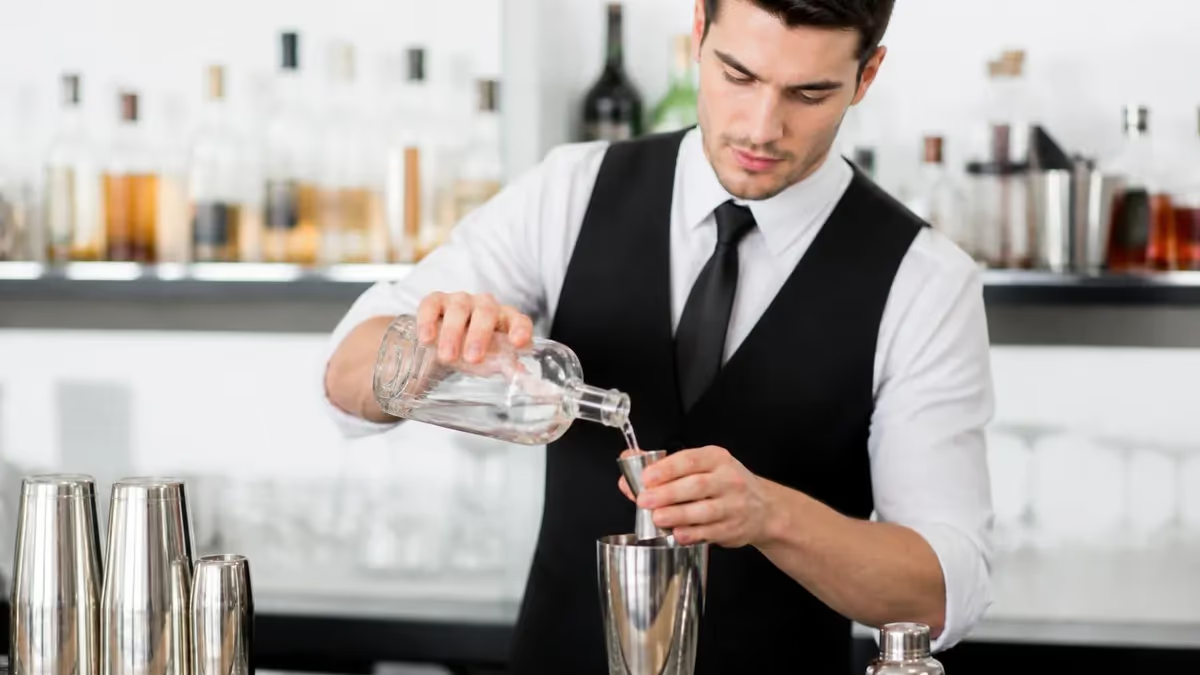
Mastering bartending terminology is the single fastest way to look, sound, and operate like a seasoned professional behind the stick. Whether you are stepping into your first shift at a neighborhood pub or training for a craft cocktail program in Manhattan, knowing the language of the bar separates rookies from veterans within the first hour. Guests notice it, managers respect it, and coworkers trust you faster when you can call out a back, a build, a neat pour, or a 86 without missing a beat.
This guide covers more than 200 essential bar terms grouped by category — pouring techniques, glassware, drink modifiers, service slang, inventory shorthand, and the colorful insider language that has evolved over a century of American bartending. We pulled this glossary from working bar manuals, BarSmarts study materials, and certification programs used by major hospitality groups so the definitions reflect how the words are actually used on a Friday night, not just how they appear in a textbook.
You will see why a guest asking for a drink "up" wants something completely different from one asking for it "neat," why "dirty" doubles its meaning depending on whether the guest ordered a martini or a chai, and how a single misheard call like "vodka tonic" versus "vodka tom collins" can throw off a whole ticket. The terminology is precise for a reason — bars move fast, mistakes cost money, and clarity is currency.
For bartenders preparing for certification exams, the Texas TABC, Utah server permit, or any state-mandated alcohol awareness course, this vocabulary is foundational. Test questions routinely assume you already know what a jigger, a free pour, or a standard drink equivalent looks like. Many candidates fail not because they cannot identify a violation, but because they get tangled up on terminology they never formally studied.
We have also included regional variations. The same drink poured in Boston might be called something different in New Orleans, and a back in Chicago means a side glass of beer chasing a shot, while in Los Angeles it sometimes refers to a water chaser. Understanding these regional quirks helps you read the room when you travel, switch concepts, or work events outside your home market.
By the end of this glossary, you should be able to read a Cocktail Codex recipe, decode a POS ticket from any major system, understand bar-back chatter during a slammed Saturday rush, and confidently explain ingredients and preparation methods to guests who want to know what they are drinking. Treat this article like a working dictionary — bookmark it, return to it, and use it alongside hands-on practice behind a real bar.
One final note before diving in: the terminology never stops evolving. New techniques like fat-washing, milk-clarification, and sous-vide infusions have added an entirely new vocabulary layer over the last decade. We will cover both the foundational language every bartender must know and the modern craft terms increasingly showing up on certification exams and high-end menus across the country.
Bartending Terminology by the Numbers
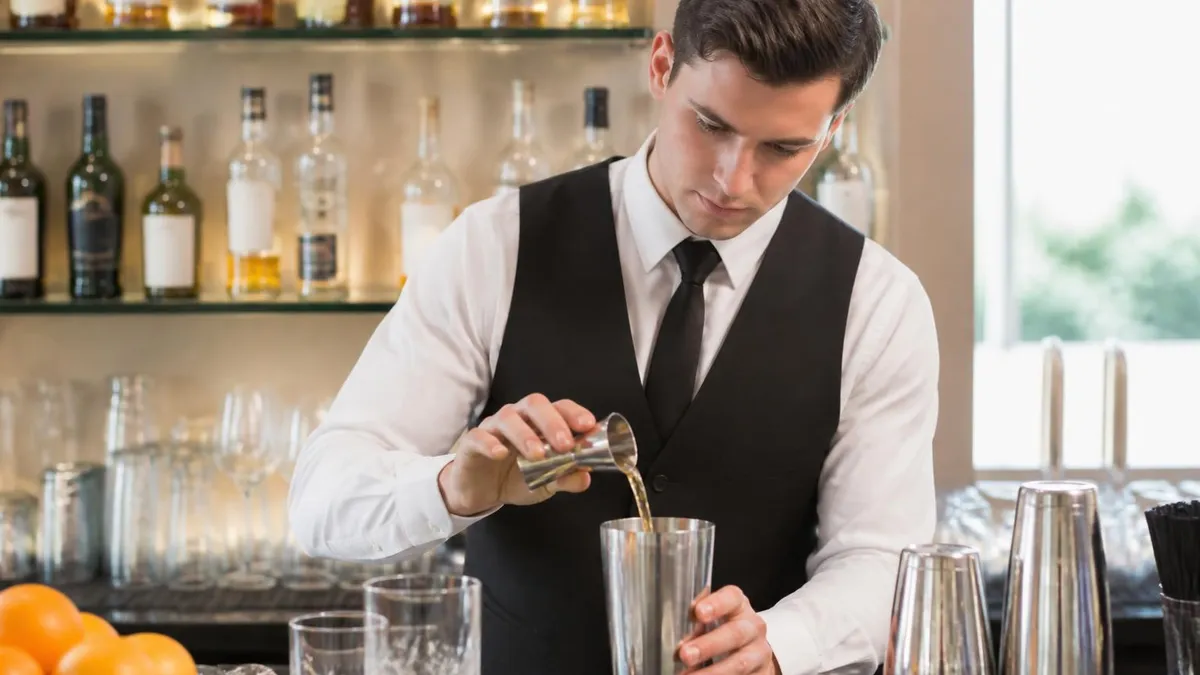
Core Pouring and Measurement Terminology
A two-sided measuring tool with a standard 1.5 oz pour on the large side and a 0.75 oz pony shot on the small side. Used to ensure consistency, control cost, and meet liquor liability standards.
Pouring liquor by counting seconds rather than measuring. A four-count typically equals one ounce. Banned in many states and most chain restaurants but common in high-volume cocktail bars.
Spirit served at room temperature in a rocks glass with no ice, no mixer, and no chill. Standard pour is two ounces. Most often requested for premium whiskey, mezcal, or aged rum.
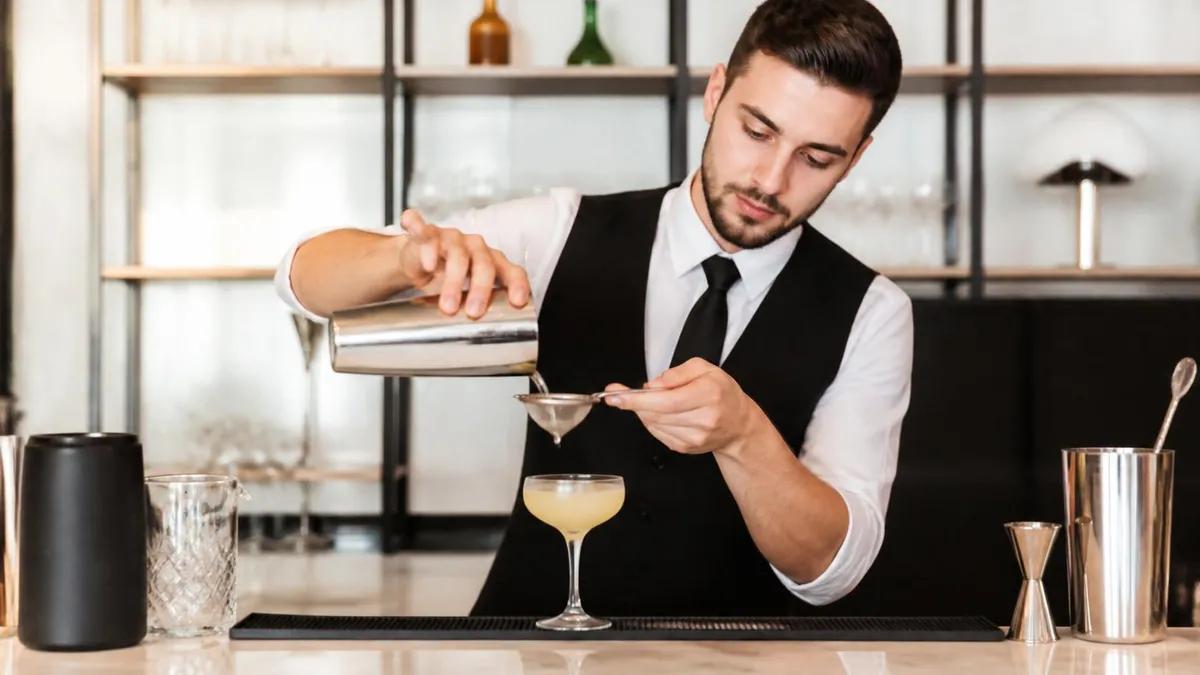
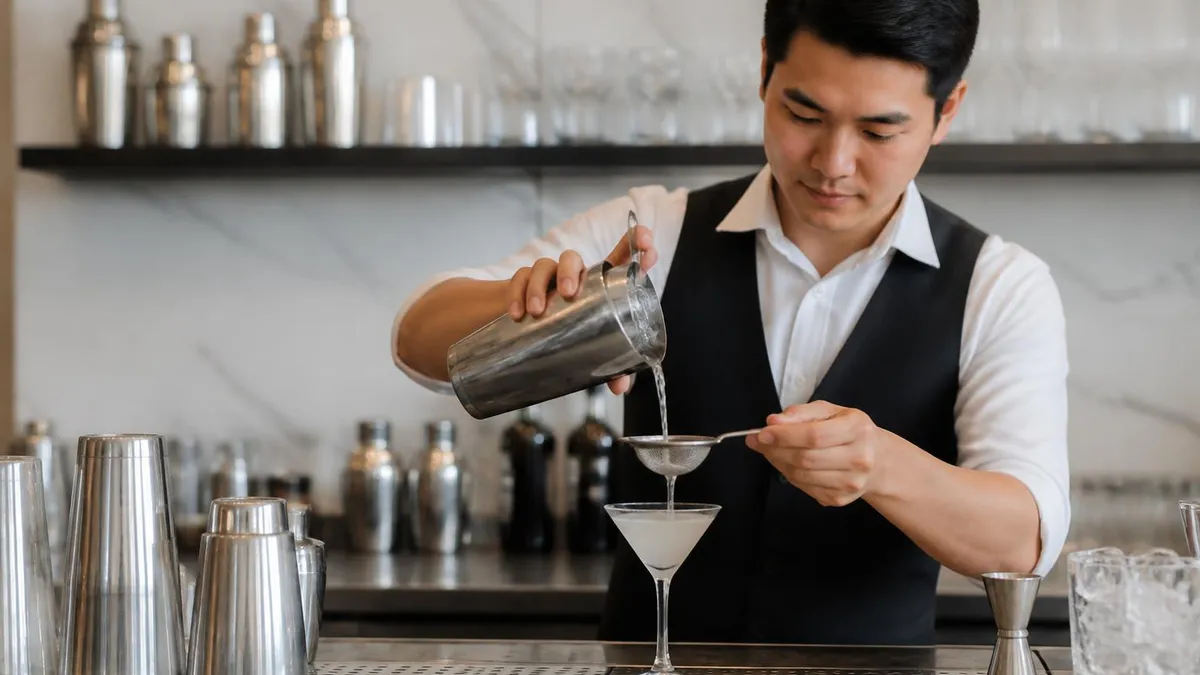
A cocktail shaken or stirred with ice, then strained into a chilled stemmed glass. The drink is cold but contains no ice. Classic examples include martinis, manhattans, and gimlets.
Constructing a drink directly in the serving glass over ice rather than in a mixing tin. Used for highballs, rum and cokes, gin and tonics, and most simple two-ingredient drinks.
Drink modifiers are the small words guests add to their orders that completely change preparation, glassware, and pricing. A guest who orders a vodka soda has a clear expectation, but a guest who orders a tall vodka soda with a lime and light ice expects three specific modifications. Misreading any one of them slows down the bar and risks a remake. Learning the most common modifiers cold is one of the highest-use things a new bartender can do during their first month behind the stick.
The word tall refers to a drink served in a highball or collins glass with extra mixer rather than the standard rocks portion. A tall vodka soda generally uses the same 1.5 ounces of vodka but stretches the soda water to fill a 10 or 12-ounce glass, lowering ABV per sip without lowering price. The opposite is short, which means served in a rocks glass with less mixer, producing a stronger sip.
Dirty refers to adding olive brine to a martini, producing a salty, cloudy finish. A filthy martini doubles the brine. Extra dry means barely any vermouth, sometimes just rinsing the glass. Wet means more vermouth than the modern standard. Perfect means equal parts sweet and dry vermouth, which used to be the default in the 1950s and has made a comeback on craft menus.
Twist, peel, expressed, and flamed all refer to citrus garnish techniques. A twist is a thin strip of peel twisted over the drink to release oils. Expressed means firmly squeezing the peel over the glass before either dropping it in or discarding it. Flamed peels are passed over a match while expressed, igniting the oils for a smoky aromatic effect, most famously on a Sazerac or flamed orange Old Fashioned.
Rocks, on the rocks, and over ice all mean the same thing — served in a rocks glass with ice cubes. A double means twice the standard pour, usually 3 ounces, charged at roughly 1.75 to 2 times the single price depending on the bar. A short pour is a half measure, sometimes offered free to regulars and sometimes used to stretch inventory at the end of a bottle. If you are exploring local opportunities for hands-on practice, our breakdown of bartender jobs in Los Angeles includes pay ranges where pour accuracy directly affects your tip average.
Back and chaser are sometimes used interchangeably, but they are technically different. A back is a small companion drink served alongside a shot or strong cocktail — typically a small beer or a glass of water. A chaser is what you actually drink after the shot to wash down the burn. In Chicago and Wisconsin, a beer back is so common that some bars build it into shot pricing automatically.
Finally, the calls — terms like well, call, premium, and top shelf — describe quality tiers. Well is the house spirit used when no brand is specified. Call is a guest naming a mid-tier brand like Tito's or Tanqueray. Premium and top shelf refer to the highest-priced bottles, typically aged or limited products. The terminology shapes pricing, so learning your bar's specific tier breakdown is essential for ringing tickets correctly.
Bartender Practice Test Questions
Prepare for the Bartender Certification exam with our free practice test modules. Each quiz covers key topics to help you pass on your first try.
Bartender Certification Bar Inventory and ...
Bartender Exam Questions covering Certification Bar Inventory and Cost Control. Master Bartender Test concepts for certification prep.
Bartender Certification Bar Law and Liquor...
Free Bartender Practice Test featuring Certification Bar Law and Liquor Regulations. Improve your Bartender Exam score with mock test prep.
Bartender Certification Bar Sanitation and...
Bartender Mock Exam on Certification Bar Sanitation and Safety. Bartender Study Guide questions to pass on your first try.
Bartender Certification Bar Setup and Orga...
Bartender Test Prep for Certification Bar Setup and Organization. Practice Bartender Quiz questions and boost your score.
Bartender Certification Bar Tools and Glas...
Bartender Questions and Answers on Certification Bar Tools and Glassware. Free Bartender practice for exam readiness.
Bartender Certification Basic
Bartender Mock Test covering Certification Basic. Online Bartender Test practice with instant feedback.
Bartender Certification Cocktail Recipes a...
Free Bartender Quiz on Certification Cocktail Recipes and Techniques. Bartender Exam prep questions with detailed explanations.
Bartender Certification Customer Service a...
Bartender Practice Questions for Certification Customer Service and Sales. Build confidence for your Bartender certification exam.
Bartender Certification Customer Service S...
Bartender Test Online for Certification Customer Service Skills. Free practice with instant results and feedback.
Bartender Certification Mixology Fundamentals
Bartender Study Material on Certification Mixology Fundamentals. Prepare effectively with real exam-style questions.
Bartender Certification Responsible Alcoho...
Free Bartender Test covering Certification Responsible Alcohol Service. Practice and track your Bartender exam readiness.
Bartender Certification Spirits, Beer, and...
Bartender Exam Questions covering Certification Spirits, Beer, and Wine. Master Bartender Test concepts for certification prep.
Bartender Certification Spirits, Liqueurs,...
Free Bartender Practice Test featuring Certification Spirits, Liqueurs, and Cocktails. Improve your Bartender Exam score with mock test prep.
Bartender Responsible Alcohol Service
Bartender Mock Exam on Responsible Alcohol Service. Bartender Study Guide questions to pass on your first try.
Bartender Spirits, Liqueurs, and Cocktails
Bartender Test Prep for Spirits, Liqueurs, and Cocktails. Practice Bartender Quiz questions and boost your score.
Bartender Bar Sanitation and Safety
Bartender Questions and Answers on Bar Sanitation and Safety. Free Bartender practice for exam readiness.
Bartender Bar Setup and Organization
Bartender Mock Test covering Bar Setup and Organization. Online Bartender Test practice with instant feedback.
Bartender Bar Tools and Glassware
Free Bartender Quiz on Bar Tools and Glassware. Bartender Exam prep questions with detailed explanations.
Bartender Basic
Bartender Practice Questions for Basic. Build confidence for your Bartender certification exam.
Bartender Cocktail Recipes and Techniques
Bartender Test Online for Cocktail Recipes and Techniques. Free practice with instant results and feedback.
Bartender Customer Service and Sales
Bartender Study Material on Customer Service and Sales. Prepare effectively with real exam-style questions.
Bartender Customer Service Skills
Free Bartender Test covering Customer Service Skills. Practice and track your Bartender exam readiness.
Bartending Terminology for Glassware and Tools
Every cocktail has an intended glass, and ordering the right vessel is part of the terminology. A coupe is a shallow stemmed glass originally designed for champagne, now standard for many shaken drinks served up. A Nick and Nora is a smaller stemmed glass shaped like a tulip, used for stirred classics. A rocks glass holds 6 to 10 ounces and is also called an Old Fashioned or lowball glass.
Highball, collins, hurricane, snifter, flute, pilsner, and pint each refer to specific shapes that affect aroma, dilution rate, and presentation. A snifter concentrates aromatic spirits like brandy. A flute preserves bubbles in sparkling wine. Calling for the right glass during a busy shift signals professionalism and avoids the awkward moment when a guest asks why their martini arrived in a rocks glass.
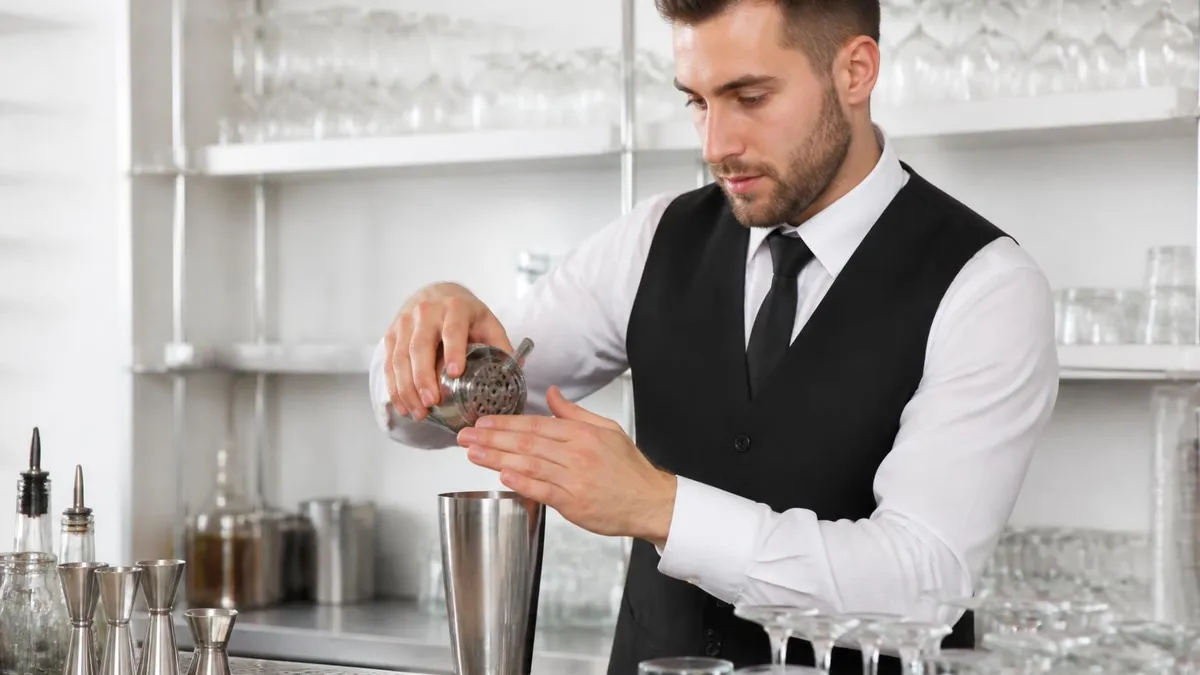
Free Pouring vs. Jiggering: Which Method Wins?
- +Jiggering guarantees consistent pour cost across every shift and bartender
- +Reduces liquor liability by enforcing standardized serving sizes
- +Easier to train new bartenders quickly with measurable benchmarks
- +Most certification programs and chain operators require it
- +Eliminates disputes during inventory variance audits
- +Helps manage intoxication levels under dram shop law
- +Builds muscle memory faster for accurate recipe execution
- −Slower on high-volume shifts during peak rush
- −Can feel impersonal in craft cocktail or upscale environments
- −Less flexibility for adjusting recipes to guest preference
- −Requires having jiggers within reach at every station
- −Sometimes perceived by guests as stingy or rigid
- −Bartender skill development plateaus without free pour practice
- −Adds visual clutter during multi-cocktail builds
Pros and Cons at a Glance
| Pros | Cons |
|---|---|
| Jiggering guarantees consistent pour cost across every shift and bartender | Slower on high-volume shifts during peak rush |
| Reduces liquor liability by enforcing standardized serving sizes | Can feel impersonal in craft cocktail or upscale environments |
| Easier to train new bartenders quickly with measurable benchmarks | Less flexibility for adjusting recipes to guest preference |
| Most certification programs and chain operators require it | Requires having jiggers within reach at every station |
| Eliminates disputes during inventory variance audits | Sometimes perceived by guests as stingy or rigid |
| Helps manage intoxication levels under dram shop law | Bartender skill development plateaus without free pour practice |
Essential Bartending Terminology You Must Memorize
- ✓Define neat, up, on the rocks, and straight up without hesitation
- ✓Know the difference between a dash, splash, barspoon, and rinse
- ✓Identify well, call, premium, and top shelf product tiers
- ✓Recognize all standard glass types by name and ounce capacity
- ✓Understand 86, in the weeds, on the fly, and other service slang
- ✓Memorize standard pour sizes for spirits, wine, and beer
- ✓Know the difference between shaken, stirred, built, and rolled
- ✓Identify dry, wet, perfect, dirty, and filthy martini modifiers
- ✓Define mise en place and explain pre-shift setup vocabulary
- ✓Recognize garnish terms — twist, peel, flag, wheel, wedge, expressed
- ✓Understand FIFO, par level, and variance in inventory contexts
- ✓Translate POS shorthand calls into actual drink orders quickly
When in doubt, repeat the order back
Even seasoned bartenders mishear modifiers during loud shifts. Repeating the call back to the guest using the exact terminology — "vodka martini, up, dirty, with a twist" — confirms accuracy and demonstrates expertise. It takes two seconds and prevents the most common cause of remakes, which costs bars roughly 4 to 6 percent of liquor inventory annually.
Beyond the formal drink terminology, every bar runs on a layer of insider slang that bartenders use to communicate quickly under pressure. The most famous is 86 — to remove an item from the menu because it ran out, or to refuse service to a guest. Its origin is debated, but the term appeared in restaurant kitchens by the 1930s and is now universally understood in American hospitality. Calling "86 the Hendrick's" tells your team the gin is out without alarming guests.
In the weeds is the universal phrase for being overwhelmed during a rush. Variations include slammed, buried, getting crushed, and underwater. When you hear a coworker say they are in the weeds, the expected response is to jump in — grabbing glassware, running drinks, restocking ice — without being asked. Bars that operate as teams rather than territories survive Friday nights. Solo cowboys burn out by year two.
On the fly means immediately, as in "two margaritas on the fly" to signal urgency to the bar from a server. Sidework refers to the cleaning, restocking, and prep tasks bartenders complete during slow moments — cutting fruit, polishing glassware, brewing tea for cocktails, juicing citrus. A well-run bar has a written sidework list posted near each station. New hires often underestimate how much sidework determines whether a closing shift takes one hour or four.
Comp and buyback are tipping-adjacent terms. A comp is a manager-approved free item, typically logged in the POS for tracking. A buyback is when the bartender gives a regular a free drink, usually after the guest has paid for three or four. Buyback culture varies dramatically by region — common in New York, almost unheard of in Las Vegas casino bars where every pour is tracked. Always check your bar's policy before pouring freebies, even for friends.
The well refers to the speed rail in front of the bartender holding the most-used spirits. Top shelf or back bar refers to the display bottles behind. Speed rack and speed rail are interchangeable. A bar-back is the support position responsible for ice runs, restocking, and glassware. Tip-out is the percentage of tips that goes to bar-backs, food runners, and barbacks at the end of the night. Tip-out structures are a frequent source of conflict — clarify yours during onboarding.
A pickup is the moment a server takes drinks from the service well to deliver to a table. A dupe is the duplicate printed ticket. A void is removing an item already rung, requiring a manager. A spill is a recorded waste event. Each term has a paper trail and a financial implication, which is why managers care so much about consistent vocabulary across shifts. Sloppy terminology produces sloppy numbers.
Finally, the human side of bar slang — the regular, the rail rider, the camper, the closer, the whale, and the lemon. Regulars are repeat guests with known preferences. Rail riders sit at the bar specifically to talk to the bartender. Campers occupy seats long after their tab closes. Closers stay until the last call. Whales spend big. Lemons are difficult, low-tipping guests. Knowing the vocabulary helps you describe your shift accurately to coworkers and managers when the night is over.
Several bartending terms carry legal weight in certain states. "Reasonable refusal" in Texas, "visible intoxication" in Oregon, and "continuous service" in Utah all have statutory definitions on certification exams. Memorize the exact phrasing your state uses — paraphrased answers are routinely marked wrong, and a single missed term can fail the test.
Bartending certification exams across all 50 states share a surprisingly consistent core vocabulary. Programs like TABC in Texas, TIPS nationally, ServSafe Alcohol, Utah's eDABS course, and Oregon's OLCC training all test the same foundational concepts using slightly different language. Once you can decode the regional phrasing, the actual exam content becomes much more manageable. This is why memorizing terminology before studying procedures pays off so significantly.
Blood alcohol concentration, abbreviated BAC, refers to the percentage of alcohol in a person's bloodstream. A BAC of 0.08 is the legal limit for driving in every state. Standard drink, often called an SDE for standard drink equivalent, is defined as 0.6 fluid ounces of pure alcohol — roughly 12 ounces of 5 percent beer, 5 ounces of 12 percent wine, or 1.5 ounces of 40 percent spirit. Every responsible service program builds on this definition.
Dram shop liability refers to the legal doctrine making establishments financially responsible for damages caused by intoxicated patrons they over-served. Forty-three states have dram shop laws on the books, with varying thresholds. The terminology shows up on virtually every certification exam, often paired with questions about reasonable steps a bartender should take when refusing service. If you want a state-specific deep dive, our guide to the Wisconsin bartending license walks through how local operator's license terminology differs from federal training language.
Visible intoxication is the legal trigger that requires refusal of service in most states. Indicators include slurred speech, impaired motor function, glassy eyes, aggressive behavior, and slowed reaction time. Exams typically present scenarios and ask which combination of signs justifies cutting someone off. Memorizing the specific list your state uses — Texas requires three indicators, Utah requires two, Oregon uses a broader judgment standard — is essential.
Carding and ID verification have their own vocabulary. A vertical license is the format issued to drivers under 21 in most states, making age verification quick at a glance. A horizontal license indicates the holder is 21 or older. A passport, military ID, and state-issued ID are the other commonly accepted documents. Expired, photocopied, and out-of-state vertical IDs raise red flags. Exams test these distinctions repeatedly.
Pour cost, beverage cost, and variance are inventory terminology you will see on every cost control exam. Pour cost is calculated as cost of goods sold divided by sales, expressed as a percentage. A typical bar runs 18 to 24 percent pour cost. Variance is the difference between expected and actual usage based on sales data. High variance points to overpouring, theft, or spillage — all topics covered in detail on the inventory control sections of bartender certification exams.
Finally, terminology around responsible service interventions — slowing service, suggesting food, offering water, calling a cab, or refusing further service — appears in scenario-based questions. The exact language varies, but the concept is consistent across programs. Memorize the steps in your state's recommended order, because exam answers are almost always evaluated on the sequence as much as the actions themselves.
Putting bartending terminology into daily practice is where most learners stumble. Reading a glossary like this one gives you familiarity, but you need to actively use the vocabulary in real conversations before it becomes second nature. The fastest method is shadowing a senior bartender during a slower weekday shift and narrating drink calls in your head as they come in. Mentally translate each ticket into proper terminology before the bartender executes the drink.
Another effective technique is flashcard drilling. Write each term on one side and the definition plus a sample sentence on the other. Twenty minutes a day for two weeks will lock in roughly 80 percent of the foundational vocabulary you need. Focus first on pour terminology, then service slang, then certification-specific legal language. The order matters because pour terms come up every shift, while legal vocabulary mainly appears on the exam and in occasional manager conversations.
Role-playing with a study partner accelerates retention. One person plays the guest, the other plays the bartender. The guest orders using random combinations of modifiers — "tall dirty Tito's martini, up, with a twist and a soda back" — and the bartender repeats the order back using proper terminology while mentally walking through the build. Even five minutes of this exercise daily produces noticeable improvement within a week.
For exam preparation specifically, practice tests are non-negotiable. Reading definitions is passive learning; answering scenario questions is active recall, which is what the brain needs to perform under pressure on test day. Aim for 80 percent correct on three consecutive practice tests before scheduling the real exam. Our quiz tiles throughout this article are designed to surface terminology gaps in real time so you can study smarter, not longer.
If you are planning to bartend at private parties or events, the terminology shifts slightly toward hospitality and event-specific language. Open bar, cash bar, hosted bar, dry bar, and ticketed bar each describe different service models with different staffing and pricing implications. Our overview of mobile bartender services goes deeper into the pricing language and contract terminology used in private event bartending.
One overlooked tactic is reading cocktail books out loud. Titles like Death and Co, Cocktail Codex, and The Joy of Mixology use precise terminology consistently throughout their recipes. Reading recipes aloud forces you to pronounce terms like orgeat, falernum, amaro, and crème de violette — words you will encounter on craft menus and certification exams alike. Mispronunciation in front of guests is a small but real signal that breaks your credibility behind the bar.
Finally, do not neglect the modern terminology that has emerged with the craft cocktail revival. Fat-washing, milk-clarification, sous-vide infusion, oleo saccharum, acid-adjusted juice, and tepache are now standard vocabulary at higher-end bars and appear with increasing frequency on advanced certification tracks. You do not need to master every technique on day one, but recognizing the terms when a manager or coworker mentions them keeps you in the conversation as the industry continues to evolve.
Sample Bartender Certification Practice Questions
Try these questions from our free Bartender Certification practice tests. The correct answer and an explanation follow each question.
You notice that a group of patrons is collectively ordering rounds at a fast pace, and one member appears to be keeping up drink-for-drink despite being visibly smaller in body size. What is the responsible approach?
- A. Continue serving since peer pressure in groups is not a server's concern
- B. Slow the pace of service for the group and monitor the smaller patron closely for signs of intoxication
- C. Only cut off the smaller patron immediately and continue serving the rest of the group at the same pace
- D. Ask the group to leave preemptively to avoid any potential issues
Answer: B. Slow the pace of service for the group and monitor the smaller patron closely for signs of intoxication
Body weight significantly affects BAC — a smaller person will reach intoxication faster consuming the same amount of alcohol. A responsible bartender should proactively slow service and monitor for signs of impairment rather than waiting until a patron is clearly intoxicated.
What is the standard definition of one 'standard drink' in the United States in terms of pure ethanol?
- A. 14 grams of pure ethanol
- B. 10 grams of pure ethanol
- C. 20 grams of pure ethanol
- D. 7 grams of pure ethanol
Answer: A. 14 grams of pure ethanol
A standard drink in the United States contains 14 grams (0.6 ounces) of pure ethanol. This is equivalent to 12 oz of regular beer, 5 oz of wine, or 1.5 oz of distilled spirits.
A patron argues that they 'feel fine' and demands another drink after you decide to stop serving them. What is the most appropriate response?
- A. Resume service if they can walk in a straight line on request
- B. Offer them a complimentary non-alcoholic beverage and calmly explain that you are no longer able to serve them alcohol
- C. Agree to one final drink as a compromise to avoid a confrontation
- D. Ignore them until they leave on their own
Answer: B. Offer them a complimentary non-alcoholic beverage and calmly explain that you are no longer able to serve them alcohol
Offering a non-alcoholic alternative is a de-escalation technique that shows respect for the patron while maintaining a firm refusal to serve more alcohol. Engaging calmly and offering an alternative reduces conflict without reversing the decision or ignoring the patron entirely.
What is a 'mixing glass' used for in bartending?
- A. Blending frozen cocktails
- B. Stirring cocktails with ice before straining into a serving glass
- C. Washing bar tools
- D. Measuring spirits for multiple orders simultaneously
Answer: B. Stirring cocktails with ice before straining into a serving glass
A mixing glass is a heavy-walled glass vessel used for stirring cocktails with ice before straining into the serving glass.
🥃 What does "neat" mean when a guest orders a spirit?
Neat means a spirit poured straight into a rocks glass at room temperature with no ice and no chilling. It differs from "up," which is chilled with ice then strained into a stemmed glass. Confirming the request avoids a remake.
START COCKTAIL PRACTICE TEST📏 What is the US standard pour for a shot of spirits?
The US standard pour is 1.5 fluid ounces, also called a single or a shot. A double is 3 ounces and a pony is 0.75 ounces. Certification exams use 1.5 ounces as the baseline for standard drink and BAC calculations.
START MIXOLOGY PRACTICE TEST🔢 What does "86" mean in bar terminology?
To 86 something means it is sold out or removed from the menu, as in "86 the IPA." It also means to refuse or remove service from a specific guest. The term dates to 1930s American restaurants and is now universal across hospitality.
START BASICS PRACTICE TEST🍸 What makes a martini "dirty"?
A dirty martini adds olive brine or olive juice for a salty, cloudy finish; filthy or extra dirty doubles the brine. Modifiers like wet, dry, and perfect describe the vermouth ratio. Confirming the exact spec prevents remakes.
START COCKTAIL PRACTICE TEST🧊 What does serving a drink "on the rocks" mean?
On the rocks means the drink is served over ice in a short rocks or old-fashioned glass. It is the opposite of "up," which is chilled then strained with no ice. The ice chills the drink and gradually adds dilution as it melts.
START MIXOLOGY PRACTICE TEST🏷️ What is the difference between well, call, and top shelf?
Well (or rail) is the house brand poured when no brand is named. Call is a mid-tier brand the guest names, like Tito's or Tanqueray. Premium and top shelf are the highest-priced bottles. Each tier is priced and rung differently to control inventory variance.
START INVENTORY PRACTICE TEST🍹 What is a "build" versus a "shake" as a mixing technique?
Build means adding ingredients directly into the serving glass over ice, like a gin and tonic. Shake means combining ingredients with ice in a shaker for drinks with juice, dairy, or egg. Stirring is reserved for spirit-forward drinks like a Manhattan to keep them clear.
START COCKTAIL PRACTICE TEST🌿 What is "muddling" in cocktail mixing techniques?
Muddling means gently pressing fruit, herbs, or sugar in the bottom of a glass with a muddler to release juices and oils, as in a mojito or old-fashioned. Over-muddling herbs releases bitter compounds, so a light press is the correct technique.
START COCKTAIL PRACTICE TEST🧮 What does "free pour" mean and how is it counted?
Free pour means measuring a spirit by counting instead of using a jigger. A standard four-count free pour from a speed pourer equals roughly 1.5 ounces, with each count adding about 0.5 ounce. Jiggers remain the most accurate method for cost control.
START INVENTORY PRACTICE TEST🍺 What is a "back" or chaser at the bar?
A back is a small side drink served alongside a shot or spirit, such as a beer back or a water back. The guest sips the back between or after the main pour. Regional usage varies, so confirming what the guest wants avoids confusion.
START BASICS PRACTICE TESTBartender Bartender Questions and Answers
Wisconsin Bartending License: Operator's License Guide 2026
Bartender for Hire: How to Book, Pricing Guide, and What to Expect in 2026
Bartender Jobs in Los Angeles: 2026 Guide to Pay, Hiring Hotspots, and Landing the Gig
Bartender Career FAQ: Pay, OLCC Rules and Must-Know Drinks
Mobile Bartender Services: Costs, Booking & What to Expect
Official Resources
- Alcohol and Tobacco Tax and Trade Bureau (TTB) — the US federal agency that defines labeling, standards of fill, and the legal terminology for distilled spirits, wine, and beer.
- National Institute on Alcohol Abuse and Alcoholism (NIAAA) — the authority behind the US standard drink definition of 0.6 fluid ounces of pure alcohol that bartenders use for pour and BAC calculations.
- Texas Alcoholic Beverage Commission (TABC) — the state regulator whose server certification sets the responsible-service rules and terminology tested on TABC and similar permit exams.
About the Author
Executive Chef & Culinary Arts Certification Educator
Culinary Institute of AmericaChef Marco Bellini is a Certified Executive Chef and graduate of the Culinary Institute of America with over 20 years of professional kitchen experience in Michelin-recognized restaurants. He teaches culinary arts certification, food safety, and hospitality exam preparation, having guided thousands of culinary students through their ServSafe, ProStart, and professional chef certifications.
Join the Discussion
Connect with other students preparing for this exam. Share tips, ask questions, and get advice from people who have been there.
View discussion (7 replies)