
ALCPT Forms Guide: Understanding the Different Test Versions 2026 October
✅ Pass the ALCPT Forms Guide: Understanding the exam with confidence. Practice questions with detailed explanations and instant feedback on every answer.
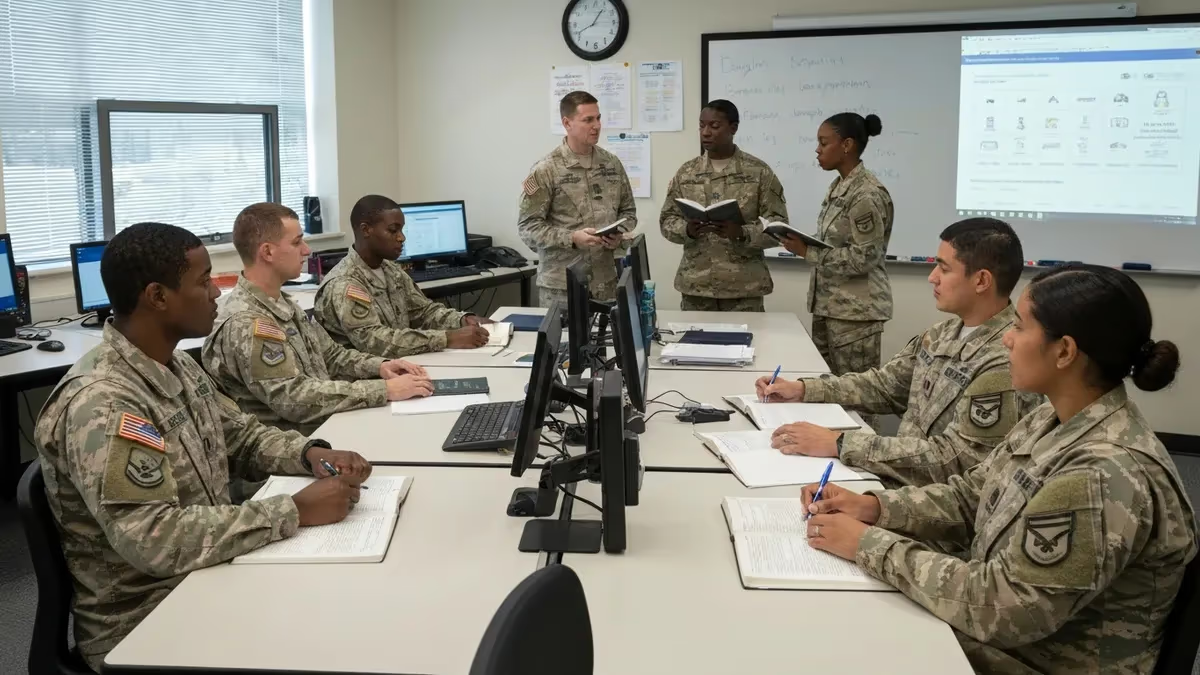
What Are ALCPT Forms?
The American Language Course Placement Test (ALCPT) is a standardized English proficiency exam used by the United States military and allied nation language programs to assess non-native English speakers. Rather than existing as a single fixed test, the ALCPT is published in multiple numbered versions called forms — for example, Form 60, Form 62, Form 70, Form 80, Form 83, Form 85, Form 87, Form 90, and others.
Each form is a parallel version of the same exam. They all measure the same two skill domains — Listening Comprehension and Reading/Grammar — at the same overall difficulty level. The questions, audio passages, and reading items differ from form to form, but the construct they measure remains identical. A score of 80 on Form 83 carries the same meaning as a score of 80 on Form 85.
This parallel-form design is standard practice in high-stakes military testing. The complete ALCPT guide covers the full exam format, but understanding forms specifically is critical for anyone preparing at a Defense Language Institute (DLI) program or an allied military language school.
Why Multiple Forms Exist
The core reason for multiple forms is test security. If every administration used the same questions, test content would inevitably leak — shared between students, posted online, or passed down through units. Once questions become public knowledge, scores no longer reflect genuine English ability; they reflect memorization of specific items.
The ALCPT is used to make high-stakes decisions: placement into language courses, qualification for certain military occupational specialties, and advancement in allied military programs. Compromised scores carry real operational consequences. Multiple forms prevent this by ensuring that even if a particular form's content becomes partially known, administrators can simply rotate to a different form.
A secondary benefit is longitudinal tracking. When a student retakes the ALCPT after a period of study, using a different form rules out the possibility that score gains come from remembering specific items rather than actual skill growth. This matters for program evaluation — language schools need clean data on whether their instruction is working.
For test-takers, this design has a direct implication: you cannot prepare by memorizing test content. The form you see on test day may differ entirely from any practice material you have encountered. This is a feature of the system, not a flaw. See our guide on ALCPT practice tips for skill-building strategies that work across all forms.
If you want more targeted practice, the alcpt test page covers the same material with additional questions and explanations.
What the Form System Means for Your Preparation
Understanding the form system fundamentally changes how you should approach ALCPT preparation. The system is designed so that only genuine English skill transfers reliably from one form to the next.
Students who attempt to prepare by finding answer keys for a specific form are wasting their time and taking a significant risk. Even if they score well through memorization, they may be placed into courses or assignments that exceed their actual English proficiency, creating downstream problems in their military career or language program. More practically: the form they memorized may not be the form administered on test day.
The right preparation approach builds the underlying skills that all ALCPT forms test:
- Active listening in English — consuming English audio daily, not just during study sessions
- Grammar pattern recognition — understanding why a sentence is correct, not which sentence appeared on a past test
- Reading comprehension habits — processing meaning at speed, not decoding word by word
- Vocabulary range — building a working knowledge of common military and academic English vocabulary
For a deeper breakdown of score targets and what they mean for placement, see the ALCPT score guide. For the full exam structure, the ALCPT overview is the best starting point.
- ✓Build daily English listening habits — podcasts, military broadcasts, or English-language news audio for at least 30 minutes per day
- ✓Study English grammar rules from first principles — subject-verb agreement, tense consistency, relative clauses, and conditional structures
- ✓Practice reading comprehension with timed passages — aim to extract main ideas and supporting details within the time constraints the ALCPT imposes
- ✓Expand vocabulary using spaced repetition — prioritize academic and military-context English terms that appear across proficiency tests
- ✓Take full-length timed practice sessions to build test endurance — 100 items under real conditions is different from untimed drills
- ✓Focus on error analysis — after each practice session, understand why wrong answers were wrong, not just which answer was right
- ✓Simulate real listening conditions — practice with audio played once only, without replaying, to match the actual test environment
- ✓Track your score trends across multiple practice sets — consistent improvement across different question sets signals real skill growth, not content familiarity
- +Industry-recognized credential boosts your resume
- +Higher earning potential (10-20% salary increase on average)
- +Demonstrates commitment to professional development
- +Opens doors to advanced career opportunities
- −Exam preparation requires significant time investment (4-8 weeks)
- −Certification fees can be $100-$400+
- −May require continuing education to maintain
- −Some employers may not require certification
Sample ALCPT - American Language Course Placement Test Practice Questions
Try these questions from our free ALCPT - American Language Course Placement Test practice tests. The correct answer and an explanation follow each question.
Choose the correct word: 'He felt ___ after completing the ALCPT successfully.'
- A. proudly
- B. pride
- C. proud
- D. proudness
Answer: C. proud
'Felt' is a linking verb, so it is followed by an adjective ('proud'), not an adverb.
Speaker A: 'Did you catch the announcement about the physical fitness test?' Speaker B: 'Only part of it. What time does it start?' What does Speaker B's response tell us?
- A. Speaker B does not want to take the fitness test.
- B. Speaker B heard the full announcement but forgot the time.
- C. Speaker B did not hear all of the announcement.
- D. Speaker B already knows when the test starts.
Answer: C. Speaker B did not hear all of the announcement.
Speaker B says they only caught 'part of it,' which means they did not hear the complete announcement and missed some details, including the time.
Speaker A: 'How did your physical fitness test go?' Speaker B: 'I passed the run, but I barely made the push-up count.' What can be inferred about Speaker B?
- A. Speaker B failed the entire fitness test.
- B. Speaker B did well on every part of the test.
- C. Speaker B passed the run easily but struggled with push-ups.
- D. Speaker B did not complete the fitness test.
Answer: C. Speaker B passed the run easily but struggled with push-ups.
'Barely made the push-up count' means Speaker B only just met the minimum requirement for push-ups, while the run was completed successfully.
Listen to this recorded instruction: 'To request leave, submit your completed form to your unit clerk at least 14 days before your requested departure date. Forms submitted fewer than 14 days in advance will be returned without processing.' What will happen to a leave request submitted 10 days before the departure date?
- A. It will be approved with a delay
- B. It will be reviewed by a supervisor
- C. It will be returned without processing
- D. It will require an additional signature
Answer: C. It will be returned without processing
The message explicitly states that forms 'submitted fewer than 14 days in advance will be returned without processing.' Ten days is fewer than the required 14-day minimum, so the form will be returned. No mention is made of delayed approval, supervisor review, or additional signatures for late submissions.
Take the full ALCPT - American Language Course Placement Test practice test
About the Author

Educational Psychologist & Academic Test Preparation Expert
Columbia University Teachers CollegeDr. Lisa Patel holds a Doctorate in Education from Columbia University Teachers College and has spent 17 years researching standardized test design and academic assessment. She has developed preparation programs for SAT, ACT, GRE, LSAT, UCAT, and numerous professional licensing exams, helping students of all backgrounds achieve their target scores.
Join the Discussion
Connect with other students preparing for this exam. Share tips, ask questions, and get advice from people who have been there.
View discussion (8 replies)