
ALCPT Score Guide 2026 October — What Your Score Means
Pass your ALCPT Score Guide 2026 October exam on the first attempt. ✏️ Practice questions with detailed answer explanations, hints, and instant scoring.
What ALCPT Scores Mean
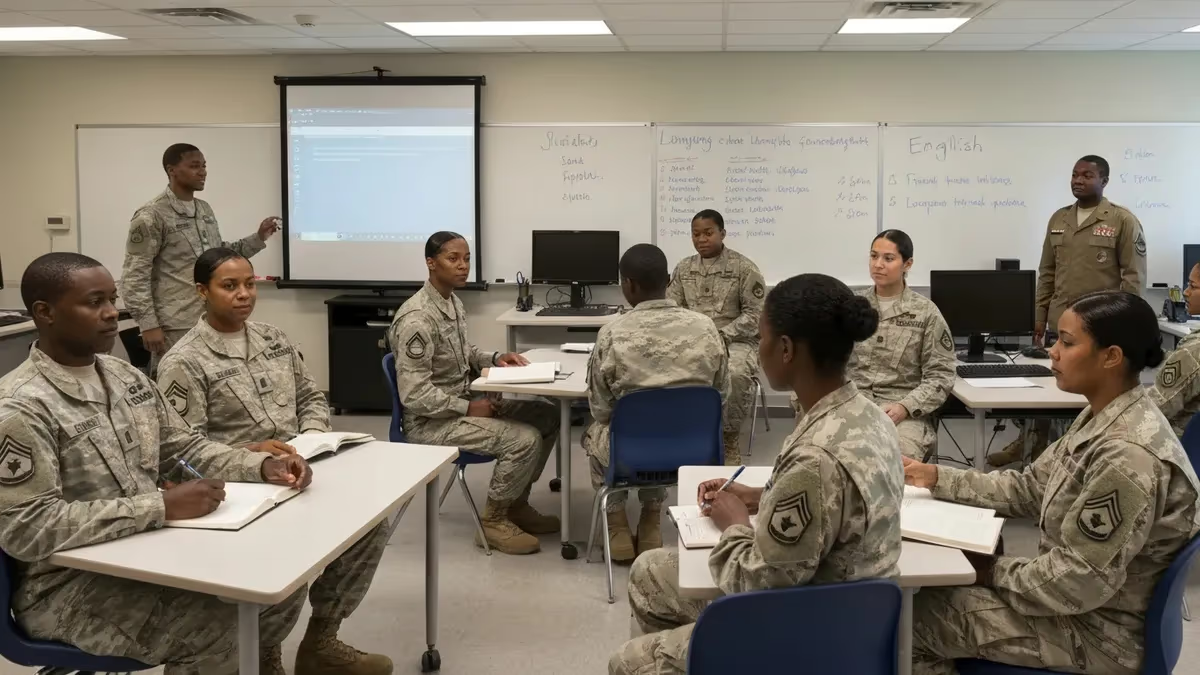
The American Language Course Placement Test (ALCPT) uses a simple 0–100 scale to measure English proficiency for placement in military language training programs. Unlike standardized civilian English tests, the ALCPT is purpose-built for the US military and allied nation forces who need a fast, reliable snapshot of where a student stands before beginning formal instruction at the Defense Language Institute (DLI) or equivalent allied training centers.
Your score is not a pass/fail result — it is a placement indicator. A score of 40 is not a failure; it means you are ready for elementary-level English instruction. A score of 85 means you may qualify for advanced programs or be waived from basic courses entirely. Understanding the band your score falls into is the single most important step after receiving your results.
The ALCPT is also used by allied militaries across the Middle East, Southeast Asia, and Latin America that train English-language skills through US-sponsored programs. In those contexts, minimum score thresholds set by host-nation agreements or US Security Assistance programs govern whether a student proceeds to advanced technical training conducted in English.
If you are preparing for your first attempt, the ALCPT Complete Guide 2026 covers everything from test format to study timelines. For a structured preparation plan, the 30-Day ALCPT Study Plan walks you through each phase week by week.
How ALCPT Scores Affect DLI Placement and Requirements
The Defense Language Institute Foreign Language Center (DLIFLC) at the Presidio of Monterey uses the ALCPT as a gatekeeping tool for English-language instruction provided to international military students. The test is not used for US service members learning foreign languages — it is specifically for foreign military students arriving to train in English or to attend technical courses taught in English.
Placement decisions follow a structured process. When a student's ALCPT score arrives at DLI, course coordinators match it against the minimum requirement for the student's designated program. If the score falls below the threshold, the student is redirected to an English language prerequisite course. Only after completing that course and retesting above the threshold is the student allowed to continue to their primary training program.
The practical implication is significant. A student who arrives with an ALCPT of 55 hoping to attend an advanced electronics maintenance course taught in English will first spend months in English instruction before touching technical content. This delays program completion, affects per-diem costs, and can impact bilateral training agreements. Scoring above the required threshold before travel is strongly preferred by both the student's home nation and DLI administrators.
For allied nations operating their own US-sponsored English programs — such as the Language Training Detachments (LTDs) in partner countries — ALCPT scores also determine eligibility for participation. Students below a set threshold are retained at their home-station programs; only those above it are approved for US-funded technical or professional military education (PME) courses.
To understand the full exam structure before test day, read the ALCPT Exam comprehensive guide. For practical test-taking strategies, the 7 essential ALCPT tips cover the most common mistakes students make.
If you want more targeted practice, the alcpt test page covers the same material with additional questions and explanations.
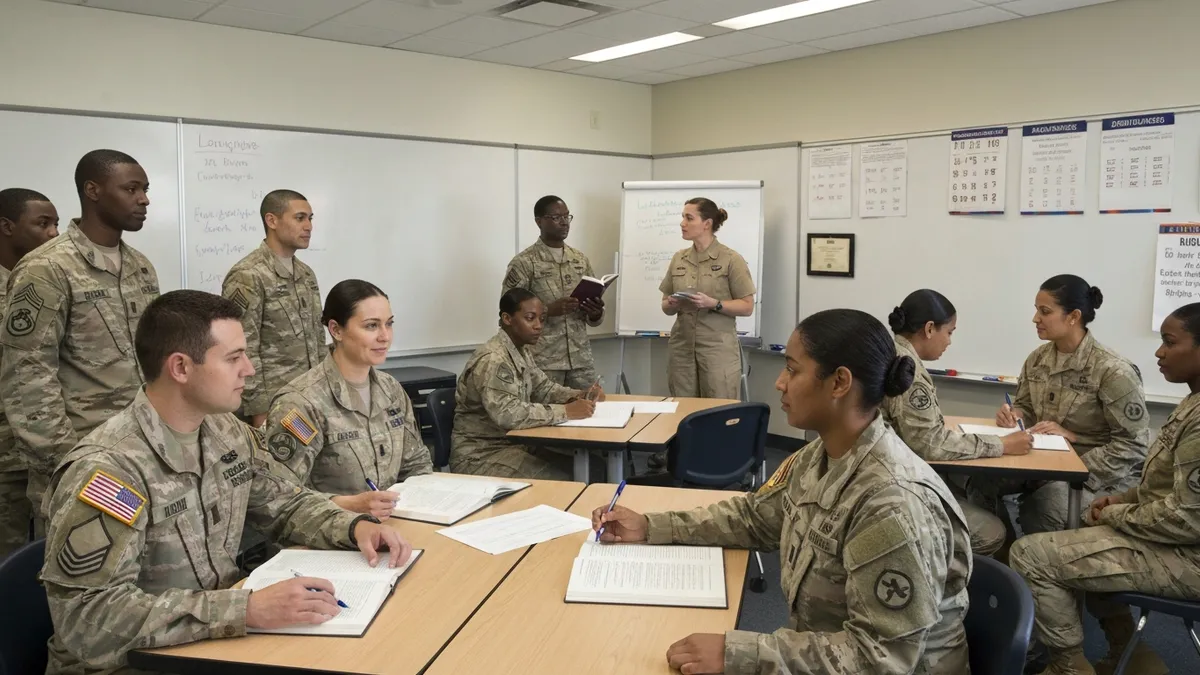
- ✓Take at least two full-length ALCPT practice tests before your exam to identify weak listening or reading areas.
- ✓Focus on military and technical English vocabulary — the ALCPT frequently uses terminology drawn from military contexts.
- ✓Practice listening to spoken American English daily using news broadcasts, instructional videos, or military English audio courses.
- ✓Study grammar at the sentence level: subject-verb agreement, tense consistency, and clause structure are heavily tested.
- ✓Use the <a href='/alcpt-american-language-course-placement-test'>ALCPT practice test hub</a> to work through graded question sets by difficulty.
- ✓Review your incorrect answers after each practice session — pattern errors (e.g., prepositions, article usage) and drill those specifically.
- ✓Build a consistent 30–60 minute daily study routine at least 4 weeks before your test date — cramming is ineffective for language placement tests.
- ✓On test day, manage your time carefully: do not spend more than 90 seconds on any single question. Flag and return.
- +Industry-recognized credential boosts your resume
- +Higher earning potential (10-20% salary increase on average)
- +Demonstrates commitment to professional development
- +Opens doors to advanced career opportunities
- −Exam preparation requires significant time investment (4-8 weeks)
- −Certification fees can be $100-$400+
- −May require continuing education to maintain
- −Some employers may not require certification
Sample ALCPT - American Language Course Placement Test Practice Questions
Try these questions from our free ALCPT - American Language Course Placement Test practice tests. The correct answer and an explanation follow each question.
What is the function of the clause 'what he said' in: 'I didn't understand what he said.'?
- A. Adjective clause modifying 'he'
- B. Adverbial clause modifying 'understand'
- C. Noun clause functioning as a direct object
- D. Independent clause
Answer: C. Noun clause functioning as a direct object
'What he said' is a noun clause acting as the direct object of 'understand.'
Woman: 'Did you hear what the commander announced at morning formation?' Man: 'No, I missed it. What did he say?' What does the man mean?
- A. He was not present for the formation announcement.
- B. He disagreed with the commander's decision.
- C. He already knew the announcement in advance.
- D. He refused to attend the formation.
Answer: A. He was not present for the formation announcement.
The man says he 'missed it,' meaning he was absent and did not hear the announcement.
Speaker A: 'How did your physical fitness test go?' Speaker B: 'I passed the run, but I need to work on my push-ups before the next one.' What can be inferred about Speaker B?
- A. Speaker B failed every part of the fitness test.
- B. Speaker B passed all parts of the fitness test.
- C. Speaker B did well on the run but struggled with push-ups.
- D. Speaker B did not show up for the fitness test.
Answer: C. Speaker B did well on the run but struggled with push-ups.
Speaker B explicitly states passing the run but needing improvement on push-ups, indicating mixed results with one strong area and one weak area.
Speaker A: 'Did you turn in your report?' Speaker B: 'I was about to, but the printer ran out of ink.' What happened to Speaker B's report?
- A. It was submitted on time
- B. It was not submitted because of a printer problem
- C. It was submitted electronically
- D. It was lost
Answer: B. It was not submitted because of a printer problem
'Was about to' indicates that the action had not yet been completed. The printer running out of ink prevented Speaker B from printing and therefore submitting the report.
Take the full ALCPT - American Language Course Placement Test practice test
ALCPT Score Flashcards
📊 What is the ALCPT score range?
The ALCPT is scored on a 0 to 100 scale, one point per item on a 100-item multiple-choice test. It is a placement indicator, not a pass/fail exam, so the score is matched against American Language Course book levels or a program's requirement.
START ALCPT PRACTICE TEST🎧 How many listening and reading questions are on the ALCPT?
Current ALCPT forms (151 and higher) have 50 listening items in Part I and 50 reading items in Part II. Older forms used a 66/34 listening-to-reading split, which DLIELC changed in 2025 to match the ECL test design.
START ALCPT PRACTICE TEST⏱️ How long does the ALCPT take?
Part I listening runs with the audio recording, about 20 minutes, and Part II reading allows 35 minutes. With directions and handing out materials, the whole session takes roughly 70 minutes according to the 2025 ALCPT Handbook.
START ALCPT PRACTICE TEST⚠️ Is an ALCPT score below 30 valid?
No. DLIELC states that scores from 0 to 29 can be attributed to guessing on a multiple-choice test and are not reliable indicators of ability. For those test-takers, input from a language instructor is recommended before deciding placement.
START ALCPT PRACTICE TEST📚 What ALCPT score places you in which ALC book?
DLIELC's placement table maps score bands to the 34 American Language Course books. For example, 25-33 suggests Book 7, 49-53 Book 13, 61-65 Book 19, 73-75 Book 25 and 82-85 Book 34, the final book.
START ALCPT PRACTICE TEST🔁 How often can you take the ALCPT?
In a training program, an end-of-level ALCPT is given once per ALC level, after Books 6, 12, 18, 24 and 30. Forms are rotated and a test-taker who leaves the room mid-test is rescheduled on a different form to protect test security.
START ALCPT PRACTICE TEST🎯 What is the difference between the ALCPT and the ECL test?
Both are 100-item listening and reading tests scored 0-100 and built on the same design with different items. The ECL is the official qualifying test for international military students and is tightly controlled, while the ALCPT is used for placement and ECL screening.
START ALCPT PRACTICE TEST✅ What ALCPT score do you need before taking the ECL?
DLIELC advises that only candidates who score within five points of their required ECL score on the ALCPT should be sent for ECL testing. If your program needs ECL 80, aim for an ALCPT score of at least 75 first.
START ALCPT PRACTICE TEST📅 How long is an ECL score valid?
An ECL score is valid for 180 days, and the ECL may be given to a student only once a month. The time limit exists because English ability can decline if a student stops studying after reaching the required score.
START ALCPT PRACTICE TEST🗣️ Does the ALCPT test speaking or writing?
No. The ALCPT measures only listening and reading, including grammar and vocabulary. Speaking ability is assessed separately with an Oral Proficiency Interview (OPI), which DLIELC also administers when a program requires it.
START ALCPT PRACTICE TESTOfficial Resources
- DLIELC ALCPT Testing: the Defense Language Institute English Language Center page with the current ALCPT Handbook and testing contacts.
- ALCPT Handbook (August 2025 Edition): the official guide to test format, scoring and the ALC placement score table for forms 151 and higher.
- DLIELC ECL Testing: official information on the English Comprehension Level test, including its 0-100 scale and 180-day score validity.
About the Author

Educational Psychologist & Academic Test Preparation Expert
Columbia University Teachers CollegeDr. Lisa Patel holds a Doctorate in Education from Columbia University Teachers College and has spent 17 years researching standardized test design and academic assessment. She has developed preparation programs for SAT, ACT, GRE, LSAT, UCAT, and numerous professional licensing exams, helping students of all backgrounds achieve their target scores.
Join the Discussion
Connect with other students preparing for this exam. Share tips, ask questions, and get advice from people who have been there.
View discussion (8 replies)