AFOQT Practice Exam: Complete Air Force Officer Test Prep Guide

AFOQT practice exam guide — all 12 subtests, composite scores, passing minimums, free vs paid prep, and a study schedule that actually works.

AFOQT Practice Exam: Complete Air Force Officer Test Prep Guide

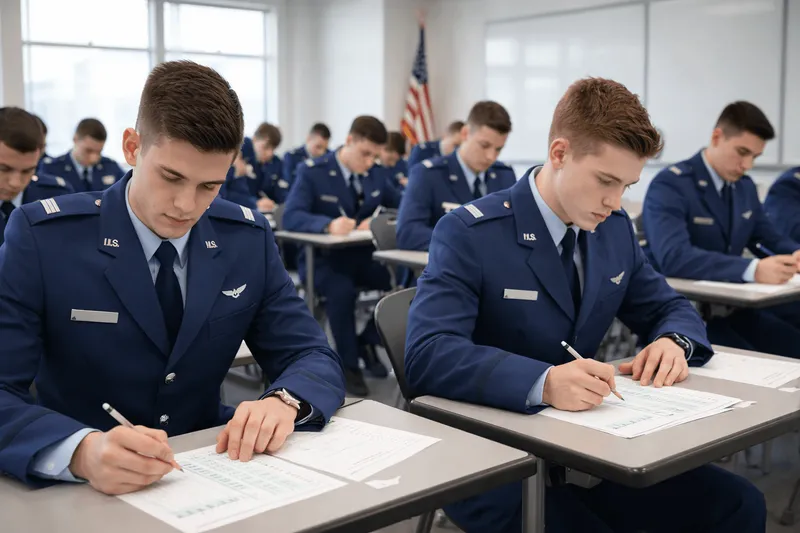
The AFOQT — the Air Force Officer Qualifying Test — is the gateway exam every aspiring Air Force officer has to clear. The current version, AFOQT Form Y, runs about three hours and thirty minutes of actual testing time, packs in 470 questions across 12 subtests, and produces five composite scores that determine which officer career paths you can pursue. Whether you're applying through ROTC, OTS, or the Air Force Academy commissioning pipeline, your AFOQT performance shapes what comes next.

Here's the part that surprises most candidates: the AFOQT isn't one test. It's twelve tests stitched together, each timed separately, each measuring a different cognitive domain. Verbal sections sit next to spatial-reasoning sections, mathematics next to aviation knowledge, situational judgment next to personality inventory. The breadth is the whole point. The Air Force wants to know if you can think like a pilot, an intelligence officer, a logistics planner — sometimes all in the same day.

That breadth also makes prep tricky. Drilling math alone won't help your Verbal Analogies score. Memorizing word lists won't move your Table Reading composite. A solid AFOQT practice exam session forces you to switch contexts on cue, which is exactly what test day demands. Below, you'll find a complete breakdown of every subtest, how composites are calculated, what scores you actually need, and which prep resources are worth your time.

AFOQT at a Glance

📝470Total Questions
⏱️3h 30mActive Testing Time
🔢12Subtests
🎯5Composite Scores
🔁3Lifetime Attempts
🚫0Calculators Allowed

The 12 AFOQT subtests are administered in a fixed order with mandatory breaks built between blocks. You can't skip subtests, you can't go back to a previous section, and you can't change your answers once a section is submitted. That rigid structure matters because it changes how you should pace yourself — each subtest is its own self-contained sprint, and burning out on Verbal Analogies will tank your Word Knowledge score eight minutes later.

Total testing time runs roughly three hours thirty minutes, but the entire test session — including admin paperwork, breaks, and instructions — typically takes about five hours from when you sit down to when you walk out. The Air Force schedules AFOQT sittings at testing centers and select military installations, and you'll need to register through your commissioning source. ROTC cadets coordinate through their detachment, OTS applicants through their recruiter, and Academy candidates through their admissions liaison.

One small detail that catches first-timers off guard: you can't use a calculator on any AFOQT subtest. Not for Math Knowledge, not for Arithmetic Reasoning, not for Block Counting. Mental math, scratch paper, and clear thinking are your only tools. If you've been leaning on a calculator for years, build calculator-free practice into your prep schedule starting day one.

What is the Afoqt - AFOQT - Air Force Officer Qualifying Test certification study resource

Current version: AFOQT Form Y, the latest standardized form used by the Air Force across all commissioning sources. Test content, scoring formulas, and percentile norms reference Form Y unless you're using legacy prep material from before 2014 — in which case the older Form T won't reflect today's structure. Always verify your prep resource is updated for Form Y before relying on its content.

Each AFOQT subtest tests a narrow skill — and understanding what each section actually measures helps you target your prep instead of grinding through random questions hoping something sticks. The Verbal Analogies subtest, for example, isn't about vocabulary alone. It's about recognizing relationship patterns: cause-effect, part-whole, function-object, synonym-antonym. Once you start spotting these patterns, the questions get noticeably faster, and the score gains follow.

Math Knowledge covers algebra through pre-calculus topics: linear and quadratic equations, geometry, basic trig identities, exponent rules. The questions tend to be procedural — recognize the formula, plug in values, choose the answer. Arithmetic Reasoning is different. It's word problems testing your ability to translate everyday situations into equations: rate problems, ratio problems, percentage problems, simple probability. These are two distinct skills, and you should drill them separately during prep. Try a focused AFOQT arithmetic reasoning practice set to see where your weak spots are.

The aviation-specific subtests are where most non-pilot applicants lose ground. Instrument Comprehension shows you cockpit instrument displays and asks you to determine the aircraft's attitude based on the artificial horizon and compass readings. Block Counting requires you to count three-dimensional blocks in stacked arrangements where some blocks are hidden behind or beneath others.

Aviation Information tests basic flight knowledge — terminology, aerodynamics fundamentals, FAA regulations. If you're not targeting a pilot or CSO slot, you can skim these. If you are, expect to spend serious prep time here, and budget at least two weeks of dedicated study to bring your scores up to competitive levels.

The Situational Judgment and Self-Description sections measure something different: officer suitability. Situational Judgment presents leadership scenarios and asks you to pick the most-effective and least-effective response. There's no perfect answer in some cases, but trained officers tend to pick similar response patterns — and that's what the test measures. Self-Description is a 240-item personality inventory designed to flag inconsistencies and detect candidates who try to fake their answers. Be honest, be consistent, and trust the process. Trying to game these sections almost always backfires.

All 12 AFOQT Subtests

🔤Verbal Analogies

25 questions in 8 minutes. Word-pair relationships testing pattern recognition: cause-effect, part-whole, function-object, synonym-antonym.

🧮Arithmetic Reasoning

25 questions in 29 minutes. Word problems requiring you to translate real-world situations into equations — rates, ratios, percentages.

📖Word Knowledge

25 questions in 5 minutes. Vocabulary recognition at a fast pace. Synonyms primarily, with occasional context-based usage questions.

📐Math Knowledge

25 questions in 22 minutes. Algebra, geometry, basic trig — no calculator. Procedural problem-solving, formula application.

📚Reading Comprehension

25 questions in 38 minutes. Short passages followed by detail, inference, and main-idea questions. Active reading required.

⚖️Situational Judgment

50 questions in 35 minutes. Leadership scenarios with most-effective and least-effective response choices for officer decision-making.

👤Self-Description Inventory

240 personality items measuring traits relevant to officer performance. No right answers — answer honestly and consistently.

⚗️Physical Science

20 questions in 10 minutes. High-school physics and chemistry concepts — Newton's laws, simple circuits, basic chemistry principles.

📊Table Reading

40 questions in 7 minutes. Find specific cells in dense numerical tables — fastest subtest, tests visual scanning under pressure.

✈️Instrument Comprehension

25 questions in 5 minutes. Read cockpit instrument displays — artificial horizon and compass — to determine aircraft attitude.

🧱Block Counting

20 questions in 4.5 minutes. Count three-dimensional blocks in stacked arrangements, including blocks hidden from direct view.

🛩️Aviation Information

20 questions in 8 minutes. Basic aviation knowledge — terminology, aerodynamics fundamentals, FAA regulations, flight principles.

Your five AFOQT composite scores aren't just averages of the subtests. Each composite combines specific subtests with weighted formulas the Air Force has refined over decades of validation studies. The Pilot composite, for instance, weighs Math Knowledge, Instrument Comprehension, Table Reading, Aviation Information, and Block Counting — the subtests most predictive of flight training success. The Academic Aptitude composite combines Verbal and Quantitative scores into a single general intelligence index.

Composite scores are reported as percentiles ranging from 1 to 99. A 50th percentile composite means you scored higher than 50% of the AFOQT-taking population (a norming group that includes thousands of past test-takers). Higher percentiles mean stronger relative performance. The Air Force doesn't release your raw subtest scores or even your raw composite scores — you only see the percentile ranking. That makes practice tests with detailed scoring breakdowns essential during prep, because they're the only way to see exactly where your weak spots are before test day.

Realistic AFOQT practice tests mimic the percentile reporting style and break down subtest accuracy so you can target the right composites. A practice test that just gives you "85% correct overall" is useless — you need accuracy by subtest, accuracy by topic within each subtest, and ideally a percentile estimate based on the latest published norms.

Can You Use Scratch Paper on Afoqt - AFOQT - Air Force Officer Qualifying Test certification study resource

How AFOQT Composite Scores Work

The Pilot composite combines Math Knowledge, Instrument Comprehension, Table Reading, Aviation Information, and Block Counting — the subtests most predictive of undergraduate pilot training success. Competitive pilot applicants aim for a Pilot composite of 70+, though the minimum qualifying score is 25. This composite is the single most important score for anyone targeting a pilot slot.

Minimum qualifying AFOQT scores vary by commissioning program and career field, so there's no single "passing score" to chase. For OTS applicants, the baseline requires at least a Verbal composite of 15 and a Quantitative composite of 10 — those are percentile scores, not raw scores. ROTC scholarship candidates often need higher minimums depending on the specific scholarship tier. Pilot candidates face additional thresholds: most programs require a Pilot composite of 25 and a CSO composite of 10 at minimum.

Competitive scores are a different story. To be genuinely competitive for a pilot slot, you'll want a Pilot composite in the 70s or higher and a CSO composite well above the minimum. Successful pilot candidates frequently report Pilot composites in the 80s and 90s. For non-rated officer career fields — intelligence, logistics, cyber, acquisitions — the Verbal and Quantitative composites carry the most weight, and competitive candidates aim for 60th percentile and above on both.

Retake policies are strict. You're allowed up to three AFOQT attempts total in your lifetime, with a mandatory 150-day waiting period between retakes. All your scores are visible to the selection boards, not just your highest, so a careless first attempt can haunt you. Some applicants delay their first sitting until they're genuinely prepared, treating prep like a serious six-month project rather than something to wing on test day.

The free-versus-paid AFOQT prep landscape is wider than most candidates realize. Free practice tests are scattered across military prep sites and YouTube channels — quality varies wildly. The best free option is the official sample questions released by the Air Force itself, available through the AFOQT preparation guide. These are limited in number but identical in style to what you'll see on test day. Beyond that, free practice quizzes can build familiarity with the format, but treat third-party difficulty estimates with skepticism. A free question that feels easy might be calibrated below the actual AFOQT difficulty curve.

Paid resources fall into a few buckets. Trivium Test Prep publishes a comprehensive AFOQT study guide that includes content review and full-length practice tests — popular and reasonably priced. BarCharts offers a quick-reference study sheet that's useful for last-minute formula refreshers but not a primary study tool.

Peterson's AFOQT prep is a longer-running resource with detailed content review chapters and explanation-rich answer keys. And there are several online prep platforms — Mometrix, Test Prep Books, JobTestPrep — each with their own strengths and weaknesses. Read recent reviews before buying any single resource, since publishers update their AFOQT material on different cycles.

Some applicants also compare AFOQT prep with ASTB-E prep, the Navy and Marine equivalent for aviation candidates. The tests share some skills — math, instrument reading, mechanical reasoning — but the structure is different enough that ASTB study materials don't substitute directly for AFOQT prep. The ASTB uses different question formats, different scoring composites, and includes a unique performance-based aviation skills section the AFOQT doesn't have. If you're applying to multiple services, plan to do separate prep cycles and don't try to cram both with the same study guide.

Afoqt Requirements - AFOQT - Air Force Officer Qualifying Test certification study resource

AFOQT Prep Resources Worth Your Time

  • Official Air Force AFOQT preparation guide — free, limited sample questions, identical style to the real test
  • Trivium Test Prep AFOQT Study Guide — comprehensive content review plus full-length practice tests
  • Peterson's Master the Air Force Officer Qualifying Test — detailed content chapters with strategy notes
  • BarCharts AFOQT Quick Study — laminated formula reference, useful for last-minute review only
  • Mometrix AFOQT Secrets Study Guide — exam-style practice questions with detailed answer explanations
  • JobTestPrep AFOQT online platform — adaptive practice tests with subtest-level analytics
  • Test Prep Books AFOQT Prep Book — affordable content review with two full-length tests included
  • Free online quizzes for individual subtest drills — Verbal Analogies, Word Knowledge, Math Knowledge
  • Aviation Information primer for non-pilots — FAA Pilot's Handbook chapters 1-3 cover the basics
  • Three or more timed full-length practice exams completed in the final month before test day

An effective AFOQT prep schedule depends on how much time you have before your test date and where you're starting from. The standard guideline is 8-12 weeks of dedicated prep, but that's a baseline — candidates targeting pilot slots or sitting after years away from school often need longer. Front-load your prep with content review: identify the subtests where you're weakest, then drill those topic-by-topic before mixing in full-length timed practice exams.

The single most valuable prep activity is the timed full-length practice test, but only if you debrief it properly afterward. Most candidates take a practice test, glance at the score, and move on. That's wasted effort. The real value sits in reviewing every wrong answer, identifying whether you missed it because of a content gap, a timing issue, or a careless error, and then targeting your follow-up study sessions at the gaps you found. Two well-reviewed practice tests are worth ten practice tests you barely look at afterward.

Build in one timed full-length practice test per week during the final month of prep. Vary the time of day you take them — your performance at 7 AM is different from your performance at 2 PM, and you don't get to choose your AFOQT slot. Take notes on energy levels, focus drift, and which subtests degrade as the session wears on. Adjust your prep accordingly. The candidates who score highest on test day are usually the ones who treated their final month of practice exams as dress rehearsals for the real thing.

AFOQT Practice Exam Pros and Cons

Pros
  • +AFOQT practice exams reveal weak subtests that content review alone can't identify
  • +Timed practice trains the pacing skills the real test demands across all 12 sections
  • +Wrong-answer review is the highest-ROI prep activity, turning mistakes into score gains
  • +Full-length practice tests build the stamina needed for the five-hour test session
  • +Practice score tracking shows measurable progress and signals when you're ready to sit
Cons
  • Third-party practice tests vary in quality — some don't reflect current AFOQT Form Y style
  • Practice scores don't perfectly predict actual AFOQT composite percentiles on test day
  • Memorizing practice questions without understanding concepts won't transfer to new items
  • Authentic official AFOQT practice material is limited — most candidates exhaust it quickly
  • Over-reliance on practice tests at the expense of content review produces inconsistent gains

Test-day logistics matter more than candidates expect. The AFOQT runs about five hours from check-in to dismissal, and you'll need to bring valid photo ID, your registration confirmation, and approved testing materials only. No phones, no smartwatches, no calculators, no outside scratch paper. The testing center provides the scratch sheets you'll use. Plan a real breakfast, dress in layers because testing rooms run cold, and arrive at least 30 minutes before your scheduled start.

During the test, pace yourself by subtest rather than overall. Each subtest has its own timer — when time's up on a section, the test moves you to the next one regardless of whether you've finished. There's no penalty for guessing on the AFOQT, so leaving questions blank is always worse than picking an answer at random. If you're running short on time, fill in remaining bubbles before the section ends. Even random answers give you a 20% chance on five-option questions, which can mean a meaningful boost to your composite score.

Between subtests, use the brief built-in breaks to reset. Stretch, sip water, take three slow breaths. Mental fatigue compounds across a five-hour session, and the candidates who maintain focus through the final subtests outscore the ones who burned through their concentration in the first two hours. Treat the AFOQT like a marathon, not a sprint — steady pace, deliberate effort, smart breaks. The final third of the test session, which includes some of the aviation-specific subtests, often correlates most strongly with pilot composite outcomes, so don't run out of energy before you get there.

Once you've finished the AFOQT, your scores typically post within 8-10 business days through your commissioning source — your ROTC detachment, OTS recruiter, or Academy admissions liaison delivers your composite scores. Plan ahead for what comes next: if you scored above your target minimums, you can move forward with your application package; if you scored below, you'll need to decide whether to retake or pivot your career-field preferences. Either way, your AFOQT scores are one factor among many. GPA, leadership experience, fitness scores, letters of recommendation, and interviews all matter alongside the test.

A few final tips from candidates who've come through the process. Start prep earlier than you think you need to — three months is comfortable, six months is better if you're rusty on math or unfamiliar with aviation content. Take at least three full-length timed practice tests before your real sitting, and review every wrong answer in detail rather than skimming the answer key.

Don't neglect the personality and self-description sections; while they don't generate composite scores in the traditional sense, they do feed into your overall officer suitability profile that selection boards review carefully. Be honest, be consistent across all 240 items, and answer in line with the leadership traits the Air Force is genuinely looking for in commissioned officers.

If you're serious about a competitive Air Force officer slot, treat AFOQT prep as a foundational investment, not a checkbox. Strong AFOQT scores open doors that mediocre scores close, and weak scores eliminate options that no amount of leadership experience can replace. Use the practice resources, build a structured schedule, debrief every practice test, and walk into test day knowing you've done the work. The candidates who score in the top percentiles aren't necessarily smarter — they're better prepared, more disciplined with their prep time, and more reflective about their wrong answers. That's a difference you control.

AFOQT Questions and Answers

About the Author

Colonel Steven Harris (Ret.)MA Military Science, BS Criminal Justice

Retired Military Officer & Armed Forces Test Preparation Specialist

United States Army War College

Colonel Steven Harris (Ret.) served 28 years in the US Army, earning a Master of Arts in Military Science from the Army War College and a Bachelor of Science in Criminal Justice. He has coached thousands of military enlistment and officer candidate program applicants through the ASVAB, AFQT, AFCT, OAR, and officer selection assessment processes across all military branches.