
AFOQT Pilot Score Requirements: Minimums, Composites & What You Actually Need
📗 Prepare for the AFOQT Pilot Score Requirements: certification. Practice questions with answer explanations covering all exam domains.
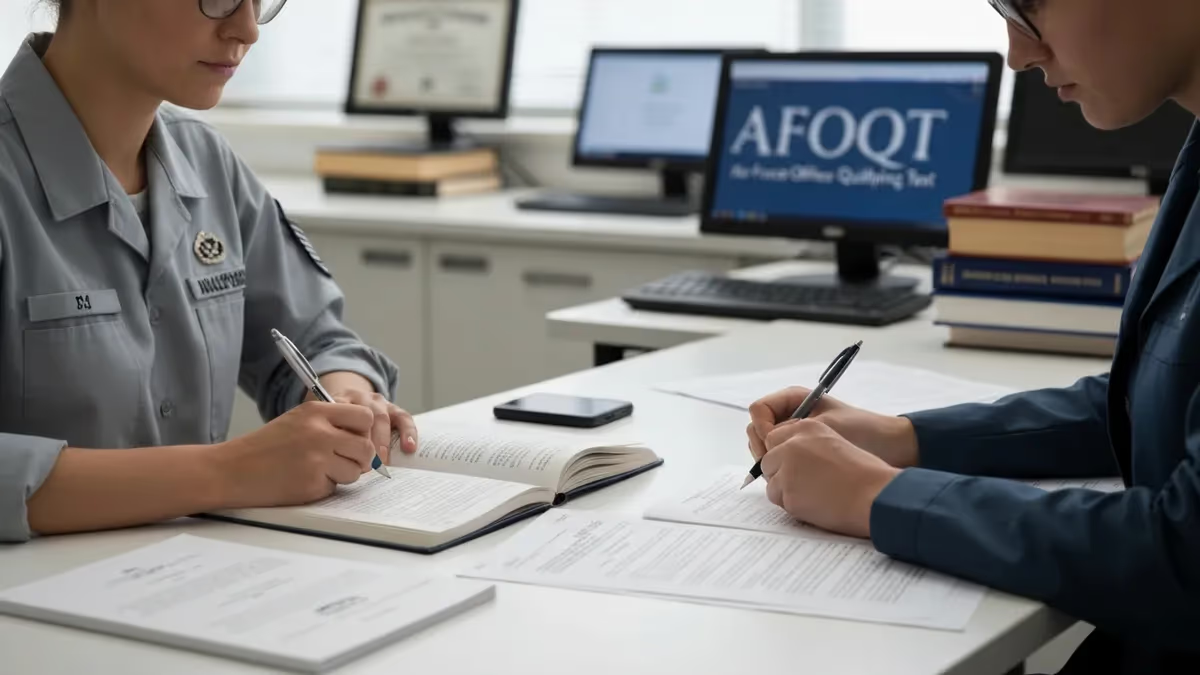
The AFOQT pilot composite minimum is 25. That's it — that's the number standing between you and a pilot training slot. But here's the thing: meeting the minimum doesn't mean you'll actually get selected, because most successful applicants score well above that floor, often landing somewhere in the 50–90 range depending on the fiscal year's competitiveness and the specific career field board reviewing your packet.
The Air Force Officer Qualifying Test measures aptitude across 12 subtests administered over roughly 5 hours — a marathon of verbal analogies, arithmetic reasoning, instrument comprehension, aviation knowledge, and several other domains that feed into five composite scores. Your pilot composite pulls from six of those subtests, and the navigator composite minimum sits at just 10. The quantitative composite needs a 10 too. These afoqt pilot score requirements aren't suggestions. They're hard cutoffs.
What catches most people off guard isn't the minimums themselves but how the composites actually get calculated. Each composite draws from a different combination of subtests, weighted differently, and your raw scores convert to percentile ranks based on the norming population — other officer candidates who've taken the same test. A 50 doesn't mean you got half the questions right. It means you outperformed 50% of everyone else.
If you're just starting your prep, grab an afoqt practice test to benchmark where you stand right now. Knowing your baseline before you build a study plan saves weeks of unfocused preparation. Most candidates who score competitively — we're talking pilot composites above 70 — spend 4 to 8 weeks in dedicated study mode, not cramming the night before.

How the Pilot Composite Score Actually Works
Your pilot composite isn't one test — it's six subtests smashed together into a single percentile. Those six are Math Knowledge, Table Reading, Instrument Comprehension, Aviation Information, Verbal Analogies, and Arithmetic Reasoning. Miss the mark on any one of them and your composite takes a hit, even if you crushed the others. That uneven pull is why targeted afoqt practice test sessions matter more than general studying.
Your afoqt scores land as percentiles from 1 to 99. The Air Force doesn't release raw-to-percentile conversion tables publicly — they update the norming sample periodically, so the same raw score might produce different percentiles across test versions. What's consistent: a pilot composite of 25 means you beat only 25% of the reference group. That's the bare minimum to qualify. Not competitive. Bare minimum.
Competitive pilot boards in recent years have seen average selectees scoring pilot composites in the 60s and 70s. Some rated boards push even higher. The exact cutoff shifts each cycle based on how many slots are open, how many applicants apply, and the overall quality of the pool. You don't control any of that — you only control your score.
Worth knowing: the AFOQT can be retaken once, for a lifetime maximum of two attempts. Your most recent scores replace the old ones entirely. No averaging. No picking the better set. If you retake it and score lower on any composite, that lower score is what the board sees. Think carefully before walking back into that testing room.
All Five AFOQT Composite Scores — What Each One Measures
The AFOQT produces five composite scores, not just pilot. Here's where most people get confused — and where a solid afoqt study guide earns its value. Each composite draws from a different subset of the 12 subtests. Some subtests feed multiple composites, so strong performance in Table Reading, for instance, boosts both your pilot and navigator numbers simultaneously.
The five composites: Pilot (minimum 25), Combat Systems Officer/Navigator (minimum 10), Academic Aptitude, Verbal, and Quantitative (minimum 10). Academic Aptitude combines verbal and quantitative subtests. Verbal pulls from Word Knowledge, Verbal Analogies, and Reading Comprehension. Quantitative uses Arithmetic Reasoning and Math Knowledge. The navigator composite adds Table Reading, Instrument Comprehension, and Block Counting to the mix. Running through afoqt practice questions for each subtest area is the fastest way to identify which composite you're weakest in.
Here's the catch: you don't get to pick which composites matter. If you're going for a pilot slot, the board cares most about pilot composite, but they see all five. A strong academic aptitude score reinforces the impression that you can handle the cognitive load of pilot training. Weak verbal scores might raise questions even if your pilot composite looks fine. Boards evaluate the whole picture.
One detail people overlook: the Situational Judgment subtest doesn't feed into any of the five traditional composites. It generates a separate score that some boards weight independently. Don't blow it off just because it's not in the math.
AFOQT Composite Score Breakdown
Minimum: 25th percentile. Draws from 6 subtests: Math Knowledge, Table Reading, Instrument Comprehension, Aviation Information, Verbal Analogies, and Arithmetic Reasoning. Competitive range: 60–90+. Most selected pilot candidates score well above 50. The aviation-specific subtests (Instrument Comprehension, Aviation Information) are unique to this composite — they don't appear in academic or verbal composites.
Inside the 12 AFOQT Subtests — Timing, Questions, and Weight
Twelve subtests. Five hours. The afoqt test structure hasn't changed dramatically in recent versions, but the afoqt scoring methodology underneath matters more than most candidates realize — each subtest contributes to composites at different weights, and the Air Force doesn't publish those exact weights publicly. What we know from official documentation and candidate debriefs: Aviation Information and Instrument Comprehension carry significant pilot composite influence.
Here's the breakdown by section: Verbal Analogies (25 questions, 8 minutes), Arithmetic Reasoning (25 questions, 29 minutes), Word Knowledge (25 questions, 5 minutes), Math Knowledge (25 questions, 22 minutes), Reading Comprehension (25 questions, 38 minutes), Situational Judgment (50 questions, 35 minutes), Self-Description Inventory (220 items, 40 minutes), Physical Science (20 questions, 10 minutes), Table Reading (40 questions, 7 minutes), Instrument Comprehension (25 questions, 5 minutes), Block Counting (30 questions, 4.5 minutes), and Aviation Information (20 questions, 8 minutes).
The time pressure varies wildly. Word Knowledge gives you 5 minutes for 25 questions — that's 12 seconds each, no time to deliberate. Meanwhile Arithmetic Reasoning offers over a minute per question. A smart afoqt study guide teaches you which sections demand speed drills versus which ones reward careful problem-solving. Don't train for all 12 subtests the same way.
Block Counting trips up even strong math students because it's pure spatial reasoning — no equations, no formulas, just mentally rotating 3D block arrangements and counting adjacencies under extreme time pressure. Four and a half minutes for 30 questions. That's 9 seconds per item. You either see it instantly or you don't.
Building a Study Plan That Actually Moves Your Score
Most candidates start with an afoqt study plan that covers all 12 subtests equally. Bad move. If you're chasing a pilot slot, your study time should weight the six pilot composite subtests at roughly 70% of your total prep hours, with the remaining 30% spread across the others. The afoqt study process should feel unbalanced — because the scoring system is unbalanced.
A barrons afoqt prep book is the classic starting point, and it's still solid for content review — especially the math and verbal sections. But Barron's alone won't prepare you for the speed demands of Table Reading or Instrument Comprehension. You need timed drill sets that simulate actual test conditions. Sit down, set a timer, and work through 40 table-reading items in 7 minutes. Then do it again. And again. Speed comes from repetition, not from reading strategy chapters.
Four to eight weeks is the sweet spot for most candidates. Less than four and you're cramming — which works for content-heavy subtests like Math Knowledge but fails for skill-based ones like Instrument Comprehension. More than eight weeks and you risk burnout or diminishing returns. The candidates who score highest tend to study in focused 60 to 90 minute blocks rather than marathon sessions.
Don't ignore Situational Judgment. It doesn't feed into your pilot composite, but some boards evaluate it separately — and a low SJ score can raise red flags about leadership potential. The SDI (Self-Description Inventory) is personality-based; you can't really study for it, but you can familiarize yourself with the format so you don't waste time figuring out the interface on test day.
AFOQT Study Checklist: 6-Week Plan
- ✓Take a full-length diagnostic practice test — untimed first, then timed
- ✓Identify your 3 weakest subtests by composite impact and focus 70% of study time there
- ✓Drill Table Reading daily — 40 questions in 7 minutes until accuracy hits 85%+
- ✓Study Instrument Comprehension with real cockpit instrument images, not just textbook diagrams
- ✓Review Aviation Information fundamentals: lift, drag, flight controls, airspace classes
- ✓Complete 200+ Arithmetic Reasoning problems — focus on word problem translation speed
- ✓Work through Math Knowledge formulas: area, volume, trig identities, quadratic formula
- ✓Take 2-3 full timed practice tests in weeks 4-5 to simulate test-day conditions
- ✓Review wrong answers systematically — categorize errors as content gaps vs. time management
- ✓Rest the day before the test — cramming the night before doesn't work for aptitude exams
Free AFOQT Practice Resources — What's Worth Your Time
Finding a quality afoqt practice test free option online takes some digging. Plenty of sites offer "free AFOQT practice" materials that are really just 10-question previews designed to push you toward a paid product. Genuine free resources do exist though — military education forums, official Air Force preparation guides, and sites like this one that provide full-length afoqt practice sets without paywalls or signup walls.
The key difference between useful free materials and junk: question quality. A good practice question mirrors the actual AFOQT in format, difficulty, and time constraints. Vague multiple-choice questions with obviously wrong distractors don't prepare you for the real test, where two or three answer choices often look plausible and you've got seconds to decide. When evaluating any free resource, check whether the questions include timing guidelines and whether the answer explanations reference actual test content domains.
Official sources worth checking: the Air Force's own AFOQT information pamphlet (available through your recruiter or education office), Peterson's practice materials (some libraries carry these), and AFPC guidance documents. Unofficial but reliable: veteran-run forums where recent test-takers share subtest-specific strategies and difficulty impressions. Take forum advice on exact questions with a grain of salt — the AFOQT rotates forms — but strategic advice about time management and section difficulty is usually accurate.
Don't sleep on flashcard apps for Word Knowledge and Aviation Information. These two subtests reward pure memorization more than any others on the AFOQT exam. Fifteen minutes of flashcard review before bed, done consistently over 4 weeks, can push your vocabulary and aviation knowledge scores up significantly with minimal effort investment.
Common AFOQT Score Mistakes — and How to Avoid Them
The first mistake: treating the afoqt exam like a college final. This isn't a knowledge test you can cram for — it's an aptitude assessment with heavy speed components. Candidates who study content without practicing under timed conditions consistently underperform their potential. The Air Force Officer Qualifying Test (AFOQT) penalizes slow-but-accurate test-takers just as much as fast-but-sloppy ones.
Second mistake: ignoring the subtests that don't directly feed your target composite. Your board packet includes all five composite scores. A stellar pilot composite paired with a bottom-quartile verbal score tells the board you've got narrow ability — and pilot training demands written communication, briefing skills, and reading comprehension alongside stick-and-rudder talent. Don't tank subtests just because they aren't in your primary composite formula.
Third: retaking without significant improvement in your weak areas. Remember, your second attempt replaces everything. If you scored a 65 pilot composite but a 15 verbal, and you retake focused entirely on verbal improvement, you might push verbal to 40 but drop pilot to 55 because you didn't maintain your math and aviation edge. Prepare across all subtests for a retake, not just the ones you bombed.
The sneaky fourth mistake: not knowing your afoqt results timeline. Scores typically arrive 8-10 business days after testing. Some candidates sit idle for weeks waiting instead of continuing preparation for other parts of their officer application. Use that waiting period productively — work on your personal statement, physical fitness, or flight hours if you're building a rated package.
You get exactly two lifetime attempts at the AFOQT. If you retake it, every composite score from your first attempt gets overwritten — even the ones where you scored higher originally. There's no picking your best scores across attempts. Study broadly before a retake, not just your weak composites, or you risk trading one strong score for a mediocre one.
Understanding Your AFOQT Results and What They Mean for Selection
When your afoqt results arrive, you'll see five composite percentile scores plus your Situational Judgment and Self-Description Inventory ratings. No raw scores, no subtest-level breakdowns — just composites. That's by design. The Air Force doesn't want candidates gaming individual subtests; they want a holistic aptitude picture.
If you're wondering whether an afoqt tutor is worth the investment, it depends entirely on your diagnostic scores and your learning style. Candidates who score below 40 on their target composite after self-study often benefit from one-on-one tutoring, particularly for math-heavy subtests where conceptual gaps — not just speed issues — are dragging scores down. A tutor won't help much for Table Reading or Block Counting; those are speed-and-pattern drills you grind out yourself.
Your composites don't expire. Once you take the AFOQT, those scores follow you through your entire Air Force career application process. If you test as a college junior and don't apply for OTS until three years later, the same scores apply. No retesting required unless you want to try for higher marks — and again, that's a one-shot deal with the replacement rule.
One nuance most guides skip: different boards weight AFOQT scores differently relative to other packet components. A rated board for pilot slots might weight your pilot composite at 30-40% of the total score, with the rest split among GPA, PCSM (Pilot Candidate Selection Method — which includes AFOQT scores, flight hours, and the TBAS), commander's ranking, and the personal statement. A high AFOQT score alone won't get you selected. But a low one will absolutely get you screened out.
AFOQT Practice Test Questions
Prepare for the AFOQT - Air Force Officer Qualifying Test exam with our free practice test modules. Each quiz covers key topics to help you pass on your first try.
AFOQT General Science Biology and Chemistry
AFOQT Exam Questions covering AFOQT General Science Biology and Chemistry. Master AFOQT Test concepts for certification prep.
AFOQT Officer Aptitude Rating and Leadership
Free AFOQT Practice Test featuring AFOQT Officer Aptitude Rating and Leadership. Improve your AFOQT Exam score with mock test prep.
AFOQT - Air Force Officer Qualifying Arith...
AFOQT Mock Exam on - Air Force Officer Qualifying Arithmetic Reasoning Word Problems. AFOQT Study Guide questions to pass on your first try.
AFOQT - Air Force Officer Qualifying Aviat...
AFOQT Test Prep for - Air Force Officer Qualifying Aviation Information Concepts. Practice AFOQT Quiz questions and boost your score.
AFOQT - Air Force Officer Qualifying Block...
AFOQT Questions and Answers on - Air Force Officer Qualifying Block Counting Spatial Apperception. Free AFOQT practice for exam readiness.
AFOQT - Air Force Officer Qualifying Instr...
AFOQT Mock Test covering - Air Force Officer Qualifying Instrument Comprehension. Online AFOQT Test practice with instant feedback.
AFOQT - Air Force Officer Qualifying Mathe...
Free AFOQT Quiz on - Air Force Officer Qualifying Mathematical Knowledge Principles. AFOQT Exam prep questions with detailed explanations.
AFOQT - Air Force Officer Qualifying Physi...
AFOQT Practice Questions for - Air Force Officer Qualifying Physical Science Principles. Build confidence for your AFOQT certification exam.
AFOQT - Air Force Officer Qualifying Readi...
AFOQT Test Online for - Air Force Officer Qualifying Reading Comprehension Skills. Free practice with instant results and feedback.
AFOQT - Air Force Officer Qualifying Situa...
AFOQT Study Material on - Air Force Officer Qualifying Situational Judgment Scenarios. Prepare effectively with real exam-style questions.
AFOQT - Air Force Officer Qualifying Table...
Free AFOQT Test covering - Air Force Officer Qualifying Table Reading Skills. Practice and track your AFOQT exam readiness.
AFOQT - Air Force Officer Qualifying Verba...
AFOQT Exam Questions covering - Air Force Officer Qualifying Verbal Analogies. Master AFOQT Test concepts for certification prep.
AFOQT Scores Explained: Percentiles, Composites, and the PCSM Connection
Let's clear up the biggest source of confusion. Your afoqt scores explained simply: they're percentile ranks, not percentage-correct scores. A pilot composite of 72 means you outperformed 72% of the norming population — not that you answered 72% of questions correctly. The norming group consists of other officer candidates, so you're being compared to a relatively high-ability reference population. Scoring at the 50th percentile means you're average among future officers, not average among the general population.
The Air Force Officer Qualifying Test AFOQT feeds directly into the PCSM score for pilot candidates. PCSM — Pilot Candidate Selection Method — combines your AFOQT pilot composite, your TBAS (Test of Basic Aviation Skills) results, and your logged flight hours into a single 1-99 score that boards use for pilot selection. More flight hours can partially offset a mediocre AFOQT pilot composite, but there are diminishing returns past 60-80 hours. The AFOQT remains the heaviest single input to PCSM for most candidates.
What about the Self-Description Inventory? Those 220 personality items generate scores that the Air Force uses for research and some administrative purposes, but most operational boards don't weight them as heavily as the five core composites. Still, answer honestly — inconsistent patterns get flagged, and an SDI validity concern can complicate your application in ways no one talks about publicly.
One last thing about score reports: they're sent to your detachment or recruiter, not mailed to you individually. If you tested through AFROTC, your cadre will receive and brief your scores. OTS applicants get scores through their recruiter. Either way, don't expect an email with a score breakdown — you'll typically learn your numbers face-to-face or through your unit's education office. Check proactively. No one chases you down to deliver good or bad news.
AFOQT Pros and Cons
- +AFOQT has a publicly available content blueprint — you know exactly what to prepare for
- +Multiple preparation pathways accommodate different schedules and budgets
- +Clear score reporting shows specific strengths and weaknesses
- +Study communities share current insights from recent test-takers
- +Retake policies allow recovery from a difficult first attempt
- −Tested content scope requires substantial preparation time
- −No single resource covers everything optimally
- −Exam-day performance can differ from practice test performance
- −Registration, prep, and retake costs accumulate significantly
- −Content changes between versions can make older materials less reliable
Pros and Cons at a Glance
| Pros | Cons |
|---|---|
| AFOQT has a publicly available content blueprint — you know exactly what to prepare for | Tested content scope requires substantial preparation time |
| Multiple preparation pathways accommodate different schedules and budgets | No single resource covers everything optimally |
| Clear score reporting shows specific strengths and weaknesses | Exam-day performance can differ from practice test performance |
| Study communities share current insights from recent test-takers | Registration, prep, and retake costs accumulate significantly |
| Retake policies allow recovery from a difficult first attempt | Content changes between versions can make older materials less reliable |
Sample AFOQT Practice Questions
Try these questions from our free AFOQT practice tests. The correct answer and an explanation follow each question.
The pilot's 'laconic' response to the air traffic controller's lengthy query was brief and to the point. What does 'laconic' mean?
- A. Rude and disrespectful
- B. Confused and uncertain
- C. Using very few words
- D. Overly detailed and technical
Answer: C. Using very few words
'Laconic' means using very few words; concise. The pilot's response was effective because it was short and clear, not because it was rude or confused.
What is the most effective strategy for solving AFOQT Rotated Blocks questions quickly and accurately?
- A. Memorize the coordinates of each face
- B. Identify one distinctive feature and mentally track its position
- C. Count all edges and vertices for each figure
- D. Calculate the exact rotation angle mathematically
Answer: B. Identify one distinctive feature and mentally track its position
Tracking a unique feature such as a notch or protrusion through a mental rotation is the most reliable and time-efficient approach.
The AFOQT Officer Aptitude Rating (OAR) composite score is primarily used as a selection tool for:
- A. Medical officer roles
- B. Intelligence analyst positions
- C. Undergraduate Pilot Training
- D. Judge Advocate General candidates
Answer: C. Undergraduate Pilot Training
The OAR composite combines Arithmetic Reasoning, Math Knowledge, and Data Interpretation scores specifically to screen UPT applicants.
In an AFOQT Table Reading question, what do the X and Y values you are given represent?
- A. The answer choices themselves
- B. The column header and row header used to locate one cell
- C. Two separate cells to add together
- D. The page and table numbers
Answer: B. The column header and row header used to locate one cell
X is read along the top (column) and Y along the side (row), intersecting at the target cell.
AFOQT Questions and Answers
About the Author

Registered Nurse & Healthcare Educator
Johns Hopkins University School of NursingDr. Sarah Mitchell is a board-certified registered nurse with over 15 years of clinical and academic experience. She completed her PhD in Nursing Science at Johns Hopkins University and has taught NCLEX preparation and clinical skills courses for nursing students across the United States. Her research focuses on evidence-based exam preparation strategies for healthcare certification candidates.