
AFOQT Study Guide Materials: Your Complete Prep Resource 2026 October
Pass the AFOQT Study Guide Materials: 🔎 Your exam with confidence. Practice questions with detailed explanations and instant feedback on every answer.
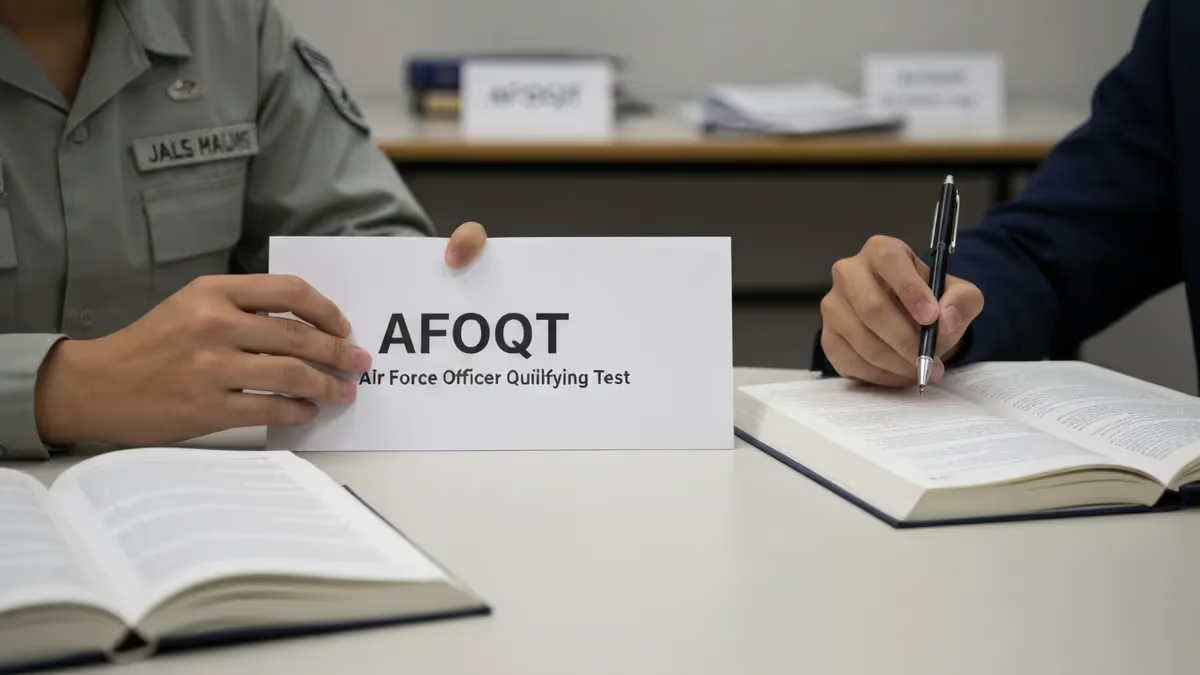
The AFOQT — the Air Force Officer Qualifying Test — stands between you and a commission as an Air Force officer. That's not hyperbole. Without a qualifying score, your application doesn't move forward. These afoqt study guide materials break down exactly what you need to prepare, which resources actually work, and where most candidates waste their time.
Here's the reality: the AFOQT covers 12 subtests across verbal, quantitative, and spatial domains. You can't cram for it the way you'd cram for a college midterm. The test measures aptitude — pattern recognition, reading speed, mental math — alongside learned knowledge in areas like aviation and science. That combination rewards sustained, targeted preparation over last-minute panic studying.
If you're looking for a solid afoqt practice test to start with, that's honestly the smartest first step. Taking a full-length practice exam before you even open a textbook tells you where you stand. Raw. Unfiltered. You'll know which subtests need heavy lifting and which ones you can maintain with light review.
Most candidates spend 4 to 8 weeks preparing. Some need longer — especially if math or spatial reasoning isn't your strong suit. The good news? Free resources exist. Paid ones do too. And the gap between them isn't as wide as publishers want you to believe.
One more thing before we dig in. The AFOQT isn't pass/fail in the traditional sense. You receive composite scores that feed into different career tracks — pilot, navigator, academic aptitude, verbal, quantitative. Your study strategy should reflect which composites matter most for your goals.

A quality afoqt practice test does more than quiz you on random facts. It simulates real testing conditions — timed sections, no calculator, answer-sheet format. That pressure changes how you perform. Candidates who only study content without practicing under time constraints consistently underperform on test day.
Your AFOQT scores determine which commissioning paths remain open to you. Pilot candidates need strong scores on the Pilot composite. Navigators focus on the Navigator-Technical composite. Academic roles lean on Verbal and Quantitative. Understanding this before you start studying saves weeks of misdirected effort.
The scoring works on a percentile basis — your raw scores get compared against everyone else who's taken the test. A score of 50 means you outperformed half of all test-takers. Most commissioning programs want to see scores above the 25th percentile at minimum, but competitive candidates typically land in the 60th to 90th range.
Don't ignore the subtests that feel easy. Verbal Analogies and Word Knowledge might seem straightforward, but they're timed aggressively. Thirty-five questions in 8 minutes for Word Knowledge means you've got roughly 14 seconds per question. Speed matters as much as accuracy.
Bottom line: your AFOQT scores shape your entire officer career trajectory. Pilot candidates live and die by their Pilot composite. If you want to fly, that number needs to be outstanding — not just passing.
When you're working through AFOQT practice questions, focus on understanding why wrong answers are wrong — not just memorizing correct ones. The test recycles question structures, not specific questions. If you understand the underlying pattern, you'll recognize it in unfamiliar contexts on exam day.
A good afoqt scores breakdown helps you set realistic targets. Your afoqt study guide should map each subtest to its composite score contribution. For example, Table Reading feeds into both the Navigator-Technical and Pilot composites. If you're pursuing a pilot slot, that subtest carries double weight in your preparation plan.
The best AFOQT practice questions come from sources that mirror the actual test format. Multiple-choice with five options. Timed. No partial credit. Free resources from military prep sites cover the basics well. Paid guides from publishers like Barron's or Trivium add depth — especially for math-heavy subtests where worked examples matter.
One mistake candidates make: studying all 12 subtests equally. That's inefficient. Your afoqt study guide should weight subtests by two factors — your current weakness and the composite scores you need. A future pilot struggling with Instrument Comprehension needs to prioritize that subtest over, say, Self-Description Inventory.
AFOQT Subtest Breakdown
Verbal Analogies — 25 questions in 8 minutes. Tests your ability to identify relationships between word pairs. Review vocabulary lists and practice identifying analogy types (cause/effect, part/whole, synonym/antonym).
Arithmetic Reasoning — 25 questions in 29 minutes. Word problems requiring basic math operations, percentages, ratios, and rate calculations. This subtest is more about reading comprehension than advanced math.
Word Knowledge — 25 questions in 5 minutes. Pure vocabulary. At 12 seconds per question, you either know the word or you don't — skip and move on if stuck.
Math Knowledge — 25 questions in 22 minutes. Algebra, geometry, basic trig, number theory. Most questions test concepts from high school math through pre-calculus.
AFOQT practice tests reveal gaps you didn't know existed. Most candidates overestimate their verbal skills and underestimate how much speed matters on quantitative subtests. A timed practice run changes that perception fast. Your afoqt score depends heavily on pacing — finishing 90% of questions accurately beats answering 70% perfectly and leaving the rest blank.
The AFOQT doesn't penalize wrong answers. That's huge. It means guessing is always better than leaving a question blank. Your test-taking strategy should account for this: when time runs short, bubble in your best guesses for remaining questions rather than leaving them empty.
Each of the five composite scores — Pilot, Combat Systems Officer, Academic Aptitude, Verbal, and Quantitative — pulls from different subtest combinations. The Pilot composite, for instance, weighs Table Reading, Instrument Comprehension, and Aviation Information most heavily. Knowing these weights lets you allocate your limited study time where it produces the highest return.
Fair warning: you only get two lifetime attempts at the AFOQT. If you don't score well the first time, you can retake it once — but there's a mandatory 150-day waiting period. Make your first attempt count by preparing thoroughly rather than treating it as a trial run.
The AFOQT test covers ground that most candidates haven't touched since high school — especially physical science and basic trigonometry. If you graduated five or more years ago, budget extra time for math review. Khan Academy fills this gap well, and it's free. Don't pay $200 for a prep course that covers the same algebra concepts available for zero dollars online.
Your afoqt study plan should span at least four weeks. Here's why: cognitive skills like spatial reasoning and reading speed improve with practice, not cramming. Studying 45 minutes daily for six weeks outperforms six hours daily for one week — the research on distributed practice is clear on this point.
The Self-Description Inventory catches people off guard. It's 240 questions, but they're personality-based — not knowledge-based. You can't study for them. Answer honestly and consistently. The AFOQT's built-in validity scales detect contradictory responses, and flagged profiles create problems during the officer selection process.
One resource most candidates overlook: talking to someone who recently took the afoqt practice questions test. Recent test-takers can tell you which subtests felt harder than expected, where time pressure was tightest, and what they wish they'd studied more. That firsthand intelligence is worth more than any book chapter.
AFOQT Preparation: Pros and Cons
- +The AFOQT is free to take — no registration fees, no hidden costs
- +Practice tests accurately predict real test performance when taken under timed conditions
- +Score reports show subtest-level breakdowns so you can target weak areas precisely
- +Multiple free study resources available online including official Air Force materials
- +Two lifetime attempts give you a safety net if the first attempt goes poorly
- +Composite scoring means a weak subtest doesn't automatically sink your overall results
- −Only two lifetime attempts — a failed retake permanently closes the door
- −The 150-day wait between attempts delays your commissioning timeline significantly
- −No calculator allowed on math subtests, which disadvantages calculator-dependent candidates
- −Self-Description Inventory results are opaque — you never see your personality scores
- −Study materials vary wildly in quality and some expensive guides add little over free options
- −Spatial reasoning subtests are difficult to improve through study alone — they test innate aptitude
AFOQT scoring uses a percentile system that compares your raw performance against the entire population of test-takers. The barrons afoqt guide explains this well: a Pilot composite score of 75 means you outperformed 75% of everyone who's taken the test. That percentile determines your competitiveness for specific career tracks within the Air Force.
Each composite score has different minimum thresholds depending on your commissioning source. ROTC, OTS, and the Air Force Academy may set different cutoffs. Check with your specific program for current minimums — they change periodically and published numbers online may be outdated.
You can't retake individual subtests. If your Pilot composite is strong but your Quantitative composite is weak, you'd need to retake the entire AFOQT to improve the weak score. That also means your strong scores could potentially drop on the retake. Think carefully before using your second attempt.
Scoring reports arrive within 8 to 10 business days after testing. Your recruiter or detachment commander receives them directly — you don't get mailed results. Follow up proactively if you haven't heard anything after two weeks.
AFOQT Study Checklist
- ✓Take a full-length diagnostic practice test under timed conditions before studying
- ✓Identify your two weakest subtests and allocate 40% of study time to them
- ✓Review high school algebra, geometry, and basic trigonometry for Math Knowledge
- ✓Build a vocabulary flashcard deck with 200+ words for Verbal Analogies and Word Knowledge
- ✓Study aviation fundamentals — aircraft controls, instruments, and flight principles
- ✓Practice Block Counting and Instrument Comprehension with visual-spatial exercises
- ✓Complete at least three full-length timed practice tests before your exam date
- ✓Review the official USAF AFOQT information pamphlet for current test format details
- ✓Practice mental math daily — no calculator allowed on quantitative subtests
- ✓Schedule your test date at least 6 weeks out to allow adequate preparation time
Looking for an afoqt practice test free option? You've got several. The official Air Force website provides sample questions for each subtest. Military prep forums share user-created practice sets. And sites like PracticeTestGeeks offer full-length AFOQT practice simulations with instant scoring — no credit card required, no registration walls.
The key to effective afoqt practice is realism. Sit down for the full 3.5 hours. No phone breaks. No pausing between subtests beyond the actual allowed transition time. Your brain needs to experience the fatigue curve that hits around subtest 8 or 9 — that's when focus lapses cause the most careless errors.
Time management separates high scorers from average ones. Each subtest has its own time limit, and they vary dramatically. Word Knowledge gives you 5 minutes for 25 questions — brutal. Reading Comprehension gives you 38 minutes for 25 questions — generous. Your pacing strategy should shift for each subtest rather than using one uniform approach.
Track your practice scores over time. You're looking for upward trends, not perfection. If your Arithmetic Reasoning score jumps from the 40th to the 60th percentile over three weeks, that's real progress. Plateaus after four-plus weeks of focused study usually mean it's time to switch your study method rather than study harder.
Worth knowing: many AFOQT practice resources online are outdated or misaligned with the current Form T. Verify the source before trusting any practice test. Questions referencing rotary dial instruments or pre-2014 subtest structures won't match what you'll see on test day.
The AFOQT exam tests a wider range of skills than most military aptitude assessments. Unlike the ASVAB — which focuses on enlisted career placement — the AFOQT measures officer-level reasoning, leadership judgment, and specialized knowledge areas like aviation. That breadth is what makes the air force officer qualifying test (afoqt) genuinely challenging.
If you're comparing the AFOQT to civilian standardized tests, think SAT meets pilot aptitude battery. The verbal and math sections feel familiar to anyone who's taken college entrance exams. But Block Counting, Instrument Comprehension, and Table Reading? Those subtests have no civilian equivalent. They require targeted preparation that general test-prep guides don't cover.
Your afoqt exam results feed into a larger officer selection package. Scores matter, but they're weighed alongside your GPA, physical fitness scores, commander's ranking, and personal statement. A strong AFOQT score with a weak GPA is better than vice versa — but competitive candidates excel across all dimensions.
The Air Force periodically updates the AFOQT. The current version is Form T, introduced in 2014. Content areas remain stable across versions, but question formats and timing can shift. Verify you're using study materials aligned with the current form — materials referencing Form S or earlier may have outdated subtest structures.
The bottom line on AFOQT exam preparation: start early, use timed practice tests, and target your weakest composites. Candidates who follow this approach consistently outscore those who rely on passive reading alone. Active recall and carefully simulated test conditions build exactly the muscle memory your brain needs under real pressure.
The AFOQT allows a maximum of two attempts in your lifetime. There's a mandatory 150-day waiting period between attempts. If you don't qualify after two tries, that door closes permanently. Prepare thoroughly for your first attempt — don't treat it as a practice run.
Understanding your AFOQT scores requires knowing how the percentile system works. Your raw score — the number of questions you answered correctly — gets converted to a percentile rank comparing you against all previous test-takers. An afoqt score of 70 on the Pilot composite means you performed better than 70% of the reference population. Not 70% correct — 70th percentile.
AFOQT results break down into five composite categories. The Academic Aptitude composite combines your Verbal and Quantitative performance. The Pilot composite weighs aviation-specific subtests heavily. Combat Systems Officer uses math and table-reading scores. Each composite serves a different career track, and minimum qualifying scores vary by commissioning source.
There's no single "passing score" for the AFOQT. Minimum thresholds depend on your commissioning program, career field, and the competitive landscape of your application cycle. ROTC scholarships might require a 25th-percentile minimum, while pilot training slots practically need 80th-percentile or higher on the Pilot composite.
Your scores explained simply: higher is better, but context matters. A 50th-percentile Quantitative score paired with a 90th-percentile Pilot score tells a very different story than uniform 60th-percentile scores across the board. Programs evaluate the composites relevant to your desired career field most heavily.
AFOQT Practice Test Questions
Prepare for the AFOQT - Air Force Officer Qualifying Test exam with our free practice test modules. Each quiz covers key topics to help you pass on your first try.
AFOQT General Science Biology and Chemistry
AFOQT Exam Questions covering AFOQT General Science Biology and Chemistry. Master AFOQT Test concepts for certification prep.
AFOQT Officer Aptitude Rating and Leadership
Free AFOQT Practice Test featuring AFOQT Officer Aptitude Rating and Leadership. Improve your AFOQT Exam score with mock test prep.
AFOQT - Air Force Officer Qualifying Arith...
AFOQT Mock Exam on - Air Force Officer Qualifying Arithmetic Reasoning Word Problems. AFOQT Study Guide questions to pass on your first try.
AFOQT - Air Force Officer Qualifying Aviat...
AFOQT Test Prep for - Air Force Officer Qualifying Aviation Information Concepts. Practice AFOQT Quiz questions and boost your score.
AFOQT - Air Force Officer Qualifying Block...
AFOQT Questions and Answers on - Air Force Officer Qualifying Block Counting Spatial Apperception. Free AFOQT practice for exam readiness.
AFOQT - Air Force Officer Qualifying Instr...
AFOQT Mock Test covering - Air Force Officer Qualifying Instrument Comprehension. Online AFOQT Test practice with instant feedback.
AFOQT - Air Force Officer Qualifying Mathe...
Free AFOQT Quiz on - Air Force Officer Qualifying Mathematical Knowledge Principles. AFOQT Exam prep questions with detailed explanations.
AFOQT - Air Force Officer Qualifying Physi...
AFOQT Practice Questions for - Air Force Officer Qualifying Physical Science Principles. Build confidence for your AFOQT certification exam.
AFOQT - Air Force Officer Qualifying Readi...
AFOQT Test Online for - Air Force Officer Qualifying Reading Comprehension Skills. Free practice with instant results and feedback.
AFOQT - Air Force Officer Qualifying Situa...
AFOQT Study Material on - Air Force Officer Qualifying Situational Judgment Scenarios. Prepare effectively with real exam-style questions.
AFOQT - Air Force Officer Qualifying Table...
Free AFOQT Test covering - Air Force Officer Qualifying Table Reading Skills. Practice and track your AFOQT exam readiness.
AFOQT - Air Force Officer Qualifying Verba...
AFOQT Exam Questions covering - Air Force Officer Qualifying Verbal Analogies. Master AFOQT Test concepts for certification prep.
The air force officer qualifying test afoqt consists of distinct sections that each demand different cognitive skills. AFOQT sections range from pure speed tests like Word Knowledge and Table Reading to reasoning-heavy assessments like Arithmetic Reasoning and Reading Comprehension. Understanding which sections test speed versus accuracy changes how you prepare for each one.
Speed-dominant subtests reward automatic responses. For Word Knowledge, either you recognize the word or you don't — spending 30 seconds deliberating wastes time without improving accuracy. For Table Reading, the skill is systematic coordinate lookup, and it improves dramatically with repetitive practice. These subtests respond well to drill-based preparation.
Reasoning-dominant subtests reward problem-solving strategies. Arithmetic Reasoning questions are word problems — the math itself is rarely harder than basic algebra, but parsing what the question actually asks trips people up. Practice translating word problems into equations quickly. Reading Comprehension requires you to distinguish between what the passage states and what it implies.
The Situational Judgment section is the wildcard. You can't study content for it — there's no factual knowledge being tested. Instead, it measures your alignment with Air Force leadership values. Read the Air Force core values document once, understand the leadership philosophy, and trust your instincts during the test. Overthinking these questions typically leads to worse scores.
Each AFOQT section feeds into specific composites differently. Table Reading contributes to both Pilot and CSO composites, making it a high-use subtest for aviation-track candidates. Knowing these connections lets you prioritize strategically rather than studying everything equally.
AFOQT Questions and Answers
About the Author

Registered Nurse & Healthcare Educator
Johns Hopkins University School of NursingDr. Sarah Mitchell is a board-certified registered nurse with over 15 years of clinical and academic experience. She completed her PhD in Nursing Science at Johns Hopkins University and has taught NCLEX preparation and clinical skills courses for nursing students across the United States. Her research focuses on evidence-based exam preparation strategies for healthcare certification candidates.