
ACLS Certification: How to Get Certified, Recertified & Stay Current
📗 Prepare for the ACLS Certification: How to Get certification. Practice questions with answer explanations covering all exam domains.
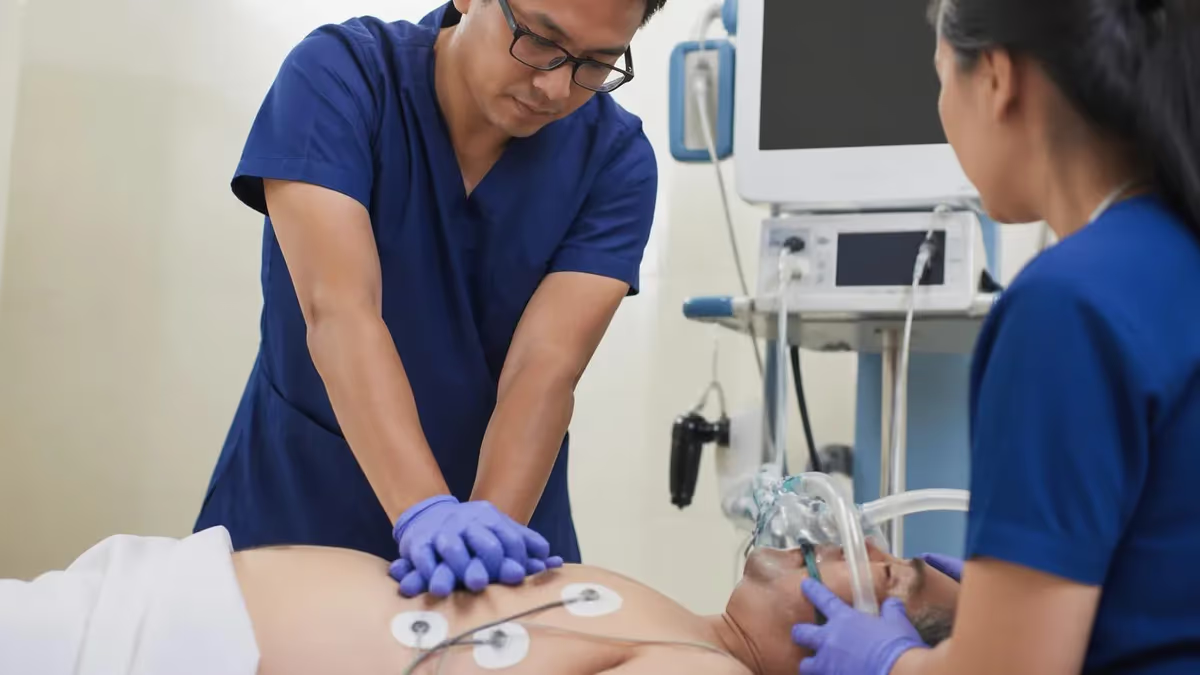
ACLS certification proves you can manage cardiac emergencies, stroke protocols, and acute arrhythmias. It's required for physicians, nurses, paramedics, respiratory therapists, and most hospital-based clinicians. The American Heart Association (AHA) sets the standard — and their ACLS Provider Course is what employers expect to see on your credentials. No AHA card, no code team. It's that simple.
Getting your AHA ACLS certification isn't as intimidating as it sounds. The course runs about 14 hours total (split across two days for classroom format), covers cardiac arrest algorithms, pharmacology, and team dynamics. You'll run through megacode scenarios where you lead a simulated resuscitation. If you already hold a current BLS card, you've handled the prerequisite. Most healthcare workers complete ACLS during their first year on the job — or earlier, during clinical rotations.
This guide covers everything: how the course works, what the exam looks like, where to find providers near you, online options, costs, renewal timelines, and how to look up your card if you've lost it. Whether you're getting certified for the first time or handling your third recertification cycle, we'll walk you through every step without the fluff.
Updated April 2026 | 10 min read

AHA ACLS Certification: What the Course Covers
The AHA ACLS certification course is built around the latest AHA Guidelines for CPR and Emergency Cardiovascular Care. You'll study cardiac arrest algorithms for VFib, pulseless VTach, PEA, and asystole. Bradycardia and tachycardia management algorithms round out the rhythm section. Pharmacology covers epinephrine, amiodarone, adenosine, atropine, and vasopressin — dosages, routes, and contraindications. It's dense, but the material is organized into clear decision trees.
If you're searching for ACLS certification near me, start with the AHA's course connector tool at heart.org. It shows authorized Training Centers in your ZIP code. Hospitals, community colleges, fire departments, and private training companies all host AHA-approved courses. Class sizes typically range from 6 to 24 students, with a 6:1 student-to-instructor ratio for skills stations. The smaller the class, the more hands-on practice you get during megacode scenarios.
Beyond cardiac arrest, the ACLS course covers acute coronary syndromes, stroke recognition using the Cincinnati Prehospital Stroke Scale, and post-cardiac-arrest care. Team dynamics — closed-loop communication, role assignments, constructive intervention — get significant attention. These "soft skills" matter because real codes are chaotic, and the team leader sets the tone. You'll practice leading and participating in simulated codes multiple times before the final evaluation.
ACLS Certification Online: How It Works
ACLS certification near me isn't always convenient — maybe you work nights, live in a rural area, or just can't commit to two consecutive classroom days. That's where ACLS certification online comes in. The AHA offers a HeartCode ACLS blended learning option: you complete the cognitive portion online at your own pace (usually 6 to 8 hours), then attend a hands-on skills session at an authorized Training Center. The skills session typically runs 2 to 3 hours.
So what is ACLS certification online really like? The HeartCode platform uses adaptive learning — it adjusts difficulty based on your responses and focuses on areas where you're weak. You work through case-based scenarios, watch video demonstrations, and take knowledge checks after each module. It's self-paced, so you can spread it across days or knock it out in a single sitting. The final cognitive exam is included in the online portion. If you pass, you print a certificate and bring it to your skills session.
Third-party online ACLS courses exist too — companies like ACLS Medical Training and United Medical Education. These are typically cheaper ($150 to $200 versus $250+ for AHA HeartCode). However, not all employers accept non-AHA cards. Check with your HR department or credentialing office before enrolling. Hospitals and most EMS agencies require the AHA-branded card specifically. Don't waste money on a card your employer won't recognize.
ACLS Course Formats Compared
The traditional classroom ACLS course runs 14 hours over 2 days. Day 1 covers didactic content — algorithms, pharmacology, ECG interpretation. Day 2 focuses on hands-on practice and the megacode evaluation. You'll work in small groups rotating through skills stations: airway management, defibrillation, IV/IO access, and team leader scenarios. The written exam happens at the end of Day 2. Classroom courses cost $200 to $350 depending on the provider and location.
The ACLS Exam: Written Test and Megacode Evaluation
The ACLS certification course culminates in two assessments: a 50-question written exam and a megacode skills test. The written exam is open-resource — you can use the ACLS Provider Manual during the test. That said, if you haven't studied, flipping through 300 pages under time pressure won't save you. The passing score is 84%, which means you can miss 8 questions. Most questions focus on algorithm steps, drug dosages, and rhythm recognition.
The megacode is where most people get nervous. You'll lead a simulated cardiac arrest scenario from start to finish. The mannequin goes into VFib — you call for the defibrillator, order epinephrine, assign roles, manage the airway. The instructor throws curveballs: the rhythm changes, the patient develops ROSC, then re-arrests. You need to demonstrate systematic assessment, appropriate interventions, and clear team communication. The ACLS card lookup system tracks your pass/fail status — once you pass both components, your provider card generates automatically in the AHA's eCard system.
If you fail either component, most Training Centers allow one same-day remediation attempt. Fail again, and you'll need to retake the full course. About 15% of first-time candidates fail the megacode on their initial attempt — it's the practical pressure, not the content knowledge, that gets them. Practice running mock codes with colleagues before your course date.
Finding ACLS Training Providers
ACLS training online through the AHA's HeartCode platform is the most flexible option, but in-person remains the gold standard for hands-on confidence. When searching for providers, check that they're authorized by an AHA Training Center. The AHA's website has a course finder — enter your ZIP code and filter by "ACLS Provider" or "ACLS Renewal." You'll see dates, locations, costs, and available seats. For ACLS certification online, select the HeartCode option.
Hospital-based Training Centers tend to have the best equipment — high-fidelity mannequins, real defibrillators, and experienced instructor-paramedics or critical care nurses. Community-based providers vary more in quality. Before you register, ask how many students will be in your class, what brand of mannequin they use, and whether they provide the ACLS Provider Manual or require you to buy it separately ($40 to $50). Some courses include the manual in the tuition; others don't. ACLS certification lookup through the AHA portal lets you verify any provider's authorization status.
Military and government employees often have access to free or reduced-cost ACLS training through their agencies. VA hospitals, military treatment facilities, and fire departments frequently host courses for their staff. If you work in one of these settings, check with your training coordinator before paying out of pocket — you may be covered entirely.
Online vs In-Person ACLS Certification
- +Online cognitive portion is self-paced — study on your schedule, not a fixed classroom day
- +Blended format reduces in-person time from 14 hours to 2-3 hours for skills only
- +Adaptive learning technology targets your weak areas for more efficient studying
- +Same AHA provider card regardless of format — employers can't tell the difference
- +Lower total time commitment makes recertification less disruptive to your work schedule
- +Online precourse materials are accessible from any device with internet
- −Hands-on skills session is still required — you can't go 100% online for AHA certification
- −Some learners retain less from self-study than from instructor-led classroom discussion
- −Third-party (non-AHA) online cards are rejected by many hospitals and EMS agencies
- −Skills session availability may be limited in rural areas — you might drive 1-2 hours
- −Blended courses still cost roughly the same as full classroom courses ($250-$350)
- −Self-paced format requires self-discipline — easy to procrastinate and cram last minute
Pros and Cons at a Glance
| Pros | Cons |
|---|---|
| Online cognitive portion is self-paced — study on your schedule, not a fixed classroom day | Some learners retain less from self-study than from instructor-led classroom discussion |
| Adaptive learning technology targets your weak areas for more efficient studying | Third-party (non-AHA) online cards are rejected by many hospitals and EMS agencies |
| Same AHA provider card regardless of format — employers can't tell the difference | Self-paced format requires self-discipline — easy to procrastinate and cram last minute |
ACLS and PALS Certification: Related Credentials
Many healthcare workers hold multiple AHA certifications. ACLS and PALS certification often get bundled together — hospitals require both for anyone working in emergency departments, ICUs, or pediatric units. PALS (Pediatric Advanced Life Support) follows a similar format to ACLS but focuses on pediatric emergencies: respiratory distress, shock management, and pediatric cardiac arrest algorithms. If you need both, some Training Centers offer back-to-back scheduling so you knock out both in a single weekend.
Your ACLS cards — whether physical or digital eCards — are issued through the AHA's online system. Since 2020, the AHA has transitioned to digital eCards as the primary format. You'll receive an email with your eCard link immediately after passing your course. The eCard is valid for credentialing — print it or save the PDF. Some older Training Centers still issue paper cards alongside eCards, but the digital version is the official record. Lost your card? You can reprint it from the AHA website anytime during its validity period.
BLS is a prerequisite for ACLS. You must hold a current BLS Provider card before enrolling in an ACLS course. If your BLS is expired, you'll need to renew it first. Some Training Centers offer combo BLS+ACLS courses that let you do both in sequence — BLS on Day 1, ACLS on Days 2-3. These combo courses save time and often cost less than booking separately.
ACLS Certification Preparation Checklist
- ✓Confirm your BLS Provider card is current (ACLS prerequisite)
- ✓Register for an AHA-approved ACLS Provider Course or HeartCode ACLS
- ✓Purchase or download the ACLS Provider Manual (2020 or later edition)
- ✓Complete the ACLS precourse self-assessment at heart.org
- ✓Review cardiac arrest algorithms: VFib/pVTach, PEA/asystole
- ✓Study bradycardia and tachycardia management algorithms
- ✓Memorize key drug dosages: epinephrine, amiodarone, adenosine, atropine
- ✓Practice ECG rhythm interpretation — especially 12-lead basics
- ✓Review team dynamics: closed-loop communication, role clarity, debriefing
- ✓Take at least two full-length ACLS practice tests before your course date
ACLS Recertification: When and How to Renew
So what is ACLS certification renewal all about? Your ACLS card expires 2 years from the date of issue. No grace period. If it lapses, you're technically uncertified — and some employers flag lapsed credentials in your personnel file. The ACLS recert process is shorter than the initial course: 6 to 8 hours for classroom renewal or about 3 hours online plus a brief skills check. You must hold a current or recently expired card to take the renewal course instead of the full initial provider course.
How recently expired is "recently"? The AHA allows you to take the renewal course within 30 days after your card's expiration date. After that, most Training Centers require the full initial course. Don't push it. Set a calendar reminder 90 days before your card expires, find a renewal course, and book it. Renewal courses cost $125 to $250 — significantly less than the $250 to $350 initial course. The renewal exam covers the same content but assumes you already know the fundamentals.
Some employers reimburse ACLS renewal costs. Check your benefits package — many hospitals cover continuing education expenses including AHA certifications. If your employer doesn't reimburse, the cost is tax-deductible as a professional development expense in most cases. Keep your receipt and eCard documentation for your records.
ACLS and BLS Recertification Together
ACLS and BLS recertification often fall on similar timelines since both certifications last 2 years. Smart clinicians align their renewal dates — when you recertify ACLS, renew BLS the same week. Some Training Centers offer combined renewal courses that cover both in a single day, saving you the hassle of scheduling two separate sessions. These combo renewals typically run $175 to $275 total.
How long is ACLS good for after you renew? Same as the initial certification — exactly 2 years from the date you pass the renewal course. The clock resets completely regardless of whether you renewed early or at the last minute. There's no penalty or shortened validity for late renewal. However, if you let it lapse entirely and have to retake the full initial course, some Training Centers won't give you any credit for your previous training. You start from scratch.
Track your certifications in a dedicated folder — digital or physical. Keep copies of your BLS card, ACLS card, PALS card (if applicable), and any employer-specific competency verifications together. Credentialing departments at hospitals request these documents during onboarding and annually during re-credentialing. Having them organized saves last-minute scrambling. The AHA's online portal stores your eCards, but always download a backup PDF.
Your ACLS certification is valid for exactly 2 years — no grace period, no exceptions. If it expires, many employers remove you from code teams and critical care assignments until you recertify. Set a reminder 90 days before expiration. The renewal course is shorter and cheaper than the initial course, but only available within 30 days of expiration. After that, you take the full course again at full price.
How to Look Up Your ACLS Card
Lost your ACLS card? Need to verify someone else's certification? The AHA's eCard system handles both. To look up your ACLS card, go to heart.org/cpr and sign into your AHA account with the email you used during your course. Your current and previous eCards appear under "My Courses." You can reprint, share a verification link, or download the PDF. If you took your course before the eCard system launched (pre-2020), contact your original Training Center — they maintain records for 5 years minimum.
For employers running credential checks, the AHA offers a verification portal. Credentialing specialists can verify any AHA card by entering the student's name, card ID number, or Training Center information. This system catches fraudulent cards — and yes, fake ACLS cards are a real problem in healthcare. If you complete an ACLS course online through a non-AHA provider, make sure the card includes a verifiable ID number. Cards without verification capability raise red flags during hospital audits.
The AHA eCard system also sends expiration reminders. About 90 days before your card expires, you'll receive an email nudging you to schedule renewal. These reminders are helpful, but don't rely on them exclusively — they go to spam folders, get filtered by hospital email systems, or get lost in inbox clutter. Set your own independent reminder in whatever calendar you actually check daily.
ACLS Practice Test Questions
Prepare for the ACLS - Advanced Cardiovascular Life Support exam with our free practice test modules. Each quiz covers key topics to help you pass on your first try.
ACLS Airway Management
ACLS Exam Questions covering ACLS Airway Management. Master ACLS Test concepts for certification prep.
ACLS Airway Management and Ventilation
Free ACLS Practice Test featuring ACLS Airway Management and Ventilation. Improve your ACLS Exam score with mock test prep.
ACLS Cardiac Rhythm Recognition
ACLS Mock Exam on ACLS Cardiac Rhythm Recognition. ACLS Study Guide questions to pass on your first try.
ACLS Cardiac Rhythms and ECG Interpretation
ACLS Test Prep for ACLS Cardiac Rhythms and ECG Interpretation. Practice ACLS Quiz questions and boost your score.
ACLS - Advanced Cardiovascular Life Suppor...
ACLS Questions and Answers on - Advanced Cardiovascular Life Support ACLS Emergency Pharmacology. Free ACLS practice for exam readiness.
ACLS - Advanced Cardiovascular Life Suppor...
ACLS Mock Test covering - Advanced Cardiovascular Life Support Acute Coronary Syndromes. Online ACLS Test practice with instant feedback.
ACLS - Advanced Cardiovascular Life Suppor...
Free ACLS Quiz on - Advanced Cardiovascular Life Support Acute Stroke Care. ACLS Exam prep questions with detailed explanations.
ACLS - Advanced Cardiovascular Life Suppor...
ACLS Practice Questions for - Advanced Cardiovascular Life Support BLS and High-Quality CPR. Build confidence for your ACLS certification exam.
ACLS - Advanced Cardiovascular Life Suppor...
ACLS Test Online for - Advanced Cardiovascular Life Support Post-Cardiac Arrest Care. Free practice with instant results and feedback.
ACLS - Advanced Cardiovascular Life Suppor...
ACLS Study Material on - Advanced Cardiovascular Life Support Tachycardia and Bradycardia Algorithms. Prepare effectively with real exam-style questions.
ACLS Advanced Cardiovascular Life Support
Free ACLS Test covering Advanced Cardiovascular Life Support. Practice and track your ACLS exam readiness.
ACLS Bradycardia
Free ACLS Practice Test featuring Bradycardia. Improve your ACLS Exam score with mock test prep.
ACLS Medical Training
ACLS Mock Exam on Medical Training. ACLS Study Guide questions to pass on your first try.
ACLS Certification Cost and What You're Paying For
ACLS certification cost varies by provider, format, and location. Initial ACLS Provider Courses typically run $200 to $350. That includes instructor time, mannequin use, defibrillator practice, and your AHA eCard. The ACLS Provider Manual is sometimes included; sometimes it's an extra $40 to $50. Renewal courses cost less — $125 to $250 — because they're shorter and assume prior knowledge.
How long does ACLS certification last relative to the cost? Two years. That works out to roughly $8 to $15 per month for your certification — less than a streaming subscription. When you factor in the career opportunities ACLS opens (ICU, ER, flight nursing, code team eligibility), the return on investment is hard to argue against. Some employers reimburse the full cost. Others cover part of it through continuing education budgets. Always ask.
Watch out for hidden costs. Some providers charge extra for the Provider Manual, retake attempts, or skills-session scheduling. Get the total cost in writing before you register. If a deal looks too good to be true — say, $75 for "full ACLS certification" — it's probably a non-AHA provider whose card your employer won't accept. The cheapest option isn't always the smartest one when your clinical credentialing is on the line. Spend the money on an official AHA course — it's worth it every single time.
ACLS Questions and Answers
About the Author

Attorney & Bar Exam Preparation Specialist
Yale Law SchoolJames R. Hargrove is a practicing attorney and legal educator with a Juris Doctor from Yale Law School and an LLM in Constitutional Law. With over a decade of experience coaching bar exam candidates across multiple jurisdictions, he specializes in MBE strategy, state-specific essay preparation, and multistate performance test techniques.
Join the Discussion
Connect with other students preparing for this exam. Share tips, ask questions, and get advice from people who have been there.
View discussion (8 replies)