
ServSafe Practice Test 2026 October — Free Questions With Answers
Free ServSafe practice test with questions and answer explanations. 🧠 Prepare for the 2026 October exam with instant scoring.
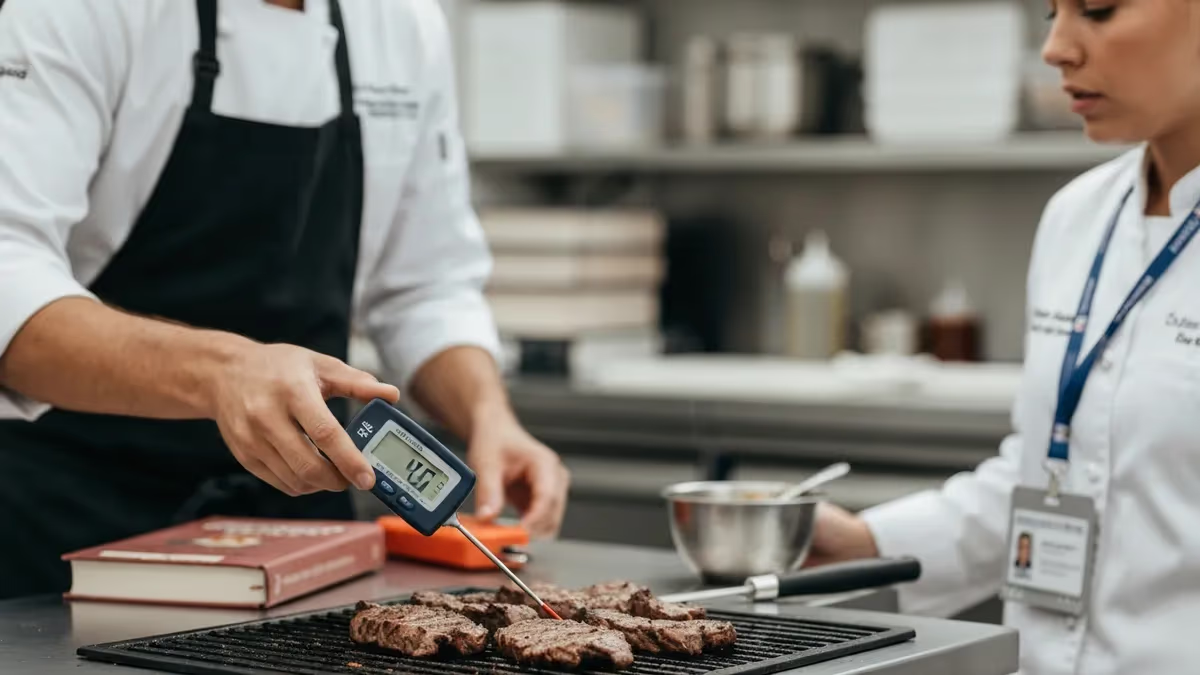
A servsafe practice test is the fastest way to find out whether you're ready for the real exam—or whether you've got gaps that could cost you a passing score. The ServSafe certification program, run by the National Restaurant Association, covers everything from foodborne pathogens to safe storage temperatures. Millions of food service workers take it every year. Most fail because they underestimate the detail.
If you are searching for a free ServSafe practice test, start with the free questions on this page: every answer comes with an explanation, and the study notes below cover the ServSafe Food Safety Practice Test exam topics in order. (Plenty of people type "safe serve practice test" into Bing or Google—it is the same ServSafe exam, and this page covers it.)
This page gives you free servsafe manager practice test questions across every major topic: food handler safety, manager-level protocols, alcohol service regulations, cross-contamination prevention, and cleaning procedures. Each question comes with an answer explanation so you actually learn the material instead of just guessing. Whether you're a first-time test-taker or renewing your certification, you'll find targeted quizzes below that match the real exam format.
The ServSafe Manager exam has 90 multiple-choice questions. You've got two hours. The passing score is 70%, which means 56 correct answers out of the 80 scored questions. That might sound generous—until you realize some questions test obscure temperature ranges or specific holding times that trip up even experienced kitchen managers. Practicing with realistic questions is the single best way to avoid surprises on exam day. The quizzes below are organized by topic so you can focus your study time where it counts. Start with any quiz below and see where you stand.

What changed for the ServSafe exam in 2026
- The ServSafe Manager exam has 90 multiple-choice questions, 10 of which are unscored pilot items; you pass with 70% or higher, meaning at least 56 of the 80 scored questions correct. (source)
- The ServSafe Food Handler assessment is 40 questions, non-proctored, with no time limit (most people finish in about 90 minutes); the passing score is 75%, and you get 3 attempts before buying a new course. (source)
- Certificate validity: the National Restaurant Association recognizes ServSafe Manager for five years and ServSafe Food Handler, Alcohol and Allergens for three years; state or employer rules can be shorter. (source)
- Current servsafe.com prices (USD, September 2026): Manager Exam access code or printed voucher $38.99; Manager Exam at a Pearson VUE testing center or online-proctored $99.00; Manager Online Course $125.00; Online Course + Exam bundles $152.95 (access code) to $179.00 (online proctor or test center); Manager Book 7th Edition $50.50. (source)
- The ServSafe Manager exam must be administered by a registered proctor (classroom, Pearson VUE test center, or online proctoring); a retest requires a new exam purchase, you may test twice within 30 days, then must wait 60 days after a second failed attempt, with no more than four attempts in 12 months. (source)
- Online courses expire: unused courses are valid one year from purchase; once started, the Food Handler course must be completed within 60 days and the Manager course within 90 days. (source)
- The ServSafe Coursebook Ninth Edition is now available, updated to align with the Supplement to the 2022 FDA Food Code; the ServSafe Manager Book 7th Edition and Coursebook 8th Edition remain on sale. (source)
- The FDA released the 2026 Food Code on September 17, 2026 (replacing the 2022 edition as the model code); ServSafe has not yet announced exam changes for it, so 2026 exams still follow the 2022 Food Code and its Supplement. (source)
Last verified: September 18, 2026 against servsafe.com (National Restaurant Association) and fda.gov.
The servsafe manager practice test focuses on scenarios you'd face running a commercial kitchen. Think: a delivery arrives at 45°F when it should be below 41°F. Do you accept it? Reject it? Ask for a credit? These judgment calls form the backbone of the exam. You don't just memorize facts—you apply food safety principles to messy, real-world situations.
Taking multiple servsafe manager practice tests before your scheduled exam date helps you internalize the decision-making framework. The exam really isn't trying to trick you. It's testing whether you can protect public health under pressure. Topics include HACCP plans, allergen management, employee illness policies, and integrated pest management. Each area has its own question style, so practicing broadly matters.
The manager certification is the gold standard in food service. Employers require it. Health departments look for it. If you're supervising any part of food preparation, storage, or service, this credential makes you legally accountable—and professionally credible. Don't walk in cold. Use the practice questions below to build genuine confidence, not false hope. Every question you encounter here mirrors the format, difficulty, and topic distribution of the actual exam—so the experience translates directly to test day performance.
Updated servsafe practice tests reflect the current ServSafe materials—the ServSafe Manager Book (7th Edition) and the new ServSafe Coursebook Ninth Edition, which is aligned to the Supplement to the 2022 FDA Food Code. Older study guides won't help you here. Temperature thresholds, holding times, and even some allergen protocols changed between editions. If your practice material references outdated standards, you're training yourself to pick the wrong answer.
The servsafe practice test 2025 questions on this page follow the latest guidelines from the FDA Food Code. We update them regularly so you're never studying stale content. Each quiz targets a specific exam domain, which means you can zero in on weak spots instead of grinding through topics you already know. That targeted approach saves hours of study time. If you like studying offline, a servsafe practice test pdf download is handy for the commute or the break room—but do your timed runs on screen, because the real exam is taken online or on a printed answer sheet under a proctor, not from a study sheet.
Here's something most study guides won't tell you: the exam recycles question patterns. Not exact questions—patterns. If you've worked through enough practice sets, you'll start recognizing the structure. A question about time-temperature abuse at receiving looks different from one at service, but the underlying logic is identical. Pattern recognition comes from volume. The more servsafe practice tests you complete, the sharper your instincts get.
Another benefit of doing regular practice: you'll start noticing how distractors work. Wrong answers on the ServSafe exam often contain real food safety terms used in the wrong context. "Sanitize before cleaning" sounds plausible if you're not paying attention—but the correct order is always clean first, then sanitize. Practice exposes these traps before the real exam does.
ServSafe Certification Types Explained
The ServSafe Manager certification is the most widely recognized food safety credential in the United States. It covers all seven exam domains—from foodborne microorganisms to facility and equipment standards. You must score 70% (56 of the 80 scored questions) on a proctored 90-question exam. The certification lasts five years, after which you'll need to recertify. Most states accept it as the required food protection manager certification under their health codes.
If you're prepping for the servsafe managers practice test, focus on the questions that test application—not just recall. The exam writers love scenario-based questions where you must choose the safest action. For example: a cook sneezes near the prep table. What should happen next? The answer isn't just "wash hands." It's discard exposed food, wash hands, and change gloves. Getting partial credit isn't an option.
A servsafe practice test with answers is worth ten times more than a simple flashcard set. When you see the correct answer and understand why it's correct, the knowledge sticks. Every quiz on this page includes detailed explanations that reference the actual ServSafe coursebook. That way you're not just memorizing—you're learning the reasoning behind each food safety rule.
Temperature control dominates the exam. The danger zone (41°F–135°F), the four-hour rule, cooling from 135°F to 70°F in two hours then to 41°F in four more—these numbers show up constantly. If you can nail every temperature question, you've probably passed. But "probably" isn't good enough when your job depends on it. Keep practicing until the numbers feel automatic.
The servsafe exam practice test questions on this page cover every topic the real exam does—including the ones people skip because they seem boring. Facility management and pest control don't sound exciting, but they account for a solid chunk of questions. Knowing the difference between an air gap and an air curtain could be the question that pushes you past the 70% threshold.
For the servsafe food handler practice test, the material is simpler but still matters. Food handler certification is often the bare minimum for employment. Some employers and health departments still call it the ServSafe basic food safety updated test, because the assessment follows the current FDA Food Code rather than an older syllabus. Fail it, and you can't legally work in most commercial kitchens. The good news: the pass rate is high because the questions are straightforward. The bad news: some people still fail because they don't practice at all. Don't be that person. Spend 30 minutes with the quizzes here and you'll walk in ready.
Cross-contamination is the exam topic that separates strong candidates from average ones. Everyone knows raw chicken shouldn't touch cooked food. But what about storing raw fish above raw beef? The correct storage order—from top to bottom—is ready-to-eat food, seafood, whole cuts of beef/pork, ground meat, then poultry. Getting this order wrong on the exam costs you one or two questions minimum. It's an easy win if you memorize it.
Chemical contamination is another subtopic people overlook. Storing cleaning supplies above food prep areas, using unlabeled spray bottles, or transferring chemicals to unmarked containers—all of these violate food safety codes. The exam will test whether you can identify chemical hazards in realistic kitchen layouts.
Pros and Cons of ServSafe Certification
- +Recognized by health departments in all 50 states
- +Boosts your resume for management positions in food service
- +Five-year validity means you don't recertify annually
- +Online and in-person exam options give you scheduling flexibility
- +Detailed coursebook covers real-world food safety scenarios
- +Employers often pay for the exam and study materials
- −Exam fee ($36–$78) plus coursebook cost ($50+) adds up
- −Manager exam requires a proctor—no unsupervised testing
- −Five-year renewal means retaking the full exam, not just a refresher
- −Some states require additional local certifications beyond ServSafe
- −Study material is dense—plan for 8–16 hours of preparation
- −Exam is only offered in English and Spanish (limited language options)
Repetition is the key to servsafe practice test questions sticking in your memory. Don't just take each quiz once. Hit the same topics two or three times on different days. Spaced repetition—coming back to material after a gap—is one of the most evidence-backed study methods in cognitive science. Your brain consolidates information during the breaks between sessions.
When you practice servsafe test questions repeatedly, something shifts. You stop reading each option carefully and start spotting the wrong answers instantly. That speed really matters on exam day. Two hours for 90 questions sounds generous, but some scenarios require careful reading. If you can blow through the easy questions in 30 seconds each, you'll have extra time for the tricky ones.
Carefully track your scores as you go. If you're consistently scoring above 80% on these practice quizzes, you're in great shape for the real thing. Below 70%? Focus on the domains where you're weakest. The structure cards above show you the four big areas—identify which one is dragging your score down and hammer it with targeted practice. Don't waste time reviewing topics you've already mastered.
Your ServSafe Study Checklist
- ✓Get the current ServSafe Manager Book (7th Edition) or ServSafe Coursebook (Ninth Edition) or eBook
- ✓Take an initial practice test to baseline your knowledge
- ✓Review the danger zone temperatures (41°F–135°F) until automatic
- ✓Memorize minimum internal cooking temperatures for all protein types
- ✓Study the Big Six foodborne pathogens and their associated foods
- ✓Practice proper cooling procedures: 135°F→70°F in 2 hrs, 70°F→41°F in 4 hrs
- ✓Learn the three-compartment sink procedure step by step
- ✓Review HACCP principles and how to identify critical control points
- ✓Take at least three full-length practice exams under timed conditions
- ✓Register for your exam date and confirm proctor requirements
The servsafe food manager practice test covers leadership-level material. You're not just answering what's safe—you're answering what a manager should do when something goes wrong. An employee shows up with jaundice. A walk-in cooler breaks overnight. A customer reports an allergic reaction. Each scenario tests your ability to protect guests, comply with health codes, and document the incident properly.
For servsafe test practice, treat each quiz session like a mini exam. Set a timer. Eliminate distractions. Answer every question before checking results. This builds the mental endurance you'll need during the actual two-hour exam. Casual studying—flipping through flashcards while watching TV—doesn't build the focused recall that multiple-choice exams demand.
One more thing most prep guides ignore: read the question stem carefully. The ServSafe exam loves qualifiers like "most important," "first step," and "best practice." Two answers might both be correct, but one is more correct in context. If the question asks for the "first step" after a foodborne illness complaint, calling the health department isn't wrong—but securing the suspected food is what happens first. Practice tests train you to catch these distinctions.
Process of elimination works remarkably well on multiple-choice food safety questions. Usually one or two options are clearly wrong—like "do nothing" or an action that would create a new hazard. Eliminating those first makes the remaining choices much easier to evaluate. This technique alone can boost your score by five to ten percentage points on the actual ServSafe certification exam.
Looking for a servsafe practice test 2026 that's still relevant? Good news: ServSafe's current materials (the ServSafe Manager Book 7th Edition, still sold on servsafe.com, and the ServSafe Coursebook Ninth Edition, aligned to the Supplement to the 2022 FDA Food Code) cover the same core content, so questions from 2024 and 2025 remain valid for 2026 exams. The FDA published the 2026 Food Code on September 17, 2026; ServSafe has not yet announced an exam or coursebook revision for it. That said, always double-check your study materials against the official ServSafe website to confirm nothing's shifted.
For a servsafe manager practice test online, you've got everything you need right here. No signup required. No paywall. Just click any quiz tile on this page and start answering questions immediately—every quiz here is a servsafe practice test free to retake as many times as you need. Each quiz gives you instant feedback—correct or incorrect—along with a detailed explanation. That instant loop between question, answer, and explanation is what makes online practice so effective compared to reading a textbook cover to cover.
Some candidates wonder whether online practice tests are "as good" as the official ServSafe practice exam. Here's the honest answer: the official exam costs money and only gives you one attempt. Free practice tests let you take unlimited attempts across every domain. You'll see more question variety, identify more weak spots, and build more confidence. Use the official exam as a final check—but do the heavy lifting here first.
Rote memorization fails on the ServSafe exam because questions are scenario-based. You'll see situations you've never encountered before and need to apply food safety principles on the spot. Focus on understanding why each rule exists—for instance, the danger zone matters because bacteria double every 20 minutes between 41°F and 135°F. When you understand the science, you can reason through any question.
A dedicated servsafe manager exam practice test simulates the pressure and pacing of the real thing. The manager exam is harder than the food handler exam—there's no debating it. Questions require you to evaluate situations from a management perspective, considering liability, employee training responsibilities, and regulatory compliance alongside basic food safety. If you can pass a well-designed practice manager exam, the real one won't surprise you.
When you take a manager servsafe practice test, pay special attention to HACCP-related questions. Hazard Analysis and Critical Control Points is a systematic approach to food safety that the exam tests heavily. You'll need to identify biological, chemical, and physical hazards at each step of the food flow—from purchasing and receiving through storage, preparation, cooking, holding, cooling, and reheating. It sounds like a lot because it is. But HACCP follows a logical sequence, and once you see the pattern, it clicks.
The manager-level material also covers employee health policies in depth. When must a food handler be excluded from work versus restricted to non-food duties? The answer depends on the specific illness or symptom. Vomiting and diarrhea mean exclusion. A sore throat with fever means restriction (if the establishment serves a high-risk population) or exclusion. Jaundice means immediate exclusion and reporting to the health department. These distinctions are exam favorites, and practice is the only way to keep them straight.
ServSafe Practice Test Questions
Prepare for the ServSafe Food Safety Practice Test exam with our free practice test modules. Each quiz covers key topics to help you pass on your first try.
ServSafe Foodborne Illnesses and Allergens
ServSafe Exam Questions covering Foodborne Illnesses and Allergens. Master ServSafe Test concepts for certification prep.
ServSafe Personal Hygiene and Health
Free ServSafe Practice Test featuring Personal Hygiene and Health. Improve your ServSafe Exam score with mock test prep.
ServSafe Preventing Cross-Contamination
ServSafe Mock Exam on Preventing Cross-Contamination. ServSafe Study Guide questions to pass on your first try.
ServSafe Safe Food Handling Practices
ServSafe Test Prep for Safe Food Handling Practices. Practice ServSafe Quiz questions and boost your score.
ServSafe Alcohol Test - Primary and Advanced
ServSafe Questions and Answers on Alcohol Test - Primary and Advanced. Free ServSafe practice for exam readiness.
ServSafe Cleaning and Sanitizing Procedures
ServSafe Mock Test covering Cleaning and Sanitizing Procedures. Online ServSafe Test practice with instant feedback.
ServSafe Food Contamination and Allergens
Free ServSafe Quiz on Food Contamination and Allergens. ServSafe Exam prep questions with detailed explanations.
ServSafe HACCP System Implementation
ServSafe Practice Questions for HACCP System Implementation. Build confidence for your ServSafe certification exam.
ServSafe Manager Exam
ServSafe Test Online for Manager Exam. Free practice with instant results and feedback.
ServSafe Proper Personal Hygiene
ServSafe Study Material on Proper Personal Hygiene. Prepare effectively with real exam-style questions.
For anyone searching for a servsafe manager practice test 90 questions and answers, here's what you need to know: the real exam is exactly 90 questions, but 10 of those are pilot questions that don't count toward your score. You won't know which ones are pilots. That means you're really being graded on 80 questions, with a passing threshold of 56 correct answers out of 80 scored questions (70%, per the official ServSafe FAQ). A servsafe test 90 questions and answers set is only useful if it is built the same way—full length, mixed topics, and an explanation on every item—and practicing with 90-question sets conditions you for the full exam length.
The servsafe manager practice test 2026 content on this page aligns with the current ServSafe Manager curriculum (Manager Book 7th Edition / Coursebook Ninth Edition). We've mapped every quiz to specific chapters from the coursebook so you can cross-reference your wrong answers with the source material. That study loop—practice, review, re-read, practice again—is how top scorers prepare. They don't rely on a single pass through the material.
Don't rush your preparation. Most people who fail the ServSafe Manager exam studied for fewer than six hours total. The National Restaurant Association recommends 12–16 hours of preparation, including coursebook reading and practice exams. Spread that over two weeks—roughly an hour a day—and you'll retain far more than cramming the night before. Your score will reflect the work you put in, and these free practice tests make that work as efficient as possible.
One final tip: review your wrong answers immediately after each practice session. Write down the topic, the correct answer, and a one-sentence explanation of why you missed it. After a few sessions, you'll have a personalized cheat sheet of your weakest areas. Study that sheet the night before your exam—it's worth more than rereading entire chapters.
ServSafe Test 90 Questions and Answers: How Scoring Really Works
The official ServSafe FAQ spells out the numbers most study guides get wrong. The ServSafe Food Protection Manager Examination has 90 multiple-choice questions, but 10 of them are pilot questions used for research only and do not count. Your result is based on the other 80, and the passing score is 70%: at least 56 correct answers out of 80 scored questions. Since you cannot tell which 10 are pilots, treat every question as live.
Delivery matters too. The manager exam must be administered by a Registered ServSafe Proctor—in a classroom, at a Pearson VUE test center, or online through remote proctoring—and you cannot proctor it for yourself. If you fail, you can retest, but you need a new Exam Access Code (online) or Exam Answer Sheet (print), and the retake must also be proctored. By contrast, the ServSafe Food Handler online assessment does not require a proctor, and it is offered in English, Spanish, Chinese, Vietnamese, and Korean.
Two timing rules catch people out: an unused online course is valid for one year from purchase, and once you start the ServSafe Manager course you must finish it within 90 days (Food Handler courses: 60 days). So work through a free servsafe practice test like the ones on this page before you activate the course, then schedule the exam while the material is fresh. Aim for 80% on full-length practice sets—comfortably above the 70% pass line—before you book a proctor.
ServSafe Questions and Answers
Official Resources
- ServSafe Manager (National Restaurant Association) — the official Food Protection Manager certification page, with exam FAQs, proctor search, and online proctoring instructions.
- ServSafe Food Handler — the official food handler course and assessment page, including state-specific versions and language options.
- FDA Food Code — the federal model code that ServSafe course content and exam questions are based on.
About the Author

Attorney & Bar Exam Preparation Specialist
Yale Law SchoolJames R. Hargrove is a practicing attorney and legal educator with a Juris Doctor from Yale Law School and an LLM in Constitutional Law. With over a decade of experience coaching bar exam candidates across multiple jurisdictions, he specializes in MBE strategy, state-specific essay preparation, and multistate performance test techniques.
Join the Discussion
Connect with other students preparing for this exam. Share tips, ask questions, and get advice from people who have been there.
View discussion (7 replies)