
SCRUM Master Certification: PSM vs CSM vs SAFe SM Compared 2026 October
Free Scrum Master Certification practice test with instant feedback and detailed answer explanations. Prepare for your exam. ❓

Scrum master certification proves you understand the Scrum framework well enough to coach teams, help events, and remove impediments. Three certifications dominate the market: PSM I from Scrum.org, CSM from Scrum Alliance, and SAFe SM from Scaled Agile. They test different things, cost different amounts, and suit different career stages. The scrum master certification test you choose shapes how employers evaluate your agile knowledge -- and how much you'll spend getting credentialed.
Here's the quick breakdown. PSM I costs $200, requires no training course, and never expires. The scrum master test cost for CSM is $1,000-$1,500 because Scrum Alliance mandates a 2-day instructor-led course before you can sit the exam. SAFe SM runs about $995 for training plus exam and renews annually at $300. The price differences are real, but they reflect different philosophies: Scrum.org believes knowledge alone should earn the credential, while Scrum Alliance and Scaled Agile require structured learning experiences.
Which one should you get? That depends on three things: your budget, your employer's preference, and whether you work in a single-team Scrum environment or a scaled enterprise. PSM I is the strongest choice for self-motivated learners who want the most respected credential at the lowest cost. CSM works better if your employer pays and you learn best in classroom settings. SAFe SM only makes sense if your organization actually runs the Scaled Agile Framework. Don't get SAFe certified for a team-level Scrum role -- it's like buying a commercial truck license to drive to work.
The scrum master test cost varies dramatically across providers. PSM I at $200 per attempt is the most affordable path -- no course fees, no renewal fees, no hidden costs. You pay once. If you fail, you pay $200 again. CSM's total cost hits $1,000-$1,500 because the mandatory 2-day training from a Certified Scrum Trainer is bundled with the exam fee. Two retake attempts come included; additional attempts cost $25 each. SAFe SM costs $995 for training plus exam, then $300 every year to maintain the credential.
The scrum certification test format differs across all three. PSM I gives you 80 questions in 60 minutes -- that's 45 seconds per question, which forces quick recall. Questions are multiple-choice and multiple-select, meaning some have more than one correct answer. CSM is gentler: 50 questions in 60 minutes with a 74% pass rate. SAFe SM falls in between with 45 questions in 90 minutes at 73%. The difficulty gap between PSM I and the others is significant. PSM I's 85% threshold means you can only miss 12 questions out of 80.
Return on investment tells the real story. Certified Scrum Masters earn a median salary of $95,000-$115,000 depending on experience and location. PSM I's $200 investment pays for itself within the first week of a salary increase. Even CSM's $1,500 cost recovers quickly. The question isn't whether certification is worth the money -- it almost always is. The question is which certification maximizes your value for your specific career context.
Looking for a scrum master certification free test? Scrum.org offers the Scrum Open assessment at no cost -- it's a sample of actual PSM I-style questions that helps you gauge readiness before paying $200. But free assessments alone won't prepare you. They're diagnostic tools, not study resources. You need to work through hundreds of scenario-based questions to build the pattern recognition that PSM I demands.
A scrum master certification mock test does something a textbook can't: it simulates exam pressure. When you've got 45 seconds per question and the scenarios describe realistic team conflicts, you need instant recall of Scrum principles. Mock tests build that speed. Work through at least three full-length practice exams (80 questions each) before your actual attempt. Score 90%+ consistently on mocks before booking the real exam. If you're hitting 85% on practice tests, you're cutting it dangerously close to the pass/fail line on exam day.
Free resources cover the fundamentals. The Scrum Guide (13 pages, free at scrumguides.org) contains everything PSM I tests. Scrum.org's learning paths provide free articles on each topic area. But the gap between understanding the Scrum Guide and applying it under exam conditions is where most failures happen. Practice tests bridge that gap. They expose the subtle distinctions -- like when a Scrum Master should coach versus when they should help -- that separate passing scores from failing ones.
PSM I vs CSM vs SAFe SM Compared
PSM I (Scrum.org)
The most rigorous entry-level Scrum Master certification. No mandatory training -- you study independently and take the exam when ready. 80 questions in 60 minutes, 85% pass threshold.
- Cost: $200 per attempt, no course required
- Expiry: Never -- credential is permanent
- Best for: Self-motivated learners, budget-conscious candidates
- Weakness: No classroom networking or instructor guidance
PSM I is considered the most credible because passing it proves genuine understanding, not just course attendance. The 85% bar is the highest among all three certifications.
A certified scrum master certification mock test should mirror the real exam's format and difficulty. For PSM I, that means 80 questions with a mix of multiple-choice (one answer) and multiple-select (two or more answers). Multiple-select questions are where most candidates lose points -- you need all correct answers selected with none of the wrong ones to get credit. No partial scoring. A practice test for scrum master certification that includes these question types is worth far more than one that only uses simple multiple-choice.
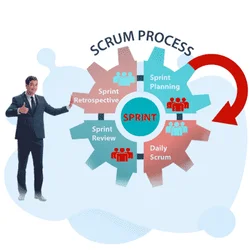
What topics should mock tests cover? The Scrum Guide defines five events (Sprint, Sprint Planning, Daily Scrum, Sprint Review, Sprint Retrospective), three artifacts (Product Backlog, Sprint Backlog, Increment), three commitments (Product Goal, Sprint Goal, Definition of Done), and three accountabilities (Scrum Master, Product Owner, Developers). PSM I tests all of them through application scenarios. "The Product Owner wants to cancel the Sprint because a competitor launched a similar feature" -- what does the Scrum Master do? That's the level of nuance you'll face.
Timing matters. At 45 seconds per PSM I question, you can't deliberate. Practice tests train your reading speed and pattern recognition. After 200+ practice questions, you'll spot the distractor patterns: answers that sound reasonable but violate a specific Scrum principle, answers that describe what a traditional project manager would do instead of a Scrum Master, answers that confuse the Product Owner's accountability with the Developers' accountability. Learn the wrong answers as deliberately as the right ones.
Scrum master certification test questions fall into distinct categories, and knowing them accelerates your preparation. About 30% test Scrum theory and empiricism (transparency, inspection, adaptation). Another 25% cover Scrum events and their purpose. About 20% focus on artifacts and commitments. The remaining 25% test accountabilities -- who does what in specific situations. The scrum master certification practice test that matches these proportions gives you the most exam-realistic experience.
Here's a question pattern that trips up first-time candidates: "During Sprint Planning, the Developers realize they cannot complete all the selected Product Backlog items. What should happen?" Wrong answer: the Scrum Master removes items from the Sprint Backlog. Wrong answer: the Product Owner reduces scope. Right answer: the Developers negotiate with the Product Owner to adjust which items to include. The distinction matters -- Developers own the Sprint Backlog and decide how much work they can commit to. The Product Owner provides priority guidance but doesn't dictate capacity.
Another common trap: questions about the Daily Scrum. It's 15 minutes, for Developers only (the Scrum Master and Product Owner attend only if they're also doing Developer work), and its purpose is to inspect progress toward the Sprint Goal and adapt the Sprint Backlog. It's not a status meeting for the Scrum Master. It's not a reporting mechanism for stakeholders. Getting these details right -- who owns what, who attends what, who decides what -- is the difference between 80% and 90% on PSM I.
Scrum Master Certification: Pros and Cons
- +PSM I at $200 is the most affordable professional certification in project management
- +Certified Scrum Masters earn 15-25% more than uncertified peers in equivalent roles
- +PSM I never expires -- no renewal fees, no continuing education requirements
- +Certification demonstrates baseline Scrum knowledge that's verifiable by employers
- +Multiple certification paths let you match your credential to your career context
- +Practice test preparation builds practical Scrum knowledge beyond just passing the exam
- −CSM's mandatory 2-day course costs $1,000-$1,500 -- expensive for self-funding candidates
- −SAFe SM's annual $300 renewal creates ongoing costs that compound over a career
- −Certification alone doesn't make you effective -- real team experience is required
- −Some employers don't distinguish between PSM I and CSM despite the difficulty gap
- −Exam-focused studying can produce credential holders who can't run a real retrospective
- −The certification market is crowded -- employers may not know which credential to trust
Pros and Cons at a Glance
| Pros | Cons |
|---|---|
| PSM I never expires -- no renewal fees, no continuing education requirements | Certification alone doesn't make you effective -- real team experience is required |
| Certification demonstrates baseline Scrum knowledge that's verifiable by employers | Some employers don't distinguish between PSM I and CSM despite the difficulty gap |
| Multiple certification paths let you match your credential to your career context | Exam-focused studying can produce credential holders who can't run a real retrospective |
| Practice test preparation builds practical Scrum knowledge beyond just passing the exam | The certification market is crowded -- employers may not know which credential to trust |
Your scrum master certification practice test strategy should follow a specific sequence. Week one: read the Scrum Guide twice, then take the free Scrum Open assessment to establish your baseline. If you score below 70%, you need more foundational study. If you're above 80%, move directly to full-length mock exams. Week two: work through 3-4 complete 80-question practice exams, reviewing every wrong answer against the Scrum Guide. Week three: focus on your weak areas -- most people struggle with artifact commitments and the nuances of Scrum Master vs Product Owner accountability.
The Scrum Guide changed significantly in 2020. Make sure your practice materials reflect the current version. Key changes: "Development Team" became "Developers," the three accountabilities replaced the three roles, and the Sprint Goal became a commitment of the Sprint Backlog (not just a nice-to-have). Older practice tests that reference the 2026 Scrum Guide will mislead you. PSM I tests the current Scrum Guide exclusively. If your mock test mentions "Development Team" as a formal term, it's outdated.
One study technique that most guides skip: read the Scrum Guide with a specific question in mind each time. First read: "Who owns each artifact?" Second read: "What's the purpose of each event?" Third read: "What can and can't the Scrum Master do?" Each focused reading surfaces details you missed before. By the fourth read, you'll notice sentences you glossed over that directly answer common exam questions. The Scrum Guide is only 13 pages. Four focused readings take less than two hours total.
Scrum Master Certification Study Checklist
- ✓Read the current Scrum Guide (2020 version) at least three times with different focus questions
- ✓Complete the free Scrum Open assessment at Scrum.org -- score 90%+ before proceeding
- ✓Work through at least 240 practice questions (3 full mock exams of 80 questions each)
- ✓Review every wrong answer and trace it to the specific Scrum Guide paragraph that explains it
- ✓Study the three accountabilities (Scrum Master, Product Owner, Developers) and their boundaries
- ✓Learn the five events and what happens if each one is skipped or poorly executed
- ✓Understand artifact commitments: Product Goal, Sprint Goal, Definition of Done
- ✓Practice answering under time pressure -- 45 seconds per question for PSM I format
- ✓Memorize the common distractor patterns: manager-like answers and role-confusion traps
- ✓Schedule the exam only after scoring 90%+ consistently on two different practice test sources
Beyond PSM I, the scrum master certification practice test landscape includes advanced certifications. PSM II from Scrum.org costs $250 and tests deeper application -- 30 questions in 90 minutes, but the questions require nuanced understanding of Scrum in complex organizational contexts. PSM III is the highest level, costing $500 with essay-style questions evaluated by Scrum.org assessors. Few people pursue PSM III, but those who hold it are recognized as subject matter authorities.
A-CSM (Advanced Certified ScrumMaster) from Scrum Alliance is the CSM upgrade path. It requires holding CSM for at least one year plus 12 months of Scrum Master work experience. Another mandatory course -- typically $1,200-$1,800 -- before the exam. Scrum Alliance loves courses. The A-CSM credential demonstrates deeper practical experience, but the cost adds up quickly: initial CSM ($1,500) plus A-CSM course ($1,500) plus biennial renewals ($100/cycle) means you're spending $3,000+ in the first two years alone.
Which advanced path is worth it? PSM II at $250 with no course requirement and no expiry is the clear value leader. The exam is genuinely difficult -- it tests your ability to handle dysfunctional teams, resistant stakeholders, and organizational impediments that classroom training doesn't prepare you for. If you pass, you've demonstrated skills that matter in practice, not just in theory. Take a scrum master certification practice test focused on PSM II topics before attempting it -- the question style shifts from recall to judgment.
The scrum master certification practice test market is crowded, but quality varies enormously. Good practice tests include realistic scenario-based questions with multiple-select options and detailed explanations for why each wrong answer is wrong. Bad practice tests ask trivia questions ("How long is a Sprint?") that don't reflect PSM I's actual difficulty. Before investing time in any practice resource, check whether it covers the 2020 Scrum Guide, includes multiple-select questions, and provides Scrum Guide references for each answer.
Free vs paid practice resources present a genuine trade-off. Free options like Scrum.org's Open assessments and our practice tests on PracticeTestGeeks give you enough material to assess readiness and practice core concepts. Paid resources from Mikhail Lapshin, Volkerdon, and others offer larger question banks (500+), adaptive difficulty, and performance analytics that help you identify weak areas systematically. For PSM I, free resources are sufficient if you're disciplined about reviewing wrong answers. For PSM II, paid resources with advanced scenarios are worth the investment.
One final preparation tip: take your last practice exam 24 hours before the real thing, not the morning of. If you score well, you'll go into the exam confident. If you score poorly, you have a day to review weak areas without the panic of an imminent test. Cramming the morning of PSM I doesn't work -- the exam tests understanding, not memorization. A clear head and solid preparation beat last-minute study every time.
If you're self-funding and want the most respected credential: get PSM I ($200, no expiry). If your employer is paying and you prefer classroom learning: get CSM ($1,000-$1,500, renews every 2 years). If your organization runs SAFe: get SAFe SM (~$995, renews annually). Don't overthink it -- any of the three opens the same job market. PSM I just does it cheaper.
Career progression after scrum master certification practice test preparation and exam success follows a predictable path. Entry-level Scrum Masters earn $85,000-$100,000 in most US markets. With 2-3 years of experience and a track record of successful Sprint deliveries, that climbs to $110,000-$130,000. Senior Scrum Masters and Agile Coaches can exceed $150,000, especially in financial services, healthcare tech, and enterprise software companies where Scrum adoption is mature.
The Scrum Master role is evolving. Five years ago, facilitation was the primary skill. Today, employers want Scrum Masters who can coach Product Owners on backlog management, mentor junior Developers on engineering practices, and influence organizational change beyond the team level. Certification proves baseline knowledge. The skills that drive salary growth -- conflict resolution, stakeholder management, metrics-driven coaching -- come from experience. You won't learn them from any exam. You'll learn them from running 50+ Sprints and navigating the real organizational friction that certification courses mention but can't simulate.
Should you get certified before or after getting Scrum Master experience? Before, if possible. Certification gives you the vocabulary and conceptual framework to learn faster on the job. You'll understand why the team runs a Sprint Retrospective, not just that they do. You'll know the Scrum Guide's position on mid-Sprint scope changes when a stakeholder pushes for one. That foundational knowledge accelerates your first six months dramatically. Get PSM I first, then let real-world practice deepen what the certification introduced.
SCRUM Practice Test Questions
Prepare for the SCRUM - Scrum Framework exam with our free practice test modules. Each quiz covers key topics to help you pass on your first try.
SCRUM Practice Test
SCRUM Exam Questions covering Practice Test. Master SCRUM Test concepts for certification prep.
SCRUM - Scrum Framework Artifacts and Comm...
Free SCRUM Practice Test featuring - Scrum Framework Artifacts and Commitments. Improve your SCRUM Exam score with mock test prep.
SCRUM - Scrum Framework Inspection and Ada...
SCRUM Mock Exam on - Scrum Framework Inspection and Adaptation Events. SCRUM Study Guide questions to pass on your first try.
SCRUM - Scrum Framework Managing the Produ...
SCRUM Test Prep for - Scrum Framework Managing the Product Backlog. Practice SCRUM Quiz questions and boost your score.
SCRUM - Scrum Framework Scrum Events and T...
SCRUM Questions and Answers on - Scrum Framework Scrum Events and Timeboxes. Free SCRUM practice for exam readiness.
SCRUM - Scrum Framework Scrum Team Account...
SCRUM Mock Test covering - Scrum Framework Scrum Team Accountabilities. Online SCRUM Test practice with instant feedback.
SCRUM - Scrum Framework Scrum Theory and P...
Free SCRUM Quiz on - Scrum Framework Scrum Theory and Principles. SCRUM Exam prep questions with detailed explanations.
SCRUM - Scrum Framework Sprint Planning an...
SCRUM Practice Questions for - Scrum Framework Sprint Planning and Goals. Build confidence for your SCRUM certification exam.
SCRUM - Scrum Framework The Developers Role
SCRUM Test Online for - Scrum Framework The Developers Role. Free practice with instant results and feedback.
SCRUM - Scrum Framework The Five Scrum Values
SCRUM Study Material on - Scrum Framework The Five Scrum Values. Prepare effectively with real exam-style questions.
The scrum master certification practice test ecosystem keeps growing because the certification market keeps growing. Over 1.5 million people hold some form of Scrum certification globally. That saturation creates both opportunity and challenge -- opportunity because agile adoption continues expanding into non-tech industries (healthcare, finance, government), and challenge because certification alone no longer differentiates candidates. You need both the credential and demonstrable experience.
Digital transformation scale agile solutions have made Scrum Master roles more visible at the enterprise level. Organizations implementing SAFe, LeSS, or Nexus need Scrum Masters who understand how team-level Scrum connects to program-level coordination. This creates demand for practitioners who hold both team-level (PSM I or CSM) and scaled-level (SAFe SM or SPS) certifications. The dual-certified Scrum Master -- competent at team Scrum and understanding of scaled frameworks -- is the profile large enterprises seek most.
Where does the Scrum Master role go from here? Two forces are pulling it in different directions. One pushes toward specialization -- Scrum Masters who focus on specific domains like DevOps teams, data engineering teams, or product discovery teams. The other pushes toward generalization -- Agile Coaches who work across multiple teams and influence organizational agility at a systemic level. Both paths pay well. Both require certification as a starting credential. The scrum master certification practice test you complete today is the first step in a career path that branches in multiple rewarding directions.
Sample SCRUM Practice Questions
Try these questions from our free SCRUM practice tests. The correct answer and an explanation follow each question.
Living the Scrum values reinforces which of Scrum's three pillars of empiricism?
- A. Transparency, inspection, and adaptation
- B. Planning, executing, and reviewing
- C. Estimation, velocity, and burndown
- D. Roles, events, and artifacts
Answer: A. Transparency, inspection, and adaptation
The values bring the empirical pillars of transparency, inspection, and adaptation to life.
A Scrum Team is working on a product that involves data science, user interface design, and technical writing. According to the Scrum framework, who is considered a 'Developer'?
- A. Only the members who write production code.
- B. The Product Owner and Scrum Master, as they develop the product strategy.
- C. All team members who are actively working on creating any aspect of the usable Increment.
- D. Only the data scientists and UI designers, as the technical writer's work is documentation.
Answer: C. All team members who are actively working on creating any aspect of the usable Increment.
The Scrum Guide uses the term 'Developers' to refer to anyone in the Scrum Team who is committed to creating any aspect of a usable Increment each Sprint. This is intentionally broad and includes professionals with various skills like programming, testing, UX design, data science, and technical writing.
During Sprint Planning the team struggles to define a clear Sprint Goal. The Scrum Master should:
- A. Define the Sprint Goal for them
- B. Facilitate the conversation so the team crafts the goal
- C. Skip the Sprint Goal this Sprint
- D. Ask the Product Owner to dictate the goal
Answer: B. Facilitate the conversation so the team crafts the goal
The Scrum Master facilitates Scrum events so they are productive, helping the team reach a Sprint Goal themselves.
A member of the Scrum Team comes to the Scrum Master with an impediment: their development workstation is underpowered and frequently crashes, slowing down their work. How should the Scrum Master, as a servant-leader, approach this?
- A. Immediately order a new computer for the Developer to remove the impediment as quickly as possible.
- B. Advise the Developer on how to troubleshoot the computer problems themselves.
- C. Coach the Developer on how to present the business case for a new computer to management and support them in navigating the procurement process.
- D. Add 'Fix computer' as a task to the Sprint Backlog for the team to address.
Answer: C. Coach the Developer on how to present the business case for a new computer to management and support them in navigating the procurement process.
A key aspect of a Scrum Master's role is to remove impediments, but also to help the team become more self-managing. While removing the impediment is important, coaching the team member to solve the problem themselves fosters empowerment and self-organization. This is a better long-term solution than the Scrum Master simply fixing every problem.
SCRUM Questions and Answers
About the Author
Attorney & Bar Exam Preparation Specialist
Yale Law SchoolJames R. Hargrove is a practicing attorney and legal educator with a Juris Doctor from Yale Law School and an LLM in Constitutional Law. With over a decade of experience coaching bar exam candidates across multiple jurisdictions, he specializes in MBE strategy, state-specific essay preparation, and multistate performance test techniques.