
SCRUM Master Certification Guide: CSM vs PSM Exam Prep for 2026 October
Free Scrum Master Certification practice test with instant 🎯 feedback and detailed answer explanations. Prepare for your exam.

This certification guide walks you through everything you need to earn your Scrum Master credential — from choosing between CSM and PSM to passing the scrum master certification test on your first attempt. Whether you're switching careers or formalizing agile experience you already have, getting certified opens doors. The Scrum framework has become the default operating system for product development teams across tech, finance, healthcare, and government. Employers aren't just requesting Scrum knowledge anymore. They're requiring proof of it.
Here's what makes this scrum master certification mock test prep different from generic study guides: we focus on what actually appears on the exam. Not theory for theory's sake. Practical knowledge, scenario-based reasoning, and the specific traps that trip up first-time test-takers. CSM and PSM each have their own quirks — and knowing those quirks is half the battle.
You'll find free practice tests, exam format breakdowns, and a step-by-step prep plan below. We've stripped out the filler and kept what matters. If you can commit 2 to 4 weeks of focused study, you can pass either exam. The question isn't whether you're smart enough. It's whether you're prepared enough. Let's fix that — starting with the decision that trips up most aspiring Scrum Masters before they even begin studying.
Choosing between CSM and PSM is the first decision you'll face — and it matters more than most guides admit. The scrum master certification mock test format differs significantly between them. CSM from Scrum Alliance requires a mandatory 2-day instructor-led course before you can sit for the exam. PSM I from Scrum.org lets you register and test whenever you're ready. No course required. No prerequisites at all.
Think of it this way. CSM is the guided path — you pay $1,000 to $1,500 for a structured course that includes the exam fee. The instructor walks you through Scrum theory, runs exercises, and prepares you directly. The exam itself? Fifty questions, 74% to pass. Most people who paid attention in the course pass on their first try. If you learn best from instructors and want networking built into the experience, CSM is your certified scrum master certification mock test path.
PSM I is the self-directed path. You study on your own using the free Scrum Guide and Scrum.org's open assessments. The exam is $200 per attempt — no bundled course softening the blow. Eighty questions, 85% passing score. That's 68 of 80 correct. The higher bar means surface-level understanding won't cut it. You need to know why each Scrum rule exists, not just what it says. PSM I rewards depth. CSM rewards participation. Neither is inherently better — your choice depends on your learning style, budget, and how quickly you want the credential in hand.
Understanding what the scrum master certification practice test actually covers is critical for efficient prep. Both CSM and PSM I test your knowledge of the Scrum Guide — the 13-page document that defines the entire Scrum framework. Everything on the exam traces back to this one document. Read it three times minimum. Not skimmed. Read — with a highlighter and notes. The scrum certification test will probe your understanding of every sentence.
CSM exam questions tend to be straightforward: "What are the three Scrum artifacts?" or "Who is responsible for the Product Backlog?" The questions test recall and basic application. PSM I goes deeper with scenario-based questions: "A Product Owner wants to add work to a Sprint that has already started. What should the Scrum Master do?" These questions don't just test whether you know the rules — they test whether you understand the principles behind them.
Both exams are online and open-book in the sense that you can take them from home. But don't let that fool you. Time pressure is real. PSM I gives you 80 questions in 60 minutes — that's 45 seconds per question. No time for looking things up. CSM gives you slightly more breathing room with 50 questions in 60 minutes. Either way, you need the answers internalized, not bookmarked.
Scrum Framework Core Concepts
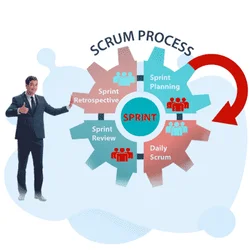
Sprint — the heartbeat of Scrum, a fixed-length iteration of 1 to 4 weeks. All other events happen inside the Sprint. The team delivers a potentially shippable Increment each Sprint. Sprint Planning starts every Sprint — the team decides what to build and how. Daily Scrum is a 15-minute daily sync for Developers only. Sprint Review inspects the Increment with stakeholders. Sprint Retrospective closes each Sprint — the team reflects and plans improvements.
Every event has a timebox. Sprint Planning: 8 hours max for a 4-week Sprint. Daily Scrum: 15 minutes, period. Sprint Review: 4 hours max. Retrospective: 3 hours max. These aren't suggestions — they're rules. The exam will test whether you know the exact timeboxes.
A practice test for scrum master certification is the single best predictor of exam readiness. Scrum.org offers a free Scrum Open assessment — 30 questions that mirror the style and difficulty of PSM I. Take it repeatedly until you score 100% consistently. Not 90%. Not 95%. One hundred percent. If you can nail every Open Assessment question without hesitation, you're ready for the scrum master certification free test that actually counts.
Don't stop at the Scrum Open. Scrum.org also offers a Product Owner Open and Developer Open assessment. PSM I draws questions from all three knowledge areas — not just the Scrum Master role. A candidate who only studies Scrum Master responsibilities will miss questions about Product Backlog ordering, Developer self-management, and Sprint Goal setting. Cover all three accountabilities equally.
Timing practice matters as much as content practice. Set a timer for 60 minutes and work through 80 questions without pausing. If you're consistently finishing with 5+ minutes to spare, your pacing is solid. If you're rushing through the last 10 questions, practice reading questions faster — most PSM I questions are answerable in 20 to 30 seconds once you've internalized the Scrum Guide. Speed comes from familiarity, not from cutting corners. Build that familiarity through repetition — daily practice tests are the fastest path to exam-day confidence.
The scrum certification practice test questions you'll encounter fall into predictable categories — and knowing those categories gives you an edge. About 30% of questions test factual recall: timeboxes, artifact names, event sequences. Another 40% test application: given a scenario, what should happen according to Scrum? The remaining 30% test deeper understanding: why does Scrum work this way? What principle underlies this rule? Those scrum master certification test questions in the third category are where most people lose points.
Common trap questions involve the Daily Scrum. It's for Developers only — the Scrum Master doesn't run it, and the Product Owner doesn't attend unless they're also a Developer. The Daily Scrum isn't a status report to management. It's a planning event where Developers inspect progress toward the Sprint Goal and adapt the Sprint Backlog. Get this distinction right and you'll dodge several exam traps.
Another frequent trap: who cancels a Sprint? Only the Product Owner can cancel a Sprint — not the Scrum Master, not the Developers, not stakeholders. And it only happens when the Sprint Goal becomes obsolete. In practice, Sprint cancellations are extremely rare. But the exam loves asking about them because the answer is counter-intuitive — many candidates assume the Scrum Master has this authority. They don't.
CSM vs PSM I: Which Should You Choose?
- +CSM's mandatory course provides structured learning — ideal if you're new to Scrum entirely
- +PSM I costs only $200 — no course fee required, making it the budget-friendly option
- +CSM offers networking with other Scrum practitioners during the 2-day course
- +PSM I's lifetime validity means no renewal fees or continuing education requirements
- +Both credentials are recognized by employers across tech, finance, and government sectors
- +PSM I's higher passing score (85%) signals deeper Scrum knowledge to hiring managers
- −CSM costs $1,000 to $1,500 total — a significant investment for early-career professionals
- −PSM I's self-study model requires strong self-discipline and time management to prepare
- −CSM requires renewal every 2 years — 20 SEUs plus approximately $100 renewal fee
- −PSM I's 80-question, 85%-pass exam is significantly harder than CSM's 50-question, 74%-pass format
- −CSM availability depends on local Certified Scrum Trainers — limited options in some regions
- −Neither certification alone guarantees job placement — experience and soft skills still matter
Your study materials make or break your exam prep — and the good news is that the best scrum master certification test questions resource is free. The Scrum Guide itself is only 13 pages. That's not a typo. Everything you need to know for either exam fits in a document shorter than most chapter summaries. But those 13 pages are dense. Every word is intentional. Exam questions often hinge on a single word — "accountable" vs. "responsible," "ordered" vs. "prioritized."
Beyond the Scrum Guide, Mikhail Lapshin's PSM I preparation quiz is a well-known free resource that closely mirrors the real exam's difficulty. Scrum.org's own Learning Path pages provide topic-by-topic breakdowns with suggested readings. For CSM candidates, the course itself provides most of what you need — but reading the Scrum Guide independently before the course dramatically improves what you absorb during the two days.
Avoid outdated study materials. The Scrum Guide was last updated in November 2020 — any prep resource referencing the 2017 guide or earlier will contain incorrect information about terminology ("roles" vs. "accountabilities"), removed concepts (Development Team as a sub-team), and restructured artifacts. Always check when your study material was last updated. Scrum master certification test questions based on old guides will actively hurt your preparation.
Scrum Certification Prep Checklist
- ✓Download and read the 2020 Scrum Guide from scrumguides.org — read it three times minimum
- ✓Take the Scrum.org Scrum Open assessment to establish your baseline knowledge level
- ✓Choose your certification path: CSM (course + easier exam) or PSM I (self-study + harder exam)
- ✓For CSM: register for a 2-day course with a Certified Scrum Trainer in your area or online
- ✓For PSM I: score 100% consistently on all three Scrum.org Open Assessments before registering
- ✓Memorize all five Scrum events and their exact timeboxes for a 4-week Sprint
- ✓Know all three artifacts and their paired commitments — this is tested heavily on both exams
- ✓Practice 80-question timed sessions (60 minutes) to build exam-day pacing and stamina
- ✓Study the Scrum Master's servant-leadership role — distinguish it from traditional project management
- ✓Schedule your exam when you're consistently scoring 90%+ on practice assessments
The career value of Scrum certification extends beyond the credential itself. Certified Scrum Masters in the United States earn median salaries of $100,000 to $130,000 — with experienced practitioners in enterprise environments pulling $140,000 to $170,000. Entry-level positions with CSM or PSM I and 1 to 2 years of experience typically start at $80,000 to $100,000. That's strong for a certification that takes 2 to 4 weeks to earn and costs under $1,500. Scrum master certification test questions you study today translate to real salary gains.
The role itself has evolved. Five years ago, most Scrum Master positions lived inside software development teams. Today, you'll find them in marketing, HR transformation, product operations, and even construction project management. Agile frameworks — Scrum being the most adopted — have spread far beyond their software origins. This expansion means more job openings and more diverse career paths for certified practitioners.
Career progression typically follows a predictable arc: Scrum Master → Senior Scrum Master → Agile Coach or Release Train Engineer (in SAFe environments) → Head of Agile or Portfolio Manager. Each step up correlates with additional certifications (PSM II, SAFe SM, ICAgile) and, more importantly, demonstrated ability to coach teams and drive organizational change. The first certification — CSM or PSM I — is your entry ticket to this career ladder. Scrum master certification test questions you master now lay the groundwork for advanced credentials later.
Exam-day strategy matters more than most candidates realize. For PSM I, the 45-seconds-per-question pace means you can't deliberate. Read the question once. Eliminate obviously wrong answers. Pick your best answer. Move on. Flag uncertain questions and return to them only if time allows. Don't get anchored on a tricky scrum master certification test questions item — one question isn't worth three minutes when the clock is ticking.
For CSM, the pace is more forgiving — about 72 seconds per question. But the exam's lower passing threshold (74%) can create false confidence. Don't assume the course alone prepared you. Review the Scrum Guide the night before, focusing on areas the instructor covered quickly. Pay special attention to Sprint cancellation rules, the Daily Scrum's purpose, and who owns each artifact.
One pattern both exams share: the longest answer isn't always the best one. Test makers use lengthy answer options as distractors — they sound authoritative because they include more detail. But Scrum values simplicity. When two answers seem equally correct, the simpler one that aligns with the Scrum Guide's exact wording is usually right. Trust the Guide's language over your interpretation of it. When in doubt, the Scrum Guide is always the final authority on any scrum master certification test questions you'll face.
Don't study from pre-2020 materials. The 2020 Scrum Guide changed key terminology — "roles" became "accountabilities" and "Development Team" was replaced with "Developers." Old materials will actively mislead you. Don't assume the Scrum Master runs the Daily Scrum. The Developers own it — the Scrum Master only ensures it happens and stays within 15 minutes. Don't neglect Product Owner questions. Both exams test all three accountabilities, not just the Scrum Master role. Don't skip practice under timed conditions — knowing the material and performing under time pressure are different skills.
Building Scrum expertise beyond the certification exam separates paper-certified practitioners from genuinely effective ones. The Scrum Guide gives you the rules. Experience gives you judgment. Once you've earned CSM or PSM I, seek out a real Scrum team — even a volunteer or internal project — and serve as Scrum Master. You'll discover that facilitating a Sprint Retrospective with a disengaged team is nothing like answering scrum master certification test questions about it.
Advanced certifications validate that practical growth. PSM II ($250, 30 questions, 85% pass, essay-style) tests your ability to apply Scrum in complex, ambiguous situations. CSP-SM (Certified Scrum Professional — ScrumMaster) requires demonstrated experience and continuing education. SAFe Scrum Master certification becomes relevant if you move into enterprise-scale agile environments where multiple Scrum teams coordinate. Each adds a layer of credibility — and salary potential.
The Scrum community itself is a valuable resource. Scrum.org forums, Scrum Alliance community events, local agile meetups, and LinkedIn groups connect you with practitioners who've navigated the same challenges you'll face. Ask questions. Share what you've learned. Mentorship in the agile community tends to flow freely — experienced Scrum Masters remember what it felt like to be new and generally enjoy coaching newcomers through those early growing pains.
SCRUM Practice Test Questions
Prepare for the SCRUM - Scrum Framework exam with our free practice test modules. Each quiz covers key topics to help you pass on your first try.
SCRUM Practice Test
SCRUM Exam Questions covering Practice Test. Master SCRUM Test concepts for certification prep.
SCRUM - Scrum Framework Artifacts and Comm...
Free SCRUM Practice Test featuring - Scrum Framework Artifacts and Commitments. Improve your SCRUM Exam score with mock test prep.
SCRUM - Scrum Framework Inspection and Ada...
SCRUM Mock Exam on - Scrum Framework Inspection and Adaptation Events. SCRUM Study Guide questions to pass on your first try.
SCRUM - Scrum Framework Managing the Produ...
SCRUM Test Prep for - Scrum Framework Managing the Product Backlog. Practice SCRUM Quiz questions and boost your score.
SCRUM - Scrum Framework Scrum Events and T...
SCRUM Questions and Answers on - Scrum Framework Scrum Events and Timeboxes. Free SCRUM practice for exam readiness.
SCRUM - Scrum Framework Scrum Team Account...
SCRUM Mock Test covering - Scrum Framework Scrum Team Accountabilities. Online SCRUM Test practice with instant feedback.
SCRUM - Scrum Framework Scrum Theory and P...
Free SCRUM Quiz on - Scrum Framework Scrum Theory and Principles. SCRUM Exam prep questions with detailed explanations.
SCRUM - Scrum Framework Sprint Planning an...
SCRUM Practice Questions for - Scrum Framework Sprint Planning and Goals. Build confidence for your SCRUM certification exam.
SCRUM - Scrum Framework The Developers Role
SCRUM Test Online for - Scrum Framework The Developers Role. Free practice with instant results and feedback.
SCRUM - Scrum Framework The Five Scrum Values
SCRUM Study Material on - Scrum Framework The Five Scrum Values. Prepare effectively with real exam-style questions.
Let's talk about the investment math. CSM's all-in cost — course plus exam — runs $1,000 to $1,500. If you're employed and your company offers professional development budgets, this is often fully reimbursable. Many employers will pay for CSM courses because the structured format guarantees their employee receives training, not just a certificate. PSM I's $200 price tag is easier to absorb out of pocket, but harder to get employer funding for because there's no training component to point to. Scrum master certification test questions preparation is self-directed for PSM.
Return on investment is strong for both paths. A certified Scrum Master earns $15,000 to $30,000 more annually than a non-certified project coordinator doing similar work. Even at the higher CSM course cost, you recoup your investment within the first month of your salary increase. For career changers entering agile project management from unrelated fields, either certification signals basic competency to hiring managers who might otherwise overlook your resume.
One underrated benefit: certification forces structured learning. Even if you've been working on Scrum teams for years, studying for the exam reveals gaps in your understanding. Most experienced practitioners discover they've been doing something "wrong" according to the Scrum Guide — skipping the Sprint Goal, treating the Daily Scrum as a status meeting, or letting the Product Owner dictate how work gets done. The certification prep process corrects these habits, making you a better practitioner regardless of the credential. Scrum master certification test questions illuminate these blind spots systematically.
SCRUM Questions and Answers




About the Author

Project Management Professional & Agile Certification Expert
University of Chicago Booth School of BusinessKevin Marshall is a Project Management Professional (PMP), PMI Agile Certified Practitioner (PMI-ACP), PRINCE2 Practitioner, and Certified Scrum Master with an MBA from the University of Chicago Booth School of Business. With 16 years of program management experience across technology, finance, and healthcare sectors, he coaches professionals through PMP, PRINCE2, SAFe, CSPO, and agile certification exams.