
SCRUM Master Certification Prerequisites: PSM, CSM & PSPO Eligibility Guide
📗 Scrum master certification prerequisites explained: PSM, CSM, PSPO eligibility, costs, training requirements, and a free scrum master practice test.

Understanding scrum master certification prerequisites is the very first step before you book an exam, pay a fee, or commit to a multi-week study plan. Unlike many IT credentials, scrum certifications vary enormously in their eligibility rules. Some, like Scrum.org's PSM I, have no formal prerequisites and let you sit the exam after creating an account and paying $200. Others, like Scrum Alliance's CSM, require completing an accredited two-day training course before you can attempt the assessment.
This guide unpacks the real eligibility requirements for the four credentials most US-based candidates pursue: the Professional Scrum Master (PSM I, II, III), the Certified ScrumMaster (CSM), the Professional Scrum Product Owner (PSPO), and SAFe Scrum Master (SSM). We cover training hours, work experience expectations, exam windows, retake policies, and the renewal cycles that catch many candidates off guard two years after they pass.
If you are weighing certifications, the smartest pre-step is benchmarking your current knowledge with a scrum master practice test covering the 2026 Scrum Guide. A diagnostic score above 75% on a realistic mock exam typically signals you have the foundational vocabulary needed to skip introductory courses and challenge PSM I directly. A score below 60% suggests you would benefit from instructor-led training before spending exam fees.
The cost spectrum matters too. PSM I costs $200 with unlimited time and no required course. CSM costs $400 to $1,200 depending on the trainer because the course fee is bundled with the exam voucher. PSPO I mirrors PSM I at $200. SAFe SSM bundles training and exam for roughly $995. These differences directly shape which prerequisites apply to you and which you can sidestep.
Eligibility also depends on the renewal model. Scrum.org certifications never expire — pass PSM I once and you hold it for life. Scrum Alliance requires a $100 renewal every two years plus 20 SEUs (Scrum Education Units). SAFe credentials renew annually for $295. Understanding these recurring obligations is part of evaluating whether you actually meet the prerequisites long-term.
Finally, several certifications have soft prerequisites that are not formally enforced but heavily affect your pass odds. PSM II expects practical Scrum Master experience. CSP-SM requires a year of documented Scrum Master practice. PMI-ACP demands 21 contact hours of agile training plus 12 months of project experience within the last five years. We'll map all of these clearly so you know exactly which exam you can sit tomorrow and which require months of preparation.
By the end of this guide, you'll know which scrum certification matches your current eligibility, what each one actually tests, how to prepare efficiently, and how to budget time and money without surprises. Let's start with a side-by-side look at the prerequisites that matter most.
Scrum Certification Prerequisites by the Numbers
Key Facts at a Glance
| Item | Value | Details |
|---|---|---|
| PSM I Exam Fee | $200 | No training required |
| CSM Training Minimum | 16 hrs | Two-day accredited course |
| PSM I Passing Score | 85% | 80 questions in 60 minutes |
| CSM Passing Score | 74% | 37 of 50 questions correct |
| CSM Renewal Cycle | 2 yrs | $100 + 20 SEUs |
| PSM Validity | Lifetime | Never expires |

Exam Format & Eligibility at a Glance
| Section | Questions | Time | Weight | Notes |
|---|---|---|---|---|
| PSM I (Scrum.org) | 80 | 60 min | 85% pass | No prerequisites |
| PSM II (Scrum.org) | 30 | 90 min | 85% pass | PSM I recommended |
| CSM (Scrum Alliance) | 50 | 60 min | 74% pass | 16-hr course required |
| PSPO I (Scrum.org) | 80 | 60 min | 85% pass | No prerequisites |
| SAFe SSM 6.0 | 45 | 90 min | 73% pass | Course attendance required |
| Total | 80 | Varies by exam | 100% |
The most frequent question candidates ask is simply: PSM or CSM? Both certify you as a Scrum Master, both are recognized by US employers, and both test the 2020 Scrum Guide. The prerequisites, however, differ in ways that materially shape your timeline and budget. PSM I from Scrum.org has zero formal prerequisites — you create an account, pay $200, and take the exam whenever you feel ready. CSM from Scrum Alliance requires you to first complete a 16-hour course taught by a Certified Scrum Trainer (CST).
That training prerequisite is not a formality. Scrum Alliance enforces attendance, and the exam voucher is only issued after the trainer marks you complete. A typical two-day CSM workshop runs $695 to $1,295 in the US, with the exam included. The course itself is the bulk of your preparation because the exam is intentionally easier than PSM I — 74% to pass versus 85% — to reward candidates for completing structured learning. If you prefer self-study and a tougher exam, PSM I is the cheaper, faster path.
PSM II adds a soft prerequisite: practical experience as a Scrum Master. Scrum.org does not verify employment, but the scenario-based questions assume you have facilitated real Sprint events, coached actual teams, and navigated organizational impediments. Candidates who attempt PSM II purely on book knowledge typically fail. A solid scrum practice test with applied scenarios is the best benchmark for whether you are ready to attempt the advanced level.
For product-focused candidates, PSPO I mirrors PSM I's eligibility model — no prerequisites, $200, 85% to pass. PSPO II and III expect demonstrated Product Owner experience. The Scrum Alliance equivalent is CSPO, which like CSM requires attending an accredited 16-hour course before sitting the exam. CSPO does not even have a traditional exam in some delivery formats; certification is awarded based on training completion.
SAFe Scrum Master (SSM) follows a different model again. SAFe certifications are tied to attendance at official Scaled Agile courses, typically a two-day workshop priced around $995 that includes one exam attempt. Unlike PSM, you cannot challenge SAFe exams without completing the course. If your employer uses SAFe at scale, the SSM credential is often more valuable locally than a generic Scrum Master cert.
One overlooked prerequisite is account eligibility itself. Scrum.org requires a verified email; Scrum Alliance requires you be added to a trainer's roster before the voucher generates. Allow 24 to 48 hours after course completion for the CSM voucher email to arrive. The voucher is then valid for 90 days — miss that window and you forfeit your first free attempt, with retakes costing $25 each thereafter.
Bottom line: if you want the fastest, cheapest path with no scheduling friction, PSM I has the loosest prerequisites in the industry. If you want guided instruction and a higher first-time pass rate, CSM's training prerequisite is a feature, not a bug. Either credential opens doors; the prerequisites just determine how you walk through them.
SCRUM Practice Test Questions
Prepare for the SCRUM - Scrum Framework exam with our free practice test modules. Each quiz covers key topics to help you pass on your first try.
SCRUM Practice Test
SCRUM Exam Questions covering Practice Test. Master SCRUM Test concepts for certification prep.
SCRUM - Scrum Framework Artifacts and Comm...
Free SCRUM Practice Test featuring - Scrum Framework Artifacts and Commitments. Improve your SCRUM Exam score with mock test prep.
SCRUM - Scrum Framework Inspection and Ada...
SCRUM Mock Exam on - Scrum Framework Inspection and Adaptation Events. SCRUM Study Guide questions to pass on your first try.
SCRUM - Scrum Framework Managing the Produ...
SCRUM Test Prep for - Scrum Framework Managing the Product Backlog. Practice SCRUM Quiz questions and boost your score.
SCRUM - Scrum Framework Scrum Events and T...
SCRUM Questions and Answers on - Scrum Framework Scrum Events and Timeboxes. Free SCRUM practice for exam readiness.
SCRUM - Scrum Framework Scrum Team Account...
SCRUM Mock Test covering - Scrum Framework Scrum Team Accountabilities. Online SCRUM Test practice with instant feedback.
SCRUM - Scrum Framework Scrum Theory and P...
Free SCRUM Quiz on - Scrum Framework Scrum Theory and Principles. SCRUM Exam prep questions with detailed explanations.
SCRUM - Scrum Framework Sprint Planning an...
SCRUM Practice Questions for - Scrum Framework Sprint Planning and Goals. Build confidence for your SCRUM certification exam.
SCRUM - Scrum Framework The Developers Role
SCRUM Test Online for - Scrum Framework The Developers Role. Free practice with instant results and feedback.
SCRUM - Scrum Framework The Five Scrum Values
SCRUM Study Material on - Scrum Framework The Five Scrum Values. Prepare effectively with real exam-style questions.
Work Experience Expectations for Your Scrum Master Test
Entry-level scrum master certifications require no documented work experience. PSM I and CSM are explicitly designed to certify foundational knowledge, not seniority. You can sit either exam as a student, a developer transitioning from a technical role, or a project manager pivoting toward agile. Employers reading your resume understand the entry-level signal: you grasp the framework, terminology, and accountabilities defined in the Scrum Guide.
That said, candidates with some team exposure — even as a developer on a Scrum team or an intern observing ceremonies — consistently score higher on situational questions. Reading the Scrum Guide three times and completing a sample scrum master test rotation typically replaces the experience gap for most testable knowledge. Plan 30 to 60 study hours if you have zero exposure to agile practices in a workplace.

PSM I vs CSM: Prerequisites and Trade-offs
- +PSM I has zero formal prerequisites — sit the exam any time
- +PSM I is $200 versus $700 to $1,300 for CSM training+exam
- +PSM is lifetime valid with no renewal fees
- +PSM exams use the official Scrum Guide as the single source of truth
- +CSM bundled training accelerates first-time pass rates above 95%
- +CSM trainers provide ongoing community access and SEU opportunities
- −PSM I's 85% pass threshold is unforgiving for unprepared candidates
- −CSM requires attending a 16-hour course you cannot skip or test out of
- −CSM renewal costs $100 plus 20 SEUs every two years
- −PSM provides no instructor support — you self-diagnose weak areas
- −CSM voucher expires 90 days after course completion
- −SAFe SSM cannot be challenged without paid course attendance
Pre-Exam Readiness Checklist for Your Scrum Master Test
- ✓Read the 2020 Scrum Guide cover to cover at least three times
- ✓Score 85% or higher on two full-length practice scrum master tests in a row
- ✓Memorize all five Scrum values: commitment, focus, openness, respect, courage
- ✓Know the three accountabilities and how they differ from old "roles" language
- ✓Distinguish the three artifacts and their commitments without prompts
- ✓Time yourself at 45 seconds per question for PSM I pacing realism
- ✓Verify your exam voucher has not expired (90 days for CSM)
- ✓Confirm a stable internet connection and quiet 75-minute exam window
- ✓Have the Scrum Guide PDF open in a second tab — allowed for PSM exams
- ✓Review at least 200 sample scrum master test questions before exam day

Practice tests are the real eligibility gate
Scrum.org's official guidance is blunt: do not attempt PSM I unless you can consistently score 85% or higher on the free Scrum Open assessment. That benchmark is not a suggestion — it correlates directly with first-attempt pass rates. Candidates scoring 70 to 80% on Scrum Open historically fail PSM I on first attempt 60% of the time. Hit 90%+ on practice tests before you spend the $200 exam fee.
Costs and renewal cycles are part of the prerequisite conversation because they determine whether your certification stays valid long enough to deliver ROI. PSM I, II, and III from Scrum.org are one-time fees of $200, $250, and $500 respectively. Once you pass, you hold the credential for life with no recurring obligations. This makes Scrum.org credentials uniquely cost-efficient over a 10-year career horizon — about $20 per year amortized for PSM I.
Scrum Alliance certifications follow a subscription model. CSM costs $400 to $1,300 upfront (bundled with required training), then $100 every two years for renewal plus 20 SEUs of continuing education. Over a decade that adds roughly $500 in renewals plus 100 hours of continuing education. SEUs can be earned through webinars, conferences, coaching, or community contributions, so the time cost is manageable for active practitioners.
SAFe credentials are the most expensive over time. SSM 6.0 costs around $995 for the course-and-exam bundle, then $295 annually to renew. Across ten years that totals nearly $4,000. SAFe credentials are worth this premium only if your employer or target employer operates a SAFe-scaled environment, which is common in large enterprises, defense contractors, and regulated industries like banking and healthcare.
Retake policies also vary significantly. PSM exams allow unlimited retakes at $200 per attempt — there is no waiting period and no cap. CSM allows two free retakes within 60 days of your course, then $25 per attempt for the third and fourth. After four failed attempts you must retake the entire course. SAFe SSM includes one free attempt; additional attempts cost $50 each and require a 10-day wait between retakes.
Plan your exam date relative to these windows. Booking PSM I for a Friday evening gives you the weekend to retake if you fail — many candidates pass on attempt two after seeing the question style. CSM candidates should plan to take the exam within two weeks of the course while material is fresh; the free retake window closes at 60 days and you do not want to be relearning Scrum events six weeks later.
One financial nuance: many employers reimburse certification costs but only after you pass. Save receipts for the exam fee, study materials, and any practice scrum master test subscriptions. Document the hours you spent preparing — some companies count certification study toward annual learning goals. If you are between jobs, check whether your state workforce agency offers training vouchers for in-demand credentials; scrum master roles consistently appear on state demand lists.
Finally, factor in time-to-job-impact. The fastest path from zero to a verifiable credential is PSM I via self-study: roughly $200 and 4 to 8 weeks of evening study for someone with no prior agile exposure. CSM costs more but compresses learning into a focused two-day workshop. Pick the model that matches your cash position and calendar — both credentials are recognized by US recruiters and ATS systems.
CSM exam vouchers expire 90 days after course completion — there are no extensions. PSM password-protected exam links expire 14 days after purchase if unused. SAFe exam attempts must be completed within 30 days of course attendance. Calendar these dates the moment you receive your voucher; thousands of dollars in training fees have been forfeited because candidates assumed eligibility was indefinite.
Choosing your first certification is less about prestige and more about matching prerequisites to your current situation. If you are pre-employment or self-funded, PSM I from Scrum.org is the obvious starting point: no training prerequisite, $200, lifetime validity, and a passing score that proves you actually know the material rather than that you attended a workshop. Recruiters increasingly recognize PSM as the more rigorous credential because of its 85% pass threshold and lack of guided instruction.
If your employer is paying, CSM offers a structured two-day immersion that compresses learning into a focused window. The trainer's expertise, real-world stories, and live Q&A often deliver more practical insight than self-study. CSM is also the standard credential in some traditional industries — financial services, government contracting, and large healthcare systems — where Scrum Alliance has deeper historical penetration. Check current job postings in your target city to see which acronym recruiters list.
For product-oriented candidates, the analogous decision is PSPO I versus CSPO. Same prerequisite pattern — PSPO I has no required course, CSPO requires a 16-hour workshop. If you already hold PSM I, adding PSPO I for $200 signals dual fluency and broadens your eligibility for Product Owner roles. Reviewing a scrum master test question library that covers both perspectives helps you avoid the trap of answering Product Owner scenarios from a Scrum Master lens.
If your target employer is a large enterprise running SAFe, prioritize SSM despite the higher cost and annual renewal. SAFe-aligned organizations often will not interview candidates without a SAFe credential because their internal vocabulary, ceremonies, and metrics differ from textbook Scrum. SSM also tests your understanding of Agile Release Trains, PI Planning, and Lean Portfolio Management — concepts absent from PSM and CSM curricula entirely.
A common dual-credential strategy for career switchers is PSM I plus CSM within six months. PSM I proves rigor and costs $200. CSM provides the trainer network and SEU community that helps you land interviews through referrals. Total cost roughly $900 to $1,400, total time under three months, and your resume now signals both depth of knowledge and structured professional development. This combination clears nearly every US Scrum Master job description's prerequisite bar.
For experienced practitioners, the next-tier decision is PSM II versus CSP-SM. PSM II is cheaper and faster — $250, no application, no formal experience verification. CSP-SM requires documented experience, a CSM prerequisite, and an application fee plus an educational component. Both signal mid-level competence; PSM II signals it more efficiently. Reserve CSP-SM for cases where your employer specifically recognizes Scrum Alliance's tier or where the educational component aligns with skills you genuinely want to build.
Whatever path you choose, the universal prerequisite is preparation. Practice tests with realistic difficulty, the 2026 Scrum Guide read repeatedly, and at least one mentor or community where you can ask questions remove most of the risk of failing your first attempt. Eligibility on paper is one thing; readiness to pass is another. Aim to be over-prepared on the day you click "Start Exam."
Final preparation is where most candidates either lock in a confident pass or stumble into a costly retake. The seven days before your exam should focus on consolidation, not new material. Re-read the 2020 Scrum Guide one last time slowly, paying attention to exact wording — Scrum.org questions are deliberately precise. The Guide says the Daily Scrum is for Developers; it is not "led by the Scrum Master." That single distinction shows up in multiple exam questions.
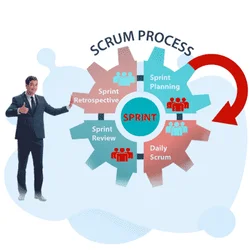
Build a personal cheat sheet you will not use during the exam but that forces you to write things down: the five values, three accountabilities, five events, three artifacts and their commitments, plus the timeboxes (Sprint Planning 8 hours max for a one-month Sprint, Sprint Review 4 hours, Retrospective 3 hours, Daily Scrum 15 minutes). Writing these by hand commits them to memory far better than re-reading.
Take two full-length timed practice tests during your final week — one mid-week, one 48 hours before exam day. Use the gap to review every wrong answer and understand not just what is correct but why each distractor was wrong. PSM exam questions often hinge on identifying the single most-correct answer when two options look plausible. The skill is elimination, not just recognition. Reviewing a sample scrum master test bank trains this exact pattern.
Logistics matter more than candidates expect. PSM exams are 60 minutes for 80 questions — 45 seconds each — and pause penalties are steep. Test your internet connection, close all browser tabs, silence your phone, and have water within reach. The Scrum Guide PDF is allowed; bookmark it open in a second tab and use Ctrl+F to search specific terms when stuck. About 5 to 8 questions per exam can be resolved by a targeted Guide search if you have time left.
Manage your time by flagging tough questions and moving on. Aim to finish a first pass in 40 minutes, leaving 20 minutes for flagged items. Do not change answers on a second pass unless you have a concrete reason — first instincts on Scrum questions are usually correct. If you finish with 10+ minutes spare and have no flags, submit. Lingering breeds doubt and unnecessary changes.
Mentally, treat the exam like any standardized test: caffeine in moderation, real food before starting, and a quick walk beforehand to settle nerves. If you fail, you can retake PSM I tomorrow for another $200 — the retake is not a catastrophe, it is data. Most candidates who fail by 3 to 5 percentage points pass comfortably on attempt two after reviewing weak topic areas. Treat attempt one as diagnostic if needed.
The day after passing, update LinkedIn, add the credential to your resume with the verifiable badge link, and notify your network. Scrum.org and Scrum Alliance both provide shareable digital badges that recruiters can verify in two clicks. Within 72 hours of certification, candidates often see a noticeable uptick in LinkedIn profile views and recruiter messages — visibility compounds quickly once the credential is public.
Sample SCRUM Practice Questions
Try these questions from our free SCRUM practice tests. The correct answer and an explanation follow each question.
A Scrum Master observes that the Developers are consistently being interrupted by stakeholders who ask for small, immediate changes directly. This is causing the team to lose focus on their Sprint Goal. Which of the following actions is the MOST appropriate for the Scrum Master to take?
- A. Tell the Developers to ignore the stakeholders and focus only on the Sprint Backlog.
- B. Coach the stakeholders on how their requests impact the team's focus and explain the proper way to introduce new work via the Product Owner.
- C. Schedule a mandatory daily meeting for stakeholders to voice all their requests at once.
- D. Act as a gatekeeper, personally fielding all stakeholder requests and deciding which ones to pass to the team.
Answer: B. Coach the stakeholders on how their requests impact the team's focus and explain the proper way to introduce new work via the Product Owner.
The Scrum Master serves the organization by helping stakeholders understand and enact Scrum. This includes coaching them on how their interactions affect the Scrum Team's ability to deliver a valuable Increment. Directing them to the Product Owner for backlog management is the correct process. Simply ignoring stakeholders or acting as a gatekeeper can damage relationships and impede the flow of value.
The relationship between the Scrum Master and the Product Owner is crucial. In what way does the Scrum Master best serve the Product Owner?
- A. By managing the Product Backlog and prioritizing items on behalf of the Product Owner.
- B. By ensuring the Product Owner attends every Daily Scrum to answer the Developers' questions.
- C. By finding techniques for effective Product Goal definition and Product Backlog management.
- D. By communicating release plans and progress metrics directly to the stakeholders.
Answer: C. By finding techniques for effective Product Goal definition and Product Backlog management.
According to the Scrum Guide, the Scrum Master serves the Product Owner by helping find techniques for effective Product Goal definition and Product Backlog management, and helping the Scrum Team understand the need for clear and concise Product Backlog items. The Product Owner is accountable for the Product Backlog, and while the Scrum Master can assist, they do not take over this accountability.
How are the Developers structured according to the Scrum Guide?
- A. Cross-functional and self-managing
- B. Organized by specialized silos
- C. Led by a single technical lead
- D. Assigned tasks by the Scrum Master
Answer: A. Cross-functional and self-managing
Developers are cross-functional, meaning they collectively have all skills needed to create value each Sprint.
A member of the Scrum Team comes to the Scrum Master with an impediment: their development workstation is underpowered and frequently crashes, slowing down their work. How should the Scrum Master, as a servant-leader, approach this?
- A. Immediately order a new computer for the Developer to remove the impediment as quickly as possible.
- B. Advise the Developer on how to troubleshoot the computer problems themselves.
- C. Coach the Developer on how to present the business case for a new computer to management and support them in navigating the procurement process.
- D. Add 'Fix computer' as a task to the Sprint Backlog for the team to address.
Answer: C. Coach the Developer on how to present the business case for a new computer to management and support them in navigating the procurement process.
A key aspect of a Scrum Master's role is to remove impediments, but also to help the team become more self-managing. While removing the impediment is important, coaching the team member to solve the problem themselves fosters empowerment and self-organization. This is a better long-term solution than the Scrum Master simply fixing every problem.
SCRUM Questions and Answers



About the Author
Project Management Professional & Agile Certification Expert
University of Chicago Booth School of BusinessKevin Marshall is a Project Management Professional (PMP), PMI Agile Certified Practitioner (PMI-ACP), PRINCE2 Practitioner, and Certified Scrum Master with an MBA from the University of Chicago Booth School of Business. With 16 years of program management experience across technology, finance, and healthcare sectors, he coaches professionals through PMP, PRINCE2, SAFe, CSPO, and agile certification exams.