
SAEE Test — Complete Guide 2026 October
Prepare for the SAEE certification. 📝 Practice questions with answer explanations covering all exam domains.

What Is the SAEE Test?
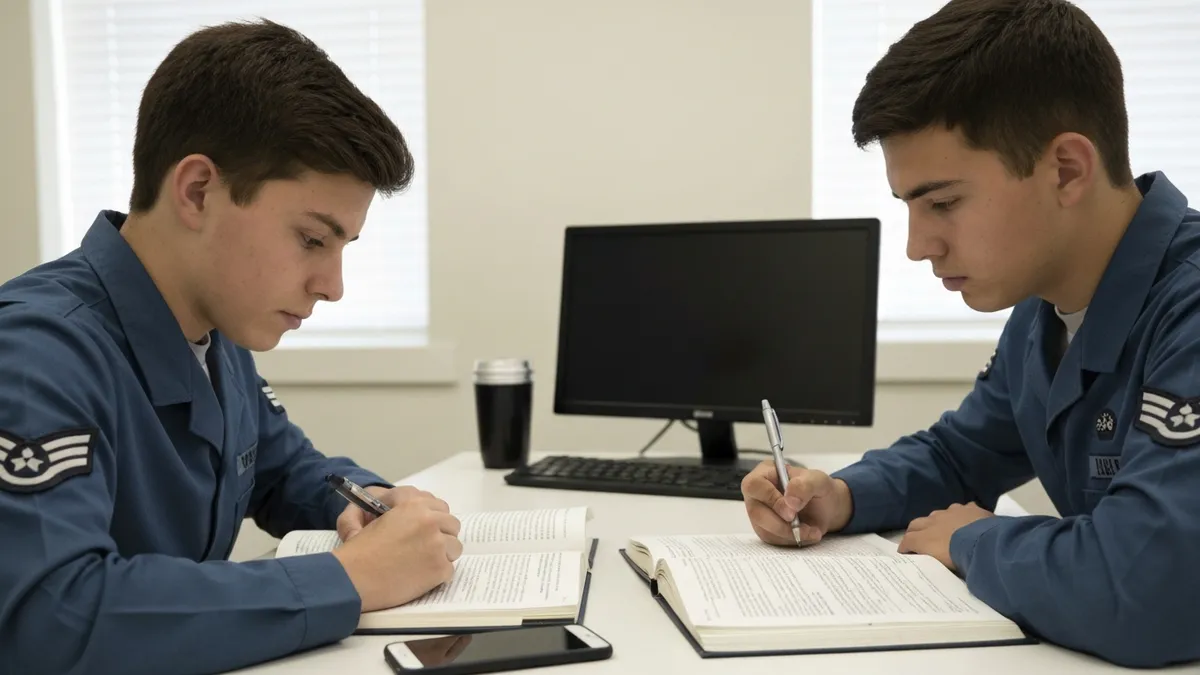
The SAEE (Student Airman Enlistment Exam) is a standardized aptitude assessment used in Air Force and military enlistment processes. It tests the same core academic and vocational aptitude areas assessed by the ASVAB (Armed Services Vocational Aptitude Battery) — the primary enlistment qualification test used across all US military branches.
The SAEE is designed to assess candidates' foundational academic skills and aptitude for learning military occupational specialties (MOS/AFSC codes). Like the ASVAB, it measures verbal, quantitative, and technical reasoning — not specific military knowledge or physical fitness.
Key characteristics:
- Multiple choice, paper or computer-based format
- Covers verbal, quantitative, and science/technical reasoning
- Scores used to determine enlistment eligibility and job qualification
- Format mirrors ASVAB core sections
- No military knowledge required — tests academic foundational skills
Prepare with our saee test practice resources and our comprehensive asvab practice test materials — the ASVAB covers the same core content areas.
SAEE Test Sections Explained
The SAEE tests the same core aptitude areas as the ASVAB. Here is a breakdown of the major subject areas:
1. Word Knowledge (WK):
Tests your vocabulary — the meaning of words in context and the ability to identify synonyms. This is one of the two verbal sections that contribute to the AFQT composite score. Strong vocabulary preparation directly improves this section.
2. Paragraph Comprehension (PC):
Tests your ability to read short passages and answer questions about the main idea, specific details, and inferences. The second verbal component of the AFQT score. Reading varied material at a college-prep level is the most effective preparation.
3. Arithmetic Reasoning (AR):
Word problems testing your ability to solve practical math problems — not abstract algebra. Problems involve percentages, ratios, fractions, averages, and applied arithmetic. This is one of the two math sections in the AFQT composite.
4. Mathematics Knowledge (MK):
Tests algebra, geometry, and number theory at a high school level. More formal math than Arithmetic Reasoning — includes solving equations, exponents, radicals, and geometric concepts. The fourth component of the AFQT score.
5. Science, Mechanical, and Technical Sections:
General Science (GS), Mechanical Comprehension (MC), Electronics Information (EI), and Auto/Shop Information (AS) — these sections do not factor into the AFQT score but determine qualification for specific military jobs. Candidates pursuing technical or aviation-related AFSCs should prepare these sections carefully.
For comprehensive section-by-section practice, use our asvab practice test resources along with our saee test overview materials.
Many readers pair this guide with the saee practice test to check their readiness before exam day.

SAEE Test Preparation Checklist
- ✓Focus the most preparation time on the four AFQT sections: Word Knowledge, Paragraph Comprehension, Arithmetic Reasoning, Mathematics Knowledge
- ✓Build vocabulary daily — use word lists, flashcards, or vocabulary apps targeted at the 8th–10th grade level
- ✓Practice paragraph comprehension with varied reading materials — news articles, technical passages, narrative texts
- ✓Review arithmetic word problems: percentages, ratios, fractions, averages, and basic statistics
- ✓Study algebra, geometry, and number theory for the Mathematics Knowledge section
- ✓If pursuing aviation or technical AFSCs, also study General Science, Mechanical Comprehension, and Electronics
- ✓Take full-length timed practice tests to build test-taking stamina and identify weak areas
- ✓Target consistently scoring 65+ on AFQT sections before your actual exam date
SAEE Pros and Cons
- +SAEE has a defined, publicly available content blueprint — candidates know exactly what to prepare for
- +Multiple preparation pathways (self-study, courses, coaching) accommodate different learning styles and schedules
- +A growing ecosystem of study resources means candidates at any budget level can access quality preparation materials
- +Clear score reporting allows candidates to identify specific strengths and weaknesses for targeted remediation
- +Professional recognition associated with strong performance provides tangible career and academic benefits
- −The scope of tested content requires substantial preparation time that competes with existing professional or academic commitments
- −No single resource covers the full content scope — candidates typically need multiple study tools for comprehensive preparation
- −Test anxiety and exam-day performance variability mean preparation effort does not always translate linearly to scores
- −Registration, preparation, and potential retake costs accumulate into a significant financial investment
- −Content and format can change between exam versions, making older preparation materials less reliable
Pros and Cons at a Glance
| Pros | Cons |
|---|---|
| SAEE has a defined, publicly available content blueprint — candidates know exactly what to prepare for | The scope of tested content requires substantial preparation time that competes with existing professional or academic commitments |
| Multiple preparation pathways (self-study, courses, coaching) accommodate different learning styles and schedules | No single resource covers the full content scope — candidates typically need multiple study tools for comprehensive preparation |
| A growing ecosystem of study resources means candidates at any budget level can access quality preparation materials | Test anxiety and exam-day performance variability mean preparation effort does not always translate linearly to scores |
| Clear score reporting allows candidates to identify specific strengths and weaknesses for targeted remediation | Registration, preparation, and potential retake costs accumulate into a significant financial investment |
| Professional recognition associated with strong performance provides tangible career and academic benefits | Content and format can change between exam versions, making older preparation materials less reliable |
Sample SAEE Test Practice Questions
Try these questions from our free SAEE Test practice tests. The correct answer and an explanation follow each question.
Under IVS 400, which of the following approaches is most commonly used to value real property interests for investment purposes?
- A. Income Approach using discounted cash flow or direct capitalization
- B. Cost Approach using depreciated replacement cost
- C. Market Approach using guideline public company method
- D. Asset-based approach using net asset value
Answer: A. Income Approach using discounted cash flow or direct capitalization
Investment real property is primarily valued using the Income Approach, which captures the present value of future cash flows from rent or lease income.
In discounted cash flow analysis, what does the terminal value represent?
- A. The projected resale price at the end of the holding period
- B. The total rental income over the hold period
- C. The property's current assessed value
- D. The outstanding mortgage balance at sale
Answer: A. The projected resale price at the end of the holding period
The terminal (reversion) value is the anticipated resale proceeds at the end of the investment holding period.
An interim use is best described as a use that:
- A. Is temporary until a higher use becomes feasible
- B. Violates zoning permanently
- C. Is the maximally productive use forever
- D. Cannot generate any income
Answer: A. Is temporary until a higher use becomes feasible
An interim use is a temporary highest and best use until conditions allow a more productive future use.
A pattern shows: 3, 7, 15, 31, 63. What is the next number in the sequence?
- A. 95
- B. 111
- C. 127
- D. 131
Answer: C. 127
Each term is found by doubling the previous term and adding 1, so 63 × 2 + 1 = 127.
SAEE Test Questions and Answers
More Military Aptitude Test Resources



About the Author

Educational Psychologist & Academic Test Preparation Expert
Columbia University Teachers CollegeDr. Lisa Patel holds a Doctorate in Education from Columbia University Teachers College and has spent 17 years researching standardized test design and academic assessment. She has developed preparation programs for SAT, ACT, GRE, LSAT, UCAT, and numerous professional licensing exams, helping students of all backgrounds achieve their target scores.