
OSHA Railing Requirements: Complete Guide to Guardrail Standards, Heights, Loads, and Fall Protection Compliance for Construction and General Industry
📝 OSHA railing requirements explained: guardrail heights, top rail loads, midrails, toe boards, and fall protection compliance for construction sites.
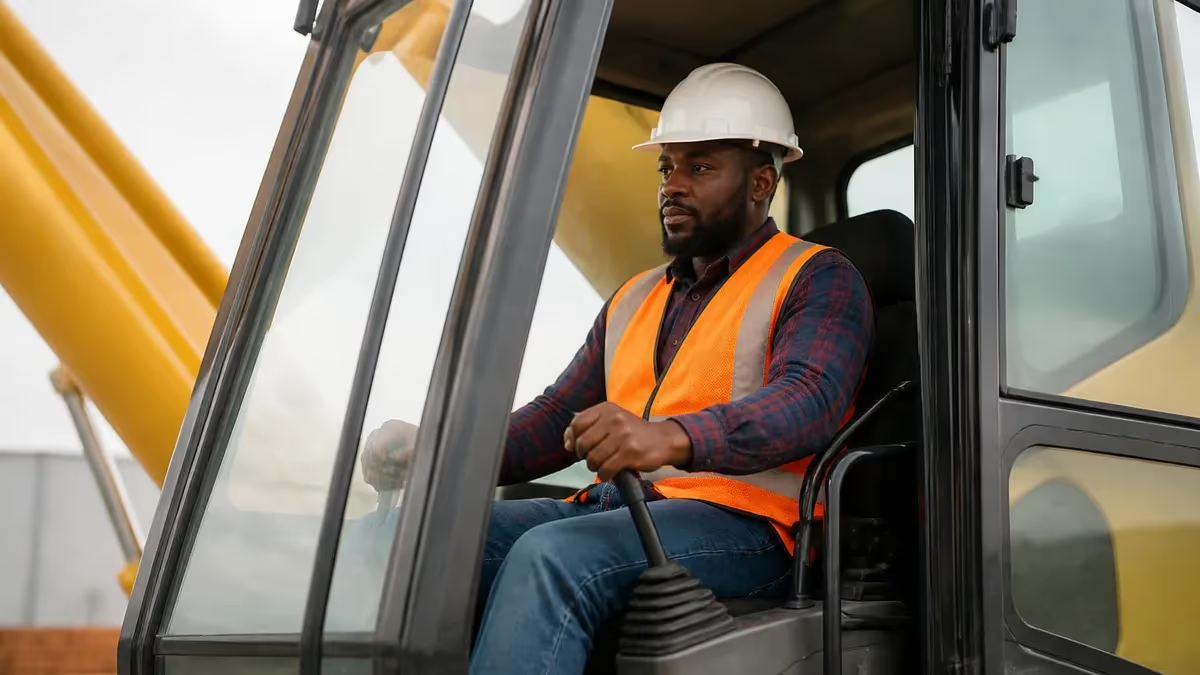
Understanding OSHA railing requirements is one of the most important responsibilities for safety managers, site supervisors, and construction professionals working at elevated heights. Guardrail systems are the most common form of passive fall protection on jobsites, and OSHA enforces strict standards under 29 CFR 1926.502 for construction and 29 CFR 1910.29 for general industry. These rules govern everything from top rail height and midrail placement to the structural load each component must withstand without failure.
Falls remain the leading cause of fatalities in construction year after year, accounting for roughly 36% of all construction deaths according to the Bureau of Labor Statistics. Properly designed and installed railings prevent the vast majority of these incidents, which is why OSHA inspectors scrutinize guardrail compliance during nearly every site visit. A railing that looks sturdy may still fail inspection if the top rail sits below 39 inches, the midrail is missing, or the system cannot withstand a 200-pound outward force without deflecting below 39 inches.
This guide breaks down every dimension, load, material, and inspection criterion you need to know to keep your site compliant. We cover the differences between construction and general industry standards, the role of toe boards and screens, when warning lines or safety nets become acceptable alternatives, and how to document your guardrail program for OSHA audits. Whether you work on scaffolds, mezzanines, roof edges, or open-sided floors, the rules described here apply.
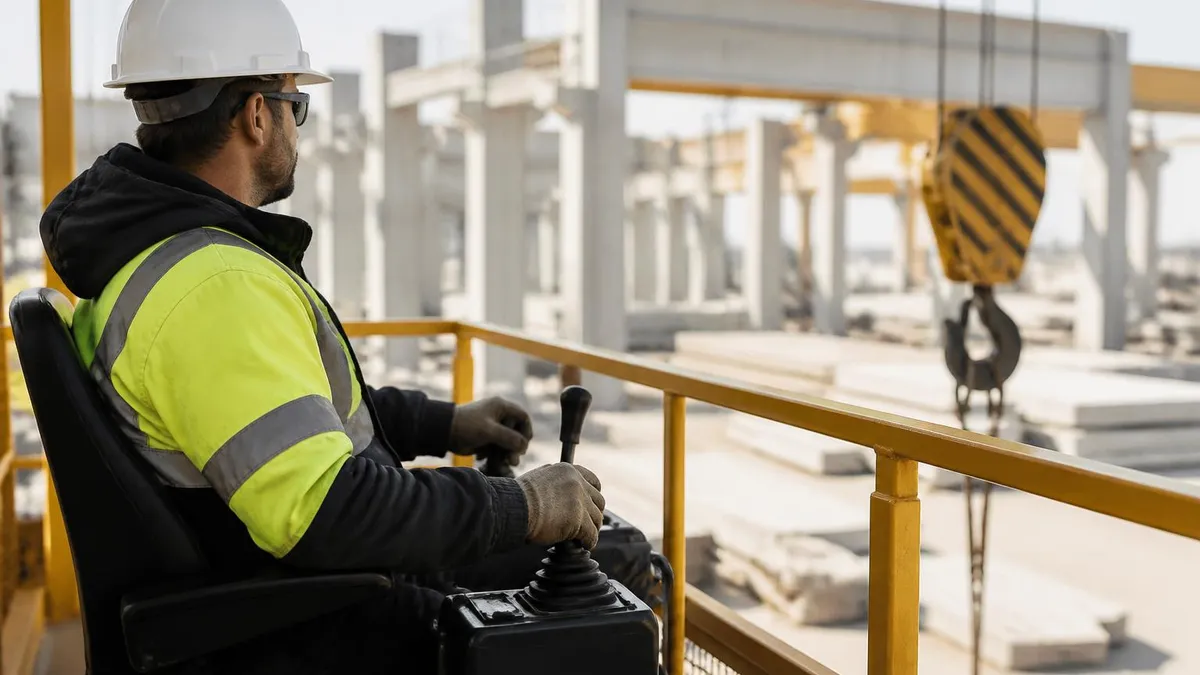
For crane operators and rigging crews, railing compliance overlaps with broader fall protection programs and equipment inspection duties. Many cab platforms, walkways, and crane access points require permanent guardrails that meet the same load and height standards as temporary jobsite rails. Reviewing the OSHA (OSHA Certified Crane Operator) Test Guide can help certified operators understand how railing standards intersect with their day-to-day equipment inspections and elevated work duties.
The penalties for railing violations are significant. OSHA issued more than 5,400 fall protection citations in fiscal year 2024 alone, with serious violations averaging $16,131 per citation and willful or repeat violations climbing to $161,323 each. Beyond the financial cost, a single railing failure can result in catastrophic injury, regulatory shutdown, increased workers compensation premiums, and lasting reputational damage that affects future bid opportunities.
This article walks through the height, load, and design specifications in plain language, explains how to inspect and document railings, and provides practical guidance for retrofitting older systems to meet current standards. We also address common misconceptions, such as the belief that wooden two-by-fours always satisfy the load requirement or that a chain across an opening counts as a compliant guardrail.
By the end of this guide, you will understand exactly what OSHA expects on your worksite, how to spot deficiencies before an inspector does, and what corrective actions to prioritize. Use the table of contents below to jump to specific sections, or read through sequentially for a comprehensive overview of guardrail compliance across both construction and general industry environments.
OSHA Railing Requirements by the Numbers
Core Components of an OSHA-Compliant Guardrail System
The uppermost horizontal member positioned 42 inches above the walking surface, with a tolerance of plus or minus 3 inches. Must resist 200 pounds of outward or downward force without deflecting below 39 inches.
Installed halfway between the top rail and the walking surface, typically at 21 inches. Must withstand 150 pounds in any downward or outward direction. Required unless a wall or parapet of equivalent height is present.
A 3.5-inch minimum vertical barrier along the floor edge that prevents tools, materials, and debris from falling onto workers below. Required when employees pass beneath the platform.
Vertical supports spaced no more than 8 feet apart for most systems. Must be securely anchored to the structure to transfer rail loads without dislodging or tipping under impact.
Optional vertical infill used in place of midrails when small objects or debris pose a hazard. Must extend from the top rail to the toe board and meet the same 150-pound load requirement.
The most important number in OSHA railing requirements is 42 inches. This is the standard top rail height measured from the walking or working surface to the top edge of the uppermost horizontal member. OSHA allows a tolerance of plus or minus 3 inches, meaning a top rail anywhere between 39 and 45 inches is compliant. Anything outside that range is a violation regardless of how sturdy the rail feels or how recently it was installed.
The 42-inch height was updated from the older 39 to 45 inch range in 1996 to reflect taller average worker heights and improve stability when leaning against the rail. Older guardrails installed before the rule change may still be in service, but any new construction or replacement system must meet the current standard. Safety managers should measure existing rails during routine inspections to confirm they have not settled, sagged, or been modified below the minimum height.
Load requirements are equally precise. The top rail must withstand a 200-pound force applied within 2 inches of the top edge in any outward or downward direction. Critically, the rail cannot deflect to a height below 39 inches during this load test. This deflection clause catches many wooden guardrails built from standard two-by-fours, which may support the 200 pounds but flex enough to drop the top rail below the legal minimum.
The midrail must resist 150 pounds of force in any direction. Midrails fill the gap between the top rail and the walking surface, preventing a worker from sliding through the opening if they slip or are pushed. The standard 21-inch midrail placement provides roughly equal openings above and below it, both small enough to block a worker's torso. For more information on related fall protection programs and inspector contacts, the OSHA Contact Number directory is a useful resource.
Toe boards are required whenever workers, equipment, or materials are present below the elevated surface. The minimum height is 3.5 inches measured from the top edge of the toe board to the floor. Toe boards must have no more than a quarter-inch gap at the floor and must withstand a 50-pound force applied in any downward or outward direction. They prevent tools, fasteners, and small debris from rolling off the platform and striking workers underneath.
Spacing between vertical posts matters as much as the rail dimensions. Most engineered systems space posts 8 feet apart, though some heavy-duty systems extend to 10 feet. Wider spacing reduces stiffness and increases deflection under load, which is why OSHA does not allow posts beyond 8 feet for standard wooden guardrails. Steel post systems with engineered base plates can sometimes span further, but the deflection limit still controls the design.
Finally, the entire system must be smooth enough to prevent lacerations, snags, and puncture injuries. Splintered wood, protruding bolts, sharp edges, or projecting nails are all citable hazards even if the rail otherwise meets dimensional and load standards. Inspectors routinely check for these surface conditions during walkthroughs, so daily visual inspections by competent persons should include both structural and finish criteria.
OSHA Practice Test Questions
Prepare for the OSHA - OSHA Certified Crane Operator exam with our free practice test modules. Each quiz covers key topics to help you pass on your first try.
OSHA Crane Operation Controls & Signal Com...
OSHA Exam Questions covering Crane Operation Controls & Signal Communication. Master OSHA Test concepts for certification prep.
OSHA Crane Safety Procedures & Hazard Prev...
Free OSHA Practice Test featuring Crane Safety Procedures & Hazard Prevention. Improve your OSHA Exam score with mock test prep.
OSHA Load Handling & Rigging Techniques
OSHA Mock Exam on Load Handling & Rigging Techniques. OSHA Study Guide questions to pass on your first try.
OSHA Regulations & Equipment Inspection St...
OSHA Test Prep for Regulations & Equipment Inspection Standards. Practice OSHA Quiz questions and boost your score.
OSHA Code Compliance
OSHA Questions and Answers on Code Compliance. Free OSHA practice for exam readiness.
OSHA Crane Operator Certification & Qualif...
OSHA Mock Test covering Crane Operator Certification & Qualification Requirements. Online OSHA Test practice with instant feedback.
OSHA Environmental Standards
Free OSHA Quiz on Environmental Standards. OSHA Exam prep questions with detailed explanations.
OSHA Equipment Operation
OSHA Practice Questions for Equipment Operation. Build confidence for your OSHA certification exam.
OSHA Maintenance Protocols
OSHA Test Online for Maintenance Protocols. Free practice with instant results and feedback.
OSHA Material Selection
OSHA Study Material on Material Selection. Prepare effectively with real exam-style questions.
OSHA Pre-Lift Planning & Load Chart Interp...
Free OSHA Test covering Pre-Lift Planning & Load Chart Interpretation. Practice and track your OSHA exam readiness.
OSHA Quality Inspection
OSHA Exam Questions covering Quality Inspection. Master OSHA Test concepts for certification prep.
OSHA Railing Requirements Across Industries
Under 29 CFR 1926.502, construction guardrail systems trigger at 6 feet of elevation for most work, but lower thresholds apply for scaffolds, steel erection, and other specialized activities. Top rails must be 42 inches plus or minus 3 inches and withstand 200 pounds of outward or downward force. Midrails, screens, mesh, or solid panels must be installed between the top rail and the walking surface unless an equivalent barrier already exists.
Construction sites often deal with temporary guardrails that move as work progresses. OSHA still expects these temporary systems to meet the same dimensional and load requirements as permanent installations. Competent persons must inspect each new placement, and any rail that has been struck, modified, or moved should be re-verified before workers approach the edge. Documentation of these inspections protects employers during enforcement actions and OSHA audits.

Guardrails vs Personal Fall Arrest Systems
- +Passive protection requires no worker action or training to activate
- +Protects all workers in the area simultaneously, including visitors
- +No anchor point inspection or harness fitting required each shift
- +Lower per-worker cost when multiple employees access the same area
- +Reduces falls before they happen rather than catching them mid-fall
- +Eliminates the rescue planning required for suspended workers
- +Compatible with material handling and tool use at the edge
- −Cannot be used everywhere, especially on irregular roof edges or leading edges
- −Requires structural anchorage that may not exist on lightweight roofs
- −Temporary systems can be moved or damaged by other trades
- −Standard wooden rails often fail the deflection portion of load testing
- −More expensive upfront than basic personal fall arrest equipment
- −Cannot protect workers who must lean or reach beyond the rail
- −May obstruct material delivery, hoisting, or window installation work
OSHA Railing Requirements Inspection Checklist
- ✓Measure top rail height at multiple points to confirm 42 inches plus or minus 3 inches
- ✓Confirm midrail placement at approximately 21 inches above the walking surface
- ✓Verify toe board height of at least 3.5 inches where workers pass below
- ✓Apply a 200-pound test load to the top rail and confirm no deflection below 39 inches
- ✓Check post spacing does not exceed 8 feet between vertical supports
- ✓Inspect for splinters, sharp edges, protruding nails, and other surface hazards
- ✓Confirm all bolts, clamps, and fasteners are tight and free from corrosion
- ✓Verify that removable sections have self-closing gates or compliant chains
- ✓Document inspection findings with date, location, inspector name, and corrective actions
- ✓Train all workers on the limits of guardrail systems and prohibited modifications
The Deflection Clause Catches Most Failures
A guardrail can pass the 200-pound load test in raw strength but still fail OSHA inspection if it deflects below 39 inches during the load. This single rule eliminates many improvised wooden rails built from standard 2x4 lumber spanning more than 6 feet. Always test deflection, not just static load capacity.
Fall protection violations have topped OSHA's most-cited list for fourteen consecutive years, and guardrail deficiencies make up a substantial share of those citations. In fiscal year 2024, OSHA issued 6,307 violations under standard 1926.501 alone, with fall protection systems criteria under 1926.502 accounting for additional thousands. Each serious violation carries a base penalty around $16,131, while willful or repeated violations can reach $161,323 per instance under the inflation-adjusted maximum.
The most common guardrail violation is missing midrails on open-sided floors and platforms. Inspectors arrive at jobsites and find a top rail in place but no intermediate barrier between the rail and the walking surface, leaving a 42-inch gap a worker can slip through. This single deficiency accounts for thousands of citations each year and is one of the easiest to correct before an inspection occurs.
Inadequate top rail height is the second most frequent issue. Older guardrails built to the pre-1996 standard may sit at 36 inches, well below the current 39-inch minimum. Settling, sagging, or modifications by other trades can drop a previously compliant rail below the threshold. A simple tape measure check during weekly walkthroughs catches these problems before an inspector documents them in a citation.
Insufficient strength is harder to detect without active testing. A wooden guardrail can look perfectly compliant but fail the 200-pound deflection test because the lumber has dried, cracked, or weakened over months of exposure. OSHA inspectors carry calibrated force gauges and routinely test rails during enforcement visits. Employers who never load-test their own rails are unlikely to know they have a problem until a citation arrives.
Missing toe boards generate citations when workers or pedestrians pass beneath the platform. Even on isolated rooftops, scaffolds that arch over building entrances or pedestrian sidewalks require toe boards to prevent dropped objects from striking people below. The 3.5-inch minimum height applies regardless of whether other debris controls such as netting are also in place.
Improper alternatives to guardrails draw frequent fines as well. Chains stretched across stair openings, rope tied between posts, and warning lines used outside their permitted contexts all fail to meet OSHA's structural requirements. A chain may serve as a self-closing gate substitute only if it can withstand the full 200-pound top rail load and 150-pound midrail load without exceeding deflection limits.
Holes in walking surfaces, including skylights and floor openings, must be protected by guardrails meeting the full standard, by covers rated to twice the anticipated load, or by personal fall arrest systems. Skylights specifically have caused dozens of fatalities and are a continuing OSHA enforcement priority, especially on warehouse and big-box retail roof projects.
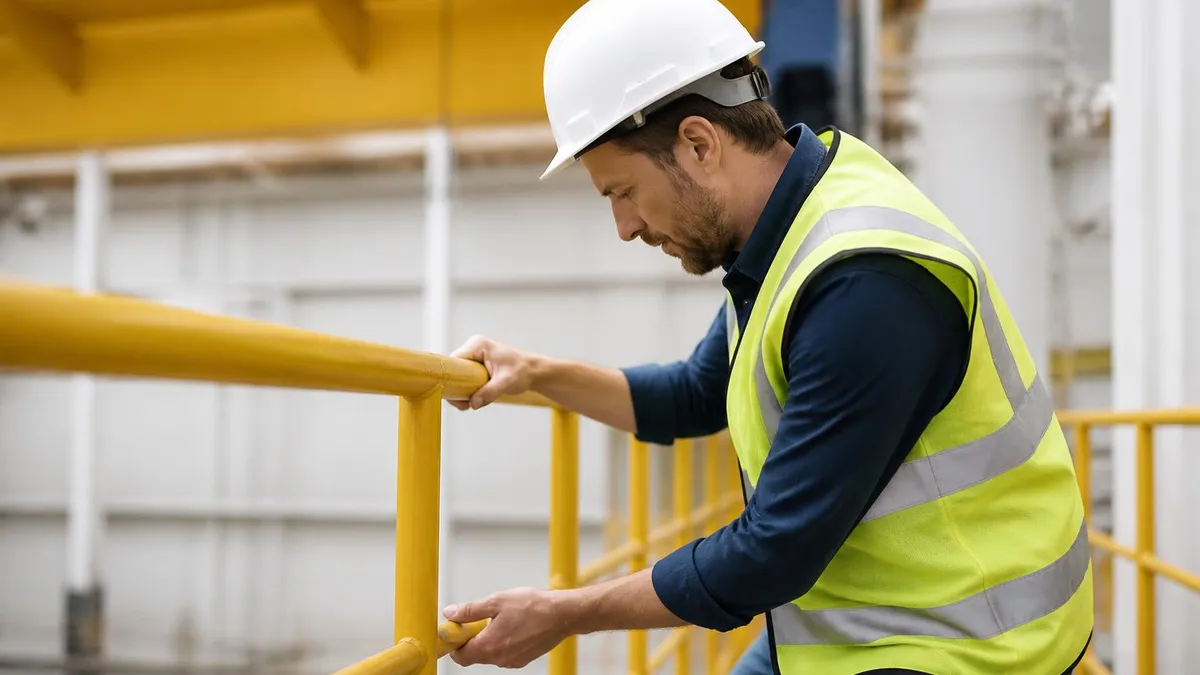
A simple chain stretched across an opening does not satisfy OSHA guardrail requirements unless it can withstand the full 200-pound top rail load and 150-pound midrail load without exceeding deflection limits. Most decorative chains fail this test and result in serious citations averaging $16,131 each.
While guardrails are the preferred form of fall protection, OSHA recognizes several alternatives when railings are infeasible or impractical. Personal fall arrest systems consisting of a full-body harness, lanyard, and certified anchor point are the most common substitute. Anchor points must be capable of supporting 5,000 pounds per attached worker, or be designed under the supervision of a qualified person with a safety factor of at least two.
Safety net systems may replace guardrails for steel erection and certain bridge work. Nets must be installed no more than 30 feet below the work surface and must extend outward sufficiently to catch a worker who falls past the platform edge. Mesh openings cannot exceed 36 square inches or be larger than 6 inches on any side, and the net must be load-tested with a 400-pound sandbag dropped from the work elevation.
Warning line systems combined with safety monitors are permitted on low-slope roofs in construction, but only under specific conditions outlined in 29 CFR 1926.501. Warning lines must be erected at least 6 feet from the roof edge for work without mechanical equipment, or 10 feet when equipment is in use. The line itself must withstand a 16-pound tipping force at 30 inches above the surface and remain visible from any angle.
Controlled access zones are sometimes used during leading-edge work, masonry construction, and certain overhead activities. These zones rely on a competent person to monitor workers and limit access to trained employees who understand the fall hazards. Controlled access zones are not a permanent solution and must be combined with other protective measures whenever feasible. Refer to the OSHA Establishment Search database to review enforcement history at similar sites.
Hole covers serve as a passive alternative to guardrails for floor openings. Covers must support twice the maximum intended load, be secured against displacement, and be marked with the word HOLE or COVER. Plywood covers are common but must be properly sized, fastened with screws or anchors, and labeled in a color that contrasts with the surrounding floor surface.
Personal fall restraint systems differ from arrest systems in that they prevent the worker from reaching the fall hazard in the first place. A restraint setup uses a body harness or belt with a fixed-length tether that physically stops the worker before they reach the edge. Restraint systems require careful anchor placement and tether length calculations to ensure the worker cannot reach the leading edge under any reasonable working motion.
Finally, positioning device systems are used in specific applications like rebar work, where the worker leans into the system to free both hands for work. These systems must limit fall distance to 2 feet and have anchors capable of supporting twice the impact load or 3,000 pounds, whichever is greater. They are not designed as primary fall protection but rather as supplemental tools for hands-free work at heights.
Implementing a compliant guardrail program starts with site-specific planning before any work begins. Walk the jobsite with the project manager, the competent person, and the fall protection coordinator. Identify every leading edge, open-sided floor, mezzanine, scaffold platform, and floor opening that will exist during the project lifecycle. Document each location and assign a primary protection method, with secondary controls as backup.
Procurement matters more than many supervisors realize. Buy engineered guardrail systems from manufacturers who provide load test data, installation instructions, and replacement parts. Avoid building guardrails from scrap lumber or improvising connections that have not been tested. The marginal cost of an engineered system is small compared to a single OSHA citation, let alone the workers compensation cost of a serious fall.
Training is mandatory under both 1926.503 and 1910.30. Every worker who could be exposed to fall hazards must receive instruction on the nature of those hazards, the procedures for protective equipment, the limitations of guardrails, and the proper care and use of personal fall arrest gear. Training must be documented with the worker's signature, the date, and the trainer's credentials, and must be repeated whenever conditions or equipment change.
Daily inspections by a competent person catch problems before they become incidents. Walk the perimeter of every elevated work area at the start of each shift. Check rail heights with a measuring stick, push on each post to confirm rigidity, and look for new damage caused by overnight weather, material deliveries, or work by other trades. Document each inspection with date, time, observations, and any corrective actions taken.
Repairs and retrofits should follow manufacturer specifications and OSHA's minimum standards. When a rail is damaged, replace the affected section with engineered components rather than patching with scrap material. If older rails on the site do not meet the current 42-inch standard, develop a phased replacement plan with clear deadlines, and document the interim controls that will protect workers in the meantime.
Communication with subcontractors and visiting workers is often overlooked. Every trade entering the site should be briefed on the fall protection plan, including which guardrails are in place, which areas require personal fall arrest equipment, and who serves as the competent person for guardrail questions. Post-fall protection signage at site entrances and conduct regular toolbox talks to keep the program top of mind.
Finally, treat near-misses as warnings. If a worker stumbles into a rail, if a rail flexes under contact, or if any worker reports concerns about a guardrail's stability, investigate immediately. Many catastrophic falls were preceded by minor incidents that were dismissed at the time. Documenting and acting on near-misses is one of the most effective ways to prevent the next fatality, and it demonstrates good faith compliance to OSHA inspectors and insurance carriers.
OSHA Questions and Answers
OSHA 500 Course Online: Complete Guide to Trainer Certification for Construction Industry Outreach
360 OSHA Training: Complete Guide to Online OSHA 10 & 30 Certification Courses for Construction and General Industry Workers
OSHA Contact Number: Complete Directory of Phone Numbers, Regional Offices, and How to Reach OSHA for Questions, Complaints, and Emergencies
OSHA (OSHA Certified Crane Operator) Test Guide
OSHA Establishment Search: How to Use the Inspection Database
About the Author
Certified Safety Professional & OSHA Compliance Expert
Indiana University of Pennsylvania Safety SciencesDr. William Foster holds a PhD in Safety Science from Indiana University of Pennsylvania and is a Certified Safety Professional (CSP) and Certified Hazardous Materials Manager. With 20 years of occupational health and safety management experience across construction, manufacturing, and chemical industries, he coaches safety professionals through OSHA certification, CSP, CHST, and safety management licensing programs.
Join the Discussion
Connect with other students preparing for this exam. Share tips, ask questions, and get advice from people who have been there.
View discussion (5 replies)