
OSHA 500 Course Online: Complete Guide to Trainer Certification for Construction Industry Outreach
✏️ Complete guide to the OSHA 500 course online — prerequisites, format, cost, authorized trainers, and how to become a certified construction outreach
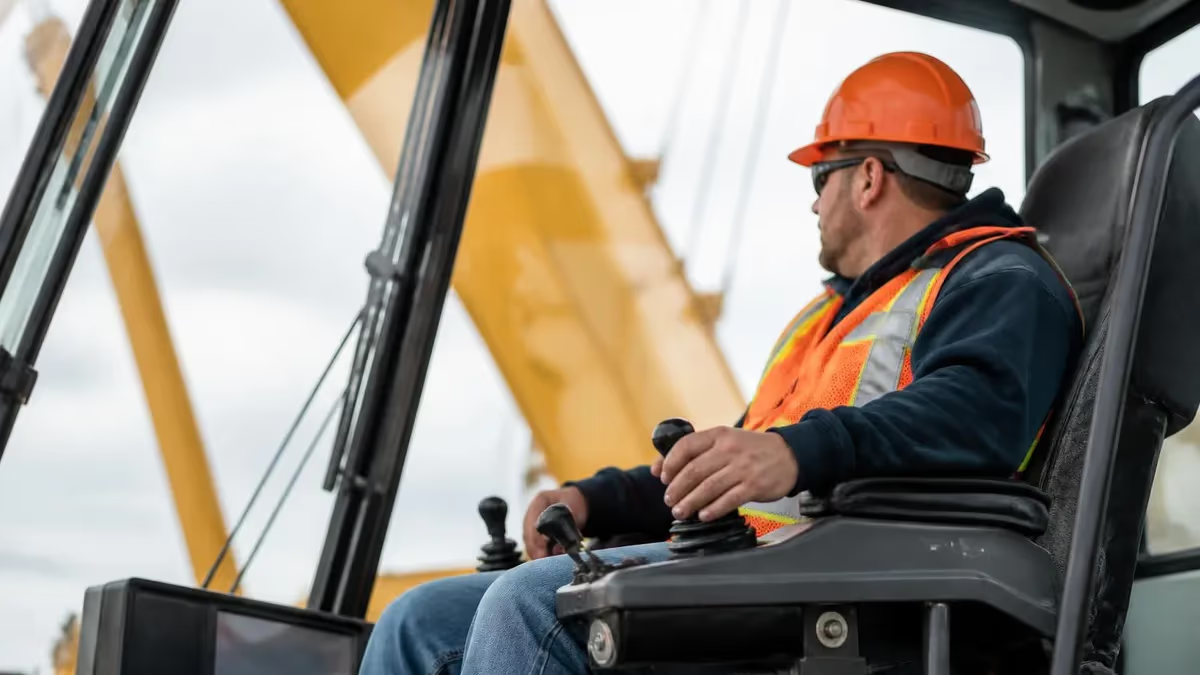
The osha 500 course online is the official OSHA Training Institute (OTI) Education Center pathway for safety professionals who want to become authorized trainers in the construction industry outreach program. Completing this course allows you to teach the widely recognized OSHA 10-hour and OSHA 30-hour construction classes and issue student completion cards through OSHA-authorized channels. For crane operators, site supervisors, and EHS managers looking to multiply their impact, becoming a certified outreach trainer is one of the most respected credentials in the construction safety world.
Unlike the standard OSHA 10 or OSHA 30 awareness classes, the OSHA 500 is a train-the-trainer program. It assumes you already understand the regulatory landscape, the structure of 29 CFR 1926, and the practical application of construction safety standards on real job sites. The online format compresses what used to be a strictly in-person week of training into a hybrid model that combines self-paced modules, scheduled virtual classroom sessions, peer teach-backs, and a final knowledge assessment delivered through an OTI Education Center.
Demand for authorized construction outreach trainers has grown steadily as general contractors, crane rental companies, and infrastructure firms tighten subcontractor safety prequalification requirements. Many bid packages now require that a percentage of field personnel hold valid OSHA 10 or 30 cards, and having an in-house trainer dramatically reduces cost and scheduling friction. That business case is the main reason so many crane crews, riggers, and site superintendents pursue the OSHA 500 online instead of traveling to a regional OTI campus.
This guide walks through everything you need to know before you register — eligibility, prerequisites, course format, what the online classroom actually looks like, how the assessment works, and what authorized trainer status lets you do once you are certified. We also cover renewal requirements (the OSHA 502 update course), pricing differences between OTI Education Centers, and how the online experience compares to the traditional residential format that has been offered since the 1970s.
If your role intersects with construction safety in any way — whether you operate cranes, supervise rigging teams, run a safety department, or consult independently — earning your OSHA 500 trainer card opens new revenue streams and substantially strengthens your professional profile. You can read more about the underlying credential framework in our OSHA (OSHA Certified Crane Operator) Test Guide to understand how the trainer pathway connects to the broader operator certification ecosystem.
Before you commit to a registration date, it pays to understand exactly what the prerequisites require, because OTI Education Centers will reject applications that do not document five years of construction safety experience and a completed OSHA 510. The remainder of this article unpacks each piece of that puzzle so you arrive on day one prepared, confident, and positioned to pass the final assessment on your first attempt rather than burning a second tuition payment on a retake.
OSHA 500 Course by the Numbers

Prerequisites & Eligibility Requirements
You must have completed the OSHA 510 Occupational Safety and Health Standards for the Construction Industry course before registering. The certificate must be presented at registration and is non-negotiable across every OTI Education Center.
Applicants must document at least five years of construction safety experience. Acceptable roles include site safety manager, EHS coordinator, competent person, crane safety supervisor, or independent construction safety consultant with verifiable references.
Many OTI centers require two professional references attesting to your construction safety background. References should come from supervisors, clients, or industry peers familiar with your direct work on active construction projects.
For the online format, you need a reliable broadband connection, a webcam, working microphone, and a quiet space for live virtual sessions. Some OTI centers also require a second camera angle during the final assessment to verify identity.
The course is delivered exclusively in English, and trainer candidates must be able to teach in English as well. Authorized trainers may later seek approval to teach OSHA outreach courses in Spanish through a separate qualification process.
The online format of the OSHA 500 course was significantly expanded after 2020, when OTI Education Centers were authorized to deliver portions of the curriculum remotely. Today, most centers run a hybrid model: roughly 40 percent of the content is asynchronous self-paced study, and 60 percent is delivered live through a virtual classroom platform such as Zoom, WebEx, or a proprietary learning management system. The blended structure preserves the interactive teach-back exercises that have always been the heart of the trainer certification.
Self-paced modules typically open one to two weeks before your scheduled live sessions. These cover regulatory background, the structure of 29 CFR 1926, OSHA outreach program requirements, recordkeeping procedures, and a deep review of the most commonly cited construction standards. You can move through this material at your own pace, but most students find that 12 to 16 hours of focused study is required to be prepared for the live classroom portion.
The live virtual portion usually runs four consecutive days, six to seven hours per day, with structured breaks. During these sessions you will be assigned to small breakout groups for teach-back exercises, where each candidate prepares and delivers a 15-to-20-minute mini-lesson on an assigned standard. Your instructors and peers evaluate your teaching style, content accuracy, use of training aids, and ability to handle student questions. This is widely considered the most stressful — and most valuable — part of the course.
Attendance policies are strict. OSHA requires that authorized trainer candidates be present for 100 percent of the contact hours. If you miss more than a single short break during a live session, most OTI centers will require you to retake the entire course. This is why selecting dates that genuinely work for you matters more than chasing the earliest available cohort. Block the week off your calendar exactly as if you were traveling to a residential program, because mentally and logistically that is what the online version still demands.
The final assessment combines a written knowledge test (usually 50 to 75 multiple-choice questions covering standards, outreach program procedures, and adult learning principles) with a graded teach-back. Most centers require 70 percent or higher on the written exam and a passing rubric score on the teach-back to receive your trainer authorization. Failing either component typically allows one retake within a defined window, after which you must register and pay for the full course again.
For context on how OSHA structures and updates these training requirements, our companion guide to What Is the OSHA Rule? Complete Guide to OSHA Rules and Standards for Crane Operators walks through the underlying CFR architecture that the OSHA 500 curriculum is built on. Understanding that framework before you start the course makes the self-paced modules far easier to absorb.
One thing worth flagging: the online OSHA 500 is identical in scope and rigor to the in-person version. Your trainer card does not indicate which delivery format you used, and your authorization is exactly the same. The decision between online and residential is purely about logistics, learning preference, and access to a nearby OTI Education Center, not about the credential's value or recognition.
OSHA Practice Test Questions
Prepare for the OSHA - OSHA Certified Crane Operator exam with our free practice test modules. Each quiz covers key topics to help you pass on your first try.
OSHA Crane Operation Controls & Signal Com...
OSHA Exam Questions covering Crane Operation Controls & Signal Communication. Master OSHA Test concepts for certification prep.
OSHA Crane Safety Procedures & Hazard Prev...
Free OSHA Practice Test featuring Crane Safety Procedures & Hazard Prevention. Improve your OSHA Exam score with mock test prep.
OSHA Load Handling & Rigging Techniques
OSHA Mock Exam on Load Handling & Rigging Techniques. OSHA Study Guide questions to pass on your first try.
OSHA Regulations & Equipment Inspection St...
OSHA Test Prep for Regulations & Equipment Inspection Standards. Practice OSHA Quiz questions and boost your score.
OSHA Code Compliance
OSHA Questions and Answers on Code Compliance. Free OSHA practice for exam readiness.
OSHA Crane Operator Certification & Qualif...
OSHA Mock Test covering Crane Operator Certification & Qualification Requirements. Online OSHA Test practice with instant feedback.
OSHA Environmental Standards
Free OSHA Quiz on Environmental Standards. OSHA Exam prep questions with detailed explanations.
OSHA Equipment Operation
OSHA Practice Questions for Equipment Operation. Build confidence for your OSHA certification exam.
OSHA Maintenance Protocols
OSHA Test Online for Maintenance Protocols. Free practice with instant results and feedback.
OSHA Material Selection
OSHA Study Material on Material Selection. Prepare effectively with real exam-style questions.
OSHA Pre-Lift Planning & Load Chart Interp...
Free OSHA Test covering Pre-Lift Planning & Load Chart Interpretation. Practice and track your OSHA exam readiness.
OSHA Quality Inspection
OSHA Exam Questions covering Quality Inspection. Master OSHA Test concepts for certification prep.
OSHA 500 Course Online Curriculum Modules
The standards review module is the longest portion of the OSHA 500 course online, occupying roughly one-third of total contact hours. It walks through the most frequently cited 29 CFR 1926 subparts, including fall protection (Subpart M), scaffolding (Subpart L), electrical (Subpart K), excavations (Subpart P), and cranes and derricks (Subpart CC). Candidates learn how to navigate the regulatory text, locate specific requirements, and translate dense legal language into plain-English explanations for outreach students.
Beyond memorization, the module emphasizes teaching strategy. You will practice building lesson plans around each standard, integrating real OSHA inspection data, and using case studies from actual fatality investigations. By the end of this section, you should be able to explain any major Subpart citation to a 10-hour outreach class without referring to the CFR text in real time, and answer the kinds of practical questions students always ask about gray areas in the standards.

Should You Take the OSHA 500 Course Online?
- +No travel costs to a distant OTI Education Center campus
- +Self-paced modules let you study around a full-time work schedule
- +Identical credential and trainer card as the in-person version
- +Recorded virtual sessions can be reviewed for reinforcement
- +Smaller breakout groups in many online cohorts than residential
- +Earlier availability — online dates open more frequently than residential
- +Easier for employers to approve since no week of travel is required
- −Strict 100 percent attendance requirement during live virtual days
- −Requires reliable broadband and quiet workspace for full course duration
- −Teach-back exercises can feel less natural on camera than in person
- −Limited peer networking compared to residential cohorts
- −Technology failures during the final assessment can trigger retakes
- −Self-paced modules require strong discipline to complete on schedule
- −Some OTI centers charge a small premium for online versus residential
OSHA 500 Course Online Trainer Card Checklist
- ✓Verify your OSHA 510 completion certificate is current and accessible
- ✓Document at least five years of construction safety work experience
- ✓Gather two professional references familiar with your construction background
- ✓Test your webcam, microphone, and broadband speed before day one
- ✓Block all four live virtual days completely off your work calendar
- ✓Download the OSHA Outreach Training Program Requirements document
- ✓Print the Construction Industry Procedures document for quick reference
- ✓Prepare a backup internet connection in case of outages during sessions
- ✓Schedule a quiet, interruption-free workspace for the entire course week
- ✓Complete every self-paced module at least three days before live sessions
- ✓Practice your teach-back lesson on camera before presenting to the cohort
- ✓Confirm trainer card delivery method and timing with your OTI Education Center
The OSHA 510 prerequisite is strictly enforced
Every OTI Education Center will verify your OSHA 510 completion before issuing a course confirmation, and there is no waiver process. If you have not yet completed the OSHA 510, register for it first — it is offered online by most of the same centers — and plan on at least 60 days between completion of the 510 and the start of your OSHA 500. Attempting to register without this prerequisite wastes application time and may forfeit non-refundable deposits.
Tuition for the osha 500 course online varies meaningfully across the 27 authorized OTI Education Centers. As of 2026, expect to pay between $1,095 and $1,495 for the course itself, with most centers clustering around the $1,295 mark. The price typically includes all course materials, access to the learning management system, the final assessment, and your initial trainer card processing fee. Some centers bundle the OSHA Outreach Trainer kit (lesson plan templates, presentation slides, and student handout masters) while others sell it as a $150 to $250 add-on.
Beyond direct tuition, factor in the cost of meeting prerequisites. The OSHA 510 course runs $595 to $795 at most OTI centers and is now also widely available online. If you do not yet have five years of documented construction safety experience, that is the longest and most expensive prerequisite to address — there is no shortcut, and OTI verification is rigorous. Some candidates spend a year in a safety coordinator role specifically to qualify, which significantly extends the timeline to becoming an authorized trainer.
OTI Education Centers are regional partnerships between OSHA and accredited universities, nonprofits, or trade organizations. Notable centers include the University of Texas Arlington, Keene State College, North Carolina State University, Eastern Kentucky University, Rocky Mountain Education Center, and the National Resource Center for OSHA Training. Each center has slightly different scheduling cadences, refund policies, retake procedures, and bundle offerings. It pays to compare three or four centers before registering rather than defaulting to the closest one geographically — for an online course, location is largely irrelevant.
Employer reimbursement is common but not automatic. If your employer is paying, get written confirmation in advance that they will cover both tuition and any retake fees, because OSHA 500 failure rates are not zero and a retake at full tuition is a meaningful expense. Many crane rental companies, general contractors, and EHS consulting firms will reimburse the course in exchange for a written commitment to deliver a minimum number of in-house outreach classes over the following 24 months.
For independent safety consultants, the OSHA 500 typically pays for itself within the first two to three outreach classes you deliver. A 10-hour construction class taught to a 20-person crew commonly bills between $1,500 and $3,500, while a 30-hour class for the same group can bill $4,500 to $9,000. Even after material costs and administrative time, the return on the OSHA 500 investment for an active independent trainer is one of the strongest in the safety credential market.
If you are also evaluating your broader OSHA footprint, our guide to the OSHA Establishment Search: How to Use the Inspection Database is a useful companion resource. Understanding inspection history is a powerful classroom tool — outreach students consistently respond more strongly to real local citation data than to abstract regulatory discussion, and being able to pull live establishment data into your lesson plans dramatically improves student engagement during the courses you will eventually teach.
One last cost consideration: technology. If your home setup is marginal, budget for a webcam upgrade, a second monitor, and potentially a backup mobile hotspot. Spending $200 to $400 on better equipment before the course starts is far cheaper than having technical failures derail your final assessment and force a retake. Treat the online environment as your professional teaching studio for the week — because functionally, that is exactly what it is.

Your OSHA 500 trainer authorization is valid for four years from the date of course completion. To maintain authorized trainer status, you must complete the OSHA 502 update course before your card expires. If your authorization lapses, you must retake the full OSHA 500 — there is no grace period and no retroactive renewal. Mark your renewal date prominently and register for OSHA 502 at least six months before expiration.
Renewal is one of the most misunderstood aspects of authorized trainer status. The OSHA 502 update course is required every four years to maintain your construction outreach trainer authorization. It is a shorter course — typically 18 to 24 contact hours — focused on regulatory changes, enforcement trends, new emphasis programs, and any updated outreach program procedures since the last cycle. The OSHA 502 is also widely available online through the same OTI Education Centers that deliver the OSHA 500.
The renewal window is strictly enforced. You must complete OSHA 502 before your current trainer card expires. If you let your authorization lapse — even by a single day — you must complete the full OSHA 500 course again, not the 502 update. Many trainers have learned this the hard way after a missed renewal cost them an extra $1,000 in tuition and a full week of additional contact hours. Set calendar reminders at the 12-month, 6-month, and 3-month marks before your card expiration date.
Once you are an authorized construction outreach trainer, you can teach OSHA 10-hour and OSHA 30-hour construction classes and issue official student completion cards through your OTI Education Center. You cannot, however, teach general industry outreach classes — that requires the parallel OSHA 501 trainer course. Some safety professionals pursue both credentials to maximize the markets they can serve, particularly those working in mixed-environment settings like industrial construction or large infrastructure projects.
Authorized trainers must adhere to specific delivery rules. OSHA 10 and 30 outreach classes must be delivered with a minimum number of contact hours, cannot be exclusively online for outreach students (except in approved circumstances), must cover required topics, and must maintain documentation for at least five years. Cards typically arrive from your OTI Education Center within four to six weeks of class completion, though several centers now offer expedited two-week processing for an additional fee.
The trainer card itself is paper, and OSHA does not maintain a central public registry of authorized trainers. This means employers verifying a trainer's status typically contact the OTI Education Center that issued the card directly, or request a copy of the trainer's authorization documentation. Keep your trainer card and your most recent OSHA 502 completion certificate together in a secure location — losing both can complicate verification for prospective clients or employers.
Trainer authorization can be suspended or revoked for outreach program violations. The most common triggers include falsifying student records, charging students directly for cards (a strict prohibition), failing to meet minimum contact hours, allowing unauthorized assistants to teach significant portions of class, and failing to verify student identity. OSHA takes program integrity seriously, and a revocation is generally permanent — you cannot simply re-take the OSHA 500 and start over. Compliance is not optional.
Finally, plan ahead for your career trajectory. Many authorized trainers eventually pursue additional credentials like the CHST, CSP, or specialized crane operator certifications to expand their teaching range and consulting opportunities. The OSHA 500 trainer card is best understood as a foundation credential — valuable on its own, but most powerful when combined with deeper subject-matter expertise that you can bring into your outreach classroom.
Practical preparation for the OSHA 500 course online begins three to four weeks before your scheduled start date. Pull out your OSHA 510 materials and re-read the most heavily tested standards — fall protection, scaffolding, electrical safety, excavation, struck-by and caught-between hazards, and cranes and derricks. The OSHA 500 assumes mastery of this foundational content, and instructors will not slow down to re-explain Subpart-level rules during the live sessions. Time invested in advance refresher reading pays back during the final written exam.
Prepare your teach-back lesson early. Most OTI Education Centers will send your assigned standard at least one week before the live sessions begin. Build your lesson plan, develop a slide deck if visuals are allowed, write your discussion questions, and rehearse the full 15-to-20-minute presentation on camera at least three times. Watch the recordings critically — listen for filler words, check your eye contact with the camera lens, and refine pacing. The teach-back is graded as much on delivery as on content accuracy.
Set up your physical teaching environment professionally. Position your camera at eye level rather than looking down at a laptop. Light your face from the front, not behind. Use a neutral, clean background — bookshelves and tidy office walls work better than blank rooms or distracting art. Wear what you would wear to teach a classroom of construction workers in person: a polo or button-down with a company logo signals professionalism. Small details add up across four full days of live evaluation by your instructors and peers.
During the live sessions, participate actively in every breakout exercise. Instructors specifically note candidates who stay engaged versus those who hide. Volunteer for early teach-back slots if possible — students who present later in the week often face higher expectations because instructors have already calibrated their grading rubrics, while early presenters benefit from a slightly more generous evaluation curve. This is a small but consistent pattern that experienced OSHA 500 instructors readily acknowledge.
Treat the self-paced modules with the same seriousness as the live content. The final written assessment pulls heavily from these modules, and candidates who skim them tend to score 10 to 15 percentage points lower than those who take detailed notes. Print the OSHA Outreach Training Program Requirements document and the Construction Industry Procedures document, highlight key requirements, and keep both within arm's reach during the entire course. These documents will be referenced repeatedly during instruction and tested directly on the written exam.
After the course, request your trainer card processing status from the OTI Education Center within 48 hours of completion. Confirm the spelling of your name, your authorization expiration date, and your trainer ID number. Once the card arrives, scan a digital copy and store it in cloud backup along with your course completion certificate, your OSHA 510 certificate, and your professional references. This documentation package is what you will present to every employer and client for the next four years until your OSHA 502 renewal cycle.
For ongoing professional development beyond initial certification, our deeper resources on How Long Is OSHA 10 Good For? Card Validity, Renewal Rules & Employer Requirements Explained provide context on the student-side validity rules that you, as an authorized trainer, will be asked about constantly. Mastering these adjacent topics makes you a substantially more credible and effective outreach trainer in front of real-world construction crews.
OSHA Questions and Answers

OSHA (OSHA Certified Crane Operator) Test Guide
OSHA Establishment Search: How to Use the Inspection Database

How Long Is OSHA 10 Good For? Card Validity, Renewal Rules & Employer Requirements Explained

What Is the OSHA Rule? Complete Guide to OSHA Rules and Standards for Crane Operators

Andy Biggs OSHA Legislation: Congressional Activity & Workplace Safety
About the Author
Certified Safety Professional & OSHA Compliance Expert
Indiana University of Pennsylvania Safety SciencesDr. William Foster holds a PhD in Safety Science from Indiana University of Pennsylvania and is a Certified Safety Professional (CSP) and Certified Hazardous Materials Manager. With 20 years of occupational health and safety management experience across construction, manufacturing, and chemical industries, he coaches safety professionals through OSHA certification, CSP, CHST, and safety management licensing programs.
Join the Discussion
Connect with other students preparing for this exam. Share tips, ask questions, and get advice from people who have been there.
View discussion (5 replies)