
OSHA Hearing Protection Fact Sheet: Complete 2026 October Guide to Noise Exposure Limits, PPE Requirements, and Workplace Compliance
🧠 OSHA hearing protection fact sheet: noise exposure limits, PPE selection, NRR ratings, audiometric testing, and 29 CFR 1910.95 compliance for 2026 October.

The official osha hearing protection fact sheet exists because noise-induced hearing loss remains one of the most common occupational illnesses in the United States, with approximately 22 million workers exposed to hazardous noise each year. Permanent hearing damage is invisible, painless, and irreversible, but it is also entirely preventable when employers follow the requirements outlined in OSHA's Occupational Noise Exposure standard, 29 CFR 1910.95. This guide breaks down every element of that fact sheet into plain language so supervisors, safety managers, and workers can act on it.
OSHA's permissible exposure limit (PEL) for noise is 90 decibels averaged across an eight-hour workday, measured on the A-weighted scale (dBA). When workers are exposed to that level or higher, employers must implement engineering or administrative controls. A second threshold, the 85 dBA action level, triggers a full Hearing Conservation Program that includes monitoring, audiometric testing, hearing protection availability, training, and recordkeeping. Both thresholds matter and both have specific compliance triggers.
Understanding how noise dose works is essential. OSHA uses a five-decibel exchange rate, which means that every five-decibel increase in noise level cuts the allowable exposure time in half. At 90 dBA a worker may be exposed for eight hours; at 95 dBA only four hours; at 100 dBA only two hours; and at 105 dBA only one hour. This logarithmic relationship surprises many new safety officers, and it is the reason that even short bursts of loud noise can push a worker over their daily limit.
The fact sheet also covers what counts as hearing protection. Earplugs, semi-insert plugs, and earmuffs are the three primary categories, each rated with a Noise Reduction Rating (NRR) printed on the package by the manufacturer under EPA regulations. OSHA requires employers to provide hearing protectors at no cost to workers exposed at or above the action level, to give workers a choice of at least one earplug type and one earmuff type, and to ensure each device is properly fitted by a trained person.
Audiometric testing is the second pillar of the standard. Within six months of an employee's first exposure at or above 85 dBA, the employer must establish a baseline audiogram. Annual audiograms follow, and a comparison detects any Standard Threshold Shift (STS), defined as an average loss of ten decibels or more at 2,000, 3,000, and 4,000 Hertz in either ear. When an STS is confirmed, the employer must notify the worker within 21 days, refit hearing protection, and may need to record the loss on the OSHA 300 log.
Worker training is the third pillar. Every employee in the Hearing Conservation Program must receive annual training that covers the effects of noise on hearing, the purpose and use of hearing protectors, the advantages and limitations of various protector types, and the purpose of audiometric testing. Training must be in language the worker understands, and training records must be retained for the duration of employment plus three years for noise exposure measurements.
For anyone studying construction safety alongside general industry rules, the OSHA Approved Hard Hats guide pairs well with this one because head and hearing PPE often appear together on osha inspection checklists. The remainder of this article walks through each compliance element with examples, numbers, and decision rules safety professionals can apply today.
OSHA Hearing Protection by the Numbers

Noise Exposure Limits and Action Levels
OSHA sets the PEL at 90 dBA as an 8-hour time-weighted average. Above this level, employers must implement feasible engineering or administrative controls, and provide hearing protectors when controls alone cannot reduce exposure.
At 85 dBA TWA, the full Hearing Conservation Program activates. This includes noise monitoring, free audiometric testing, hearing protector availability, annual training, and recordkeeping for all exposed workers.
No worker may be exposed to continuous noise above 115 dBA without proper protection. Impulse or impact noise must not exceed 140 dB peak sound pressure level under any circumstance, regardless of duration.
OSHA uses a 5 dB exchange rate, so each 5 dB increase cuts allowable time in half. A 100 dBA exposure permits only 2 hours per day before exceeding the PEL of 100 percent dose.
Employers must monitor noise whenever exposures may equal or exceed 85 dBA. Monitoring repeats whenever production, process, equipment, or controls change in a way that could increase exposure levels.
Selecting the right hearing protection device begins with understanding the actual noise levels in your workplace. A sound level meter or noise dosimeter provides the baseline data needed to choose appropriate protection. The Noise Reduction Rating (NRR) printed on every hearing protector represents laboratory-tested attenuation under ideal conditions, but real-world performance is often half or less of the labeled value because of fit problems, incomplete seals, and inconsistent use throughout the shift.
OSHA recommends derating the NRR when estimating real-world protection. For workers using single hearing protection, subtract seven from the NRR, then divide by two. For example, an earplug labeled NRR 29 provides an estimated 11 decibels of real-world attenuation: (29 − 7) ÷ 2 = 11. If the worker is exposed to 100 dBA, the protected exposure is approximately 89 dBA, which is below the PEL but still above the action level. Dual protection (earplugs plus earmuffs) adds about five additional decibels of attenuation.
Three categories of hearing protectors dominate American workplaces. Foam earplugs are inexpensive, disposable, and offer the highest NRRs (often 29 to 33), but require correct rolling, insertion, and hold time to seal properly. Reusable pre-molded earplugs provide consistent fit and are easier to insert correctly, though typically with slightly lower NRRs in the 25 to 27 range. Earmuffs slip over the head and seal around the ears with foam cushions, deliver NRRs from 22 to 31, and are easier to verify visually for compliance.
Specialty hearing protectors serve specific needs. Electronic earmuffs amplify low-level sounds like voices while attenuating loud impulses, which is valuable for law enforcement, military, and operators of equipment requiring radio communication. Level-dependent or non-linear earplugs allow speech to pass while blocking impacts. Custom-molded earplugs offer superior comfort for long shifts and consistent fit, though at much higher cost — typically $80 to $200 per pair compared to pennies for disposable foam.
Fit testing is becoming standard practice and is strongly encouraged in OSHA enforcement guidance. Several commercial systems measure the Personal Attenuation Rating (PAR) for each individual worker wearing a specific protector. This identifies workers who cannot achieve adequate protection with a given device and steers them toward better-fitting alternatives. While not yet mandated by federal OSHA, fit testing closes the gap between labeled NRR and real-world performance and is a strong defense if a citation or audiogram shift occurs.
Comfort, communication, and compatibility with other PPE all influence whether workers actually wear their protection consistently. A device that hurts after two hours will end up in a pocket. An earmuff that interferes with a hard hat or respirator will be removed. Provide multiple choices, replace damaged devices immediately, and watch for signs of non-compliance during walkthroughs. For workers preparing for general safety certification exams, the osha 510 training outreach osha 500 trainer course covers selection criteria in significant depth.
Finally, document everything. Keep records of which protectors are issued to which employees, what NRRs they provide, when training occurred, and any fit-test results. During an OSHA inspection, the compliance officer will ask for these records, and missing documentation is one of the easiest avoidable citations under 29 CFR 1910.95.
OSHA Practice Test Questions
Prepare for the OSHA - Safety Certificate exam with our free practice test modules. Each quiz covers key topics to help you pass on your first try.
OSHA Basic OSHA Practice
OSHA Exam Questions covering Basic OSHA Practice. Master OSHA Test concepts for certification prep.
OSHA Confined Space Entry
Free OSHA Practice Test featuring Confined Space Entry. Improve your OSHA Exam score with mock test prep.
OSHA Fall Protection
OSHA Mock Exam on Fall Protection. OSHA Study Guide questions to pass on your first try.
OSHA - Safety Certificate Electrical Safet...
Free OSHA Quiz on OSHA - Safety Certificate Electrical Safety Standards Questions and Answers. OSHA Exam prep questions with detailed explanations.
OSHA - Safety Certificate Emergency Action...
OSHA Practice Questions for OSHA - Safety Certificate Emergency Action and Fire Plans Questions and Answers. Build confidence for your OSHA certification exam.
OSHA - Safety Certificate Hazard Communica...
OSHA Test Online for OSHA - Safety Certificate Hazard Communication Standard Questions and Answers. Free practice with instant results and feedback.
OSHA - Safety Certificate Introduction to ...
OSHA Study Material on OSHA - Safety Certificate Introduction to OSHA Questions and Answers. Prepare effectively with real exam-style questions.
OSHA - Safety Certificate Lockout/Tagout P...
Free OSHA Test covering OSHA - Safety Certificate Lockout/Tagout Procedures Questions and Answers. Practice and track your OSHA exam readiness.
OSHA - Safety Certificate Machine Guarding...
OSHA Exam Questions covering OSHA - Safety Certificate Machine Guarding Requirements Questions and Answers. Master OSHA Test concepts for certification prep.
OSHA - Safety Certificate OSHA Recordkeepi...
Free OSHA Practice Test featuring OSHA - Safety Certificate OSHA Recordkeeping and Reporting Questions and Answers. Improve your OSHA Exam score with mock test prep.
OSHA - Safety Certificate Personal Protect...
OSHA Mock Exam on OSHA - Safety Certificate Personal Protective Equipment (PPE) Questions and Answers. OSHA Study Guide questions to pass on your first try.
OSHA - Safety Certificate Walking and Work...
OSHA Test Prep for OSHA - Safety Certificate Walking and Working Surfaces Questions and Answers. Practice OSHA Quiz questions and boost your score.
OSHA - Safety Certificate Electrical Safet...
OSHA Mock Test covering - Safety Certificate Electrical Safety Standards. Online OSHA Test practice with instant feedback.
OSHA - Safety Certificate Emergency Action...
Free OSHA Quiz on - Safety Certificate Emergency Action and Fire Plans. OSHA Exam prep questions with detailed explanations.
OSHA - Safety Certificate Hazard Communica...
OSHA Practice Questions for - Safety Certificate Hazard Communication Standard. Build confidence for your OSHA certification exam.
OSHA - Safety Certificate Introduction to ...
OSHA Test Online for - Safety Certificate Introduction to OSHA. Free practice with instant results and feedback.
OSHA - Safety Certificate Lockout/Tagout P...
OSHA Study Material on - Safety Certificate Lockout/Tagout Procedures. Prepare effectively with real exam-style questions.
OSHA - Safety Certificate Machine Guarding...
Free OSHA Test covering - Safety Certificate Machine Guarding Requirements. Practice and track your OSHA exam readiness.
OSHA - Safety Certificate OSHA Recordkeepi...
OSHA Exam Questions covering - Safety Certificate OSHA Recordkeeping and Reporting. Master OSHA Test concepts for certification prep.
Hearing Conservation Program Elements
Noise monitoring is the gateway to the Hearing Conservation Program. Employers must measure exposures whenever information suggests workers may be exposed at or above the 85 dBA action level. Personal dosimeters worn on the shoulder for a full shift provide the most accurate dose data, while area sound level meters help identify which equipment, processes, or zones contribute most to overall exposure throughout the production area.
Monitoring must include continuous, intermittent, and impulse noise, and must repeat whenever workplace changes could alter exposure levels. Employees and their representatives have the right to observe monitoring and to access exposure records. Records of monitoring must be kept for at least two years, although best practice and most state-plan jurisdictions retain them far longer to demonstrate program continuity during inspections and audits.
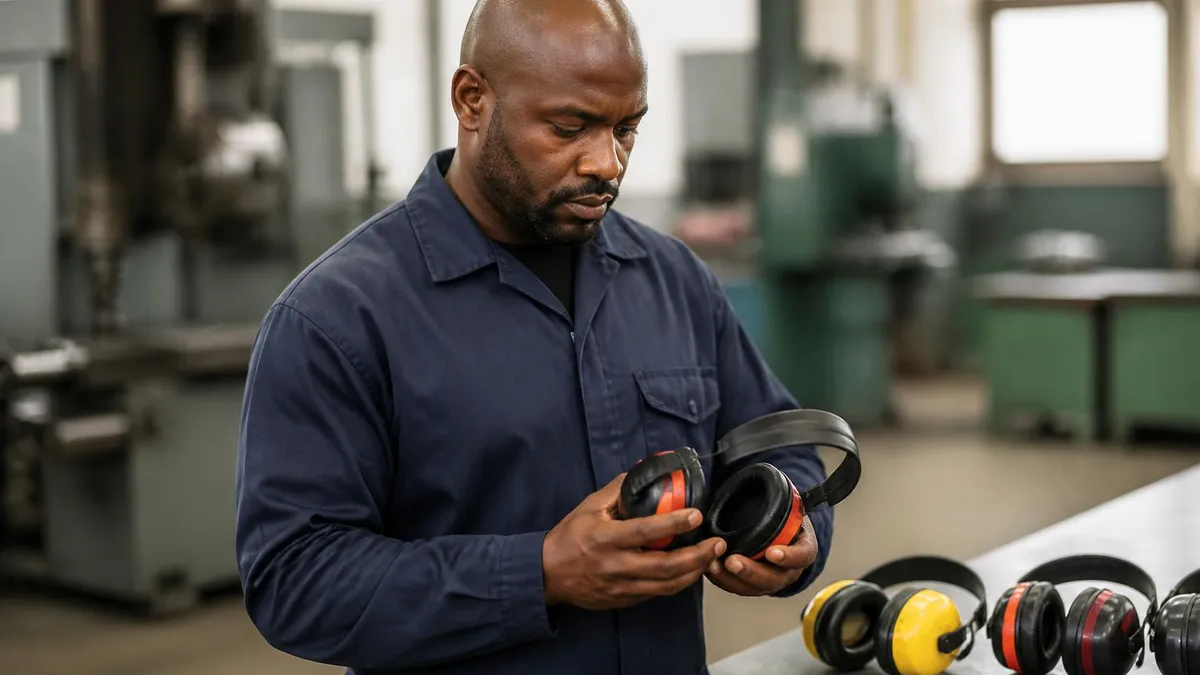
Earplugs vs. Earmuffs: Which Hearing Protector Wins?
- +Earplugs offer higher NRRs, often 29-33 dB, ideal for very loud environments
- +Earplugs are inexpensive, with disposable foam costing pennies per pair
- +Earplugs fit easily under hard hats, welding hoods, and respirators
- +Earplugs are lightweight and comfortable in hot or humid conditions
- +Earplugs do not interfere with hairstyles, earrings, or eyewear temples
- +Earplugs allow easier head movement in confined or overhead spaces
- +Earplugs can be color-coded for visual compliance checks across crews
- −Earplugs require correct insertion technique, leading to fit failures
- −Earplugs introduce contamination risk if hands are dirty during insertion
- −Earplugs may cause ear canal irritation with prolonged daily use
- −Earplugs are harder to verify visually from a distance by supervisors
- −Earplugs can be lost or misplaced more easily than earmuffs
- −Earplugs provide inconsistent attenuation across different ear canal sizes
- −Earplugs may not seal properly with certain medical conditions present
OSHA Hearing Protection Compliance Checklist
- ✓Conduct initial noise monitoring whenever exposures may reach 85 dBA TWA
- ✓Document all dosimeter readings and area sound surveys with date and location
- ✓Provide hearing protectors at no cost to every worker at or above the action level
- ✓Offer workers a choice of at least one earplug and one earmuff style
- ✓Establish baseline audiograms within six months of first 85 dBA exposure
- ✓Schedule annual audiograms for all employees in the conservation program
- ✓Notify any worker showing a Standard Threshold Shift within 21 calendar days
- ✓Deliver annual training covering noise effects, PPE use, and audiometric testing
- ✓Retain noise exposure records for two years and audiometric records for the duration of employment
- ✓Post the OSHA Job Safety and Health poster in a visible location for employees
- ✓Review and update the written Hearing Conservation Program annually
- ✓Investigate every recordable STS and document corrective actions taken promptly
Real-World Protection Is Usually Half the Label
Never assume the NRR printed on the package reflects what your worker actually receives. OSHA's recommended derating formula — (NRR − 7) ÷ 2 — accounts for fit variability, training gaps, and inconsistent use. A 33 NRR earplug worn imperfectly delivers about 13 dB of real protection. Fit testing each worker is the only reliable way to confirm adequate attenuation in your specific environment.
Audiometric testing is the diagnostic backbone of any hearing conservation program, and it is also the area where employers most often misunderstand their obligations. The baseline audiogram is the reference point against which all future tests are compared, so it must be obtained under quiet conditions and only after a quiet period of at least 14 hours without workplace noise exposure. Workers should be reminded to avoid loud non-occupational noise like concerts or shooting during this rest period.
Annual audiograms follow the baseline and must be conducted in a calibrated audiometric booth meeting ANSI S3.1-1991 specifications for maximum permissible background noise. The audiometer itself must be calibrated functionally before each day's use and acoustically at least annually. Testing is conducted at frequencies of 500, 1,000, 2,000, 3,000, 4,000, and 6,000 Hz in each ear separately, and results are recorded on a standardized audiogram form retained in the worker's medical file.
When comparing the annual audiogram to the baseline, the reviewer applies an age correction factor from Appendix F of 1910.95 if desired. This correction accounts for the natural hearing loss that occurs with aging, called presbycusis, and can prevent over-recording of shifts that are not work-related. A Standard Threshold Shift is then identified as an average ten-decibel or greater change at 2,000, 3,000, and 4,000 Hz in either ear compared to the baseline, after age correction is applied.
If an STS is confirmed, the employer has several specific obligations within 21 days of receiving the audiologist's report. The worker must be informed in writing of the shift, fitted (or refitted) with hearing protectors, trained in their use, and required to wear them. The worker must also be referred for clinical audiological evaluation or an otological examination if the audiologist suspects a medical pathology of the ear caused or aggravated by the wearing of hearing protectors.
Recordability on the OSHA 300 log is a separate analysis from STS identification. A hearing loss case is recordable when the worker's audiogram reveals an STS in either ear and the worker's total hearing level is 25 decibels or more above audiometric zero, averaged at 2,000, 3,000, and 4,000 Hz in the same ear. This dual threshold prevents recording every minor shift while still capturing significant occupational hearing impairment that compromises function and quality of life.
Many employers contract with mobile audiometric testing vendors who bring a self-contained booth to the worksite. This approach minimizes lost production time and centralizes records. Whichever method is used, the employer remains responsible for ensuring testing meets the standard, results are reviewed promptly, and follow-up actions are completed within the regulatory timeframes. Failure to act on an STS is one of the most common citations in this area.
Finally, audiometric records must be retained for the duration of the affected employee's employment, and noise exposure measurement records for at least two years. Many employers exceed these minimums and retain records permanently because hearing loss claims can surface years after employment ends. Comprehensive retention also supports the worker's ability to access their own medical information under 29 CFR 1910.1020.

If a Standard Threshold Shift is identified, the employer must notify the affected worker in writing within 21 calendar days of receiving the audiologist's determination. Missing this deadline is a frequent citation under 29 CFR 1910.95(g)(8). Build a tracking system into your audiometric vendor contract so notifications never slip through scheduling gaps.
osha inspector salarys return to the same handful of citations under 29 CFR 1910.95 year after year, which means most violations are preventable with simple program discipline. The most frequent citation is paragraph (c)(1), failure to administer a continuing, effective hearing conservation program whenever exposures equal or exceed an eight-hour time-weighted average of 85 dBA. This is often cited when monitoring is outdated, training records are missing, or audiometric testing has lapsed for a portion of the workforce.
The second most common citation is paragraph (i), failure to provide and ensure use of hearing protectors. This includes situations where protectors are available but workers are not actually wearing them, where only one style is offered, or where protectors are not provided at no cost. Inspectors observe the floor and interview workers — they do not rely solely on documentation — so visible compliance during operations matters as much as paperwork in the safety office files.
Paragraph (g), audiometric testing, generates a substantial share of citations. Common failures include missed annual tests, baselines not established within six months, inadequate booth acoustics, and uncertified technicians performing tests. Reviewing your audiometric vendor's credentials, calibration records, and booth specifications annually is a quick way to close exposure to these citations. Ask for documentation of CAOHC certification and booth ambient noise measurements before signing each year's contract renewal.
Paragraph (k), training, is another frequent citation source. Training must occur annually, must cover the specific topics enumerated in the standard, and must be documented by name and date. Generic safety meetings that touch on hearing protection in passing do not satisfy the requirement. Develop a dedicated annual training module, use sign-in sheets, retain trainer credentials, and include a brief comprehension check to demonstrate effectiveness during your next compliance review.
Paragraph (m), recordkeeping, ties everything together. Noise exposure measurement records must be kept for two years, and audiometric test records for the duration of employment. The records must include the employee's name, job classification, date, examiner's name, audiometer make and serial number, and date of last calibration. Missing fields are still violations even when testing actually occurred, so build a checklist into your records review process before filing each audiogram.
State-plan states like California, Washington, Oregon, and Michigan have hearing conservation requirements that are equivalent to or more stringent than federal OSHA. Cal/OSHA, for example, requires hearing protection use whenever exposures reach 85 dBA, not just availability. Verify your specific state requirements with the appropriate state plan agency, because following federal OSHA alone may leave gaps in compliance for employers operating in those jurisdictions and lead to unexpected enforcement actions during inspections.
If you are also working through general industry exam preparation, the How to Get OSHA 10 Certified guide covers noise exposure within the broader context of the ten-hour outreach curriculum. Hearing conservation appears on virtually every general industry exam and is a high-yield study topic for both the 10-hour and 30-hour courses available through authorized trainers nationwide.
Practical implementation of an effective hearing conservation program comes down to building habits that survive turnover, schedule changes, and inspection pressure. Start by appointing a single accountable owner for the program — usually the safety manager or EHS director — and give that person calendar authority to schedule monitoring, audiograms, training, and program reviews on fixed dates each year. Programs without a clear owner drift, and drifting programs generate citations no matter how good the original written plan looked on paper.
Conduct a fresh noise survey at least every two years and whenever you add, remove, or modify equipment that could change exposures. Use a calibrated Type 2 sound level meter for area surveys and personal dosimeters for time-weighted averages. Map your facility into noise zones, post signs at every entrance to areas exceeding 85 dBA, and update the map whenever readings shift. Workers should know at a glance which areas require hearing protection before they step inside.
Stock multiple styles of hearing protection at every entry point to high-noise zones. Disposable foam earplugs in dispensers, banded plugs hanging on hooks, and earmuffs for visitors and short-term tasks cover the most common needs. Replace dispensers when stock drops below 25 percent capacity. Visitors, contractors, and temporary workers must all receive protection and a brief orientation before entering, and that orientation should be documented to demonstrate program completeness.
Train new hires before they enter any noise area, not weeks later when their next scheduled session arrives. A 15-minute orientation covering noise hazards, protector selection, insertion technique, and audiometric testing meets the immediate need, with the full annual training following on the regular schedule. Use a hands-on demonstration with foam earplugs — many workers have never been taught the roll-pull-hold technique that produces an adequate seal.
Schedule audiometric testing during a low-noise period of the shift to avoid temporary threshold shifts that masquerade as permanent loss. Many facilities run mobile testing during the first two hours of the morning shift or schedule night-shift workers for testing before their shift begins. Communicate the 14-hour quiet period requirement clearly, and provide written notice in advance so workers can plan their off-shift activities accordingly and arrive ready for valid testing.
Track Standard Threshold Shifts in a simple spreadsheet that flags 21-day deadlines automatically. Include columns for employee name, baseline date, annual test date, shift detected, notification date, refit date, retraining date, and recordability decision. Review the spreadsheet monthly with your audiometric vendor and your medical reviewer to catch anything that slipped. Inspectors love clean tracking documentation because it demonstrates active program management rather than passive paperwork compliance.
Finally, measure your program's effectiveness by tracking the year-over-year STS rate. A well-run program shows a stable or declining rate as osha hazard controls, better PPE, and training take effect. A rising rate signals problems that paperwork compliance alone will not solve — usually inadequate engineering controls, poor PPE selection, or low actual wear time. Use the data to drive continuous improvement and to justify capital investment in noise control equipment when management requests business cases.
OSHA Questions and Answers

OSHA Approved Hard Hats: Complete 2026 Guide to ANSI Z89.1 Compliance, Types, and Workplace Requirements

OSHA Logo: What It Means and How to Spot the Real Thing

OSHA.gov: Your Complete Guide to the Official OSHA Website

OSHA 510: Course Content, Path to Trainer, and Realistic Path

How to Get OSHA 10 Certified: Complete 2026 Guide to Enrolling, Passing, and Receiving Your DOL Card
About the Author

Certified Safety Professional & OSHA Compliance Expert
Indiana University of Pennsylvania Safety SciencesDr. William Foster holds a PhD in Safety Science from Indiana University of Pennsylvania and is a Certified Safety Professional (CSP) and Certified Hazardous Materials Manager. With 20 years of occupational health and safety management experience across construction, manufacturing, and chemical industries, he coaches safety professionals through OSHA certification, CSP, CHST, and safety management licensing programs.
Join the Discussion
Connect with other students preparing for this exam. Share tips, ask questions, and get advice from people who have been there.
View discussion (8 replies)