
OSHA Forklift Regulations: Complete 2026 October Guide to 29 CFR 1910.178 Compliance, Training, and Workplace Safety Requirements
OSHA forklift regulations explained: 29 CFR 1910.178 training, certification, inspections, and workplace requirements for 2026 October compliance. 🎓

OSHA forklift regulations are codified under 29 CFR 1910.178, the federal standard governing powered industrial trucks used in warehouses, construction sites, distribution centers, manufacturing plants, and retail facilities across the United States. These rules dictate how employers must train operators, inspect equipment, maintain certifications, and respond to workplace incidents involving forklifts. With more than 70 forklift-related fatalities and 7,000 nonfatal injuries occurring annually in U.S. workplaces, compliance with the standard is not optional — it is the legal baseline that protects workers and shields employers from six-figure citations.
The standard applies to every employer in general industry, maritime, and construction who uses powered industrial trucks. That includes sit-down counterbalance forklifts, stand-up reach trucks, order pickers, pallet jacks with riders, rough-terrain forklifts, and even some specialized telehandlers. If a vehicle is powered by an electric motor or internal combustion engine and is used to lift, stack, or tier materials, OSHA's forklift rule almost certainly covers it. Battery-powered hand trucks without rider platforms are generally exempt, but the line between covered and exempt equipment is narrower than most managers assume.
The most-cited element of the standard is operator training. Under 1910.178(l), every forklift operator must complete formal classroom instruction, hands-on practical evaluation, and an employer-issued certification — and that certification must be renewed every three years or sooner if the operator is involved in an accident, observed operating unsafely, or assigned to a new type of truck. Beyond training, the regulation imposes detailed requirements for pre-shift inspections, load handling, pedestrian safety, refueling, battery charging, attachments, and operating surfaces.
This 2026 guide walks through every major section of the standard, the most common citations OSHA issues each year, the documentation employers must keep on file, and the practical steps a safety manager can take to verify compliance before an inspector arrives. Whether you are a new operator preparing for evaluation, a supervisor auditing your training program, or an EHS professional rewriting your forklift policy, you will find the specific citations and implementation guidance you need below.
If you are studying for an OSHA card or workplace assessment, complete OSHA 30 Answers alongside this guide — the OSHA 30 curriculum covers powered industrial trucks in depth and pairs naturally with forklift-specific training. Understanding the regulatory language directly, rather than relying on third-hand summaries, helps operators answer evaluator questions confidently and helps supervisors defend their programs during inspections.
OSHA does not certify forklift operators itself. Instead, the agency requires employers to certify their own operators after delivering compliant training. That distinction matters because many vendors sell "OSHA-approved" cards that have no legal standing on their own — the card is only valid evidence of compliance when paired with employer evaluation and site-specific instruction. We will untangle that misconception, along with several others, throughout this guide.
Penalties for violations climbed again in 2026. Serious violations now carry a maximum penalty of $16,550 per instance, and willful or repeated violations can reach $165,514. Employers who treat forklift training as a one-time onboarding checkbox routinely face citation stacks in the $50,000 to $200,000 range after a single inspection — a financial risk that dwarfs the cost of running a compliant program.
OSHA Forklift Regulations by the Numbers
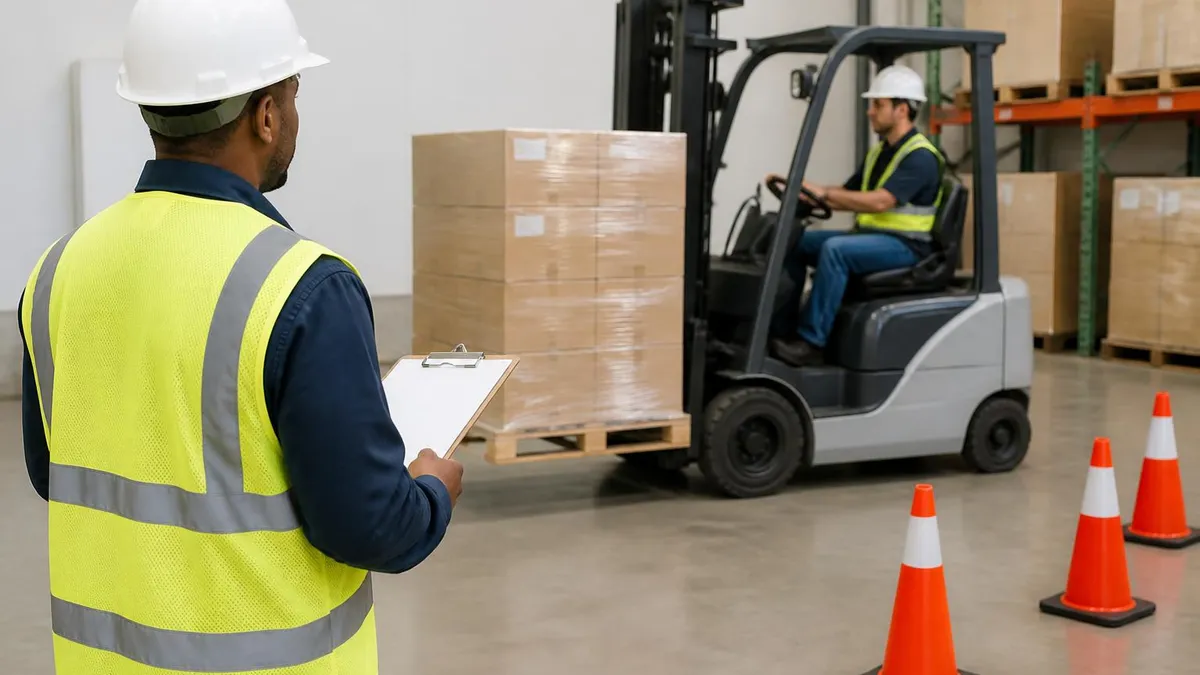
Core Regulatory Framework Under 29 CFR 1910.178
Section 1910.178(a) defines covered equipment, sets approval standards for trucks used in hazardous locations, and requires that all modifications affecting capacity or safety be approved in writing by the manufacturer.
Subsections (b) and (c) restrict which truck types may operate in specific atmospheres — flammable storage, grain handling, chemical plants — based on Class I, II, or III hazardous location classifications under the National Electrical Code.
Section 1910.178(l) is the most frequently cited part of the rule. It requires formal instruction, practical training, workplace evaluation, and refresher training tied to specific triggering events documented by the employer.
Subsections (m), (n), and (o) govern safe operating practices: traveling speeds, load handling, pedestrian right-of-way, parking procedures, and the prohibition against riding on forks or unauthorized passengers.
Subsection (q) requires daily pre-shift inspection of every truck before use, immediate removal from service of any defective truck, and repair only by authorized personnel using OEM-approved parts.
Operator training under 29 CFR 1910.178(l) is the heart of OSHA forklift regulations and the source of more than half of all forklift-related citations issued each year. The standard requires three integrated components: formal instruction (lecture, video, written material, or interactive computer learning), practical training (demonstrations and hands-on exercises), and workplace evaluation (the trainer observes the operator performing actual job tasks on the actual equipment in the actual environment). All three must be completed before an operator drives independently.
The formal instruction portion covers truck-specific topics — controls, instrumentation, engine or motor operation, steering, visibility limitations, capacity, stability, attachments, refueling, and operating limitations from the manufacturer's manual — plus workplace-specific topics including surface conditions, load composition, stacking, pedestrian traffic, narrow aisles, ramps, hazardous atmospheres, and any unique operational hazards at the facility. Online-only training that omits the workplace-specific component is not compliant, regardless of how comprehensive the curriculum appears.
Practical evaluation must be performed by a person who has the knowledge, training, and experience to train operators and evaluate their competence. That evaluator does not need to be OSHA-certified — the agency does not certify trainers — but must be designated in writing by the employer and capable of judging operator skill under real working conditions. A peer who happens to drive a forklift well does not automatically qualify; the evaluator needs documented competency in instruction and assessment.
The certification record itself is simple but essential. It must include the name of the operator, the date of the training, the date of the evaluation, and the identity of the person performing the training and evaluation. Many employers use a small wallet card plus a master log; OSHA accepts either format as long as the four data points are present and the record can be produced on request. Missing certifications are among the easiest citations an inspector can write.
Refresher training is required when an operator is observed operating unsafely, is involved in an accident or near-miss, receives a documented unsatisfactory evaluation, is assigned to a different type of truck, or when conditions in the workplace change in a manner that could affect safe operation. The three-year evaluation requirement applies in addition to these triggers — every operator must be re-evaluated at least every three years even if no incident has occurred. Many employers conflate "refresher training" with the three-year evaluation; they are related but distinct obligations.
Training records must be kept for the duration of the operator's employment plus a period adequate to defend against future inspections — three years is the practical minimum, longer is recommended. If you are also tracking general OSHA program training, the same recordkeeping discipline applies across OSHA Training Near Me resources used by your workforce, including 10-hour and 30-hour cards earned outside the workplace.
Finally, no operator under the age of 18 may operate a forklift in non-agricultural employment under federal child labor regulations, regardless of OSHA training status. Agricultural operations have narrower exceptions but are heavily regulated, and several states have stricter rules than the federal floor. Always check state child labor and forklift age requirements alongside the federal standard before authorizing a younger worker to train.
OSHA Practice Test Questions
Prepare for the OSHA - Safety Certificate exam with our free practice test modules. Each quiz covers key topics to help you pass on your first try.
OSHA Basic OSHA Practice
OSHA Exam Questions covering Basic OSHA Practice. Master OSHA Test concepts for certification prep.
OSHA Confined Space Entry
Free OSHA Practice Test featuring Confined Space Entry. Improve your OSHA Exam score with mock test prep.
OSHA Fall Protection
OSHA Mock Exam on Fall Protection. OSHA Study Guide questions to pass on your first try.
OSHA - Safety Certificate Electrical Safet...
Free OSHA Quiz on OSHA - Safety Certificate Electrical Safety Standards Questions and Answers. OSHA Exam prep questions with detailed explanations.
OSHA - Safety Certificate Emergency Action...
OSHA Practice Questions for OSHA - Safety Certificate Emergency Action and Fire Plans Questions and Answers. Build confidence for your OSHA certification exam.
OSHA - Safety Certificate Hazard Communica...
OSHA Test Online for OSHA - Safety Certificate Hazard Communication Standard Questions and Answers. Free practice with instant results and feedback.
OSHA - Safety Certificate Introduction to ...
OSHA Study Material on OSHA - Safety Certificate Introduction to OSHA Questions and Answers. Prepare effectively with real exam-style questions.
OSHA - Safety Certificate Lockout/Tagout P...
Free OSHA Test covering OSHA - Safety Certificate Lockout/Tagout Procedures Questions and Answers. Practice and track your OSHA exam readiness.
OSHA - Safety Certificate Machine Guarding...
OSHA Exam Questions covering OSHA - Safety Certificate Machine Guarding Requirements Questions and Answers. Master OSHA Test concepts for certification prep.
OSHA - Safety Certificate OSHA Recordkeepi...
Free OSHA Practice Test featuring OSHA - Safety Certificate OSHA Recordkeeping and Reporting Questions and Answers. Improve your OSHA Exam score with mock test prep.
OSHA - Safety Certificate Personal Protect...
OSHA Mock Exam on OSHA - Safety Certificate Personal Protective Equipment (PPE) Questions and Answers. OSHA Study Guide questions to pass on your first try.
OSHA - Safety Certificate Walking and Work...
OSHA Test Prep for OSHA - Safety Certificate Walking and Working Surfaces Questions and Answers. Practice OSHA Quiz questions and boost your score.
OSHA - Safety Certificate Electrical Safet...
OSHA Mock Test covering - Safety Certificate Electrical Safety Standards. Online OSHA Test practice with instant feedback.
OSHA - Safety Certificate Emergency Action...
Free OSHA Quiz on - Safety Certificate Emergency Action and Fire Plans. OSHA Exam prep questions with detailed explanations.
OSHA - Safety Certificate Hazard Communica...
OSHA Practice Questions for - Safety Certificate Hazard Communication Standard. Build confidence for your OSHA certification exam.
OSHA - Safety Certificate Introduction to ...
OSHA Test Online for - Safety Certificate Introduction to OSHA. Free practice with instant results and feedback.
OSHA - Safety Certificate Lockout/Tagout P...
OSHA Study Material on - Safety Certificate Lockout/Tagout Procedures. Prepare effectively with real exam-style questions.
OSHA - Safety Certificate Machine Guarding...
Free OSHA Test covering - Safety Certificate Machine Guarding Requirements. Practice and track your OSHA exam readiness.
OSHA - Safety Certificate OSHA Recordkeepi...
OSHA Exam Questions covering - Safety Certificate OSHA Recordkeeping and Reporting. Master OSHA Test concepts for certification prep.
OSHA Forklift Inspection Requirements by Truck Type
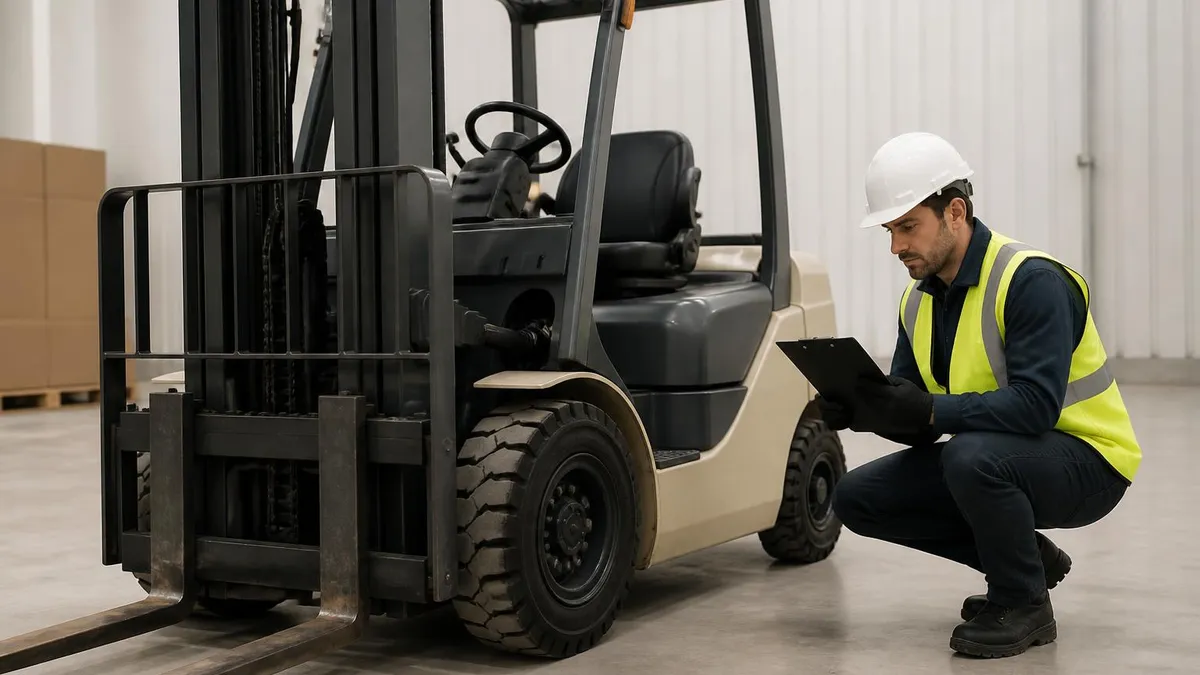
Electric forklifts — Classes I, II, and III under ITSDF standards — must be inspected before each shift and after each refueling or battery change. Operators check battery condition, electrolyte levels for flooded cells, cable connections, charging plug condition, brake operation, steering, horn, lights, tires, forks, mast chains, hydraulic hoses, and the operator restraint system. Any defect that affects safe operation requires immediate removal from service.
Battery handling adds a parallel set of requirements under 1910.178(g). Charging areas must have eye-wash stations, ventilation to prevent hydrogen buildup, smoking prohibitions, fire protection, and procedures for spill cleanup. Lithium-ion batteries are increasingly common and trigger additional manufacturer-specific protocols. Document the inspection on a daily checklist that lives with the truck or in a digital system accessible to supervisors.
In-House vs. Third-Party Forklift Training Programs
- +In-house training is tailored to your specific equipment, layout, products, and hazards
- +Workplace-specific evaluation requirement is naturally satisfied on your floor
- +Lower per-operator cost once a qualified internal trainer is established
- +Faster scheduling for new hires and refresher cycles without vendor coordination
- +Trainer becomes a permanent safety resource for daily questions and incident response
- +Customized documentation integrates with existing safety management systems
- +Training content can be updated immediately when equipment or processes change
- −Internal trainer must have documented competency that an OSHA inspector will accept
- −Curriculum development consumes significant initial time and EHS bandwidth
- −Small facilities may not have anyone qualified to evaluate practical skills
- −Risk of program drift if the qualified trainer leaves the company unexpectedly
- −Liability stays fully with the employer if training is later judged inadequate
- −Updating curriculum to match new OSHA interpretations requires active monitoring
Pros and Cons at a Glance
| Pros | Cons |
|---|---|
| In-house training is tailored to your specific equipment, layout, products, and hazards | Internal trainer must have documented competency that an OSHA inspector will accept |
| Workplace-specific evaluation requirement is naturally satisfied on your floor | Curriculum development consumes significant initial time and EHS bandwidth |
| Lower per-operator cost once a qualified internal trainer is established | Small facilities may not have anyone qualified to evaluate practical skills |
| Faster scheduling for new hires and refresher cycles without vendor coordination | Risk of program drift if the qualified trainer leaves the company unexpectedly |
| Trainer becomes a permanent safety resource for daily questions and incident response | Liability stays fully with the employer if training is later judged inadequate |
| Customized documentation integrates with existing safety management systems | Updating curriculum to match new OSHA interpretations requires active monitoring |
Daily OSHA Forklift Compliance Checklist
- ✓Verify current operator certification card is on the operator's person before key-on
- ✓Complete and sign the pre-shift inspection form covering forks, mast, hydraulics, brakes, steering, horn, lights, and seatbelt
- ✓Tag out and remove from service any truck with a defect affecting safe operation
- ✓Confirm the data plate is legible and matches any attachments installed on the truck
- ✓Wear the operator restraint (seatbelt) any time the truck is in motion
- ✓Sound the horn at intersections, blind corners, and when pedestrians are present
- ✓Travel with forks lowered to four to six inches above the floor and tilted back
- ✓Never lift, lower, or transport a load with people standing under or near the forks
- ✓Park the truck with forks down, controls neutral, key out, and wheels chocked on grades
- ✓Report any near-miss, tip-over, or accident immediately to trigger refresher evaluation
The Documentation Gap Costs Employers Six Figures Each Year
OSHA's compliance officers do not need to watch a forklift accident happen to issue a citation. A missing or incomplete certification record — operator name, training date, evaluation date, trainer identity — is itself a Serious violation under 1910.178(l)(6). Multiply by your headcount of unverified operators and the math becomes ugly fast. Run a documentation audit before your next inspector visit.
The most-cited subsection of 29 CFR 1910.178 every year is paragraph (l) — operator training and certification. In OSHA's fiscal year 2025 enforcement data, powered industrial trucks ranked seventh on the agency's Top 10 Most Frequently Cited Standards list, with the lion's share of citations falling under (l)(6) for missing certification records, (l)(1)(i) for inadequate training, and (l)(4) for failing to provide refresher training after a triggering event. These three citations alone account for roughly 70 percent of all forklift-related enforcement actions.
Beyond training, the next-most-cited subsection is (q)(7), which requires that powered industrial trucks be examined at least daily before being placed in service. Inspectors often ask to see a stack of completed pre-shift inspection forms covering the last 30 days. When the stack is thin, missing dates, or full of identical checkmarks suggesting a pencil-whipped form, citations follow quickly. Some employers use mobile apps with timestamps and GPS to defend against this allegation; others maintain dated paper logs at each charging station.
Maintenance citations under (q)(1) through (q)(6) frequently follow inspection citations. If a truck is found with defective brakes, missing seat belt, broken backup alarm, or modified mast not approved in writing by the manufacturer, the inspector will cite both the defect and the failure of the inspection program to catch it. The compounding effect of paired citations is one reason small inspection gaps translate into very large penalties.
Operating practice citations under (m) and (n) require an inspector to actually observe unsafe behavior or document it through interviews. Riding on forks, lifting loads with passengers, speeding, traveling with raised loads, and unauthorized stunt driving all show up in citation logs. Video evidence — your own internal cameras — sometimes becomes part of an inspection if an accident triggered the visit. Decide your camera retention and review policy before a serious incident forces the question.
Maximum civil penalties adjusted for inflation in 2026 sit at $16,550 per Serious violation, $16,550 per Other-than-Serious, $16,550 per Failure to Abate per day, and $165,514 per Willful or Repeated violation. A multi-violation inspection with five operators trained inadequately, no pre-shift records, and one observed unsafe operation can easily exceed $100,000 in proposed penalties before negotiation. Settled amounts are often lower, but the time, legal cost, and reputational damage cannot be settled away.
State Plan states — California, Michigan, Oregon, Washington, and several others — adopt the federal forklift standard with state-specific additions. Cal/OSHA, for example, has stricter operator-age and program-documentation requirements. If you operate in multiple states, build the strictest jurisdiction's rules into your corporate baseline rather than maintaining separate state-by-state programs that are easy to confuse. For California-specific guidance, the cal osha contact lists the consultation offices that provide free pre-citation reviews.
Finally, OSHA's General Duty Clause — Section 5(a)(1) of the Occupational Safety and Health Act — can be invoked when no specific forklift standard applies but a recognized hazard exists. Pedestrian-forklift interaction in high-density facilities, struck-by incidents on poorly marked walkways, and unguarded floor edges near loading docks have all been cited under the General Duty Clause when 1910.178 did not squarely cover the facts. Treat the standard as a floor, not a ceiling, when designing your program.
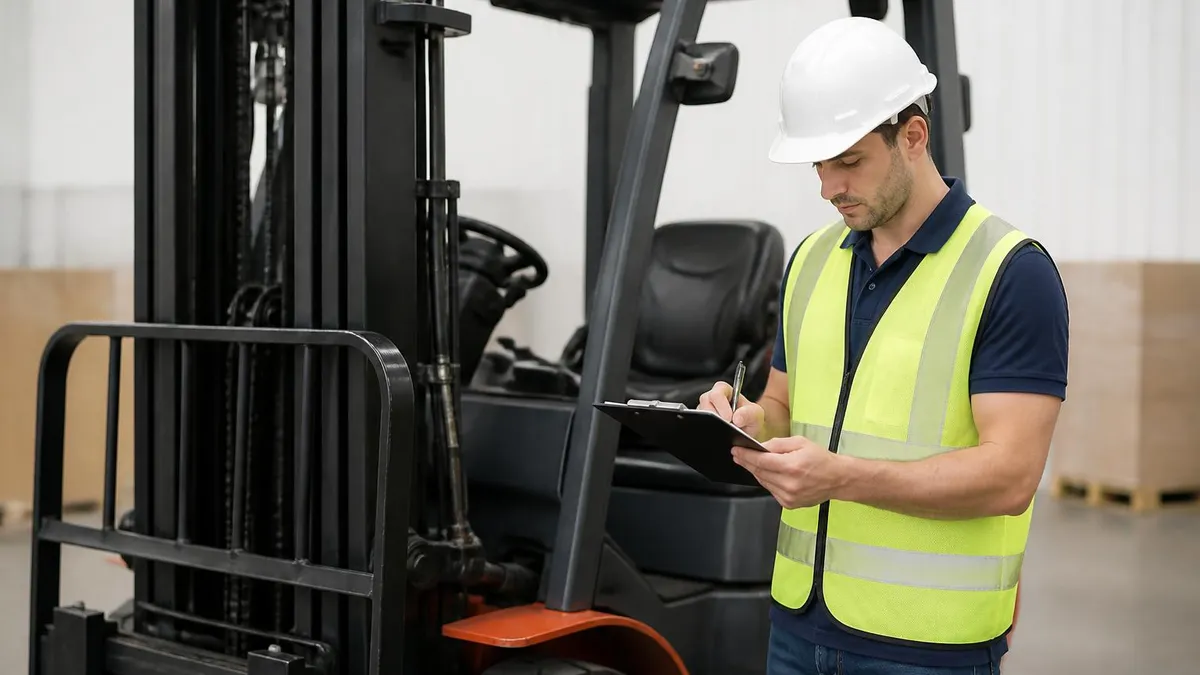
Any accident, near-miss, observed unsafe operation, unsatisfactory evaluation, change of truck type, or change in workplace conditions requires refresher training and re-evaluation before the operator returns to driving. Documenting the trigger event and the corrective re-evaluation is mandatory under 1910.178(l)(4) — gaps here are a top-five OSHA citation every year.
Building a compliant OSHA forklift program starts with a written policy that mirrors the language of 29 CFR 1910.178 and names specific responsible parties for each element: the program administrator, the qualified trainer, the qualified evaluator, the maintenance lead, and the recordkeeper. A vague policy that says "all operators will be trained" without naming who trains, who evaluates, and who retains records will fail under inspection scrutiny. Specificity is your friend.
The second step is an equipment inventory tied to truck classification. List every powered industrial truck on site, the ITSDF class (I through VII), the manufacturer, model, serial number, capacity, attachments installed, and whether the truck operates in any hazardous-location designated area. This inventory drives which operators must be trained on which trucks, since the standard requires truck-type-specific evaluation rather than a generic forklift card.
The third step is a workplace hazard assessment that documents the operational environment each truck encounters: aisle widths, dock configurations, pedestrian traffic, ramp grades, surface conditions, load characteristics, and any narrow-aisle or tall-rack hazards. This assessment becomes the workplace-specific portion of operator training and must be reviewed whenever the layout, product mix, or process flow changes materially.
The fourth step is selecting and qualifying a trainer-evaluator. Some employers send a seasoned supervisor to a train-the-trainer course offered by equipment dealers, ITSDF, or OSHA Outreach trainers; others contract with a third-party instructor for the formal instruction component and use internal supervisors only for the workplace evaluation. Either approach works as long as the qualifications are documented and the evaluator can defend their competency to an inspector.
The fifth step is the daily inspection system. Whether you use paper checklists clipped to the truck, a key-fob system that locks out the truck until inspection is complete, or a mobile-app workflow integrated with maintenance ticketing, the system must produce verifiable daily records and route defects to maintenance promptly. The best programs report inspection compliance as a leading indicator on monthly safety scorecards, not as a buried metric.
The sixth step is an incident response protocol that automatically triggers refresher training and equipment removal after any forklift-involved event. Many compliant programs use a "three-bucket" model: near-miss (refresher within 30 days), property damage only (refresher within 7 days plus root-cause analysis), and personal injury (immediate suspension of operator pending investigation and re-evaluation). Tying training events to osha 301 form closes the loop OSHA expects to see closed. Pair this protocol with broader site PPE expectations — including current OSHA Approved Hard Hats guidance for areas where overhead loads or struck-by hazards exist.
Finally, audit the program annually using a written checklist that mirrors the citation history above. Pull a random sample of certifications, inspection logs, and incident reports. Interview operators about their training and ask them to demonstrate a pre-shift inspection. The audit findings become the agenda for the next year's program improvements and the documentation you produce if OSHA arrives without warning.
Practical tips for operators preparing for an evaluation begin with the manufacturer's manual. Spend an hour with the operator's manual for the specific make and model you will be evaluated on — control layouts, capacity ratings, hydraulic limits, and parking-brake procedures vary more than most new operators expect. Evaluators routinely ask candidates to point out the data plate, recite the rated capacity, and explain how attachments change the capacity. A confident answer here often sets the tone for the rest of the evaluation.
Master the pre-shift inspection before you touch the controls. Walk around the truck in the same order every time: tires, forks, mast chains, hydraulic hoses, leaks under the truck, data plate legibility, overhead guard, seat belt, horn, lights, backup alarm, brakes, and steering. Engine-on items come last. A predictable inspection sequence prevents skipped steps and impresses evaluators who have watched hundreds of inconsistent walk-arounds. Practice talking through your inspection out loud — verbalizing it forces you to actually look at each item.
For the driving portion, lead with smooth control inputs and exaggerated awareness of pedestrians. Slow before intersections, sound the horn, look both ways, and make eye contact with any pedestrian in range. Travel with forks at four to six inches and tilted back, and never lift the mast more than needed for the immediate task. When you set down a load, square the truck to the rack, raise the mast deliberately, ease forward, lower onto the deck, tilt forward to release pressure, and back straight out before turning. Smoothness signals competence; speed signals risk.
Stability is the single most-tested concept on evaluations and the single biggest cause of forklift fatalities. Understand the stability triangle: front wheels and the rear-axle pivot point form a triangle, and the truck's combined center of gravity must stay inside that triangle.
Heavy loads, raised loads, sharp turns, slopes, and uneven surfaces all push the center of gravity toward the edge of the triangle. Tip-overs happen fast — the correct response is to brace against the steering wheel, lean away from the direction of fall, and stay belted in. Jumping is the wrong move and a leading cause of crush fatalities.
Refueling and battery procedures get their own evaluation block. For LPG, know how to close the cylinder valve, disconnect the hose, install the dust cap, secure the empty cylinder, and connect a full cylinder with the relief valve up. For electric, know your charging area procedures, water-filling intervals for flooded cells, safe disconnection of the charger, and the difference between equalize and standard charge modes. Lithium-ion procedures differ from lead-acid; do not assume.
If your facility uses the OSHA logo on training materials, learn to identify authentic agency branding. The OSHA Logo guide explains what an authentic federal mark looks like and how to spot the unauthorized variations that some training vendors use to imply approval the agency has never given. Operators who understand this distinction are less likely to be misled by low-quality online cards.
Finally, build a habit of asking questions during training. Evaluators expect operators to flag conditions they are unsure about — a damaged pallet, an unfamiliar load, an unlit aisle, a leaking hydraulic line. The best operators are not the ones who never stop; they are the ones who stop the truck and ask a supervisor when something looks off. That habit is osha basics forklift regulations are ultimately designed to encourage, and it is what keeps every shift ending safely.
Sample OSHA Safety Certificate Practice Questions
Try these questions from our free OSHA Safety Certificate practice tests. The correct answer and an explanation follow each question.
Under OSHA regulations, which type of hazard does prolonged exposure to high decibel levels represent?
- A. Chemical hazard
- B. Ergonomic hazard
- C. Physical hazard
- D. Psychosocial hazard
Answer: C. Physical hazard
Excessive noise is classified as a physical hazard, and OSHA requires hearing conservation programs when exposure reaches 85 dB over an 8-hour TWA.
Under OSHA 1910.212, at what point on a machine must a guard prevent the operator from having any part of the body in the danger zone?
- A. At the point of operation
- B. Only at the power source
- C. Only during maintenance
- D. At the machine's on/off switch
Answer: A. At the point of operation
OSHA requires guarding at the point of operation where work is actually performed on the material.
What does 'PPE' stand for in workplace safety?
- A. Public Property Endorsement
- B. Personal Protective Equipment
- C. Post Production Evaluation
- D. Payroll Processing Entry
Answer: B. Personal Protective Equipment
PPE means Personal Protective Equipment worn to reduce exposure to hazards.
What does the acronym PPE stand for in workplace safety?
- A. Personal Protective Equipment
- B. Professional Protection Enforcement
- C. Primary Prevention Evaluation
- D. Physical Protection Engagement
Answer: A. Personal Protective Equipment
PPE stands for Personal Protective Equipment, which includes items like gloves, hard hats, safety glasses, and respirators.
OSHA Questions and Answers

OSHA Approved Hard Hats: Complete 2026 Guide to ANSI Z89.1 Compliance, Types, and Workplace Requirements

OSHA Logo: What It Means and How to Spot the Real Thing

Cal/OSHA Contact Guide: Phone Numbers, Offices, and How to Reach Help in 2026

OSHA Training Near Me: How to Find Classes, Online Courses & DOL Cards in 2026

OSHA 30 Answers: Complete Study Guide & Test Preparation for 2026
About the Author

Certified Safety Professional & OSHA Compliance Expert
Indiana University of Pennsylvania Safety SciencesDr. William Foster holds a PhD in Safety Science from Indiana University of Pennsylvania and is a Certified Safety Professional (CSP) and Certified Hazardous Materials Manager. With 20 years of occupational health and safety management experience across construction, manufacturing, and chemical industries, he coaches safety professionals through OSHA certification, CSP, CHST, and safety management licensing programs.
Join the Discussion
Connect with other students preparing for this exam. Share tips, ask questions, and get advice from people who have been there.
View discussion (8 replies)