
OSHA 500 Prerequisites: Everything You Need to Know Before You Enroll
Meet the OSHA 500 prerequisites before you enroll. 🎯 Learn trainer experience, OSHA 30 requirements, application steps & tips to qualify fast.
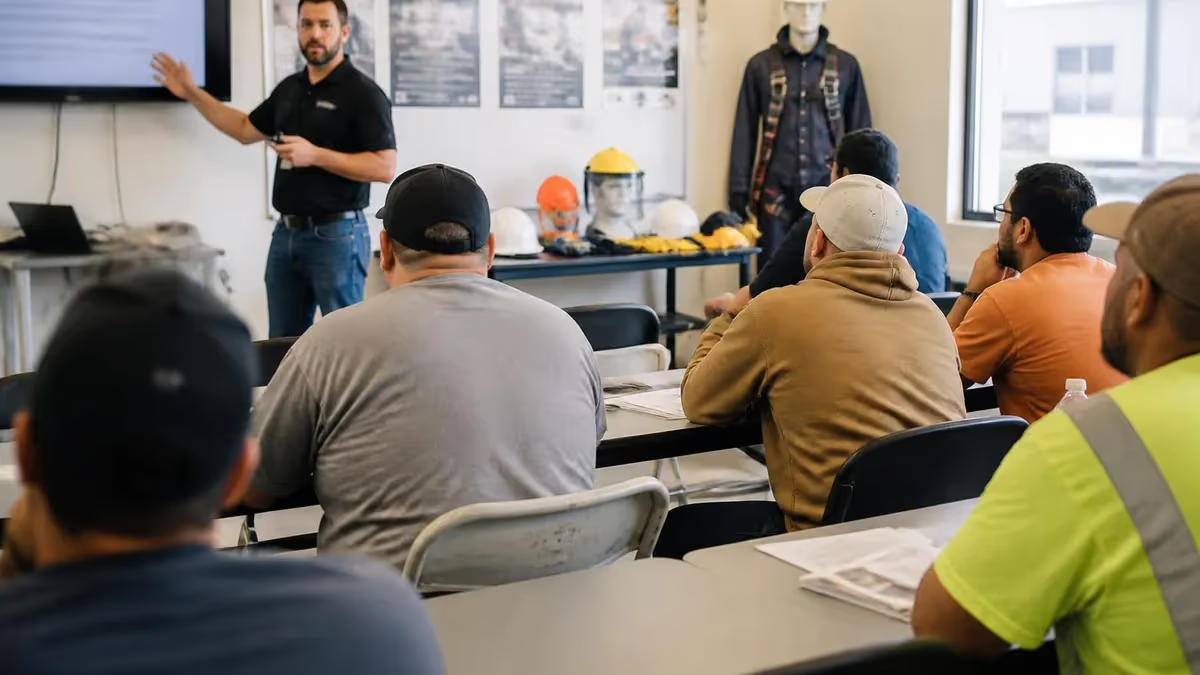
Understanding the OSHA 500 prerequisites is the first critical step for any safety professional who wants to become an authorized OSHA outreach trainer in construction. The OSHA 500 course, formally titled "Trainer Course in Occupational Safety and Health Standards for the Construction Industry," is not an entry-level program. OSHA designed it for experienced safety practitioners who already hold foundational credentials and can demonstrate meaningful field experience. Skipping the eligibility review is one of the most common mistakes applicants make, so reading the full requirements before registering will save you significant time and money.
The path to OSHA trainer status begins well before the 500 course itself. Applicants must first verify that they hold a current, valid OSHA 30-Hour Construction card — a requirement that cannot be waived or substituted. If your card has expired or you completed the training through an unauthorized provider, OSHA will not accept your application. Many candidates are surprised to learn that the 30-hour card must have been issued through the official OSHA Outreach Training Program, not through an equivalent state-plan course or employer-specific program, however comprehensive those alternatives might be.
Beyond the OSHA 30-Hour card, the agency evaluates your professional background with genuine scrutiny. OSHA expects applicants to have at least five years of construction safety and health work experience, or a combination of education and experience that demonstrates comparable depth. This experience requirement exists because the OSHA 500 course trains you to teach others — and you simply cannot explain real-world hazard recognition, fall protection systems, or scaffold compliance to a room full of workers if you have never managed those risks yourself on an active job site.
Educational credentials can partially offset work experience, but they do not eliminate it entirely. Holding a degree in occupational safety, industrial hygiene, or a related engineering discipline may allow OSHA to count academic training toward the five-year benchmark. Some Authorized Training Centers accept candidates with three years of direct field experience combined with a four-year safety degree, while others hold strictly to the five-year rule regardless of formal education. Always confirm the specific interpretation used by the Authorized Training Center (ATC) where you plan to enroll, because policies vary.
Continuing education requirements also play a role. OSHA strongly recommends — and many ATCs require — that applicants have recent professional development in safety and health topics. Certifications such as the Certified Safety Professional (CSP), Construction Health and Safety Technician (CHST), or Associate Safety Professional (ASP) credentials from the Board of Certified Safety Professionals carry significant weight during the eligibility review. These certifications signal to both OSHA and the ATC that you are actively engaged with current standards, not relying on knowledge acquired years ago without updates.
English language proficiency is a practical prerequisite that the official documentation sometimes understates. Because the OSHA 500 course requires participants to deliver training demonstrations in English to their peers, candidates who are not comfortable teaching in English will struggle considerably. OSHA Outreach training materials are produced in English, and while bilingual trainers are highly valuable in the field, the 500 course itself is conducted in English. Plan to review technical vocabulary for fall protection, scaffolding, electrical safety, and confined space standards before arriving so classroom demonstrations flow naturally.
You can learn more about osha 500 prerequisites and supporting safety equipment standards that will be tested throughout the course. Reviewing those materials early helps you walk into the OSHA 500 already familiar with the regulatory framework rather than encountering it for the first time in a compressed, fast-moving classroom environment. Preparation at the prerequisite stage genuinely determines how much you absorb during the five-day course itself.
OSHA 500 Prerequisites by the Numbers
Key Facts at a Glance
| Item | Value | Details |
|---|---|---|
| Minimum Work Experience | 5 Years | Construction safety & health |
| Required OSHA Card | 30 Hours | Must be current and valid |
| Course Duration | 5 Days | ~40 contact hours total |
| Card Validity After Completion | 4 Years | Requires renewal training |
| Typical Course Cost | $600–$900 | Varies by Authorized Training Center |

Core OSHA 500 Eligibility Requirements
You must hold a current OSHA 30-Hour Construction card issued through the official Outreach Training Program. The card cannot be expired and must have been granted by an authorized OSHA outreach trainer, not an equivalent employer course.
OSHA requires at least five years of documented construction safety and health experience. Field supervisory roles, safety officer positions, and site safety coordinator work all qualify. Education in a related field may offset up to two years of this requirement.
While not always mandatory, credentials like CSP, CHST, ASP, or STSC from recognized safety boards significantly strengthen your application. Many Authorized Training Centers prioritize candidates with active professional certifications alongside their field experience.
The OSHA 500 is taught in English and requires participants to conduct live training demonstrations in English. Candidates must be comfortable reading OSHA standards, explaining regulatory requirements, and presenting to adult learners entirely in English.
You must register through an OSHA-approved Authorized Training Center. Each ATC may apply slightly different eligibility interpretations. Confirm the center's specific documentation requirements before you pay any registration fees.
Breaking down the education and experience requirements in detail helps candidates understand exactly where they stand before approaching an Authorized Training Center. OSHA's five-year experience guideline is not simply about years on a payroll — it refers specifically to active engagement with construction safety and health responsibilities. Working as a general laborer for five years, even on large commercial projects, would not satisfy this requirement unless your role included formal safety functions such as hazard identification, toolbox talk facilitation, incident investigation, or regulatory compliance monitoring.
Safety directors, site safety officers, OSHA compliance officers at the state or federal level, union safety representatives, and workers' compensation loss control consultants are all examples of roles that OSHA recognizes as qualifying experience. Conversely, project managers and superintendents whose safety involvement was incidental to their core production duties may need to document specific safety responsibilities carefully rather than assuming the job title alone speaks for itself. The application narrative matters enormously in borderline cases.
For candidates who hold a bachelor's degree or higher in occupational safety and health, industrial hygiene, safety engineering, or a closely related discipline, OSHA guidelines generally allow up to two years of work experience to be credited against the five-year requirement. This means a candidate with a four-year safety degree and three years of relevant field experience may meet the threshold, depending on the ATC's interpretation. A two-year associate degree in safety technology typically carries less weight, often crediting one year toward the experience requirement at most.
Advanced professional certifications create another pathway for candidates who are slightly short on direct field years. The CSP (Certified Safety Professional) credential, administered by the Board of Certified Safety Professionals, requires its own substantial experience and examination before it is awarded, which OSHA views as indirect evidence of professional competency. Candidates who hold a CSP alongside three to four years of field experience often receive favorable consideration from ATCs even when they technically fall short of the strict five-year benchmark.
Military occupational specialties in safety, industrial hygiene, or combat engineering can also count toward the experience requirement. Veterans who served as safety NCOs, explosive ordnance disposal technicians, or construction equipment operators with documented safety oversight duties have successfully used military service records to satisfy OSHA's experience criteria. DD-214 forms and official duty descriptions that specifically mention safety and health responsibilities are the key documentation pieces for military applicants.
Volunteer safety work and emergency response experience occupy a gray area. OSHA does not categorically exclude volunteer experience, but ATCs typically require that volunteer safety roles involved consistent, documented responsibilities rather than occasional participation. Serving as a fire department safety officer, industrial fire brigade coordinator, or community emergency response team trainer on a regular schedule over multiple years can supplement — though rarely replace — paid professional experience in the OSHA 500 application process.
Community college and technical school coursework in OSHA standards, construction safety regulations, or hazardous materials management can further strengthen an application that is otherwise borderline. While these courses don't carry the same weight as a four-year degree, completing OSHA 510 (the prerequisite course for 500 that covers construction safety standards at depth) is viewed very favorably by ATCs as direct evidence that a candidate understands the subject matter well enough to teach it. OSHA 510 completion is sometimes required before enrollment in the 500 course, so check with your specific ATC.
OSHA 500 Application Process: Step by Step
Before submitting any application materials, gather your supporting documentation in one place. You will need your original OSHA 30-Hour Construction card (or a verified replacement from your original training provider), a current resume detailing your construction safety experience by year and employer, copies of any professional certifications with their expiration dates, and official transcripts if you are using education to offset the experience requirement. Having these documents organized prevents delays and demonstrates professionalism to the ATC reviewer.
Contact at least two or three Authorized Training Centers before committing to one. ATCs are independently operated and can charge different fees, use different scheduling formats (consecutive days vs. spread over two weeks), and apply slightly different interpretations of OSHA's eligibility criteria. Some ATCs offer pre-screening consultations at no cost so you can confirm your eligibility before paying the registration deposit. This step is especially valuable for candidates who are near the borderline on experience or education requirements.
Pros and Cons of Pursuing the OSHA 500 Trainer Credential
- +Authorizes you to deliver OSHA 10 and 30-Hour construction courses independently
- +Significantly increases your earning potential as a safety trainer or consultant
- +Strengthens your professional credibility with employers, unions, and contractors
- +Adds a recognized national credential to your safety portfolio
- +Allows you to generate revenue by hosting your own Outreach training classes
- +Demonstrates mastery of OSHA construction standards to regulatory agencies
- −Requires five years of documented field experience before you can even apply
- −Costs $600–$900 or more in course fees, plus travel and lodging if needed
- −The trainer card must be renewed every four years through continued education
- −Course attendance requirements are absolute — missing any hours can disqualify you
- −Not all Authorized Training Centers accept the same experience substitutions
- −Becoming an authorized trainer does not guarantee employers will hire you as one
OSHA 500 Prerequisites Checklist Before You Enroll
- ✓Confirm your OSHA 30-Hour Construction card is current and was issued by an authorized outreach trainer.
- ✓Document at least five years of construction safety and health work experience with specific role descriptions.
- ✓Gather employer letters, performance reviews, or signed affidavits to verify your safety responsibilities.
- ✓Obtain official transcripts if you plan to use a safety-related degree to offset experience years.
- ✓List all active professional certifications (CSP, CHST, ASP, STSC) with expiration dates.
- ✓Complete or confirm enrollment in OSHA 510 if your chosen ATC requires it as a prerequisite.
- ✓Research at least two Authorized Training Centers to compare fees, schedules, and eligibility standards.
- ✓Schedule a pre-screening consultation with your preferred ATC before paying a registration deposit.
- ✓Prepare a written experience narrative that details your specific safety duties, not just job titles.
- ✓Confirm you can attend every scheduled session — 100% attendance is a non-negotiable requirement.
Your OSHA 30-Hour Card Must Be from the Official Outreach Program
One of the most overlooked OSHA 500 prerequisites is card validity. Your OSHA 30-Hour Construction card must have been issued through the official OSHA Outreach Training Program by an authorized trainer — not through a state-plan equivalent, an employer-developed safety course, or an online provider that is not officially authorized. If your card does not meet this standard, you will need to retake the 30-Hour course before applying for the OSHA 500, regardless of how much field experience you have.
The OSHA 500 course itself is structured to develop teaching competency alongside technical knowledge. Unlike the OSHA 10 or 30-Hour courses, which focus purely on regulatory content, the 500 course asks you to become a professional adult educator. This means the curriculum covers learning theories, instructional design, effective presentation techniques, and methods for engaging workers who may be skeptical, distracted, or limited in English proficiency. Understanding how adults learn differently from students is a core element of what separates an effective outreach trainer from someone who simply reads slides aloud.
The construction standards covered during the OSHA 500 course are drawn directly from 29 CFR Part 1926 — the primary federal OSHA regulation governing construction work. Topics include fall protection (Subpart M), scaffolding (Subpart L), excavation and trenching (Subpart P), electrical safety (Subpart K), personal protective equipment (Subpart E), and struck-by and caught-in or between hazards. Candidates should arrive with working familiarity with these subparts since the course builds on existing knowledge rather than introducing the regulations from scratch.
Training demonstrations are the most anxiety-inducing component for many participants, but they are also the most educational. During the five-day course, each participant delivers multiple short presentations to their peers on assigned or self-selected OSHA construction topics. Instructors evaluate the presentations on content accuracy, organization, learner engagement, and time management. Peer feedback is also incorporated so participants learn both by presenting and by observing their classmates. Candidates who practice at least one mock presentation before arriving perform noticeably better on formal demonstrations.
The teaching materials provided during the OSHA 500 course are substantial. Participants receive official OSHA outreach training guides, PowerPoint templates, and reference binders that can be used when delivering future 10-Hour and 30-Hour courses. These materials are updated periodically as OSHA revises its standards, and authorized trainers are responsible for ensuring they are using current content in their subsequent training sessions. One practical task before attending the 500 course is downloading the most current version of the construction 10-Hour and 30-Hour outreach training guides from the OSHA website to review what you will eventually be delivering as a trainer.
Class sizes for the OSHA 500 are intentionally kept small — typically between 10 and 20 participants — to allow sufficient time for each person to complete training demonstrations and receive individual feedback from the course instructor. This intimate format also means that active participation is expected and noticeable. Candidates who sit quietly and avoid engaging in discussions or group exercises will be evaluated less favorably than those who contribute their field experience to classroom conversations. The course is genuinely interactive, not a passive lecture series.
Assessment in the OSHA 500 combines written evaluation and practical demonstration rather than relying solely on a multiple-choice examination. While some ATCs administer a written knowledge test covering construction safety standards, the training demonstration component carries significant weight. Candidates who fail a demonstration may be given an opportunity to retry, but candidates who consistently struggle with both content knowledge and delivery skills may be asked to retake the course rather than receiving a trainer card. The ATC instructor has final authority over whether a candidate is ready to be authorized as an outreach trainer.
Networking during the OSHA 500 is an underappreciated benefit. The other participants in your cohort are experienced safety professionals from diverse sectors of the construction industry — general contractors, specialty subcontractors, union representatives, and independent consultants. The relationships formed during five intensive days of collaborative learning often lead to referrals, partnerships, and professional friendships that outlast the course itself. Exchange contact information and follow up with classmates after graduation because the construction safety community is smaller and more interconnected than it initially appears.

Completing the OSHA 500 course grants you a trainer card that is valid for four years from the date of issuance. To maintain your authorization to deliver OSHA Outreach courses, you must complete the OSHA 502 update course before your card expires. If your card lapses, you will be required to retake the full OSHA 500 course rather than simply completing the shorter update program. Set a calendar reminder well in advance — renewal options may be limited in your area and scheduling the 502 can take months.
Once you have earned your OSHA 500 trainer card, a practical set of responsibilities begins immediately. As an authorized OSHA Outreach trainer, you are permitted to issue official OSHA 10-Hour and 30-Hour completion cards to workers who complete your courses. However, you are also bound by the OSHA Outreach Training Program requirements, which govern how the courses must be structured, what content must be covered, minimum and maximum course delivery hours, and how student completion records must be maintained. These administrative obligations are not optional and non-compliance can result in revocation of your trainer authorization.
Course delivery rules are more specific than many new trainers expect. The OSHA 10-Hour construction course must be delivered in a minimum of two calendar days, with no more than seven and a half contact hours delivered on any single day. The OSHA 30-Hour course must be delivered over a minimum of four calendar days.
These rules exist to prevent cramming and ensure that adult learners have adequate time to process safety information. Online delivery of outreach courses is permitted only through OSHA-authorized online training providers, and a newly authorized trainer cannot simply create their own online course format without separate approval.
Marketing your services as an authorized trainer requires accuracy and transparency. You may advertise that you are an OSHA-authorized outreach trainer and that you deliver official OSHA 10-Hour and 30-Hour construction courses, but you cannot imply that OSHA itself endorses your specific business or that completing your course certifies workers beyond what the outreach program actually provides. The OSHA Outreach card signals that workers received safety training — it is not an OSHA certification or license in the regulatory sense. Many workers and even some employers misunderstand this distinction, so clear communication is part of a trainer's professional responsibility.
Pricing for OSHA 10 and 30-Hour courses delivered by authorized trainers varies widely across the country. For the 10-Hour course, trainer fees typically range from $150 to $400 per student depending on location, client type, and whether the training is delivered onsite or at a training facility. The 30-Hour course commands $300 to $700 per student in many markets.
Trainers who work for safety consulting firms may deliver courses as part of their standard employment duties rather than charging separately, while independent trainers who run their own businesses must price competitively enough to attract clients while covering operating costs including materials, insurance, and continuing education.
Building a client base as an independent OSHA outreach trainer requires consistent outreach to construction firms, general contractors, subcontractors, staffing agencies that place construction workers, and labor unions with construction members. Many trainers develop relationships with construction associations, home builders associations, and electrical or plumbing contractor groups that regularly need OSHA training for their member companies. Union apprenticeship programs are another strong market since they routinely need OSHA 10-Hour training for new apprentices entering the trades and often prefer trainers who understand union safety culture and language.
Your ongoing professional development does not stop after earning the OSHA 500 trainer card. OSHA expects trainers to stay current with regulatory changes, and updated OSHA standards can affect what content must be covered in outreach courses. Subscribing to OSHA's digital newsletter, attending the annual American Society of Safety Professionals (ASSP) conference, and completing continuing education credits toward CSP or other credential renewals all contribute to keeping your knowledge current. Trainers who stop learning often find their course material gradually drifting out of alignment with current OSHA enforcement priorities, which undermines the value they provide to clients.
Building a reputation as a skilled outreach trainer takes time but compounds significantly with each satisfied client. Contractors who receive positive feedback from workers often rebook the same trainer year after year and refer colleagues. Asking satisfied clients for written testimonials — with permission to use them in marketing materials — accelerates reputation-building considerably. Over time, experienced authorized trainers often expand their practice to include safety consulting, incident investigation support, and compliance auditing, using their OSHA trainer credential as a foundational differentiator that signals deep regulatory expertise to prospective clients.
Practical preparation strategies make a measurable difference in how smoothly candidates move through both the application process and the course itself. Start your preparation at least three to four months before your target enrollment date. Use that lead time to gather documentation, contact ATCs, and address any gaps in your prerequisite qualifications — whether that means completing additional continuing education, requesting verification letters from former employers, or retaking the OSHA 30-Hour if your current card has lapsed. Rushed applications with incomplete documentation are a leading reason candidates are denied enrollment or delayed until a later course date.
Study 29 CFR Part 1926 before arriving at the course. Download the complete construction safety and health standards from OSHA's official website and read the subparts most frequently cited in construction enforcement — fall protection, scaffolding, excavation, electrical, and PPE. You do not need to memorize regulatory citation numbers, but you should understand what each major subpart requires, why the requirements exist, and how violations typically occur in real field conditions. This background knowledge makes classroom discussions more productive and your training demonstrations noticeably more credible.
Prepare at least two or three sample training topics in advance of the course. Choose topics from the OSHA 10-Hour construction curriculum that you know well from your own field experience — topics where you can speak authentically about what hazards look like in practice, not just what the standard says in regulatory language. Scaffold safety, fall protection systems, and struck-by hazards involving vehicles and cranes are perennially strong demonstration topics for candidates with construction backgrounds because they are visually concrete and directly relevant to workers' daily risks.
Adult learning principles deserve specific pre-course attention. Read at least one accessible resource on adult learning theory — even a short article on Malcolm Knowles' andragogy model or the Four-Stage Learning Cycle — before arriving at the OSHA 500.
Understanding that adult learners are self-directed, motivated by relevance to their immediate needs, and bring substantial prior experience to the classroom will dramatically improve both your demonstration performance and your ability to explain, during the course evaluations, why you made the instructional choices you did. Course instructors respond positively to candidates who demonstrate intentional pedagogical thinking rather than just lecturing from memory.
Consider visiting the OSHA Training Institute (OTI) website to review course descriptions, update information, and frequently asked questions before enrolling. OSHA periodically revises outreach program policies, and the most current guidance document — formally called the "Procedures for Becoming an OSHA Authorized Outreach Trainer" — supersedes any third-party summaries you might read online, including this one. Checking directly with OSHA ensures that the prerequisites you are working to satisfy match the current requirements rather than an older version of the program policies.
Budget planning is an underemphasized aspect of OSHA 500 preparation. In addition to the $600–$900 course fee, factor in travel costs if the nearest ATC requires you to travel, lodging for five consecutive days if the course is not local, materials you may want to purchase for your future training practice (dry-erase boards, printing equipment, a projector, and first-year liability insurance as a trainer), and the cost of renewing your professional certifications if they are approaching their expiration dates during the same period.
Approaching the OSHA 500 as a professional investment with a complete budget reduces financial stress during the course itself.
Finally, connect with other OSHA 500 graduates before and after the course. Online communities including LinkedIn groups for OSHA trainers, ASSP chapter networks, and construction safety forums contain active discussions from certified trainers who regularly share advice about the application process, ATC recommendations, student management strategies, and business development. Reading these discussions gives you a realistic picture of what the path looks like from someone who has already walked it, and participating in them after you earn your card creates professional relationships that benefit your practice for years to come.
Sample OSHA Safety Certificate Practice Questions
Try these questions from our free OSHA Safety Certificate practice tests. The correct answer and an explanation follow each question.
Under OSHA's Lockout/Tagout standard, what must be done BEFORE servicing equipment that has stored electrical energy in capacitors?
- A. The stored energy must be dissipated or restrained before servicing begins
- B. A warning sign must be posted near the capacitors
- C. The circuit breaker must be switched off only
- D. The equipment must be unplugged and left for 24 hours
Answer: A. The stored energy must be dissipated or restrained before servicing begins
OSHA 29 CFR 1910.147 requires that all potentially hazardous stored energy, including charged capacitors, be relieved or restrained before any servicing work begins.
Before using a respirator, OSHA requires that employees undergo which of the following?
- A. A written safety pledge
- B. A medical evaluation to determine if they are physically capable of wearing a respirator
- C. A 40-hour safety training course
- D. An annual eye examination
Answer: B. A medical evaluation to determine if they are physically capable of wearing a respirator
OSHA 29 CFR 1910.134 mandates a medical evaluation before initial respirator use to ensure the employee can safely wear the respirator without health risks.
What does OSHA require employers to do before any employee works in an area where fall hazards exist?
- A. Issue a written warning to the employee
- B. Conduct a job hazard analysis and implement fall protection measures
- C. Require the employee to sign a waiver
- D. Post a sign warning of the fall hazard only
Answer: B. Conduct a job hazard analysis and implement fall protection measures
Employers must identify fall hazards through a job hazard analysis and implement appropriate fall protection controls before workers are exposed to those hazards.
According to OSHA 29 CFR 1910.132, what is the first step an employer must take before providing Personal Protective Equipment (PPE) to employees?
- A. Purchase the least expensive PPE available.
- B. Require employees to purchase their own PPE.
- C. Perform a written certification of a workplace hazard assessment.
- D. Train employees on how to use various types of PPE.
Answer: C. Perform a written certification of a workplace hazard assessment.
OSHA standard 29 CFR 1910.132(d) requires employers to first assess the workplace to determine if hazards are present that necessitate the use of PPE. The employer must then verify that this assessment has been performed through a written certification. This assessment is fundamental to selecting the correct PPE.
OSHA Questions and Answers

OSHA Approved Safety Glasses: Complete 2026 Guide to ANSI Z87.1 Eye Protection Standards, Selection, and Workplace Compliance

OSHA Lightning Safety: Standards, Rules & Outdoor Worker Protection Guide for 2026

Is OSHA a Government Agency? The Federal Body Behind US Workplace Safety

How to Get OSHA Certified: Complete 2026 Guide to Training, Cards & Compliance

OSHA 10 Test Answers: Complete Study Guide & Practice Questions for 2026
About the Author

Certified Safety Professional & OSHA Compliance Expert
Indiana University of Pennsylvania Safety SciencesDr. William Foster holds a PhD in Safety Science from Indiana University of Pennsylvania and is a Certified Safety Professional (CSP) and Certified Hazardous Materials Manager. With 20 years of occupational health and safety management experience across construction, manufacturing, and chemical industries, he coaches safety professionals through OSHA certification, CSP, CHST, and safety management licensing programs.
Join the Discussion
Connect with other students preparing for this exam. Share tips, ask questions, and get advice from people who have been there.
View discussion (8 replies)