
NREMT Exam Prep 2026 October — Free Practice Tests and Study Strategies for EMT Certification
Prepare for the NREMT certification. Practice questions with answer explanations covering all exam domains. 🎓
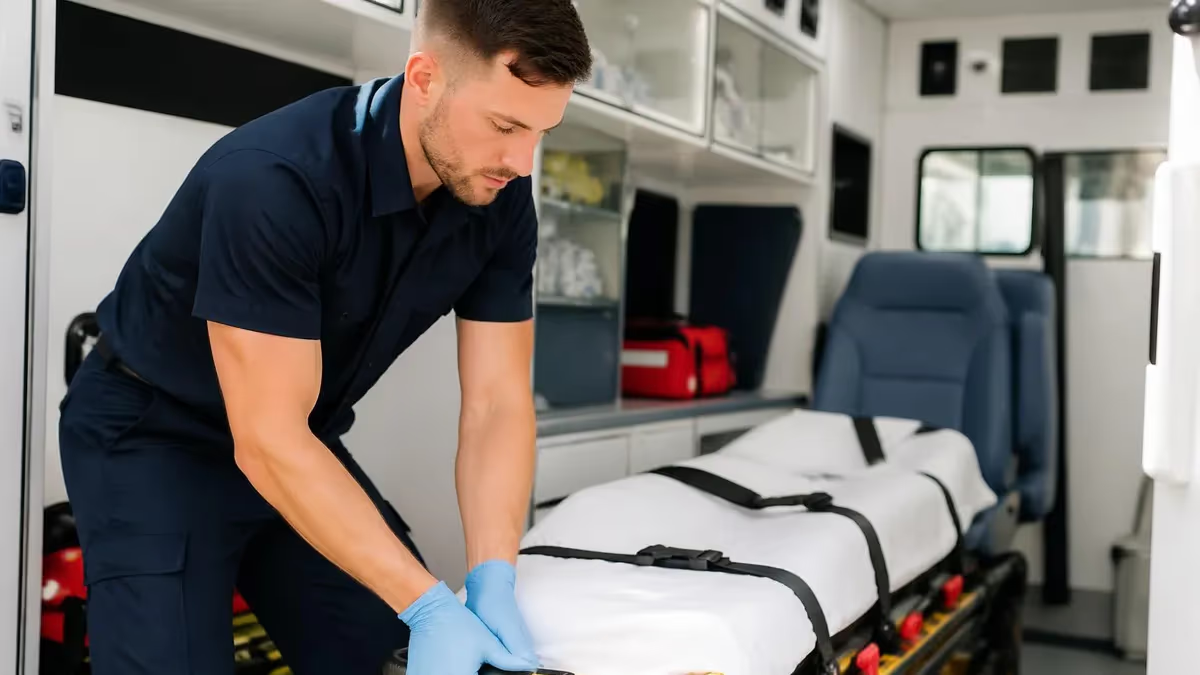
NREMT exam prep doesn't have to be expensive or overwhelming. Thousands of EMT candidates pass every year using free resources, smart study habits, and targeted practice. The key isn't studying more — it's studying the right material in the right way. If you're getting ready to sit for the National Registry of Emergency Medical Technicians cognitive exam, this guide gives you a clear path from nervous to confident.
The NREMT tests your ability to make clinical decisions under pressure. It's computer-adaptive, meaning the difficulty adjusts based on your answers. Get a question right, the next one gets harder. Get one wrong, it gets easier. The algorithm needs between 70 and 120 questions to determine whether you've met competency. That format rewards deep understanding over memorization — and it's exactly why taking a nremt practice test free of charge matters so much during your preparation.
Whether you're fresh out of EMT school or retaking after a previous attempt, your study strategy needs structure. Random reading won't cut it. You need to know which content areas carry the most weight, where most candidates struggle, and how to practice under realistic conditions. We'll cover all of that here — plus link you to nremt b practice test free resources that actually mirror the real exam format.
Most first-time candidates spend 2-4 weeks in focused prep mode. Some need less, especially if their EMT course was recent and thorough. Others need a full month. The timeline matters less than the consistency — thirty minutes of daily, focused practice beats a weekend cram session every time.

Finding quality study materials doesn't mean spending hundreds of dollars. You can access a nremt b practice test free right here on our site, covering airway management, cardiology, trauma, and more. These quizzes use the same question format you'll encounter on exam day — scenario-based, multiple choice, with one best answer. The key difference between paid prep courses and free resources isn't quality. It's structure. Paid courses organize the material for you. Free resources require you to build your own study plan.
A free nremt practice test serves two purposes during your prep. First, it identifies your weak spots before they cost you on the real exam. Maybe you're solid on trauma assessment but shaky on pharmacology. Or you know your airway algorithms but second-guess cardiac rhythm interpretation. Practice tests reveal these gaps quickly. Second, they build familiarity with the test-taking experience itself. The NREMT's adaptive format feels different from classroom exams, and practicing under similar conditions reduces test-day anxiety.
Don't just take practice tests — review every wrong answer thoroughly. Understanding why a distractor was wrong teaches you as much as knowing the right answer. Write down the concepts behind your mistakes. Track which content areas produce the most errors. Then redirect your study time toward those weak areas. That feedback loop — test, review, study, retest — is the most efficient path to passing.
Your NREMT test prep free study plan should center on the five major content areas the exam covers. Airway, Respiration, and Ventilation typically accounts for 18-22% of questions — it's the single largest content area. Cardiology and Resuscitation follows at 20-24%. Trauma makes up 14-18%. Medical and Obstetrics/Gynecology covers 27-31%. EMS Operations rounds it out at 10-14%. Knowing these weights helps you allocate study time where it counts most.
The candidates who fail often make the same mistake: they study what they already know because it feels productive. Don't fall into that trap. Your free nremt practice test results should dictate your study schedule. Scoring 90% on airway questions? Great — spend less time there. Scoring 60% on medical emergencies? That's where your study hours need to go. Comfort isn't the goal. Competency across all five areas is.
One practical technique that works: create a study rotation. Monday focuses on airway and breathing. Tuesday covers cardiology. Wednesday tackles trauma. Thursday handles medical emergencies. Friday is a full-length nremt practice exam free simulation followed by review. Weekends are for revisiting the topics where you scored lowest. This rotation ensures you're touching every content area regularly without burning out on any single subject.
NREMT Exam Content Areas Explained
Airway, Respiration, and Ventilation is the foundation of emergency care — and the NREMT tests it heavily. Expect questions on airway adjuncts (OPA, NPA), suctioning techniques, bag-valve-mask ventilation, supplemental oxygen delivery, and recognizing respiratory distress versus failure. You'll see scenario-based questions asking you to choose the correct intervention for a patient with specific signs and symptoms. Know the difference between upper and lower airway obstructions and when to escalate from basic to advanced airway management.
The computer-adaptive format of the NREMT is what makes it different from every other test you've taken. Most exams give everyone the same questions. The NREMT doesn't. It selects each question based on your performance so far. If you're answering above the competency line, questions get progressively harder. If you're below it, they get easier. The test ends when the algorithm reaches 95% confidence in its pass/fail determination — or when you hit 120 questions.
This format means you can't game the test with memorization alone. A nremt free practice test that mimics this adaptive approach gives you the best preparation possible. You need to understand concepts deeply enough to answer questions you've never seen before. The NREMT question bank contains thousands of items, and your exam pulls from them algorithmically. Two people sitting side by side will get completely different tests. What stays constant is the competency standard you're measured against.
Here's what the adaptive format means practically: don't panic if questions feel hard. Difficult questions often mean you're performing well and the algorithm is testing your ceiling. Easy questions late in the exam might actually be a concerning sign. Focus on each question individually without trying to read the tea leaves of difficulty progression. Your job is to pick the best answer for the patient in front of you — every single time. That's it. Let the algorithm worry about the rest. Take plenty of nremt practice tests free to build this mindset before test day.
Let's talk about the topics that trip up the most candidates. According to NREMT's own data, the Medical and OB/GYN content area has the highest failure rate. Why? Because it's broad. Diabetic emergencies, allergic reactions, poisoning, behavioral health, obstetric complications — they're all lumped into one section. A nremt basic practice test free covering these topics should be your top priority if practice exams reveal weakness here.
Airway management is the second most common struggle area. Candidates know the interventions but freeze when asked to choose between them in context. When do you use an OPA versus an NPA? When do you switch from nasal cannula to non-rebreather? These decisions depend on the patient's mental status, respiratory rate, and SpO2 — and the NREMT expects you to evaluate all three simultaneously. Practice questions that present messy, realistic scenarios build this skill better than flashcards ever could.
A targeted approach using free nremt practice tests across all content areas will show you exactly where you stand. Don't guess at your weaknesses — measure them. Take a baseline practice exam, calculate your percentage correct in each content area, and build your study plan around the results. Then take another practice exam a week later and compare. If your weak areas improved but strong areas slipped, adjust. Your nremt test prep free resources should drive a continuous improvement cycle, not just a one-time knowledge check.
NREMT Computer-Adaptive Testing: Pros and Cons
- +Shorter test for well-prepared candidates — can finish in 70 questions
- +Adjusts difficulty to your level so questions are always appropriately challenging
- +Reduces the chance of passing by guessing on easy questions
- +Tests true competency rather than rote memorization
- +Results typically available within 2 business days
- +Standardized scoring prevents bias from different exam versions
- −Can't go back to change previous answers once submitted
- −Difficult questions may feel discouraging even when you're performing well
- −No way to know during the test whether you're passing or failing
- −More questions doesn't necessarily mean you're failing — it's ambiguous
- −Requires deeper understanding than traditional fixed-form exams
- −Test anxiety is common because the format feels unfamiliar to most candidates
Test day logistics matter more than you'd think. A free nremt basic practice test prepares your knowledge, but you also need to prepare yourself physically and mentally. The NREMT cognitive exam is administered at Pearson VUE testing centers — the same network used for nursing boards, IT certifications, and bar exams. You'll need two forms of identification, including one government-issued photo ID. Arrive 30 minutes early. Late arrivals get turned away, and you forfeit your exam fee.
During the exam, you'll sit at a computer in a monitored room. No phones, no notes, no scratch paper in most locations (some provide a small whiteboard). You can't bring food or drinks into the testing area. Each question presents a clinical scenario with four answer options. Read the entire question — including all four options — before selecting your answer. The NREMT loves questions where two answers seem correct, and the right one depends on a detail buried in the scenario stem.
Here's a mental trick that helps: for every question, ask yourself "what would kill this patient first?" The NREMT consistently rewards answers that address the most life-threatening condition. Airway before breathing. Breathing before circulation. Circulation before everything else. When you're stuck between two reasonable answers, the one that addresses the higher-priority threat is almost always correct. Practicing with a practice nremt test free of charge will reinforce this pattern until it becomes instinct.
NREMT Exam Day Checklist
- ✓Confirm your exam date, time, and Pearson VUE testing center location
- ✓Bring two valid forms of ID — one must be a government-issued photo ID
- ✓Arrive at least 30 minutes before your scheduled exam time
- ✓Leave your phone, watch, and all electronics in your car or a locker
- ✓Use the restroom before checking in — breaks aren't always allowed
- ✓Read every question completely before looking at the answer choices
- ✓Don't rush — you have 2 full hours for a maximum of 120 questions
- ✓Focus on one question at a time — you can't go back to previous answers
- ✓Use the ABC prioritization framework when stuck between two options
- ✓Stay calm if you see many questions — more doesn't automatically mean failure
What happens if you don't pass? It's not the end of the road. The NREMT allows up to six attempts within a two-year window from your course completion date. For attempts one through three, you simply reschedule, pay the $80 fee again, and retake the exam. Starting with your fourth attempt, you'll need to complete a 24-hour remedial training course before you're eligible to retest. That's a significant time and money investment, so making your early attempts count is important.
Between attempts, take a free practice nremt test diagnostic to pinpoint exactly where you fell short. The NREMT sends a feedback report after each attempt showing your performance by content area — above passing, near passing, or below passing. Use that report as your study roadmap. Don't just retake the exam hoping for different questions. Genuinely address the content gaps that caused you to fall short. A different study approach — not more of the same — is what turns a failed attempt into a passing one.
Consider whether your test-taking strategy needs adjustment too. Some candidates know the material but struggle with the adaptive format itself. They second-guess correct answers, spend too long on hard questions, or let anxiety override their clinical reasoning. NREMT practice test online simulations that mimic the real format help you practice not just content but composure. Walk through questions at a steady pace, commit to answers without agonizing, and trust your training. That mental discipline is trainable — and it makes a measurable difference on exam day.
Beyond the cognitive exam, don't forget the psychomotor skills component. The NREMT requires you to pass both a written (cognitive) and practical (psychomotor) exam. The psychomotor exam tests hands-on skills: patient assessment, cardiac arrest management, BVM ventilation, spinal immobilization, and bleeding control. Your EMT course typically administers the psychomotor exam, so you may have already completed it by the time you sit for the cognitive test.
Your nremt practice test online sessions should complement — not replace — hands-on skills practice. Set up practice stations at home using whatever supplies you have. Walk through patient assessments out loud, verbalize your findings, and practice the exact sequence your skills sheets require. The cognitive and psychomotor exams test different things, but the clinical reasoning behind them is the same. Strong assessment skills on the practical exam translate directly to better clinical decision-making on the cognitive exam.
Study groups can accelerate your preparation if you find the right people. Two or three focused classmates who quiz each other, run through scenarios, and hold each other accountable will outperform solo study. Set ground rules: no phones, specific topics each session, and everyone takes turns teaching. The person who explains a concept always learns it better than the person listening. That dynamic makes study groups one of the most underrated NREMT prep tools available.
Your NREMT exam authorization is valid for a limited window — typically 90 days from approval. If you don't schedule and take your exam within that period, you'll need to reapply and potentially pay another fee. Don't let procrastination cost you money. Set a target exam date as soon as you receive your authorization to test, then build your study schedule backward from that date.
Let's address the elephant in the room: test anxiety. It's real, it's common, and it's manageable. More NREMT candidates fail because of anxiety than because of knowledge gaps. The adaptive format amplifies stress — you can't skip questions, you can't go back, and you have no idea whether you're passing or failing. That uncertainty creates a mental pressure cooker. But here's the thing: you can train for it the same way you train for clinical skills.
Taking an nremt practice test online under realistic conditions is the single best anxiety reducer. Set a timer. Sit at a desk, not on your couch. Don't pause to check your phone. Answer every question in order without going back. Simulate the testing center environment as closely as possible. After three or four of these simulated test sessions, the format stops feeling foreign. Your brain learns that the discomfort of not knowing your score is normal — not a sign of failure.
Breathing techniques also help during the exam itself. If you feel your heart rate climbing or your thinking getting cloudy, pause for ten seconds. Take three slow breaths — in through your nose, out through your mouth. This activates your parasympathetic nervous system and clears the stress hormones that impair decision-making. It sounds too simple to work, but emergency medicine professionals use this technique in actual crisis situations. If it works in the back of an ambulance, it'll work in a testing center.
NREMT Practice Test Questions
Prepare for the NREMT - National Registry of Emergency Medical Technicians exam with our free practice test modules. Each quiz covers key topics to help you pass on your first try.
NREMT EMT Airway and Breathing Practice Test
NREMT Exam Questions covering EMT Airway and Breathing Practice Test. Master NREMT Test concepts for certification prep.
NREMT EMT Airways and Breathing Practice Test
Free NREMT Practice Test featuring EMT Airways and Breathing Practice Test. Improve your NREMT Exam score with mock test prep.
NREMT EMT Cardiology Practice Test
NREMT Mock Exam on EMT Cardiology Practice Test. NREMT Study Guide questions to pass on your first try.
NREMT EMT Cardiology Sample Test
NREMT Test Prep for EMT Cardiology Sample Test. Practice NREMT Quiz questions and boost your score.
NREMT EMT Medical Practice Test
NREMT Questions and Answers on EMT Medical Practice Test. Free NREMT practice for exam readiness.
NREMT EMT Medical Sample Test
NREMT Mock Test covering EMT Medical Sample Test. Online NREMT Test practice with instant feedback.
NREMT EMT/NREMT Practice Test (Cardiology)
Free NREMT Quiz on EMT/NREMT Practice Test (Cardiology). NREMT Exam prep questions with detailed explanations.
NREMT EMT/NREMT Practice Test (Medical)
NREMT Practice Questions for EMT/NREMT Practice Test (Medical). Build confidence for your NREMT certification exam.
NREMT EMT/NREMT Practice Test (Operations)
NREMT Test Online for EMT/NREMT Practice Test (Operations). Free practice with instant results and feedback.
NREMT EMT/NREMT Trauma Practice Test
NREMT Study Material on EMT/NREMT Trauma Practice Test. Prepare effectively with real exam-style questions.
NREMT EMT Operations Practice Test
Free NREMT Test covering EMT Operations Practice Test. Practice and track your NREMT exam readiness.
NREMT EMT Trauma Practice Test
NREMT Exam Questions covering EMT Trauma Practice Test. Master NREMT Test concepts for certification prep.
NREMT EMT Practice Test
Free NREMT Practice Test featuring EMT Practice Test. Improve your NREMT Exam score with mock test prep.
NREMT Ethical Considerations & Legal Respo...
NREMT Mock Exam on Ethical Considerations & Legal Responsibilities. NREMT Study Guide questions to pass on your first try.
NREMT Neurological Emergencies & Stroke Care
NREMT Test Prep for Neurological Emergencies & Stroke Care. Practice NREMT Quiz questions and boost your score.
NREMT Neurological Emergencies & Stroke Cares
NREMT Questions and Answers on Neurological Emergencies & Stroke Cares. Free NREMT practice for exam readiness.
NREMT Obstetrics & Gynecology Emergencies
NREMT Mock Test covering Obstetrics & Gynecology Emergencies. Online NREMT Test practice with instant feedback.
NREMT Patient Assessment & Decision-Making
Free NREMT Quiz on Patient Assessment & Decision-Making. NREMT Exam prep questions with detailed explanations.
NREMT Pediatric Assessment & Neonatal Care
NREMT Practice Questions for Pediatric Assessment & Neonatal Care. Build confidence for your NREMT certification exam.
NREMT Pharmacology & Medication Administra...
NREMT Test Online for Pharmacology & Medication Administration. Free practice with instant results and feedback.
NREMT Practice Test
NREMT Study Material on Practice Test. Prepare effectively with real exam-style questions.
NREMT Respiratory Emergencies & Oxygen Del...
Free NREMT Test covering Respiratory Emergencies & Oxygen Delivery. Practice and track your NREMT exam readiness.
Your NREMT certification opens the door to a career that matters. EMTs respond to cardiac arrests, car accidents, overdoses, and every other emergency that makes someone call 911. The national median salary for EMTs is around $36,000, with paramedics earning significantly more. But compensation varies wildly by region, employer, and specialty. Fire department EMTs in major metros can earn $60,000+ with overtime and benefits.
Passing the NREMT is step one. After certification, you'll need to apply for state licensure — the NREMT is a national credential, but each state has its own licensing requirements. Most states accept NREMT certification as their baseline, adding their own application fees and background check requirements. Once licensed, you're employable. And in the current EMS job market, agencies are hiring aggressively. Staffing shortages mean new EMTs can often choose their employer rather than the other way around.
Start your exam prep today. Don't wait for the perfect study moment — it doesn't exist. Open a practice test, answer 20 questions, and see where you stand. That single action creates momentum. From there, build a daily study habit, track your progress, and keep pushing until practice test scores consistently hit 80% or higher. The NREMT exam is passable. Thousands prove it every month. With the right preparation, nremt practice test online tools, and disciplined study habits, you'll be one of them.
NREMT Questions and Answers


About the Author

Paramedic & Emergency Services Certification Trainer
George Washington UniversityCaptain Ryan O'Brien is a licensed paramedic and NREMT-certified emergency medical professional with a Bachelor of Science in Emergency Medical Services from George Washington University. He has 15 years of field experience as a paramedic and firefighter, and has coached hundreds of EMT and paramedic candidates through their NREMT written and psychomotor licensing examinations.
Join the Discussion
Connect with other students preparing for this exam. Share tips, ask questions, and get advice from people who have been there.
View discussion (2 replies)