
EMT Certification 2026 October — NREMT Exam Requirements, Levels, and How to Pass
Pass your nremt practice test exam. Practice questions with detailed answer ❓ explanations for the 2026 October exam. Instant scoring and study guides.
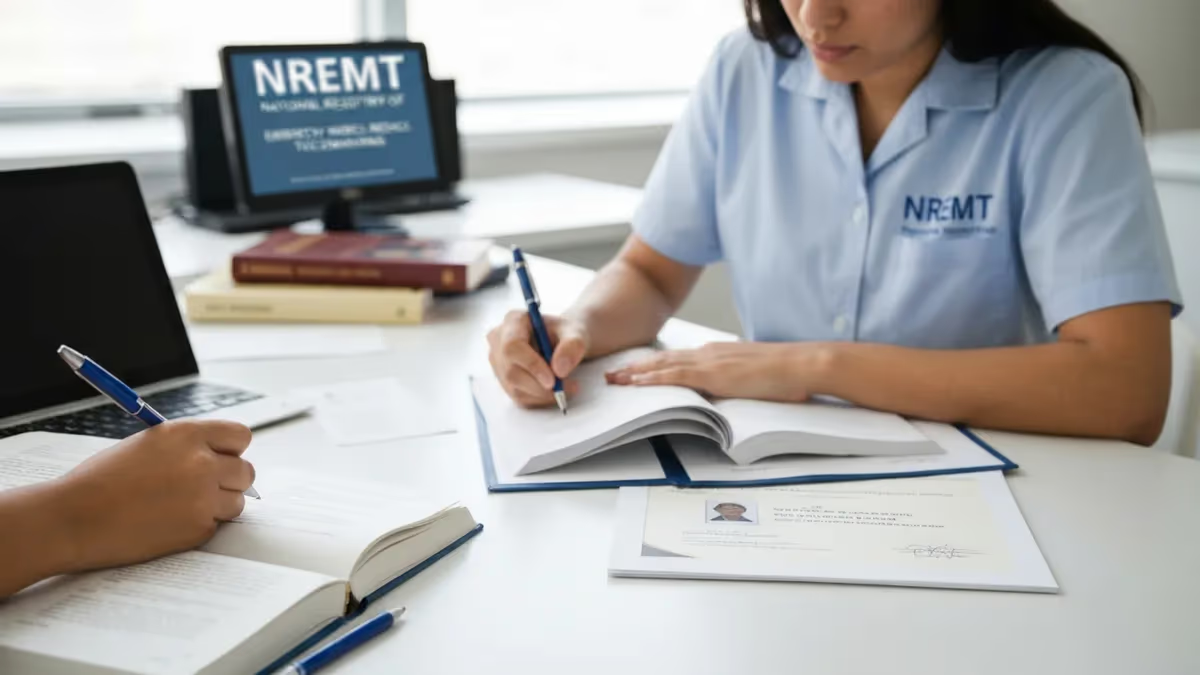
EMT certification opens the door to emergency medical services — and it doesn't take years of schooling. Most EMT courses run 120 to 180 hours over 3 to 6 months. After completing your training, you'll face the NREMT exam: a computer-adaptive test that determines whether you're ready to treat patients in the field. Thousands of candidates sit for it each year, and the national first-attempt pass rate hovers around 70%. That means roughly 3 in 10 people fail on the first try. A solid NREMT practice test can make the difference between passing and retaking.
The certification process involves two parts — cognitive and psychomotor. The cognitive exam tests your medical knowledge through scenario-based questions covering airway management, cardiology, trauma, and EMS operations. The psychomotor exam evaluates hands-on skills at a state-approved testing site. Both must be passed to earn your NREMT credential. Once certified, you'll apply for state licensure, which may have additional requirements depending on where you plan to work.
Whether you're a college student exploring healthcare, a career changer at 40, or a firefighter adding EMS credentials, this guide walks you through every step. We'll cover exam structure, study strategies, recertification requirements, and the NREMT study test options that help candidates pass on the first attempt. You'll also find free practice questions linked throughout — use them. Active recall through practice testing beats passive reading every time, and the data backs that up.

Taking an NREMT study test before exam day is one of the smartest things you can do. The NREMT cognitive exam uses computer-adaptive testing (CAT), meaning each question's difficulty adjusts based on your previous answer. Get one right, and the next gets harder. Get one wrong, and it gets easier. The algorithm is measuring your competency level — not counting correct answers. This format feels different from classroom exams, and practice tests help you acclimate.
The NREMT exam covers five content areas: airway/respiration/ventilation, cardiology/resuscitation, trauma, medical/obstetrics/gynecology, and EMS operations. Each area carries a different weight. Airway and cardiology questions appear most frequently, accounting for roughly 40% of the test. Trauma and medical emergencies make up another 40%, with operations rounding out the final 20%. Knowing these proportions helps you allocate study time wisely.
Registration happens at nremt.org. You'll need authorization from your EMT course director, a valid government-issued ID, and the $80 exam fee. Once approved, you schedule through Pearson VUE — the same testing network used for nursing and IT certification exams. Test centers operate in every state, and appointment slots typically open within 1-2 weeks. Don't procrastinate on scheduling; popular centers in metro areas fill fast, especially in spring and fall when training programs graduate new cohorts.
The NREMT exam isn't designed to trick you — but it is designed to challenge you. Questions present clinical scenarios where you must identify the most appropriate action. "Most appropriate" is the key phrase. Multiple answers might seem correct, but only one reflects the highest standard of care for an EMT-level provider. This distinction trips up a lot of candidates. You're not picking what a paramedic would do. You're picking what an EMT should do within their scope of practice.
NREMT test anxiety is real and surprisingly common. About 30% of first-time failures cite test anxiety as a contributing factor. The adaptive format amplifies this — you can't go back and change answers, you don't know how many questions remain, and the difficulty shifts constantly. Combat this by simulating test conditions during study sessions. Set a timer, use a quiet room, and answer questions without pausing to look things up. Build that mental endurance before exam day.
NREMT certification requires passing both the cognitive and psychomotor exams. The psychomotor (practical) exam tests skills stations: patient assessment (medical and trauma), cardiac arrest management/AED, BVM ventilation, oxygen administration, and spinal immobilization. Each station has critical criteria — miss one, and you fail that station. Most states allow immediate retesting of failed stations. Practice these skills until they feel automatic, because nervousness can make you skip steps you know by heart.
NREMT Exam Content Areas Explained
Airway, respiration, and ventilation questions make up about 18-22% of the exam. Expect scenarios involving upper airway obstruction, BVM technique, suctioning, and supplemental oxygen. Cardiology and resuscitation cover another 20-24%, focusing on cardiac arrest protocols, AED use, CPR quality, and recognizing stroke and MI symptoms. Together, these two areas form the largest portion of the NREMT cognitive exam. Master them first.
NREMT recertification sneaks up on people. Your certification expires every two years, and if you let it lapse, you'll need to retake the cognitive exam — not just submit paperwork. The recertification process requires 40 hours of continuing education (CE), including specific hours in national, local, and individual categories. At least 20 hours must come from CAPCE-accredited providers. The remaining hours can include local protocol reviews, skills refreshers, and self-directed learning.
NREMT exam prep should start 4-6 weeks before your test date. That timeline gives you enough runway to cover all five content areas without cramming. Spend the first two weeks reviewing didactic material — textbooks, lecture notes, and protocol guides. Weeks three and four should shift heavily toward practice testing. Use timed practice exams that mimic the CAT format. In the final two weeks, focus on your weakest areas and drill high-yield topics like cardiac arrest algorithms, medication dosages, and patient assessment sequences.
Study groups help, but only if everyone's committed. A four-person group that meets twice weekly can cover material faster than solo study — each member presents one content area and fields questions. Avoid groups larger than five; they turn into social sessions. Online study communities on Reddit (r/NewToEMS, r/ems) and Facebook groups also provide peer support, practice questions, and advice from recently certified EMTs who remember what the exam emphasized.
NREMT recert deadlines aren't flexible. If your certification expires, you enter a 2-year grace period during which you can still recertify — but you'll need additional documentation and potentially a skills verification. After that grace period? Start over. That means retaking the cognitive exam, possibly repeating a refresher course, and paying all associated fees again. Set calendar reminders 6 months and 3 months before expiration. The NREMT test isn't something you want to face twice because of a missed deadline.
A quality NREMT practice exam mimics the real test experience. It should use scenario-based questions, limit answer choices to four, prevent you from going back to previous questions, and adjust difficulty as you progress. Free options exist, but paid platforms like EMTprep, Fisdap, and Limmer Education offer more sophisticated adaptive algorithms. The best approach combines both: use free practice tests for broad exposure and paid platforms for targeted weakness remediation.
Don't underestimate the psychomotor exam. About 15% of candidates who pass the cognitive exam fail a skills station on their first attempt. The most common failures happen in patient assessment — candidates skip verbal ABCs, forget to state their general impression, or miss critical interventions like spinal motion restriction. Practice each station with a partner who reads from the official NREMT skill sheet. Every checkmark on that sheet is a step you must verbalize or demonstrate. Silence equals failure.
Pros and Cons of EMT Certification
- +Fast training — most programs finish in 3-6 months
- +Low cost compared to other healthcare certifications ($1,000-$3,000)
- +Immediate job availability across all 50 states
- +Stepping stone to paramedic, nursing, PA, or medical school
- +Portable credential — NREMT is recognized nationally
- +Hands-on work with direct patient impact from day one
- −Starting salary is modest — median $38,930 nationally
- −Physically demanding with irregular hours and shift work
- −Emotional toll from trauma exposure and patient outcomes
- −Limited scope of practice compared to AEMTs and paramedics
- −Recertification every 2 years requires 40 CE hours
- −High burnout rate in busy urban EMS systems
Pros and Cons at a Glance
| Pros | Cons |
|---|---|
| Stepping stone to paramedic, nursing, PA, or medical school | Physically demanding with irregular hours and shift work |
| Portable credential — NREMT is recognized nationally | Emotional toll from trauma exposure and patient outcomes |
| Hands-on work with direct patient impact from day one | Limited scope of practice compared to AEMTs and paramedics |
When you practice for the NREMT test, focus on the "why" behind each answer — not just the "what." The exam rewards clinical reasoning over rote memorization. A question might describe a patient with altered mental status, cool/clammy skin, and rapid pulse. Memorizers pick "shock" and move on. Critical thinkers ask: what type of shock? Hypovolemic from internal bleeding? Cardiogenic from MI? Distributive from anaphylaxis? The correct intervention depends on the cause, and that's exactly what the NREMT is testing.
The NREMT practical exam (psychomotor) follows a standardized format. You'll rotate through skills stations, each lasting 10-15 minutes. A state examiner observes and scores you using an official checklist. Stations include: trauma patient assessment, medical patient assessment, cardiac arrest management with AED, BVM ventilation of an apneic adult, supplemental oxygen administration, and sometimes a random skills station (like bleeding control or joint immobilization). Talk through everything you're doing — examiners can't read your mind.
Timing matters during the practical exam. You'll have a set time limit per station, and rushing leads to skipped steps. But moving too slowly means you don't complete the assessment. Practice until you can finish each station comfortably within 8-10 minutes. Film yourself during practice — watching playback reveals habits you don't notice in the moment, like forgetting to verbalize BSI/scene safety or skipping the rapid trauma assessment on an unconscious patient.
NREMT EMT Certification Checklist
- ✓Complete a state-approved EMT training course (120-180 hours)
- ✓Obtain course completion documentation from your program director
- ✓Create an account at nremt.org and submit your application
- ✓Pay the $80 NREMT cognitive exam fee
- ✓Schedule your exam at a Pearson VUE testing center
- ✓Pass the NREMT cognitive (written) exam
- ✓Pass all NREMT psychomotor (skills) exam stations
- ✓Apply for state EMS licensure through your state EMS office
- ✓Complete a background check if required by your state
- ✓Set a calendar reminder for recertification 2 years from certification date
NREMT practice tests serve a dual purpose: they reveal knowledge gaps and build test-taking stamina. The cognitive exam can last up to 2.5 hours, and mental fatigue causes mistakes in the final third. By taking full-length timed practice tests, you train your brain to maintain focus across 70-120 questions. Aim to complete at least five full-length practice exams before test day. Review every wrong answer — not just the right choice, but why each wrong choice was incorrect.
The NREMT examination process has evolved. In 2024, the NREMT updated its practice analysis, adjusting the weight of certain content areas. EMS operations gained slightly more emphasis, and scenario complexity increased across all categories. If you're using study materials older than 2023, supplement them with current NREMT blueprint documents available on their website. Outdated resources teach outdated protocols, and the exam reflects current evidence-based practice standards.
Your NREMT certification unlocks more than ambulance work. Certified EMTs find roles in hospital emergency departments, urgent care centers, event medical teams, industrial safety, wilderness medicine, and disaster response organizations. Some EMTs work on oil rigs, at ski resorts, or aboard cruise ships. The credential also serves as a prerequisite for paramedic programs, nursing school clinical experience, and physician assistant programs that value pre-hospital patient contact hours.
NREMT testing centers operate through Pearson VUE's nationwide network. You'll find locations in nearly every major city and most mid-sized towns. The testing environment is standardized: you'll sit at an individual computer station, store personal belongings in a locker, and present government-issued photo ID before starting. Fingerprint or palm-vein scanning confirms your identity. No calculators, reference materials, or electronic devices are permitted inside the testing room.
Taking NREMT practice exams regularly is the single most effective study strategy backed by research. A 2023 study in Prehospital Emergency Care found that EMT students who completed 3+ practice exams scored 12% higher on the cognitive exam than those who only reviewed textbooks. Spaced repetition — reviewing missed questions at increasing intervals — strengthens long-term retention. Apps like Anki let you create digital flashcards that automatically schedule review based on how well you recalled each answer.
If you fail the NREMT cognitive exam, you can retake it after a 15-day waiting period. The first and second retakes require no additional coursework — just the $80 fee. After the third failure, you'll need to complete a 24-hour refresher course before testing again. Don't treat a failed attempt as the end. Analyze your score report, which shows performance by content area. If you scored "below passing" in cardiology, that's where your study hours should go. Targeted remediation works better than general review.
NREMT certification expires every 2 years. If you miss the recertification deadline, you enter a grace period that adds extra requirements and fees. After the grace period, you must retake the full cognitive exam. Set reminders at 6 months and 3 months before expiration. Complete your 40 CE hours early — don't wait until the last month to scramble for approved courses.
An NREMT exam practice test should mirror the real exam's question format: scenario-based, four answer choices, no ability to return to previous questions. Many free resources use simple recall questions ("What does AED stand for?") that don't prepare you for the clinical reasoning the actual exam demands. Look for practice tests that present a patient scenario and ask what you'd do next — those questions train the decision-making skills the CAT algorithm measures.
NREMT exam practice goes beyond answering questions. Study the National EMS Education Standards document — it defines exactly what an EMT-level provider should know and be able to do. Each learning objective maps to potential exam questions. Cross-reference your study materials against this document. If your textbook skips a topic listed in the standards (like emergency moves vs. non-emergency moves, or the difference between expressed and implied consent), find supplemental resources to fill that gap.
Flashcard apps, YouTube channels (like PrepMedic and MedicTests), and EMS podcasts supplement traditional studying. But nothing replaces hands-on practice. If your EMT course has ended, volunteer with a local ambulance service or fire department to keep your skills sharp. Muscle memory for BVM ventilation, CPR, and splinting fades without repetition. Some candidates schedule their exam within 2-4 weeks of course completion to minimize skill decay. The sooner you test, the fresher the material.
NREMT Practice Test Questions
Prepare for the NREMT - National Registry of Emergency Medical Technicians exam with our free practice test modules. Each quiz covers key topics to help you pass on your first try.
NREMT EMT Airway and Breathing Practice Test
NREMT Exam Questions covering EMT Airway and Breathing Practice Test. Master NREMT Test concepts for certification prep.
NREMT EMT Airways and Breathing Practice Test
Free NREMT Practice Test featuring EMT Airways and Breathing Practice Test. Improve your NREMT Exam score with mock test prep.
NREMT EMT Cardiology Practice Test
NREMT Mock Exam on EMT Cardiology Practice Test. NREMT Study Guide questions to pass on your first try.
NREMT EMT Cardiology Sample Test
NREMT Test Prep for EMT Cardiology Sample Test. Practice NREMT Quiz questions and boost your score.
NREMT EMT Medical Practice Test
NREMT Questions and Answers on EMT Medical Practice Test. Free NREMT practice for exam readiness.
NREMT EMT Medical Sample Test
NREMT Mock Test covering EMT Medical Sample Test. Online NREMT Test practice with instant feedback.
NREMT EMT/NREMT Practice Test (Cardiology)
Free NREMT Quiz on EMT/NREMT Practice Test (Cardiology). NREMT Exam prep questions with detailed explanations.
NREMT EMT/NREMT Practice Test (Medical)
NREMT Practice Questions for EMT/NREMT Practice Test (Medical). Build confidence for your NREMT certification exam.
NREMT EMT/NREMT Practice Test (Operations)
NREMT Test Online for EMT/NREMT Practice Test (Operations). Free practice with instant results and feedback.
NREMT EMT/NREMT Trauma Practice Test
NREMT Study Material on EMT/NREMT Trauma Practice Test. Prepare effectively with real exam-style questions.
NREMT EMT Operations Practice Test
Free NREMT Test covering EMT Operations Practice Test. Practice and track your NREMT exam readiness.
NREMT EMT Trauma Practice Test
NREMT Exam Questions covering EMT Trauma Practice Test. Master NREMT Test concepts for certification prep.
NREMT EMT Practice Test
Free NREMT Practice Test featuring EMT Practice Test. Improve your NREMT Exam score with mock test prep.
NREMT Ethical Considerations & Legal Respo...
NREMT Mock Exam on Ethical Considerations & Legal Responsibilities. NREMT Study Guide questions to pass on your first try.
NREMT Neurological Emergencies & Stroke Care
NREMT Test Prep for Neurological Emergencies & Stroke Care. Practice NREMT Quiz questions and boost your score.
NREMT Neurological Emergencies & Stroke Cares
NREMT Questions and Answers on Neurological Emergencies & Stroke Cares. Free NREMT practice for exam readiness.
NREMT Obstetrics & Gynecology Emergencies
NREMT Mock Test covering Obstetrics & Gynecology Emergencies. Online NREMT Test practice with instant feedback.
NREMT Patient Assessment & Decision-Making
Free NREMT Quiz on Patient Assessment & Decision-Making. NREMT Exam prep questions with detailed explanations.
NREMT Pediatric Assessment & Neonatal Care
NREMT Practice Questions for Pediatric Assessment & Neonatal Care. Build confidence for your NREMT certification exam.
NREMT Pharmacology & Medication Administra...
NREMT Test Online for Pharmacology & Medication Administration. Free practice with instant results and feedback.
NREMT Practice Test
NREMT Study Material on Practice Test. Prepare effectively with real exam-style questions.
NREMT Respiratory Emergencies & Oxygen Del...
Free NREMT Test covering Respiratory Emergencies & Oxygen Delivery. Practice and track your NREMT exam readiness.
The NREMT cognitive exam uses a pass/fail model — there's no numerical score. The computer-adaptive algorithm determines, with 95% statistical confidence, whether you perform above or below the competency standard. That's why the test length varies. Strong candidates who consistently answer at or above the passing standard may finish in 70 questions. Candidates whose performance fluctuates near the threshold will face more questions — up to 120 — as the algorithm gathers more data to make its determination.
To practice for the NREMT exam effectively, build a study calendar and stick to it. Block 1-2 hours daily, alternating between content review and practice testing. Monday: airway and cardiology. Tuesday: practice exam. Wednesday: trauma and medical. Thursday: practice exam. Friday: EMS operations and weak areas. Weekends: full-length timed exams. This structured approach prevents the common mistake of studying only comfortable topics while avoiding weak areas. Discipline beats motivation every time.
EMT certification is your starting line, not your finish line. The skills you build — patient assessment, critical thinking under pressure, teamwork in chaotic environments — transfer to every healthcare career path. Paramedic school, nursing programs, PA school, and even medical school admissions committees value NREMT-certified applicants because they've demonstrated competency in real patient care. Whatever your long-term goal, passing the NREMT exam proves you can perform when it counts.
Sample NREMT Practice Questions
Try these questions from our free NREMT practice tests. The correct answer and an explanation follow each question.
You are transporting an elderly male patient in respiratory distress with a history of COPD... The patient has very shallow, rapid respirations with minimal chest wall motion and slight wheezing in the upper lung fields. Given this situation, what would you expect the arterial carbon dioxide levels to be?
- A. Not enough information to determine
- B. Normal
- C. Lowered
- D. Elevated
Answer: D. Elevated
Shallow, rapid respirations with minimal chest wall motion in a COPD patient indicate ineffective ventilation. This type of breathing pattern does not allow for adequate gas exchange, leading to the retention of carbon dioxide in the blood. Consequently, the arterial carbon dioxide levels would be elevated, a condition known as hypercapnia.
What is the preferred oxygen delivery for a COPD patient with low oxygen levels?
- A. Non-rebreather mask.
- B. Bag-valve-mask (BVM).
- C. Nasal cannula
- D. Ventilator.
Answer: C. Nasal cannula
For COPD patients with low oxygen levels, a nasal cannula is generally the preferred oxygen delivery method because it provides controlled, low-flow oxygen. Administering high concentrations of oxygen via a non-rebreather mask can suppress the hypoxic drive in some COPD patients, potentially leading to respiratory depression. The goal is to improve oxygenation without compromising their respiratory drive.
You arrive at a patient who has fallen off a ladder. Which of the following information is NOT important to the patient's care?
- A. Surface the patient landed on
- B. What part of the body hit first
- C. Height of the ladder
- D. Distance the patient fell from
Answer: C. Height of the ladder
In assessing a fall, the *distance* the patient fell from is crucial for determining the potential for significant injury, as greater fall heights correlate with higher energy transfer and injury risk. The *surface* landed on and *what part of the body hit first* also directly impact injury patterns. The *height of the ladder itself* is less directly relevant to the patient's injuries than the actual fall distance.
NREMT Questions and Answers
About the Author

Attorney & Bar Exam Preparation Specialist
Yale Law SchoolJames R. Hargrove is a practicing attorney and legal educator with a Juris Doctor from Yale Law School and an LLM in Constitutional Law. With over a decade of experience coaching bar exam candidates across multiple jurisdictions, he specializes in MBE strategy, state-specific essay preparation, and multistate performance test techniques.
Join the Discussion
Connect with other students preparing for this exam. Share tips, ask questions, and get advice from people who have been there.
View discussion (2 replies)