
Police Sit-Up Test: How Many Sit-Ups You Need for the NPOST & Complete Training Guide
How many sit-ups for police test? Learn NPOST fitness standards, training plans & passing scores. ✅ Complete prep guide for aspiring officers.
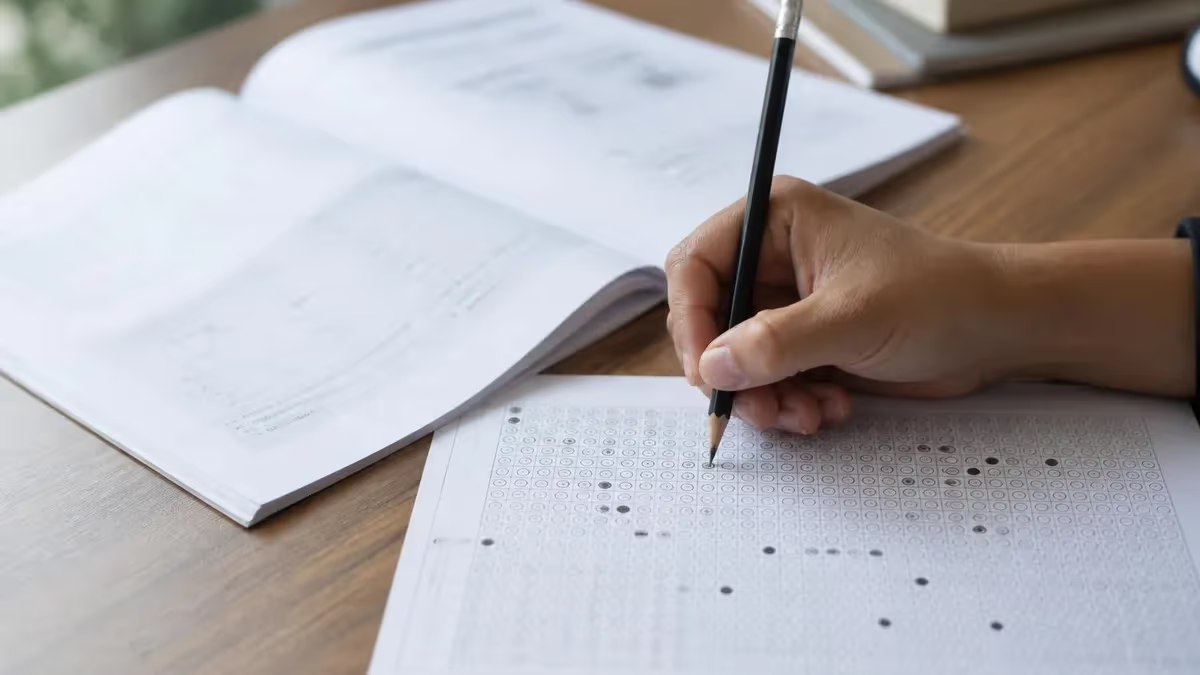
If you are preparing for a law enforcement career, understanding how many sit-ups for police test requirements you must meet is one of the most practical steps you can take. The National Police Officer Selection Test (NPOST) is a written cognitive exam, but virtually every agency that uses it also requires candidates to pass a physical fitness evaluation—and the sit-up component is among the most commonly tested exercises. Knowing the exact standards before you walk into the testing facility can be the difference between moving forward in the hiring process and being eliminated on day one.
The NPOST, formally called the National Police Officer Selection Test POST, was developed by Stanard & Associates and is used by hundreds of law enforcement agencies across the United States. It measures cognitive abilities including reading comprehension, arithmetic, grammar, and incident report writing.
However, the physical fitness test that frequently accompanies the NPOST is where many candidates struggle, not because the standards are impossibly high, but because candidates underestimate the preparation required. The sit-up test specifically evaluates core muscular endurance, which is directly relevant to officer safety tasks like subduing suspects, wearing duty belts for eight-hour shifts, and recovering quickly during foot pursuits.
Most agencies that administer the NPOST alongside a physical ability test (PAT) use age- and gender-adjusted sit-up standards derived from nationally recognized fitness norms. For a male candidate between the ages of 20 and 29, the typical passing standard is completing 38 or more sit-ups in 60 seconds.
Female candidates in the same age bracket typically need to complete 32 or more sit-ups in 60 seconds. These benchmarks come from the Cooper Institute's law enforcement fitness norms, which are the most widely adopted standards in American policing. However, individual agencies can and do set higher or lower cutoffs, so always verify with your specific department.
Preparing for the sit-up portion of a police fitness test is not a matter of doing a few crunches the week before your exam. A structured training program spanning six to twelve weeks is the gold standard approach.
Candidates who start at fewer than 20 sit-ups per minute often need the full twelve weeks to reach the 38-plus threshold, while those already completing 30 or more may need only four to six weeks of targeted work. The key training principles involved are progressive overload, adequate recovery, and core stability development through complementary exercises such as planks, dead bugs, and hip flexor stretches.
Beyond raw numbers, technique matters enormously on test day. Most law enforcement fitness tests define a proper sit-up with very specific form requirements: feet flat on the floor or held by a partner, hands clasped behind the head or crossed over the chest, and the torso rising until the elbows touch or pass the knees.
A rep that does not meet the form standard will not be counted, which means a candidate who rushes and sacrifices form may actually post a lower official score than their training numbers would suggest. Practicing with correct form from the first day of training ensures that your test-day reps all count.
This comprehensive training guide covers everything you need to know about the police sit-up test requirements, including the full NPOST context, age and gender standards broken down by bracket, a week-by-week training progression, nutrition and recovery tips, and answers to the most frequently asked questions from candidates. Whether you are just beginning your law enforcement journey or retaking a fitness test after a previous attempt, this guide provides the framework to walk in confident and physically prepared. You can also explore national police officer selection test practice questions to strengthen your cognitive readiness alongside your physical training.
Understanding the relationship between the written NPOST exam and the physical fitness component is essential for holistic preparation. Many candidates focus exclusively on one or the other, only to find themselves underprepared in the area they neglected. The agencies that use the NPOST view both cognitive and physical readiness as equally non-negotiable.
A candidate who aces the written test but cannot complete the required number of sit-ups will not advance to the academy, and vice versa. Integrated preparation—studying for the written exam and training your body simultaneously—is the approach that consistently produces the highest candidate success rates according to police hiring experts.
NPOST Fitness Test by the Numbers

NPOST Fitness Standards: Sit-Up Requirements by Age & Gender
Male candidates must complete 38 or more sit-ups in 60 seconds. Female candidates must complete 32 or more. This age group faces the highest raw number standard, reflecting peak muscular endurance expectations for new officers.
Male candidates need 35 sit-ups in 60 seconds; females need 27. Standards decrease slightly with age, but the test remains competitive. Candidates in this bracket often have prior fitness experience that helps offset the physical demands.
Male candidates require 29 sit-ups; females require 24 in 60 seconds. Core training remains critical even with reduced thresholds. Many agencies view consistent technique as more important than raw numbers in this age bracket.
Male candidates need 25 sit-ups; females need 18. While the standard is lower, proper form and injury prevention become critical for this group. A gradual progressive training program is essential to avoid strain.
Some departments set standards above the Cooper Institute norms. Always check your specific agency's written fitness testing guidelines. State-run police officer standards commissions may also publish their own tables that supersede general norms.
Building the core endurance needed to pass the police sit-up test requires more than just doing sit-ups every day. Effective training follows a progressive overload model, which means you systematically increase the demand placed on your muscles over time so that they adapt and grow stronger. A candidate who performs the same number of sit-ups at the same pace every workout will plateau quickly, often within two to three weeks. To keep improving, you need to either increase your daily volume, reduce your rest intervals, or add complementary core exercises that challenge your abdominals from different angles.
The most effective weekly structure for sit-up training involves three to four dedicated core sessions per week with at least one full rest day between sessions. On training days, perform three to five sets of sit-ups, stopping each set two to three reps before failure. This approach—known as leaving reps in reserve—allows your muscles to recover sufficiently between sets while still accumulating enough total volume to drive adaptation. For a candidate starting at 20 sit-ups, a sample first week might look like: five sets of 15 reps with 90 seconds of rest between sets, performed three times that week.
Complementary exercises are not optional—they are essential. The sit-up test primarily loads the rectus abdominis and hip flexors, but weakness anywhere in the core kinetic chain will limit your performance and increase injury risk. Planks (aim for three sets of 45 to 60 seconds) develop the transverse abdominis and improve overall core rigidity.
Dead bug exercises train your core to resist extension while your limbs are moving, which mirrors the biomechanics of sit-ups. Glute bridges and hip flexor stretches prevent the tight hip flexors that cause lower back pain in high-volume sit-up training. Include two to three of these exercises at the end of every training session.
Weeks one through four of your training block should focus on building the movement pattern and accumulating baseline volume. During this phase, your goal is not maximum speed—it is perfect technique repeated consistently. Each rep should begin with your lower back firmly in contact with the floor, rise smoothly until your elbows touch your knees, and lower with control rather than collapsing. Fast, sloppy reps in training lead to fast, sloppy—and non-counting—reps on test day. Time yourself weekly with a 60-second max-effort test to track progress and adjust your training targets accordingly.
Weeks five through eight represent the intensification phase. By this point, you should have established solid form and accumulated meaningful base volume. Now you increase the intensity by shortening rest periods between sets from 90 seconds to 60 seconds, and by adding one additional set to each workout. You should also introduce tempo variation: two or three sets per session at maximum speed to simulate test conditions, followed by slower technique sets to maintain form quality. Many candidates find their numbers jump significantly during this phase as neuromuscular efficiency improves alongside raw muscle endurance.
Weeks nine through twelve are your peaking and taper phase. Continue max-effort 60-second tests every five to seven days to confirm you are on track. In the final two weeks before your test date, reduce your total training volume by about 40 percent while maintaining the intensity. This taper allows your muscles to fully recover and perform at their absolute peak on test day.
Many candidates make the mistake of training heavily right up to the test, arriving fatigued instead of fresh. A proper taper can add four to eight additional reps to your test-day performance compared to training mid-cycle. For more comprehensive preparation resources, the national police officer selection test practice test materials can help you approach the cognitive and physical components together.
Recovery between sessions deserves as much attention as the workouts themselves. Aim for seven to nine hours of sleep per night, as growth hormone released during deep sleep is the primary driver of muscular adaptation. Foam rolling the lower back, hip flexors, and glutes for five to ten minutes after each training session reduces delayed onset muscle soreness (DOMS) and keeps your range of motion optimal.
Active recovery on rest days—light walking, swimming, or yoga—promotes blood flow and accelerates tissue repair without adding training stress. Candidates who treat recovery as part of their program consistently outperform those who simply train hard and ignore it.
National Police Officer Selection Test: Written Exam Overview
The reading comprehension section of the national police officer selection test presents candidates with short passages—typically police incident reports, policy documents, or news excerpts—followed by multiple-choice questions testing whether you understood the material. This section evaluates your ability to extract key facts, identify the main idea, and draw logical inferences, all skills directly relevant to police report writing and courtroom testimony. Most administrations include 20 to 25 reading questions, and a score of 70 percent or higher is generally required to pass.
Effective preparation for the reading section involves practicing with high-density informational texts, not leisure reading. Read police department press releases, municipal codes, and law enforcement policy manuals to familiarize yourself with the formal, precise language style used in test passages. When answering questions, always base your answer on what the passage actually states rather than outside knowledge. Many candidates lose points by answering from general awareness rather than from the specific text in front of them—a critical distinction the test is designed to expose.

NPOST Physical Test: Advantages and Challenges of the Sit-Up Standard
- +Age- and gender-adjusted standards make the test fair for all qualifying candidates
- +The 60-second window is long enough that pacing strategy can significantly boost your score
- +Core fitness built through sit-up training also improves performance in other PAT components like the run
- +Consistent training over 8-12 weeks reliably brings most candidates up to the passing standard
- +Proper sit-up technique is easy to learn and practice without any gym equipment
- +Passing the physical test alongside the NPOST written exam demonstrates holistic readiness to hiring panels
- −Standards vary by agency and are not always published clearly in advance, creating uncertainty
- −Hip flexor and lower back strain are common injuries when candidates train with poor form
- −Candidates who neglect the physical test while focusing on the written NPOST often fail on test day
- −Age group cutoffs can disadvantage candidates who are just above a bracket threshold
- −Overtraining in the final week is a frequent mistake that leaves candidates fatigued during the actual test
- −Some agencies combine sit-ups, push-ups, and a 1.5-mile run in a single session, increasing overall fatigue
Pros and Cons at a Glance
| Pros | Cons |
|---|---|
| Age- and gender-adjusted standards make the test fair for all qualifying candidates | Standards vary by agency and are not always published clearly in advance, creating uncertainty |
| Core fitness built through sit-up training also improves performance in other PAT components like the run | Hip flexor and lower back strain are common injuries when candidates train with poor form |
| Proper sit-up technique is easy to learn and practice without any gym equipment | Candidates who neglect the physical test while focusing on the written NPOST often fail on test day |
| Passing the physical test alongside the NPOST written exam demonstrates holistic readiness to hiring panels | Age group cutoffs can disadvantage candidates who are just above a bracket threshold |
NPOST Physical Test Preparation Checklist
- ✓Confirm your agency's exact sit-up standard and age-bracket cutoff in writing before beginning training.
- ✓Perform a baseline 60-second max sit-up test in week one to establish your starting point.
- ✓Schedule three to four core training sessions per week with at least one full rest day in between.
- ✓Practice sit-ups with the exact form required by your agency—hands behind head or crossed on chest, elbows touching knees.
- ✓Add planks, dead bugs, and hip flexor stretches to every training session to prevent injury.
- ✓Time yourself with a 60-second max-effort test every five to seven days to track progress.
- ✓Reduce training volume by 40 percent in the final two weeks before test day for a proper taper.
- ✓Get seven to nine hours of sleep every night during your training block.
- ✓Eat a moderate-carbohydrate meal two to three hours before your test—avoid heavy or unfamiliar foods on test morning.
- ✓Arrive at the testing site early, complete a dynamic warm-up, and perform five to ten slow practice reps before the timed test begins.
Rest Adds Reps — Don't Skip the Taper
Candidates who reduce training volume by 40 percent in the final two weeks before their test date consistently score four to eight reps higher than they do mid-training-cycle. Your muscles need time to fully recover and glycogen-load before a max-effort test. Arriving fresh is not laziness—it is smart athletic periodization that police academy instructors and strength coaches universally recommend.
One of the most preventable failure points for police fitness test candidates is poor technique rather than inadequate fitness. Many candidates can physically produce enough muscular force to complete the required number of sit-ups, but they fail to meet the standard because their reps are not being counted.
Understanding exactly what constitutes a valid repetition under your agency's testing protocol—and training exclusively with that form from day one—eliminates this entirely avoidable source of failure. The two most common form errors that cause non-counted reps are failing to touch elbows to knees at the top of the movement and failing to lower the back fully to the floor at the bottom.
The elbow-to-knee contact requirement is often stricter than candidates expect. Some agencies require the elbow to pass beyond the knee, not just touch it. If you have been training with a partial range of motion—rising to about 80 percent of the full movement to save energy—you may find that a significant portion of your test-day reps are disqualified. The corrective approach is simple: in every training session, exaggerate the top position by reaching your elbows clearly past your knees. This builds the habit and the flexibility required for full-range reps under fatigue.
The descent phase of the sit-up is equally important and often overlooked. A rep is typically not counted if the shoulder blades do not return to the floor between repetitions. Some candidates develop a momentum-based bouncing technique where they never fully lower themselves, allowing hip flexor elastic energy to carry them back up. This technique generates impressive looking repetitions in training but produces frequent non-counts during official testing when a proctor is watching closely. Train with a deliberate two-count descent—lower yourself in two seconds, not one—to build the habit of full-range repetitions.
Breathing technique during the sit-up test is a performance factor that receives almost no attention in mainstream preparation guides, yet it has a meaningful impact on endurance during a 60-second max effort. The correct approach is to exhale sharply on the rise and inhale on the descent. This pattern keeps your diaphragm engaged, maintains intra-abdominal pressure, and prevents the premature core fatigue that comes from holding your breath or breathing at random. Candidates who breathe correctly can typically add two to five additional reps to their score compared to those who breathe reactively under pressure.
Pacing strategy is another underappreciated element of test performance. Rather than starting at maximum speed and fading in the final 20 seconds—which most untrained candidates do—experienced physical test takers aim for a controlled, even pace during the first 40 seconds and accelerate only in the final 15 to 20 seconds.
A candidate targeting 40 reps should aim for approximately one rep every 1.5 seconds for the first 40 seconds (about 27 reps), then push to maximum speed for the final 20 seconds to add the remaining 13 or more reps. This pacing approach uses energy more efficiently and typically produces better final scores than an all-out sprint from the start.
Mental preparation for the sit-up test is often the factor that separates candidates who hit their training numbers on test day from those who fall short. Physical fitness tests are inherently stressful—you are being evaluated by strangers, the stakes are high, and fatigue makes the discomfort feel more severe than it does in solo training sessions.
Visualization practice, where you mentally rehearse completing the full 60 seconds at your target pace with perfect form, has been shown in sports psychology research to improve performance under pressure. Spend five minutes per day in the final two weeks before your test visualizing your ideal test performance in as much sensory detail as possible.
Injury prevention must be woven throughout every phase of your preparation. The two most common training injuries for sit-up candidates are lower back strain and hip flexor tightness that progresses into iliopsoas tendinopathy. Both are caused by training volume that exceeds tissue tolerance without adequate recovery.
Warning signs include sharp pain during the sit-up movement (as opposed to the expected muscular burn of exertion), pain that persists for more than 48 hours after a session, or a noticeable decrease in your range of motion. If you experience any of these symptoms, take two full rest days and reduce your training volume by 50 percent when you return. Pushing through genuine injury signals will not produce faster improvement—it will produce a longer setback.

The sit-up standards published in this guide are based on Cooper Institute law enforcement norms, which are the most widely adopted baseline in US policing. However, individual agencies may require higher minimums, use different form standards, or combine sit-ups with other exercises in a single timed circuit. Always request your specific department's physical ability test (PAT) documentation in writing before beginning your training program so your preparation targets the correct standard.
The written portion of the national police officer selection test demands the same disciplined, structured preparation as the physical fitness components. Many candidates underestimate the cognitive demands of the NPOST, particularly the arithmetic section, because they assume that basic math will be straightforward. In practice, the combination of time pressure, unfamiliar word-problem formats, and testing anxiety causes many cognitively capable candidates to perform below their true ability level on test day. The solution is the same as for the physical test: structured, timed practice that simulates actual test conditions as closely as possible.
The NPOST is scored on a pass/fail basis by most agencies, though some agencies use raw scores for rank-ordering candidates when multiple people pass. The passing threshold is typically 70 percent on each section, though some agencies require 70 percent overall with no individual section minimum.
Understanding your specific agency's scoring methodology matters because it shapes how you allocate your study time. If your agency uses a composite score, you can afford to be slightly stronger in one section than another. If each section must independently reach 70 percent, you need balanced preparation across all four areas without neglecting any single section.
Reading the test instructions carefully on exam day sounds obvious, but it is a step that fatigued or anxious candidates routinely rush. The NPOST instructions specify how to handle questions you are unsure about (most versions do not penalize wrong answers, making guessing preferable to leaving blanks), how to mark your answer sheet, and what materials are permitted.
A candidate who misreads the instructions and leaves blank answers on uncertain questions when there is no guessing penalty will systematically underperform relative to their actual knowledge. Treat the instructions as part of the exam and read them with the same careful attention you give to the questions themselves.
Time management during the written NPOST is a critical skill that can be practiced before test day. Each section is timed separately, and most candidates report that the arithmetic section is the most time-pressured. A useful strategy is the two-pass approach: on your first pass through each section, answer every question you can solve quickly and confidently, skipping harder questions.
On your second pass, return to the skipped questions with whatever time remains. This approach ensures you do not lose easy points by spending too long on difficult questions early in a section. Most candidates who use this strategy report answering three to five additional questions correctly compared to a linear approach.
Study materials for the NPOST are available from multiple sources, and choosing high-quality resources significantly accelerates preparation. The official study guide published by Stanard & Associates is the most accurate representation of the test format and difficulty level. Third-party prep books are useful supplements but vary considerably in quality—prioritize materials that include timed practice tests over those that only provide content review.
Online practice platforms offer the additional advantage of instant scoring and detailed explanations for each answer, which helps you understand not just what the correct answer is but why it is correct. For downloadable resources, the national police officer selection test pdf study materials provide a convenient offline option for candidates who prefer print-based preparation.
Creating a study schedule that integrates both the written exam and physical fitness preparation is the hallmark of the most successful NPOST candidates. A practical integrated schedule dedicates mornings to physical training and evenings to written study, or alternates between dedicated study days and dedicated training days depending on your personal schedule constraints. The key principle is consistency: daily engagement with both components, even in small doses, produces better outcomes than sporadic intensive sessions. Thirty minutes of arithmetic practice every evening is more effective than a four-hour marathon study session once a week.
Mock testing under full test conditions—timed, quiet, no interruptions, using official answer sheets if available—should be completed at least twice in the four weeks before your test date. Full mock tests reveal time management problems, stamina issues, and anxiety patterns that shorter practice sessions never expose. After each mock test, conduct a structured review: categorize every wrong answer by question type, identify the top two or three categories where you lost the most points, and target those categories specifically in your remaining study sessions. This data-driven approach to gap analysis is far more efficient than reviewing material randomly.
The final two weeks before your NPOST test date should be devoted to consolidation, not new learning. This means reviewing your weakest areas with the goal of reinforcing what you already know rather than cramming new content that has not been practiced enough to be retained under pressure.
Research in cognitive science consistently shows that attempting to learn new material in the final days before a high-stakes exam produces minimal retention and can actually impair performance by creating confusion between newly learned information and existing knowledge. Trust the preparation you have built over the preceding weeks and use the final period to sharpen, not scramble.
Sleep in the week before your test is non-negotiable for both physical and cognitive performance. Sleep deprivation degrades working memory, processing speed, and emotional regulation—all of which are essential for performing well on a timed written exam under pressure. A candidate who trained consistently for ten weeks and then slept five hours a night in the final week will underperform relative to a less-prepared candidate who arrived fully rested.
Prioritize an 8-hour sleep opportunity every night starting seven days before your test. If anxiety makes falling asleep difficult, limit screen exposure for one hour before bed and use a consistent pre-sleep routine to signal your nervous system that it is time to rest.
On the morning of your test, eat a breakfast you have practiced eating before training sessions—not something new. Your gastrointestinal system is sensitive to both novel foods and stress hormones, and an upset stomach on test day is both distracting and physically limiting.
Moderate carbohydrates with a small amount of protein two to three hours before the test is the widely recommended approach: oatmeal with eggs, whole grain toast with peanut butter, or a bagel with low-fat cream cheese are all appropriate choices. Avoid high-fat foods that slow digestion and large portions that create heaviness. Stay well-hydrated but do not over-drink, which can cause discomfort during the physical portion of testing.
Arriving at the testing facility 30 minutes early serves multiple practical purposes. It allows you time to complete check-in paperwork without rushing, find the specific testing room, and complete a brief physical warm-up before the fitness test begins. A dynamic warm-up for the sit-up test should include leg swings, hip circles, cat-cow stretches, and five to ten slow practice sit-ups.
This activates the muscles you are about to max-test, increases tissue temperature, and reduces injury risk. Candidates who walk directly from a cold car into a timed sit-up test without warming up consistently post lower scores than those who take five minutes to prepare their bodies.
Managing anxiety on test day is as much a skill as anything you practiced during training. Mild anxiety is actually performance-enhancing—it increases alertness and motivation. The goal is not to eliminate nervousness but to prevent it from escalating into panic that impairs cognitive function and causes physical trembling.
Controlled breathing is the most evidence-backed real-time anxiety management tool: inhale for four counts, hold for four counts, exhale for six counts. Practice this pattern in training so it is automatic on test day. Using it for two to three minutes before each test section or before the physical test begins will measurably reduce your physiological stress response.
After your test, regardless of the outcome, conduct an honest self-assessment. Candidates who pass should document what worked in their preparation to replicate it for any subsequent testing requirements in the hiring process, such as polygraph examinations or psychological evaluations.
Candidates who do not reach the standard should identify specifically which components they fell short on and by how much, then build a targeted remediation plan before their next attempt. Most agencies allow multiple testing attempts, and candidates who approach a retake with a structured plan based on data from their first attempt succeed at significantly higher rates than those who simply repeat the same preparation and hope for a different result.
The investment you make in preparing thoroughly for the NPOST—both the written exam and the physical fitness test—pays dividends far beyond the hiring process. The core endurance, cognitive fitness habits, and disciplined preparation skills you develop during this process are directly applicable to police academy training and to the physical and mental demands of a law enforcement career.
Agencies that use the NPOST are selecting candidates who demonstrate the capacity to function effectively under both intellectual and physical pressure simultaneously. By training both components seriously, you demonstrate from the first step of the process that you understand what the job actually requires.
Sample NPOST Police Test Practice Questions
Try these questions from our free NPOST Police Test practice tests. The correct answer and an explanation follow each question.
A police department's evidence room contains 1,200 items. 35% of the items are drug-related, and 40% of the remaining items are firearms. How many items in the evidence room are firearms?
- A. 420
- B. 480
- C. 312
- D. 780
Answer: C. 312
First, find the number of drug-related items: 1,200 * 0.35 = 420. Next, find the number of remaining items: 1,200 - 420 = 780. Finally, calculate 40% of the remaining items to find the number of firearms: 780 * 0.40 = 312.
All officers in the precinct must complete firearms training. Officer Lee has not completed firearms training. What can be logically concluded?
- A. Officer Lee is not in the precinct
- B. Officer Lee failed the training
- C. Officer Lee is a new recruit
- D. Officer Lee was given an exemption
Answer: A. Officer Lee is not in the precinct
If all precinct officers must complete the training and Lee has not, then Lee cannot be a precinct officer.
Passage: 'An officer must complete 40 hours of training annually, with at least 8 hours in firearms.' The maximum non-firearms training hours allowed toward the requirement is:
- A. 8 hours
- B. 16 hours
- C. 32 hours
- D. 40 hours
Answer: C. 32 hours
With 8 of 40 hours required in firearms, up to 32 hours may be non-firearms.
Which of the following statements is the most objective and fact-based for inclusion in a police report?
- A. The suspect was acting nervously and seemed to be hiding something.
- B. The driver was clearly intoxicated and driving recklessly.
- C. The witness appeared credible and was visibly upset by the incident.
- D. The subject spoke with slurred speech, had bloodshot eyes, and was unsteady on his feet.
Answer: D. The subject spoke with slurred speech, had bloodshot eyes, and was unsteady on his feet.
Police reports must be based on objective, observable facts. The correct answer describes specific, observable details (slurred speech, bloodshot eyes, unsteadiness) without drawing a conclusion. The other options include subjective conclusions like 'nervously,' 'clearly intoxicated,' and 'appeared credible,' which are interpretations, not direct observations.
NPOST Questions and Answers

How Hard Is the Police Fitness Test? NPOST Difficulty, Requirements & Training Guide

Police Academy Swim Test & the National Police Officer Selection Test: Complete Preparation Guide

NPOST Police Test Study Guide: Complete Prep for the National Police Officer Selection Test

National Police Officer Selection Test: Understanding Blood Test Results & Complete NPOST Prep Guide

Police Detective Test: Complete Guide to the National Police Officer Selection Test (NPOST) 2026
About the Author

Educational Psychologist & Academic Test Preparation Expert
Columbia University Teachers CollegeDr. Lisa Patel holds a Doctorate in Education from Columbia University Teachers College and has spent 17 years researching standardized test design and academic assessment. She has developed preparation programs for SAT, ACT, GRE, LSAT, UCAT, and numerous professional licensing exams, helping students of all backgrounds achieve their target scores.
Join the Discussion
Connect with other students preparing for this exam. Share tips, ask questions, and get advice from people who have been there.
View discussion (8 replies)