
Police Academy Swim Test & the National Police Officer Selection Test: Complete Preparation Guide
National police officer selection test prep meets swim test requirements. 🎯 Learn NPOST format, passing scores, and physical fitness standards.

The police academy swim test is one of the most discussed physical fitness requirements among police candidates, yet many applicants focus so heavily on the written portion — the national police officer selection test — that they underestimate how physical standards and cognitive assessments work together to determine academy admission. The National Police Officer Selection Test, commonly known as NPOST, evaluates candidates on reading comprehension, arithmetic, grammar, and incident report writing. Understanding both components gives you a significant edge over applicants who prepare for only one side of the hiring process.
Most state and municipal police departments require candidates to pass a standardized written entrance exam before they ever set foot in a police academy. The national police officer selection test is the most widely adopted of these exams, used by hundreds of departments across more than 40 states. Developed by Stanard & Associates, NPOST is designed to measure the cognitive abilities most critical to effective law enforcement work — skills that directly predict on-the-job performance in report writing, evidence evaluation, and public communication.
Physical fitness testing, including pool-based swim evaluations, typically occurs at the academy stage after a candidate has already cleared the written exam, background check, polygraph, and medical screening. This means your NPOST score is often the first real filter in the entire hiring pipeline. If you do not clear the written test with a competitive score, you will never reach the physical fitness phase where swim tests are administered. Treating the written exam as an afterthought is a costly strategic error.
Candidates who have a national police officer selection test study guide in hand before their exam date consistently outperform those who rely on general knowledge alone. The test is not impossibly difficult, but it is specific in its format, timing constraints, and the types of questions it asks. Familiarity with the question style reduces test-day anxiety and improves pacing, both of which directly impact final scores.
The swim test itself varies considerably by department and state. Some academies require candidates to swim 100 yards continuously, tread water for a set period, or retrieve a weighted object from the pool floor. Other departments have no swim requirement whatsoever. Because there is no single national standard for police academy swim tests, your first step should always be contacting the specific department or academy to which you are applying to obtain their exact physical fitness standards document.
This guide covers everything you need to succeed on both fronts: understanding the structure and scoring of the national police officer selection test, developing a study plan that addresses every tested section, and building the physical conditioning necessary to pass whatever swim and fitness evaluations your target academy requires. Whether you are preparing for your first law enforcement application or retaking a test after a previous unsuccessful attempt, the strategies in this guide apply directly to your situation.
Preparation timelines matter enormously. Candidates who begin studying eight to twelve weeks before their exam date and simultaneously build their aerobic base — which translates directly to swim test performance — consistently report higher confidence, better test scores, and lower physical fitness failure rates. Starting both types of preparation early is the single most impactful decision you can make right now.
NPOST & Police Academy Swim Test by the Numbers
Key Facts at a Glance
| Item | Value | Details |
|---|---|---|
| NPOST Questions | 105 | Across 4 tested sections |
| Total Exam Time | 2.5 hrs | Strictly timed sections |
| Typical Passing Score | 70% | Varies by department |

NPOST Exam Format & Structure
| Section | Questions | Time | Weight | Notes |
|---|---|---|---|---|
| Arithmetic | 20 | 20 min | 19% | Basic math, no calculator |
| Reading Comprehension | 25 | 25 min | 24% | Short passages with questions |
| Grammar | 20 | 15 min | 19% | Sentence correction and usage |
| Incident Report Writing | 40 | 40 min | 38% | Narrative ordering and accuracy |
| Total | 105 | 2.5 hours | 100% |
The police academy swim test requirement is one of the most variable physical fitness standards across American law enforcement agencies. Unlike the national police officer selection test, which follows a single standardized format administered nationwide, swim test requirements differ dramatically from state to state and even from one municipal department to another within the same state. Understanding this variability helps you focus your preparation on the specific standards that apply to your target department rather than training for a mythical universal benchmark that does not exist.
California's POST (Peace Officer Standards and Training) physical agility battery, for example, has historically included water rescue components at some academy sites, while many Midwest academies emphasize land-based physical agility tests with no aquatic component at all. Departments in coastal states and those with maritime patrol responsibilities — such as Florida, New York, and Washington — are more likely to include rigorous swim evaluations because officers may genuinely need those skills in the field. Inland departments often substitute timed runs, obstacle courses, or body composition assessments instead.
When a swim test is required, the most common formats include a 100-yard continuous swim using any stroke (typically completed in under 3 minutes and 30 seconds for younger candidates), a 25-yard underwater breath-hold swim, a treading water exercise lasting 2 to 10 minutes, and a simulated drowning victim rescue in which the candidate must tow a passive adult mannequin or live actor to the pool edge. Some academies test all four components; others test only one or two. A minority of agencies require a full lifeguard-level water rescue certification as a condition of hire.
Preparation for a swim test requires building both technique and cardiovascular endurance. Candidates who are weak swimmers often make the mistake of simply swimming more laps without correcting fundamental stroke mechanics. Poor technique wastes energy rapidly, which is particularly dangerous during a timed evaluation or a simulated rescue scenario where panic and fatigue can set in quickly. Working with a qualified swim coach or joining a Masters swimming program for even four to six weeks can correct technique issues that years of self-directed lap swimming failed to address.
The relationship between aerobic fitness — the same fitness that helps you pass a swim test — and cognitive performance on the national police officer selection test is well established in exercise science literature. Regular aerobic training improves working memory, processing speed, and sustained attention, all of which directly support performance on the reading comprehension and incident report writing sections of NPOST. Candidates who build their physical conditioning as part of their overall preparation strategy often report that their test-day focus and stamina also improve noticeably.
If you need additional written test resources, exploring a national police officer selection practice test that mirrors the real exam format is one of the most efficient preparation methods available. Practice tests reveal which question types consume the most time, where conceptual gaps exist, and how your performance changes under timed conditions versus untimed practice. These are insights that reading a study guide alone cannot provide.
Departments that include swim tests in their academy curriculum typically provide candidates with a physical fitness preparation packet several months before the academy start date. This packet outlines the exact standards, the scoring rubric, and sometimes specific training recommendations. Reading this document carefully and building your training plan around its requirements — rather than generic fitness advice — ensures that every hour of preparation is targeted toward outcomes that actually count toward your academy standing.
National Police Officer Selection Test Study Guide: Section-by-Section Strategies
The NPOST arithmetic section tests 20 questions in 20 minutes — exactly one minute per question. Topics include whole number operations, fractions, decimals, percentages, ratios, and basic algebra. Calculators are not permitted, so candidates must be comfortable performing multi-step calculations by hand under time pressure. The most common mistakes involve percentage word problems where candidates reverse the base and the rate, and ratio problems where the answer choices are designed to trap candidates who skip setting up a proper proportion before solving.
To prepare effectively, practice daily arithmetic drills for three to four weeks before your exam, focusing especially on percentage increase/decrease problems, unit conversions, and two-step word problems. Time yourself strictly — if a problem is taking more than 90 seconds, mark it and move on. Returning to skipped problems with fresh eyes often produces correct answers faster than grinding through a problem while time pressure mounts. Use NPOST-specific practice materials rather than generic GED or SAT math prep, because the question formats and difficulty levels are calibrated differently for the law enforcement context.

NPOST vs. Department-Specific Written Tests: Which Preparation Path Fits You?
- +NPOST is accepted by hundreds of departments, so one preparation effort covers multiple applications simultaneously
- +The standardized format means high-quality practice materials are widely available and affordable
- +NPOST scores are sometimes transferable between departments, reducing re-testing burden for candidates
- +The four-section format directly maps to core police officer job skills, making preparation feel relevant and motivating
- +Strong NPOST scores signal cognitive readiness to academies, which can offset marginal physical fitness scores during holistic review
- +Preparation resources for NPOST are more strong and better validated than materials for most department-specific exams
- −Not every department uses NPOST — some require proprietary exams with very different formats and content emphases
- −NPOST scores do not expire on a fixed schedule, but departments set their own score validity windows, which vary widely
- −The incident report writing section is difficult to prepare for without access to realistic practice scenarios and answer explanations
- −Candidates with strong physical fitness may still be eliminated early if their NPOST arithmetic scores fall below departmental cutoffs
- −Test anxiety affects NPOST performance more than many candidates anticipate because all four sections are strictly timed
- −The swim test and other physical fitness requirements must be prepared for separately — NPOST preparation does not address these at all
Pre-Exam Preparation Checklist: National Police Officer Selection Test Practice
- ✓Obtain your target department's official NPOST score requirement and score validity period in writing before beginning your study plan.
- ✓Complete at least three full-length timed NPOST practice tests under realistic conditions — no breaks, no phone, quiet room.
- ✓Review every incorrect practice answer with a written explanation of why the correct answer is right and why your choice was wrong.
- ✓Drill arithmetic without a calculator daily for at least 20 minutes, focusing on percentages, ratios, and two-step word problems.
- ✓Read one police incident report per day in the two weeks before your exam to build familiarity with report structure and terminology.
- ✓Review the 30 most common grammar error types tested on police officer entry exams, including comma splices and pronoun agreement.
- ✓Confirm your test center location, parking options, required identification documents, and check-in time at least one week before exam day.
- ✓Build a targeted swim training plan based on your specific academy's published aquatic fitness standards — not generic swim test advice.
- ✓Complete a timed 1.5-mile run at least once per week to build the aerobic base that supports both swim test performance and test-day mental stamina.
- ✓Schedule a full rest day the day before your NPOST exam — sleep, light movement, and familiar food support peak cognitive performance far better than last-minute cramming.

Your NPOST Score Determines Whether You Reach the Swim Test Stage
Many candidates train intensively for the police academy swim test while neglecting NPOST preparation — but the written exam is the first elimination round. If your score falls below the department's cutoff, your swim training is irrelevant. Nail the written test first, then build your physical fitness in parallel. Departments review NPOST scores before scheduling any physical fitness evaluations.
Scoring on the national police officer selection test operates on a raw score basis — each correct answer adds one point, and there is no penalty for incorrect answers. This means you should never leave a question blank on NPOST. Even a random guess gives you a one-in-four chance of earning a point, while a blank guarantees zero. Many candidates lose competitive scores not because they answered questions wrong, but because they ran out of time and left questions unanswered that they might have guessed correctly.
Departmental passing score requirements vary widely. Some agencies set the minimum passing score at 70% correct, which translates to 74 out of 105 questions answered correctly. Others set the bar higher — at 75% or even 80% — particularly competitive urban departments that receive large applicant pools and can afford to screen out borderline candidates. A handful of departments use NPOST scores as a ranking mechanism rather than a simple pass/fail threshold, placing candidates on an eligibility list ranked by score, with the highest scorers receiving the first interview invitations.
Understanding which scoring model your target department uses changes your preparation strategy. If the department uses a simple pass/fail cutoff, your goal is to clear that threshold reliably, with enough margin to account for exam-day variability. If the department ranks candidates by score, every additional point matters enormously — the difference between the 70th and 85th percentile on NPOST can mean the difference between an interview call and a year on the waiting list with no contact from the department.
Score validity periods also vary by department. Some agencies accept NPOST scores earned within the previous two years; others require scores earned within the past twelve months. If you are applying to multiple departments simultaneously — which is a smart strategy for maximizing your hiring odds — verify each department's score validity policy before assuming a single test sitting will cover all your applications. Some departments administer their own NPOST sessions; others accept scores earned at independently administered testing sites.
Retake policies differ as well. Most departments allow candidates who did not pass the initial exam to retake NPOST after a waiting period, typically 30 to 90 days. A small number of departments limit the total number of attempts a candidate may make within a calendar year. If you fail to reach the passing score on your first attempt, request your score report immediately and analyze which sections pulled your score down — then concentrate your re-study effort specifically on those sections rather than repeating your entire original study plan.
Those preparing for the psychological screening stage that typically follows the written exam should explore a national police officer selection test practice resource that addresses the full candidate evaluation process. The psychological examination is a separate hurdle from NPOST but is equally important in the overall hiring sequence, and candidates who understand what evaluators look for in the psychological interview are better positioned to present themselves authentically and effectively throughout the entire screening process.
National percentile data from Stanard & Associates — the publisher of NPOST — indicates that the average candidate scores in the range of 65 to 70 percent correct across all four sections. Candidates who score at the 75th percentile or above are generally considered strongly competitive by most participating departments. Reaching that level requires disciplined, structured preparation rather than casual review, but it is absolutely achievable with the right materials, consistent effort, and honest self-assessment of your current skill gaps.
There is no single national standard for police academy swim tests. Requirements vary by state, department size, geographic region, and patrol function. Before investing significant time in swim-specific training, contact your target department's academy coordinator and request the official physical fitness standards document. Training for the wrong standard wastes preparation time that could be spent on NPOST practice and general conditioning.
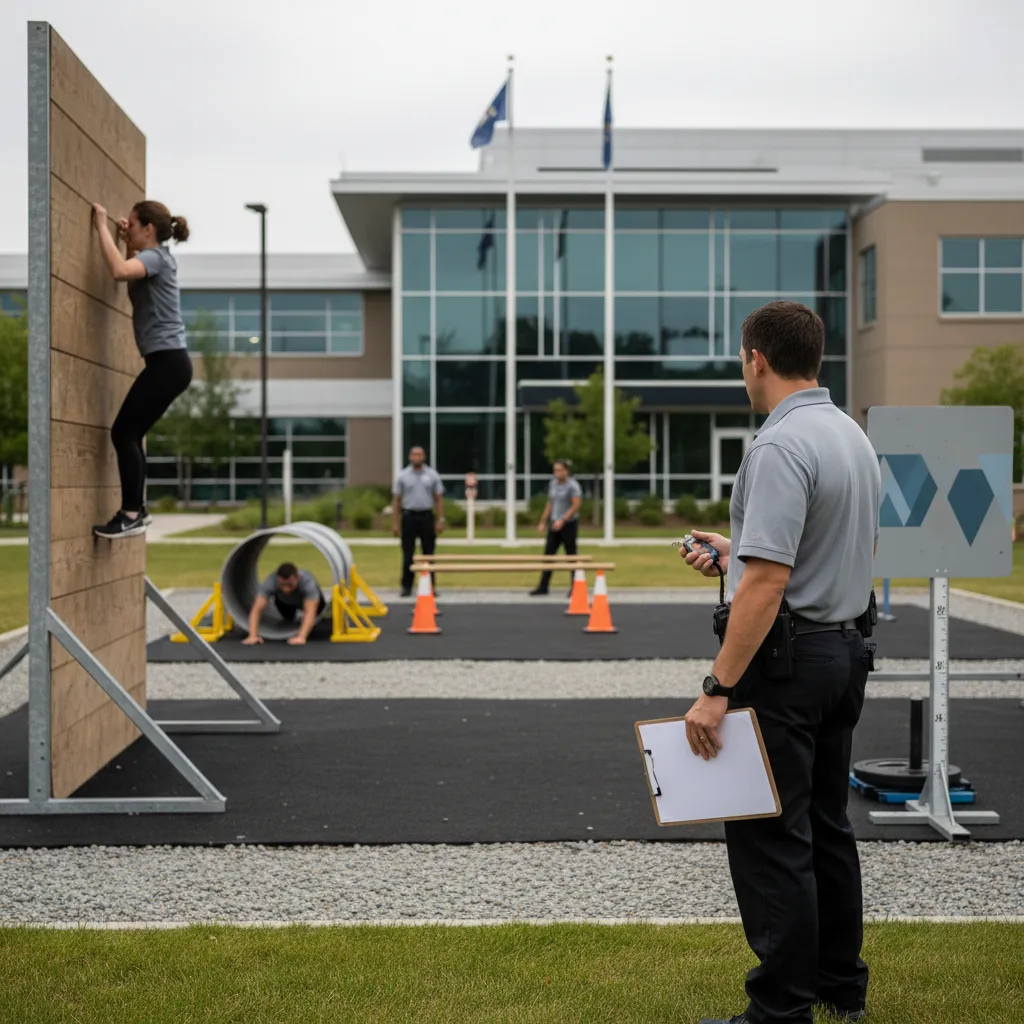
Physical fitness training for police academy admission requires a systematic approach that addresses the specific demands of academy evaluation rather than generic athletic goals. The swim test, where required, is one component of a broader physical agility battery that typically also includes a timed 1.5-mile run, a vertical jump measurement, a maximum push-up test, a sit-up or plank endurance test, and sometimes an obstacle course. Preparing for each of these components in isolation is far less effective than building a base of general cardiovascular and muscular endurance that transfers across all of them.
For swim-specific preparation, the 12-week periodization model used by competitive swimmers translates well to police academy swim test preparation. In weeks one through four, focus on technique: work with a coach or experienced swimmer to correct stroke mechanics, breathing patterns, and turns. Even modest technique improvements in this phase can reduce your 100-yard swim time by 20 to 40 seconds, which is a substantial margin relative to most departmental standards. Poor technique is the primary reason physically fit candidates fail swim tests — not lack of aerobic fitness.
In weeks five through eight, shift focus to building aerobic capacity with progressively longer continuous swim sets. If your target standard is a 100-yard continuous swim, your practice sessions should include sets of 200 to 400 continuous yards at a comfortable pace that you could sustain for 15 minutes. This training load ensures that the 100-yard requirement feels manageable rather than maximal on test day. Also practice water treading during this phase — it uses a different muscle recruitment pattern than forward swimming and requires its own conditioning.
In the final four weeks before your academy fitness evaluation, shift toward race-pace simulation. Practice swimming your target distance at the pace you will need to achieve, then rest briefly and repeat. Practice the complete test sequence — swim, tread, recover — as a single continuous session at least three times in this phase so that your body adapts to the specific demands of the evaluation rather than just isolated fitness components. Avoid heavy strength training or high-impact running in the final week before your fitness test to allow your neuromuscular system to recover and perform at its peak.
The mental component of both the swim test and the written exam deserves explicit attention in your preparation. Controlled breathing techniques — diaphragmatic breathing, box breathing, and progressive muscle relaxation — reduce acute anxiety responses that impair both physical performance and cognitive function under evaluation conditions. Practicing these techniques during your toughest study sessions and hardest swim workouts builds the psychological resilience you need to perform when it counts most.
Candidates who want to ensure their written test preparation is as thorough as possible should work through national police officer selection test practice questions that span all four NPOST sections in a realistic format. The most effective practice questions include detailed explanations for both correct and incorrect answer choices — not just an answer key — because understanding why a wrong answer is wrong prevents you from making the same reasoning error on the actual exam when the stakes are real.
Nutrition and sleep are performance factors that most candidates significantly underestimate in the weeks before both the written exam and the physical fitness evaluation. Sleep deprivation of even two hours per night over a week measurably impairs working memory, reaction time, and emotional regulation — all of which directly affect NPOST performance and physical coordination during swim tests. Aim for seven to nine hours of sleep per night in the final two weeks before any evaluation, and prioritize protein and complex carbohydrates in your diet to support both cognitive function and physical recovery between training sessions.
The final weeks of preparation before your NPOST exam and academy fitness evaluations should shift from building new skills to consolidating and performing what you have already developed. This consolidation phase is where many candidates make the strategic mistake of intensifying their preparation precisely when they should be tapering and optimizing. Adding new study materials in the final week rarely improves scores and often increases anxiety, while a focused review of previously covered material with adequate rest reliably produces better outcomes.
Create a final-week study schedule that dedicates no more than 90 minutes per day to NPOST review, prioritizing your historically weakest sections. If arithmetic has consistently pulled down your practice test scores, spend that 90 minutes on targeted arithmetic drills rather than re-reading grammar rules you already know. Use the final two days before the exam for light review only — 30 to 45 minutes maximum — focused on refreshing test-taking strategies and format familiarity rather than content acquisition.
On exam day, arrive at the testing center with enough time to check in, organize your materials, and settle your nerves before the proctor begins instructions. Most NPOST test centers open check-in 30 minutes before the scheduled start time. Arriving at least 20 minutes early eliminates the stress of rushing and gives you time to observe the testing environment, adjust to the temperature and lighting, and complete any administrative paperwork calmly. Bring your required identification documents, any permitted materials specified in your admission ticket, and a modest snack to consume during any scheduled break periods.
During the exam, manage your time by section rather than by individual question. Each section has a fixed time limit, so develop a feel for the pace required by completing enough practice tests that you internalize the rhythm. In the arithmetic section, for instance, you have exactly 60 seconds per question — if you find yourself spending more than 90 seconds on any single problem during the actual exam, circle it on your answer sheet and advance. Return after completing the remaining questions if time permits.
After the exam, document your experience while it is fresh in your memory — which question types felt easy, which felt difficult, which sections ran short on time. This information is invaluable if you need to retake the exam and is useful even if you pass, because it tells you where your cognitive strengths and gaps lie as you enter academy training. Officers who understand their own learning and performance profiles adapt more effectively to the demanding academic environment of a police academy, where material is presented rapidly and tested frequently.
For the physical side of your preparation, the final week before a swim test or physical agility battery should be a full taper week: reduce training volume by 40 to 50 percent compared to your peak training weeks, maintain intensity in two brief workouts to preserve neuromuscular readiness, and prioritize sleep and nutrition above all else. Your fitness is built in the previous 10 to 11 weeks — the final week is about letting your body absorb the training adaptations and arrive at the evaluation fully recovered rather than fatigued.
Long-term career success in law enforcement begins with a strong start in the competitive selection process. Candidates who approach both the national police officer selection test and the physical fitness evaluation with structured preparation, honest self-assessment, and disciplined execution of a well-designed training plan consistently outperform those who rely on raw ability alone. The investment of eight to twelve weeks of focused preparation before your exam and academy evaluation pays dividends not just in admission rates but in the confidence and readiness you bring to every challenge that follows in your law enforcement career.
Sample NPOST Police Test Practice Questions
Try these questions from our free NPOST Police Test practice tests. The correct answer and an explanation follow each question.
Officer Miller pulls over a driver for speeding. As he approaches, he recognizes the driver as an off-duty officer from a neighboring police department. The off-duty officer apologizes and asks if Officer Miller can give him 'a break.' What is the most ethical and professional action for Officer Miller to take?
- A. Let the off-duty officer go with a friendly verbal warning as a 'professional courtesy.'
- B. Issue a citation for the speeding violation, just as he would for any other citizen.
- C. Call his own supervisor to the scene to make the decision.
- D. Pretend to write a citation but then tell the officer he's letting him go.
Answer: B. Issue a citation for the speeding violation, just as he would for any other citizen.
The most ethical action is to enforce the law impartially, regardless of the violator's profession. Treating a fellow officer differently from other citizens undermines public trust and creates an appearance of impropriety. Calling a supervisor is an unnecessary escalation, and deceptive actions are unprofessional.
An officer is patrolling a residential area late at night, a location which has experienced a recent string of burglaries. The officer observes an individual dressed in all black, carrying a crowbar and a backpack, peering into the windows of a closed business. The legal standard that allows the officer to lawfully detain and question this individual is known as:
- A. A Mere Hunch
- B. Probable Cause
- C. Beyond a Reasonable Doubt
- D. Reasonable Suspicion
Answer: D. Reasonable Suspicion
Reasonable suspicion is the legal standard that allows a police officer to detain a person briefly for investigation if the officer has a reasonable belief, based on articulable facts, that criminal activity is afoot. The described scenario provides specific facts (time, location, recent crimes, clothing, crowbar, actions) that constitute reasonable suspicion, which is less than probable cause but more than a hunch.
Passage: 'An officer must complete 40 hours of training annually, with at least 8 hours in firearms.' The maximum non-firearms training hours allowed toward the requirement is:
- A. 8 hours
- B. 16 hours
- C. 32 hours
- D. 40 hours
Answer: C. 32 hours
With 8 of 40 hours required in firearms, up to 32 hours may be non-firearms.
All officers in the precinct must complete firearms training. Officer Lee has not completed firearms training. What can be logically concluded?
- A. Officer Lee is not in the precinct
- B. Officer Lee failed the training
- C. Officer Lee is a new recruit
- D. Officer Lee was given an exemption
Answer: A. Officer Lee is not in the precinct
If all precinct officers must complete the training and Lee has not, then Lee cannot be a precinct officer.
NPOST Questions and Answers

How Hard Is the Police Fitness Test? NPOST Difficulty, Requirements & Training Guide

Police Detective Test: Complete Guide to the National Police Officer Selection Test (NPOST) 2026

Police Psychological Exam Practice Test: Complete NPOST Study Guide 2026
NPOST - Police Test: Complete Study Guide 2026

Police Officer Tests: Complete Guide to the National Police Officer Selection Test (NPOST) in 2026
About the Author

Educational Psychologist & Academic Test Preparation Expert
Columbia University Teachers CollegeDr. Lisa Patel holds a Doctorate in Education from Columbia University Teachers College and has spent 17 years researching standardized test design and academic assessment. She has developed preparation programs for SAT, ACT, GRE, LSAT, UCAT, and numerous professional licensing exams, helping students of all backgrounds achieve their target scores.
Join the Discussion
Connect with other students preparing for this exam. Share tips, ask questions, and get advice from people who have been there.
View discussion (8 replies)