
Notario Público Cerca de Mí: How to Find a Trusted Notary Public Near You in 2026 October
⏳ Searching notario público cerca de mi? Learn what a notary public does, where to find one nearby, costs, ID needs, and free notary options in 2026 October.

If you have typed notario público cerca de mi into a search engine recently, you are not alone. Millions of Americans every year need a notary to witness a signature, confirm an identity, or stamp a document, and most have no idea where to begin. The good news is that finding a qualified notary near you is usually faster and cheaper than people expect, especially once you understand what a notary actually does and what kinds of documents they can legally certify in your state.
So what is a notary public? In the United States, a notary public is a state-commissioned official authorized to administer oaths, take acknowledgments, and verify the identity of people signing legal documents. The notary is not a lawyer, cannot give legal advice, and cannot translate documents. This is an important point for Spanish-speaking clients, because the Spanish term notario refers to a highly trained legal professional in Latin America, which is very different from the role in the U.S.
The most common places to find a notary near you include banks, shipping stores like UPS and FedEx, public libraries, county clerk offices, AAA branches, and pharmacies such as some CVS locations. Many people are surprised to learn that notario publico services are also offered by mobile notaries who travel to your home, hospital room, or office for a small additional fee, often within an hour of booking through an online platform.
Pricing varies by state. California, Florida, and New York cap notary fees by statute, with most charging between $5 and $15 per signature. Texas allows up to $10 per acknowledgment, while some states let notaries set their own price. Mobile notaries typically add a travel fee of $25 to $75. Always ask for the total cost upfront, including travel, waiting time, and any printing fees, so there are no surprises when the work is complete.
Before you walk into any notary appointment, gather a current government-issued photo ID, the unsigned document, and the names and contact information of any witnesses required by the document. Do not sign the document beforehand. The notary must observe the actual signing, or the notarization may be legally invalid. Bringing the wrong ID is the single most common reason appointments get rejected at the counter.
This guide will walk you through every step of finding the right notary for your situation, comparing free options with paid ones, understanding what a notary public can and cannot do, and making sure your document gets signed, sealed, and accepted on the first try. Whether you need a quick power of attorney or a complex real estate closing, you will leave with a clear plan and realistic cost expectations.
We will also cover Spanish-language notary services, how to verify a notary's commission online, what to expect at a bank, and how to spot red flags that a so-called notario is operating outside their legal authority. By the end, the search for a notario público cerca de mi will feel less stressful and a lot more straightforward.
Notary Services in the U.S. by the Numbers
Where to Find a Notary Public Near You
Most major banks including Bank of America, Chase, Wells Fargo, and local credit unions provide free notary services to account holders. Call ahead, as not every branch has a commissioned notary on duty every day, especially on weekends.
The UPS Store, FedEx Office, and many independent shipping centers offer walk-in notary services for around $10 to $25 per signature. These are convenient for evening and weekend hours when bank notaries are unavailable.
County clerk offices, public libraries, and city halls often provide free or very low-cost notary services. Hours can be limited, and some require appointments, but it is the cheapest reliable option in many cities.
Mobile notaries travel to your home, hospital, nursing home, or office. They typically charge a state-capped signature fee plus a travel fee between $25 and $75. Ideal for elderly clients, real estate closings, and after-hours needs.
Remote Online Notarization, or RON, lets you connect with a commissioned notary via video call from anywhere. Platforms like Notarize, DocuSign Notary, and OneNotary charge $25 to $35 per session and finish in under 15 minutes.
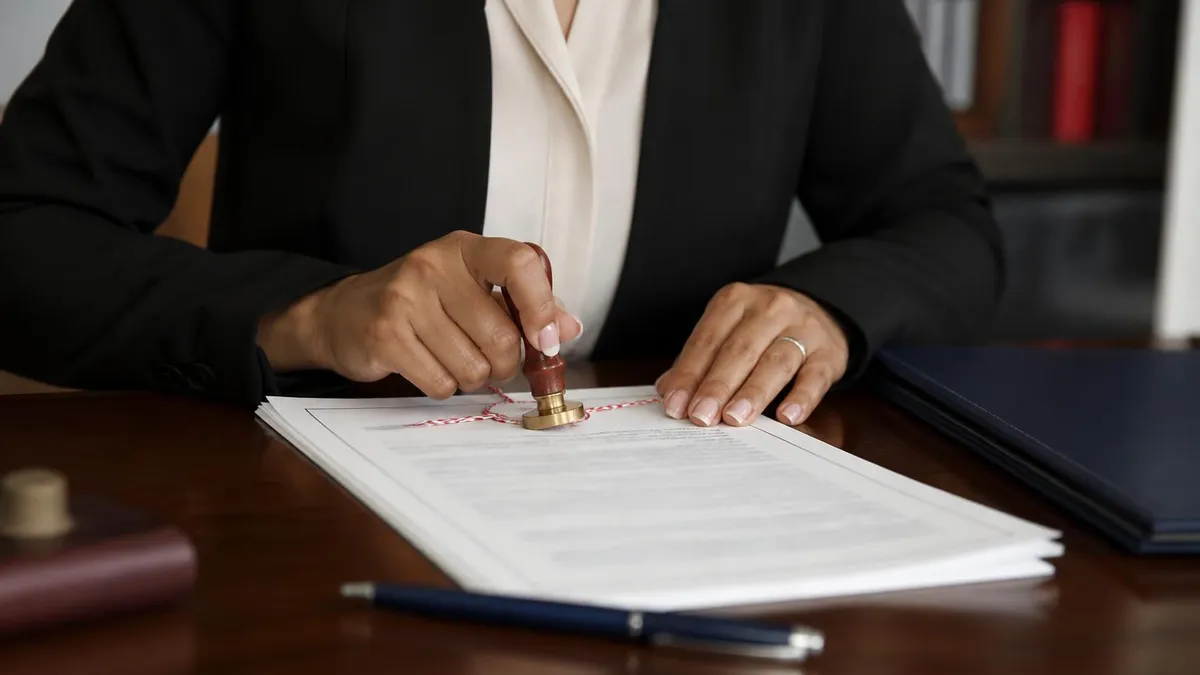
To understand why a notary public matters, it helps to know exactly what they verify. A notary's core job is to confirm three things: that the signer appeared in person, that the signer is who they claim to be, and that the signer appears willing and aware. The notary does not vouch for the truth of the document's contents. They only certify the act of signing, which is then sealed with a notary public stamp and recorded in the notary's official journal.
There are two primary types of notarial acts. An acknowledgment confirms that a person voluntarily signed a document, typically used for deeds, powers of attorney, and contracts. A jurat, by contrast, requires the signer to swear or affirm under oath that the contents of the document are true. Jurats are common for affidavits and sworn statements. Mixing up the two is a frequent error that can invalidate filings, so always ask which one your document requires.
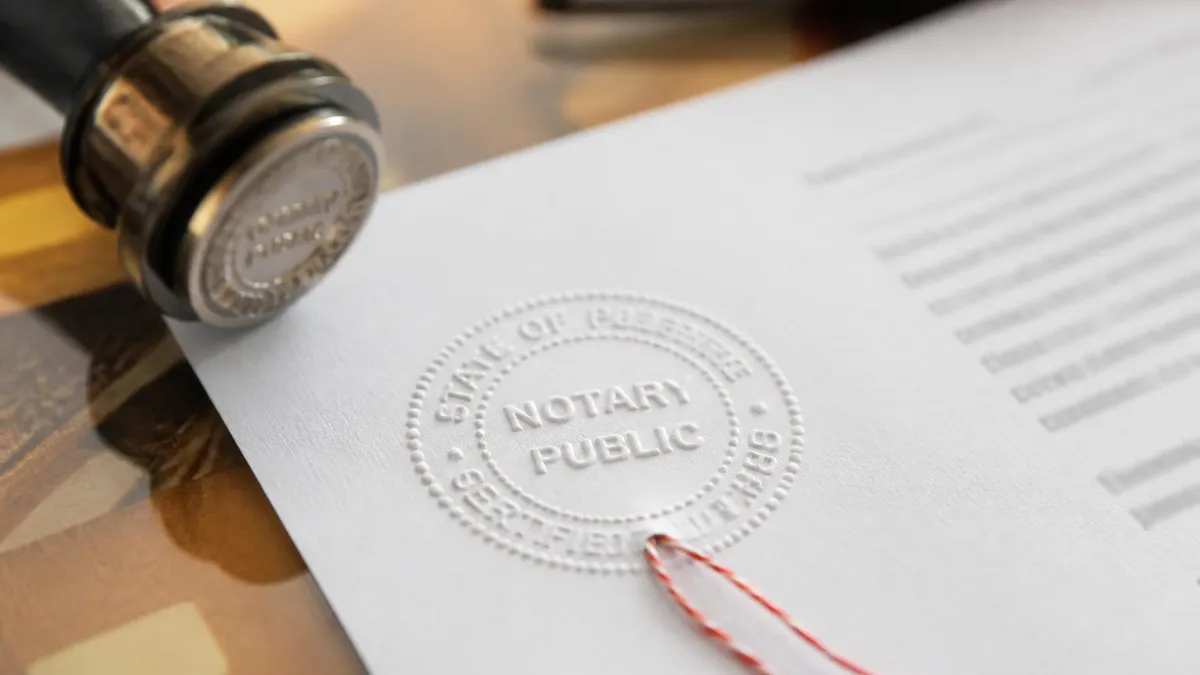
The notary public seal, also called the notary stamp, includes the notary's name, commission number, state, and expiration date. Some states require a raised embosser in addition to an ink stamp. The seal is what gives a document its presumed legal validity. If a document is missing the seal, or if any element of the seal is illegible, the document can be rejected by courts, banks, or recording offices, forcing you to start over.
Notaries cannot perform every type of certification. They cannot certify true copies of vital records like birth certificates or marriage licenses in most states. Those must come from the issuing government agency. They also cannot notarize a document that is blank, incomplete, or in a language the notary does not understand well enough to identify the document type. If the signer cannot communicate directly with the notary, the appointment must be rescheduled.
One of the most misunderstood limits is the prohibition on legal advice. A notary cannot tell you which type of acknowledgment to use, draft language for you, or explain the legal effect of what you are signing. Doing so would constitute the unauthorized practice of law, which carries serious penalties. If you have questions about the document itself, consult an attorney before your appointment. The notary's job begins and ends with verifying your identity and signature.
Notaries are also required to keep records. Most states mandate a bound journal that tracks every notarization with the date, document type, signer's name, ID used, and signature. This journal becomes essential evidence if the notarization is ever challenged in court. When you sign the journal, you are creating a permanent legal record that protects both you and the notary from future disputes about whether the signing actually took place.
Finally, remember that a notary's commission is geographic. A Texas-commissioned notary can only notarize within Texas, even if they happen to be visiting another state. If you need a document notarized while traveling, you must find a local notary. This rule applies even to mobile notaries, who can travel anywhere within their commissioning state but cannot cross state lines to perform notarizations.

Notary Public Practice Test Questions
Prepare for the Notary Public Exam exam with our free practice test modules. Each quiz covers key topics to help you pass on your first try.
Notary Public Basic Notary Public
Notary Public Exam Questions covering Basic Notary Public. Master Notary Public Test concepts for certification prep.
Notary Public Duties & Responsibilities of...
Free Notary Public Practice Test featuring Duties & Responsibilities of a Notary. Improve your Notary Public Exam score with mock test prep.
Notary Public Ethics & Professional Conduct
Notary Public Mock Exam on Ethics & Professional Conduct. Notary Public Study Guide questions to pass on your first try.
Notary Public Fraud Prevention & Security
Notary Public Test Prep for Fraud Prevention & Security. Practice Notary Public Quiz questions and boost your score.
Notary Public Identification & Credential ...
Notary Public Questions and Answers on Identification & Credential Verification. Free Notary Public practice for exam readiness.
Notary Public Jurats & Acknowledgments
Notary Public Mock Test covering Jurats & Acknowledgments. Online Notary Public Test practice with instant feedback.
Notary Public Notarial Acts & Procedures
Free Notary Public Quiz on Notarial Acts & Procedures. Notary Public Exam prep questions with detailed explanations.
Notary Public Notary Laws & Regulations
Notary Public Practice Questions for Notary Laws & Regulations. Build confidence for your Notary Public certification exam.
Notary Public MCQ
Notary Public Test Online for MCQ. Free practice with instant results and feedback.
Notary Public
Notary Public Study Material on Notary Public. Prepare effectively with real exam-style questions.
Notary Public Oaths & Affirmations
Free Notary Public Test covering Oaths & Affirmations. Practice and track your Notary Public exam readiness.
Notary Public Recordkeeping & Journal Entries
Notary Public Exam Questions covering Recordkeeping & Journal Entries. Master Notary Public Test concepts for certification prep.
Notary Public Exam Basic Notary Public
Free Notary Public Practice Test featuring Exam Basic Notary Public. Improve your Notary Public Exam score with mock test prep.
Notary Public Exam Duties & Responsibiliti...
Notary Public Mock Exam on Exam Duties & Responsibilities of a Notary. Notary Public Study Guide questions to pass on your first try.
Notary Public Exam Ethics & Professional C...
Notary Public Test Prep for Exam Ethics & Professional Conduct. Practice Notary Public Quiz questions and boost your score.
Notary Public Exam Fraud Prevention & Secu...
Notary Public Questions and Answers on Exam Fraud Prevention & Security. Free Notary Public practice for exam readiness.
Notary Public Exam Identification & Creden...
Notary Public Mock Test covering Exam Identification & Credential Verification. Online Notary Public Test practice with instant feedback.
Notary Public Exam Jurats & Acknowledgments
Free Notary Public Quiz on Exam Jurats & Acknowledgments. Notary Public Exam prep questions with detailed explanations.
Notary Public Exam Notarial Acts & Procedures
Notary Public Practice Questions for Exam Notarial Acts & Procedures. Build confidence for your Notary Public certification exam.
Notary Public Exam Notary Certificates & W...
Notary Public Test Online for Exam Notary Certificates & Wording. Free practice with instant results and feedback.
Notary Public Exam Notary Laws & Regulations
Notary Public Study Material on Exam Notary Laws & Regulations. Prepare effectively with real exam-style questions.
Notary Public Exam Notary Public
Free Notary Public Test covering Exam Notary Public. Practice and track your Notary Public exam readiness.
Notary Public Exam Notary Public MCQ
Notary Public Exam Questions covering Exam Notary Public MCQ. Master Notary Public Test concepts for certification prep.
Notary Public Exam Notary Seal & Stamp Req...
Free Notary Public Practice Test featuring Exam Notary Seal & Stamp Requirements. Improve your Notary Public Exam score with mock test prep.
Notary Public in Bank of America and Other Options
The notary public in bank of america is one of the most searched options because the service is free for account holders at most branches. Chase, Wells Fargo, Citibank, and PNC offer similar perks. Non-customers may be turned away or charged a small fee, so always call the specific branch first to confirm a notary is on duty.
Bank notaries typically handle simple acknowledgments only. They will refuse complex real estate packages, multi-page affidavits, or anything requiring witnesses they cannot provide. If your document is more than a few pages or involves property transfer, plan to use a mobile notary or title company instead of a bank counter.
Free Notary vs. Paid Mobile Notary: Which Is Right for You?
- +Free notaries at banks save $10 to $25 per signature for account holders
- +Public library and county clerk notaries are completely free in many cities
- +AAA members get free notarizations at most branch offices nationwide
- +Walk-in availability means no appointment scheduling for simple documents
- +Trusted institutional setting reduces fraud risk for vulnerable signers
- +No travel fees because you go to them during normal business hours
- −Limited hours, rarely open evenings or weekends when most people need them
- −Bank notaries often refuse complex packets like real estate or wills
- −Long wait times during lunch hours and end-of-month deadlines
- −Some branches only have one notary, who may be out sick or on vacation
- −No witnesses provided, so you must bring your own if document requires them
- −Cannot accommodate homebound clients, hospital signings, or after-hours emergencies
Pros and Cons at a Glance
| Pros | Cons |
|---|---|
| Public library and county clerk notaries are completely free in many cities | Limited hours, rarely open evenings or weekends when most people need them |
| AAA members get free notarizations at most branch offices nationwide | Bank notaries often refuse complex packets like real estate or wills |
| Walk-in availability means no appointment scheduling for simple documents | Long wait times during lunch hours and end-of-month deadlines |
| Trusted institutional setting reduces fraud risk for vulnerable signers | Some branches only have one notary, who may be out sick or on vacation |
| No travel fees because you go to them during normal business hours | No witnesses provided, so you must bring your own if document requires them |
What to Bring to Your Notary Public Appointment
- ✓A current, government-issued photo ID such as a driver's license, passport, or state ID
- ✓The complete document, unsigned, with every page included
- ✓Any required witnesses, with their own valid photo identification
- ✓Cash, card, or check to cover the notary fee, including travel charges if mobile
- ✓Knowledge of which notarial act you need: acknowledgment, jurat, or copy certification
- ✓Contact information for the receiving party in case the notary has format questions
- ✓A second form of ID if your primary ID is expired or missing key elements
- ✓Spelling of your name exactly as it appears on the ID, including middle names or suffixes
- ✓Translator or interpreter if you cannot communicate directly with the notary
- ✓Plenty of time, since complex packets and signature verification cannot be rushed
A U.S. notary is not the same as a Latin American notario.
In many Latin American countries, a notario is a highly trained attorney with broad legal authority. In the U.S., a notary public has narrow, ceremonial powers and cannot give legal advice, draft contracts, or represent you in immigration matters. Anyone advertising as a notario while offering legal services may be committing fraud. Always ask for a state-issued commission number and verify it on your secretary of state's website before paying for any service.
Notary fees in the United States are regulated at the state level, which means the maximum you can be charged for a single notarization varies dramatically depending on where you live. California allows up to $15 per signature, while notary public texas rules cap fees at $10 per acknowledgment and $6 per jurat. Florida permits $10 per notarial act, and New York keeps it low at just $2. Knowing your state's cap before you walk in protects you from being overcharged at storefront notary mills.
Beyond the basic notarization fee, expect additional costs for travel, document printing, after-hours service, and witnesses. A typical mobile notary visit in a metro area runs $50 to $125 all-in for a simple acknowledgment. Real estate loan signings cost $100 to $200 because the notary signing agent must be trained on lender packages, carry errors and omissions insurance, and complete dozens of pages with zero errors. Always request a written quote.
If cost matters, a quick search for free public notary near me will surface banks, credit unions, AAA offices, and some county libraries in your area. Most banks notarize for free if you have any account with them, even a basic savings account opened years ago. AAA members enjoy free notary services at most branch offices. Some employers, like large insurance companies and law firms, also keep a staff notary who will help employees at no cost during business hours.
Veterans and active military members have additional free options. Every U.S. military installation has a JAG office that provides free notarization for service members and their immediate family. The State Department also offers free notarial services at U.S. embassies and consulates abroad for American citizens, though appointments often need to be booked weeks in advance and can be subject to long wait times during busy travel seasons.
For Spanish-speaking communities, many notario publico services in the U.S. operate as paid storefronts charging $10 to $25 per signature. While most are legitimate, this is also where the most common consumer fraud occurs. A storefront calling itself a notaría and offering to help with immigration paperwork is almost certainly engaged in the unauthorized practice of law. Look instead for bilingual mobile notaries or community legal aid clinics that offer free or sliding-scale services.
One often-overlooked free option is the public library. Major systems in cities like Los Angeles, Chicago, Houston, and Phoenix offer free notary services to cardholders during specific hours each week. The service is staffed by trained librarians who hold notary commissions. Appointments fill quickly, so call several days in advance. Some libraries also notarize for non-cardholders for a nominal $5 fee, which is still well below storefront rates.
Finally, do not forget that some employers include free notarization as a workplace benefit. Banks, insurance companies, law firms, real estate brokerages, and government agencies often keep a commissioned notary on staff. Check your employee handbook or ask HR. Even if your company does not have one, a colleague in another department might be commissioned and willing to help during a lunch break, saving you both time and the cost of an outside appointment.
Storefronts advertising themselves as notarios often target Spanish-speaking immigrants with promises of legal help they are not authorized to provide. A U.S. notary cannot file immigration paperwork, give legal advice, or represent you in any proceeding. If anyone offers these services for a fee, walk away and report them to your state attorney general. Always verify a notary's commission number on your secretary of state's website before signing.
Notary fraud is unfortunately common, especially in communities where English is a second language or where signers are elderly, isolated, or unfamiliar with how U.S. notarization works. The single best protection is to verify the notary's commission before your appointment. Every state secretary of state maintains a public database where you can search by name, commission number, or county. A notary public in bank of america branch is verified by the bank, but for mobile or storefront notaries, the lookup is on you.
Red flags to watch for include a notary who offers to give legal advice, fill out forms for you, translate documents into English, or backdate a signing. Legitimate notaries will politely refuse all four of these requests every single time. Any willingness to bend the rules is a serious warning sign, both because it likely invalidates the notarization and because it suggests the notary may be willing to commit larger acts of fraud later, possibly involving your identity or finances.
Another red flag is being asked to sign a document the notary has not personally examined for completeness. A notary must visually confirm that the document is complete, free of blank spaces in critical fields, and not obviously fraudulent. If a notary stamps and signs a clearly incomplete document, walk away. That notarization will likely be challenged later and could expose you to financial or legal harm down the line if a fraudster fills in the blanks afterward.
Identity verification is the backbone of every notarial act. The notary will examine your photo ID for tampering, compare the photo to your face, and may ask security questions if the ID looks unfamiliar. Acceptable IDs typically include a driver's license, U.S. passport, state-issued ID, military ID, or in some states a permanent resident card. Expired IDs are usually rejected, though a few states allow IDs expired less than five years. Always bring a backup ID.
If you ever feel pressured to sign, leave. A notary is required to refuse the notarization if the signer appears coerced, confused, intoxicated, or unable to understand what they are signing. This protection exists specifically for vulnerable adults and elderly clients who may be targeted for elder fraud. Bring a trusted family member or friend to any appointment if you feel uncertain, and never let anyone else handle your ID, document, or signature for you.
For documents going to a foreign country, you may also need an apostille or authentication after notarization. An apostille is a certificate issued by your state's secretary of state that confirms the notary's signature is genuine. It is recognized by all countries that signed the 1961 Hague Convention. Countries not in the convention require a more complex authentication process. Always ask the receiving party in advance which version they need to avoid costly rework.
Finally, keep a copy of every notarized document, along with a note of the notary's name, commission number, and the date. If a dispute ever arises, this information lets you or your attorney quickly request a copy of the notary's journal entry, which serves as legally admissible evidence of the signing. A few minutes of recordkeeping on your end can save weeks of investigation later if your document is challenged in court or by a recording office.
Once you have found a trusted notary nearby, a little preparation makes the actual appointment fast and stress-free. Print your document on standard letter-size paper and bring every page, even pages that do not require a signature. Notaries need to see the full document to confirm it is complete. Leaving pages at home is a common reason appointments get rescheduled, costing you another trip and possibly another fee if you are using a mobile or paid notary.
Review the document yourself before you arrive. Look at where the notarial language appears, which is usually at the bottom of the last page or on a separate notary certificate. The language will indicate whether you need an acknowledgment or a jurat. If the document does not include notarial language at all, ask the receiving party which type they need before your appointment. A notary cannot pick for you, and the wrong certificate can invalidate the entire filing.
Practice signing your name exactly as it appears on your ID. If your ID says "Robert James Smith" but you usually sign "Bob Smith," the notary may require you to sign as "Robert James Smith" to match. This small detail trips up many first-time signers and can require additional notary public seal work later if the receiving party rejects the signature for inconsistency. Bring both your formal and informal signatures if you are uncertain which the document requires.
If your document requires witnesses, plan ahead. Witnesses must be adults, mentally competent, disinterested in the transaction, and able to provide their own photo identification. Family members, beneficiaries, or anyone named in the document usually cannot serve as witnesses. Some banks and shipping stores will not provide witnesses for liability reasons, so confirm in advance or bring your own. Mobile notaries often provide witnesses for an extra $10 to $25 each if you give them notice.
Arrive a few minutes early and turn off your phone. Notaries appreciate signers who are calm, attentive, and ready. They will administer any required oath, watch you sign, complete the notarial certificate, apply the seal, and ask you to sign their journal. The whole process for a single signature takes about 10 minutes. Multi-page packets or real estate closings can take 45 minutes to two hours, so plan your day accordingly and avoid booking back-to-back meetings.
After the notarization, double-check that the notary's stamp is clear, the date is correct, and the commission expiration is visible. A smudged stamp or missing date can cause the document to be rejected at the recording office, the bank, or the court. If anything looks off, ask the notary to re-stamp on a fresh page right then. Fixing it on the spot takes seconds. Fixing it later means scheduling another full appointment and possibly paying again.
Finally, store the original notarized document somewhere safe and scan a digital backup. Many people lose original notarized documents in moves or filing cabinets, only to discover they need them years later for a court case, immigration matter, or estate proceeding. A scanned PDF stored in cloud backup and a paper copy in a fireproof safe is the gold standard. The few minutes spent storing it properly today can save days of stress and hundreds of dollars in re-notarization fees in the future.
Sample Notary Public Exam Practice Questions
Try these questions from our free Notary Public Exam practice tests. The correct answer and an explanation follow each question.
What is the difference between a 'sworn statement' and an 'unsworn declaration'?
- A. There is no legal difference between the two
- B. A sworn statement is made under oath before an authorized official; an unsworn declaration declares truth under penalty of perjury without a formal oath
- C. An unsworn declaration has no legal validity
- D. A sworn statement is used only in federal courts
Answer: B. A sworn statement is made under oath before an authorized official; an unsworn declaration declares truth under penalty of perjury without a formal oath
A sworn statement requires an oath administered by an authorized official (like a notary); an unsworn declaration—authorized by federal law and many state laws—allows a person to declare the truth of a statement under penalty of perjury without an official oath.
A credible witness in notarial practice is someone who:
- A. Has witnessed more than 100 notarizations
- B. Is personally known to the notary and vouches for the signer's identity
- C. Is a licensed attorney present at the signing
- D. Has read the entire document being notarized
Answer: B. Is personally known to the notary and vouches for the signer's identity
A credible witness is someone personally known to the notary who can vouch for the identity of a signer who lacks acceptable ID.
Which ink color is most commonly recommended for a notary's rubber stamp to ensure the impression is distinguishable from a photocopy?
- A. Blue or purple ink, because it is clearly distinguishable from black-and-white photocopies
- B. Red ink, because it stands out the most
- C. Black ink only, as required by all states
- D. No ink preference exists — any color is equally acceptable in every state
Answer: A. Blue or purple ink, because it is clearly distinguishable from black-and-white photocopies
Blue or purple ink is widely recommended because it clearly shows the stamp is original and not a photocopy, though individual state rules may vary.
Should a notary stamp their seal on a document that still contains blank spaces?
- A. No, blank spaces create a fraud risk and must be filled in or lined through before the seal is affixed
- B. Yes, the seal is applied first and blanks are completed by the signer afterward
- C. Only if the signer specifically requests it
- D. Yes, because the seal serves as proof the blanks were intentional
Answer: A. No, blank spaces create a fraud risk and must be filled in or lined through before the seal is affixed
Notarizing a document with blank spaces is risky because information could be fraudulently inserted after the fact; blanks should be filled or crossed out before the seal is placed.
Notary Public Questions and Answers

About the Author

Notary Public Law Expert & State Notary Exam Specialist
Georgetown University Law CenterAttorney Sarah Williams is a licensed attorney and National Notary Association (NNA) certified notary with a Juris Doctor from Georgetown University Law Center. She has 13 years of experience in notarial law, document authentication, and real estate closings. Sarah coaches candidates through state notary public examinations, notary signing agent certification, and loan signing agent training programs.