
NCLEX Prep Course: Best Review Courses, Tutors, and Study Programs for 2026 June
Free NCLEX Prep Course: 🗨️ Best Review Courses, practice test with questions and answer explanations. Prepare for the 2026 June exam with instant scoring.
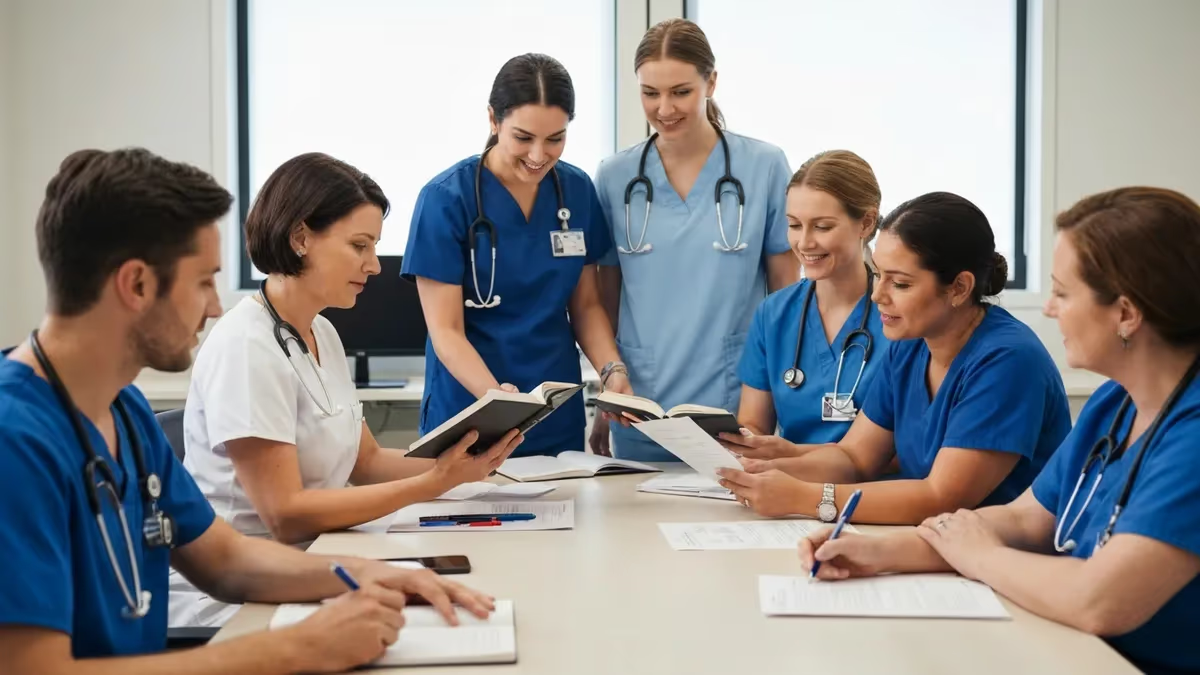
Choosing the right NCLEX prep course can feel overwhelming. Dozens of companies promise guaranteed results, and the prices range from free to several thousand dollars. Here's the truth: no single course works for everyone. Your learning style, your budget, and how much time you have before your test date all shape which option fits best. The good news? You don't have to guess. This guide breaks down everything — from self-paced online courses to working with an NCLEX tutor one-on-one.
The NCLEX-RN and NCLEX-PN exams test whether you can think like a nurse in real clinical situations. Memorizing facts isn't enough. You need to apply knowledge, prioritize patient care, and make judgment calls under pressure. That's why the best prep courses emphasize critical thinking and question strategy — not just content review. If you're searching for an NCLEX tutor near me, you'll want someone who understands this distinction.
Whether you're a first-time test-taker or retaking after a previous attempt, the right preparation makes a measurable difference. Pass rates for well-prepared candidates run significantly higher than the overall national average. This article covers course types, costs, what to look for in a tutor, and how to build a study plan that actually sticks. No fluff — just the practical, actionable information you need to pass.

When you search for an NCLEX tutor near me, you'll find a mix of independent tutors, tutoring companies, and nursing school faculty who moonlight as coaches. Independent tutors often charge $40-$100 per hour. Companies like Kaplan or UWorld offer structured tutoring packages that bundle content review with practice questions. Faculty tutors bring classroom experience but may not specialize in NCLEX-specific strategy.
Looking for NCLEX tutors near me in person? In-person options have shrunk since 2020, but they still exist in major metro areas. Many nursing schools partner with local tutoring centers that offer NCLEX review sessions. Check with your school's student services office — they often maintain lists of approved tutors. Community colleges with nursing programs sometimes run affordable prep workshops open to graduates from any school.
Online tutoring has become the dominant format for good reason. It's flexible, often cheaper, and gives you access to tutors who specialize specifically in NCLEX prep regardless of your location. Platforms like Wyzant and Varsity Tutors connect you with vetted NCLEX specialists. Most offer a free introductory session so you can gauge fit before committing. Don't skip that trial — chemistry with your tutor matters more than credentials on paper. A tutor who understands how you learn will accelerate your progress far faster than someone with better qualifications but a mismatched teaching style.
Finding the right NCLEX tutors near me is just one piece of the puzzle. A tutor for NCLEX works best when combined with a structured study plan and consistent practice questions. Think of tutoring as targeted intervention — you use it to address specific weak areas, not to replace your own study time. Most successful candidates spend 4-8 weeks preparing, with tutoring sessions once or twice a week.
NCLEX tutors who specialize in the exam understand something general tutors don't: the NCLEX uses computerized adaptive testing (CAT). That means the test adjusts difficulty based on your responses. Getting a harder question is actually a good sign. Your tutor should teach you how CAT works, how to recognize question difficulty levels, and how to avoid second-guessing yourself when questions feel impossibly hard.
What separates a great NCLEX tutor from a mediocre one? Content knowledge is baseline — every nursing tutor knows pharmacology and med-surg. The differentiator is test strategy. Great tutors teach you how to eliminate wrong answers systematically, how to identify what the question is really asking (the "stem"), and how to manage time and anxiety during the actual exam. Ask potential tutors about their approach to test strategy, not just their nursing background. A tutor who can't explain their method clearly probably won't explain NCLEX concepts clearly either.
Types of NCLEX Prep Courses
Self-paced courses from UWorld, Archer, and Kaplan let you study on your own schedule. UWorld is widely considered the gold standard for its question bank — over 2,100 questions with detailed rationales. Archer offers a more affordable alternative ($50-$80) with solid content and a pass guarantee. Kaplan provides a full curriculum with video lessons, practice tests, and decision trees. Self-paced works best if you're disciplined and don't need external accountability.
NCLEX tutoring near me searches have spiked over the past few years, and it's not hard to see why. The NCLEX-RN passing standard was raised in 2023, making the exam slightly harder than previous versions. Candidates who failed on their first attempt — or who feel underprepared — are increasingly turning to NCLEX tutoring as a way to close knowledge gaps and build confidence before retesting.
If you're considering tutoring after a failed attempt, don't just repeat what you did before. A good tutor will start by analyzing your NCLEX Candidate Performance Report (CPR) — the document you receive after failing that breaks down your performance by content area. Your CPR tells you exactly where you fell below the passing standard. Focus your tutoring sessions on those areas. Spreading your study time equally across all topics wastes effort on areas you've already mastered.
Group tutoring is another option worth considering. Some tutoring companies offer small-group sessions (3-6 students) at a lower per-person cost than private sessions. You still get instructor guidance and can learn from other students' questions. The trade-off is less individualized attention. Group sessions work well if your weak areas are common ones — pharmacology, prioritization, and delegation are topics most students struggle with.
Searching for an NCLEX RN tutor near me or an NCLEX refresher course? Refresher courses serve a specific audience — nurses who graduated months or years ago and haven't taken the exam yet, or those returning to nursing after a career break. These courses rebuild foundational knowledge before you layer on test strategy. Many state boards require a refresher course if too much time has passed since your nursing program graduation.
A tutor for NCLEX refresher scenarios typically covers pharmacology updates, current clinical guidelines, and any changes to the NCLEX test plan since you last studied. The NCLEX test plan updates every three years — the most recent version took effect in April 2023. If your nursing education predates that update, you'll want a tutor or course that covers the new Clinical Judgment Measurement Model (CJMM) and the updated question types it introduced.
Don't confuse refresher courses with remediation courses. Refresher courses are for people who haven't tested yet. Remediation is for people who've failed and need to address specific weaknesses identified in their Candidate Performance Report. Some programs combine both, but they serve different purposes. Make sure you're enrolling in the right type for your situation — wasting weeks in the wrong program costs time you can't afford. Ask the program coordinator directly whether their course targets first-time candidates or repeat test-takers before you sign up.
Pros and Cons of NCLEX Prep Courses
- +Structured study plans keep you accountable and on track through exam day
- +Expert instructors teach test-taking strategy you won't learn in nursing school
- +Practice question banks mirror real NCLEX format and difficulty levels
- +Many courses offer pass guarantees or money-back refund policies
- +Online options provide 24/7 access so you can study around work schedules
- +Peer communities in live courses reduce isolation and boost motivation
- −Premium courses cost $200-$2,000+ which strains already tight nursing budgets
- −Self-paced courses require strong self-discipline to complete without procrastinating
- −Some courses focus heavily on content review but neglect critical thinking skills
- −Live courses have rigid schedules that conflict with clinical rotations or jobs
- −Information overload from large question banks can increase anxiety rather than reduce it
- −Not all pass guarantees are meaningful — read the fine print on eligibility requirements
If you're looking for the best NCLEX prep classes near me, start by checking whether your nursing school offers post-graduation review sessions. Many programs include a free or discounted review course as part of their curriculum. Kaplan and Hurst both partner with nursing schools to offer on-campus reviews. These sessions are often the most affordable option available — some are even included in your tuition.
A tutor for NCLEX exam preparation isn't always expensive. Peer tutoring is an underutilized option. Recent NCLEX passers remember what worked, what tripped them up, and what the exam actually felt like. Some nursing school alumni groups organize free or low-cost peer study sessions. The quality varies widely, but the cost-to-benefit ratio is hard to beat. Just make sure your peer tutor passed on their first attempt — you want advice from someone who did it right.
Budget-conscious candidates should also explore free resources before committing to paid courses. Khan Academy, YouTube nursing channels like RegisteredNurseRN, and free question banks like NCSBN's official practice exam offer substantial study material at no cost. Combine free resources with targeted tutoring for weak areas, and you can build an effective study plan without spending a fortune. Smart preparation doesn't require an expensive course — it requires the right course for your needs. Start with free options, identify your gaps, and invest money only where it will make the biggest difference in your weak areas.
NCLEX Study Plan Checklist
- ✓Register for NCLEX through Pearson VUE and confirm your ATT (Authorization to Test)
- ✓Take a diagnostic practice exam to identify your strongest and weakest content areas
- ✓Choose a prep course or tutor based on your learning style, budget, and timeline
- ✓Create a 4-8 week study schedule with specific daily goals and rest days built in
- ✓Complete at least 100-150 practice questions per day during your final 2 weeks
- ✓Review all wrong answers thoroughly — understand why each wrong choice is wrong
- ✓Focus extra time on pharmacology, prioritization, and delegation (common weak areas)
- ✓Take at least 2 full-length timed practice exams to build stamina and pacing
- ✓Practice the new Clinical Judgment question types (bowtie, drag-and-drop, matrix)
- ✓Schedule your test date and do a light review — not cramming — the day before
An NCLEX PN prep course follows the same general structure as RN prep but covers different content domains. The NCLEX-PN focuses on coordinated care, safety and infection control, pharmacology, and basic nursing care. PN-specific prep courses from providers like Archer and Kaplan tailor their content to the PN test plan. Don't use an RN prep course for PN preparation — the emphasis areas differ significantly enough to matter.
NCLEX tutor jobs have grown as demand for private tutoring increases. If you're a nurse who passed the NCLEX and enjoy teaching, tutoring can be a rewarding side career. Rates for experienced NCLEX tutors range from $50-$150 per hour depending on your track record and specialization. Most tutors work independently through platforms like Wyzant, though some join tutoring companies that handle marketing and scheduling.
Whether you're hiring a tutor or becoming one, the NCLEX tutoring market is growing because the stakes are high. A failed attempt costs $200 in retake fees, delays your nursing career by weeks or months, and takes an emotional toll. Investing in quality preparation — whether that's a course, a tutor, or both — pays for itself many times over when you pass on your first try. Your nursing career starts the moment you pass. Every dollar and hour spent on solid prep brings that moment closer.
Many candidates search for tutors for NCLEX after a failed first attempt, and that's actually one of the smartest moves you can make. A remedial course for NCLEX RN is sometimes required by state boards before you can retake the exam. Florida, California, and Texas all have specific remediation requirements — check your state board's rules before scheduling your retest. Some states require a formal course; others accept documented self-study with a tutor.
Remediation programs typically run 2-6 weeks and focus heavily on the content areas flagged in your CPR. Programs like Feuer Nursing Review and Achieve Test Prep specialize in NCLEX remediation and have strong track records with repeat test-takers. Costs range from $300-$1,500 depending on the program length and whether tutoring is included. If your nursing school offers remediation support, start there — it's usually the cheapest option.
Don't let shame about a failed attempt prevent you from getting help. NCLEX first-time pass rates hover around 87% for RN and 83% for PN — that means thousands of candidates fail each testing cycle. Failure isn't a reflection of your nursing ability. It's a signal that your test preparation strategy needs adjustment. Get the right support, target your weak areas, and you'll be well-positioned to pass on your next attempt.
If you fail the NCLEX, you must wait 45 days before retaking the exam. Use this time productively — don't just repeat your previous study plan. Analyze your Candidate Performance Report, address specific weaknesses, and consider working with a tutor or enrolling in a remediation course. Some states limit the number of retake attempts (typically 3-8), so make each attempt count with better preparation.
Wondering about NCLEX Khan Academy resources? Khan Academy doesn't offer a dedicated NCLEX course, but their free health and medicine content covers anatomy, physiology, and pharmacology fundamentals that support NCLEX preparation. It's a solid free supplement — not a replacement — for a structured prep course. Use it to shore up foundational science knowledge if that's where you're weakest.
The NCLEX Crusade 7 day training is a popular intensive program that condenses NCLEX prep into one week. Programs like this appeal to candidates who learn best through immersion and want to avoid months of slow-burn studying. The intensity can be effective — some candidates report feeling sharper and more confident after a week-long boot camp. But it's not ideal if you have major content gaps. Seven days isn't enough to learn material from scratch. It works best as a final push after weeks of prior study.
Short-term intensive programs have another advantage: they build momentum. After a week of focused daily study, you've built a routine and a knowledge base that carries into your remaining prep time. Many candidates use a 7-day program to kickstart their preparation, then continue with self-study or tutoring for another 3-4 weeks before their test date. This hybrid approach combines the motivation of a structured program with the flexibility of independent study. It's the best of both worlds for candidates who want structure without a months-long commitment.
NCLEX Practice Test Questions
Prepare for the NCLEX - National Council Licensure Examination exam with our free practice test modules. Each quiz covers key topics to help you pass on your first try.
NCLEX Basic Care and Comfort
NCLEX Exam Questions covering Basic Care and Comfort. Master NCLEX Test concepts for certification prep.
NCLEX Coordination of Care
Free NCLEX Practice Test featuring Coordination of Care. Improve your NCLEX Exam score with mock test prep.
NCLEX Medical Surgical Nursing
NCLEX Mock Exam on Medical Surgical Nursing. NCLEX Study Guide questions to pass on your first try.
NCLEX Medical Surgical Nursing Questions a...
NCLEX Test Prep for Medical Surgical Nursing Questions and Answers. Practice NCLEX Quiz questions and boost your score.
NCLEX Health Promotion and Maintenance
NCLEX Questions and Answers on Health Promotion and Maintenance. Free NCLEX practice for exam readiness.
NCLEX Management of Care
NCLEX Mock Test covering Management of Care. Online NCLEX Test practice with instant feedback.
NCLEX Exam: Nursing Prioritization, Delega...
Free NCLEX Quiz on Exam: Nursing Prioritization, Delegation and Assignment. NCLEX Exam prep questions with detailed explanations.
NCLEX-PN Test
NCLEX Practice Questions for NCLEX-PN Test. Build confidence for your NCLEX certification exam.
NCLEX-PN Test #10
NCLEX Test Online for NCLEX-PN Test #10. Free practice with instant results and feedback.
NCLEX-PN Test #1
NCLEX Study Material on NCLEX-PN Test #1. Prepare effectively with real exam-style questions.
NCLEX-PN Test #11
Free NCLEX Test covering NCLEX-PN Test #11. Practice and track your NCLEX exam readiness.
NCLEX-PN Test #12
NCLEX Exam Questions covering NCLEX-PN Test #12. Master NCLEX Test concepts for certification prep.
NCLEX-PN Test #13
Free NCLEX Practice Test featuring NCLEX-PN Test #13. Improve your NCLEX Exam score with mock test prep.
NCLEX-PN Test #14
NCLEX Mock Exam on NCLEX-PN Test #14. NCLEX Study Guide questions to pass on your first try.
NCLEX-PN Test #15
NCLEX Test Prep for NCLEX-PN Test #15. Practice NCLEX Quiz questions and boost your score.
NCLEX-PN Test #16
NCLEX Questions and Answers on NCLEX-PN Test #16. Free NCLEX practice for exam readiness.
NCLEX-PN Test #17
NCLEX Mock Test covering NCLEX-PN Test #17. Online NCLEX Test practice with instant feedback.
NCLEX-PN Test #18
Free NCLEX Quiz on NCLEX-PN Test #18. NCLEX Exam prep questions with detailed explanations.
NCLEX-PN Test #19
NCLEX Practice Questions for NCLEX-PN Test #19. Build confidence for your NCLEX certification exam.
NCLEX-PN Test #20
NCLEX Test Online for NCLEX-PN Test #20. Free practice with instant results and feedback.
NCLEX-PN Test #2
NCLEX Study Material on NCLEX-PN Test #2. Prepare effectively with real exam-style questions.
NCLEX-PN Test #22
Free NCLEX Test covering NCLEX-PN Test #22. Practice and track your NCLEX exam readiness.
NCLEX-PN Test #23
NCLEX Exam Questions covering NCLEX-PN Test #23. Master NCLEX Test concepts for certification prep.
NCLEX-PN Test #24
Free NCLEX Practice Test featuring NCLEX-PN Test #24. Improve your NCLEX Exam score with mock test prep.
NCLEX-PN Test #3
NCLEX Mock Exam on NCLEX-PN Test #3. NCLEX Study Guide questions to pass on your first try.
NCLEX-PN Test #4
NCLEX Test Prep for NCLEX-PN Test #4. Practice NCLEX Quiz questions and boost your score.
NCLEX-PN Test #5
NCLEX Questions and Answers on NCLEX-PN Test #5. Free NCLEX practice for exam readiness.
NCLEX-PN Test #6
NCLEX Mock Test covering NCLEX-PN Test #6. Online NCLEX Test practice with instant feedback.
NCLEX-PN Test #7
Free NCLEX Quiz on NCLEX-PN Test #7. NCLEX Exam prep questions with detailed explanations.
NCLEX-PN Test #8
NCLEX Practice Questions for NCLEX-PN Test #8. Build confidence for your NCLEX certification exam.
NCLEX-PN Test #9
NCLEX Test Online for NCLEX-PN Test #9. Free practice with instant results and feedback.
NCLEX Practice Exam
NCLEX Study Material on Practice Exam. Prepare effectively with real exam-style questions.
NCLEX-RN Practice Test
Free NCLEX Test covering NCLEX-RN Practice Test. Practice and track your NCLEX exam readiness.
NCLEX-RN Practice Test #12
NCLEX Exam Questions covering NCLEX-RN Practice Test #12. Master NCLEX Test concepts for certification prep.
NCLEX Select All That Apply Practice Exam
Free NCLEX Practice Test featuring Select All That Apply Practice Exam. Improve your NCLEX Exam score with mock test prep.
NCLEX Nursing Process
NCLEX Mock Exam on Nursing Process. NCLEX Study Guide questions to pass on your first try.
NCLEX Pharmacological and Parenteral Thera...
NCLEX Test Prep for Pharmacological and Parenteral Therapies. Practice NCLEX Quiz questions and boost your score.
NCLEX Physiological Integrity
NCLEX Questions and Answers on Physiological Integrity. Free NCLEX practice for exam readiness.
NCLEX Psychosocial Integrity
NCLEX Mock Test covering Psychosocial Integrity. Online NCLEX Test practice with instant feedback.
What are the best NCLEX prep courses overall? It depends on what you need. For question banks, UWorld dominates — their rationales are unmatched. For content review, Hurst and Kaplan provide the most thorough coverage. For affordability, Archer and SimpleNursing offer strong value. For tutoring, Wyzant and independent specialists give you personalized attention. No single course excels at everything, which is why many successful candidates combine two resources.
If you need an NCLEX remedial course Florida specifically, check with the Florida Board of Nursing for approved providers. Florida requires candidates who fail twice to complete a board-approved remediation course before their third attempt. Providers like Feuer Nursing Review (based in Miami) specialize in Florida remediation and understand the state's specific requirements. Other states have similar rules — always verify with your state board before enrolling in any remediation program.
The bottom line: your NCLEX prep course should match your learning style, timeline, and budget. Don't choose based on marketing alone. Read reviews from recent test-takers. Ask nursing school alumni what worked for them. Take advantage of free trials and sample questions before committing money. The right preparation feels challenging but manageable — if a course feels overwhelming or too easy, it's probably not the right fit for where you are right now.
NCLEX Questions and Answers
NCLEX Exam Tips: Proven Strategies to Pass RN and PN on Your First Try

NCLEX Exam Prep: Study Strategies That Actually Work for RN and PN

NCLEX Practice Tests: Free Questions to Build Your Confidence
Pearson VUE NCLEX 2026: Registration, Scheduling & Quick Results
What Is the NCLEX? Everything You Need to Know About the Nursing Exam
About the Author
Registered Nurse & Healthcare Educator
Johns Hopkins University School of NursingDr. Sarah Mitchell is a board-certified registered nurse with over 15 years of clinical and academic experience. She completed her PhD in Nursing Science at Johns Hopkins University and has taught NCLEX preparation and clinical skills courses for nursing students across the United States. Her research focuses on evidence-based exam preparation strategies for healthcare certification candidates.
Join the Discussion
Connect with other students preparing for this exam. Share tips, ask questions, and get advice from people who have been there.
View discussion (4 replies)