
NCLEX Pass Rates: RN & PN Statistics by State and School 2026 October
Get ready for your NCLEX Pass Rates: RN & PN Statistics by certification. Practice questions with step-by-step answer explanations and instant scoring. 📚
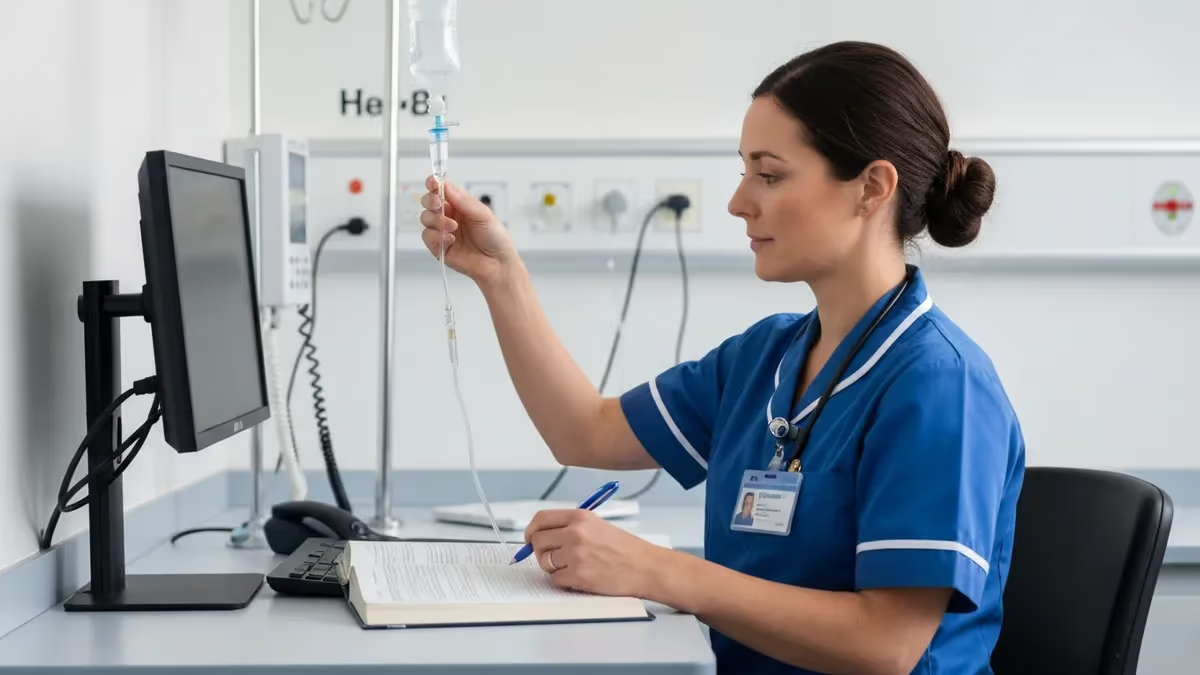
The NCLEX pass rates tell you exactly where you stand before exam day. In 2026, US-educated first-time RN candidates passed at 82.8% — a number that's been sliding since the 88.6% peak in 2019. That drop isn't random. The Next Generation NCLEX format, launched in April 2023, introduced Clinical Judgment Measurement Model case studies that test reasoning, not just recall. If you're preparing now, you need to understand what these numbers actually mean for your chances. NCLEX pass rates vary wildly depending on your state, your nursing program, and whether you're a first-time or repeat test-taker.
Why do NCLEX pass rates California hover around 72% while Minnesota hits 89%? It's not that California nurses are worse — it's that the state data includes a massive pool of internationally educated and repeat candidates who drag the average down. First-attempt domestic graduates in states like California actually perform close to the national average. The difference is in how each state's board reports the numbers.
Here's what matters: your individual preparation trumps every statistic on this page. Candidates who complete 2,000+ practice questions with rationale review pass at rates 15-20 points above the baseline. The data isn't destiny — it's a starting point. Whether you're eyeing the NCLEX-RN or NCLEX-PN, the strategies that move your odds are concrete and measurable. We'll break down every angle — state-by-state data, school rankings, question-count probabilities, and the exact study moves that shift your pass rate from average to near-certain.

State-level data reveals a huge gap in NCLEX pass rates California versus Midwest states. California's overall rate sits near 72%. That sounds alarming — until you realize the state processes more internationally educated nursing graduates than any other. Domestic first-timers from UC programs (UCLA, UCSF) regularly clear 90%. The statewide average gets pulled down by volume, not by quality.
If you're researching NCLEX pass rates news, you'll notice this pattern repeating in every NCSBN quarterly report: states with large immigrant nursing pipelines show lower aggregate rates but strong domestic performance. NCLEX pass rates California data from the Board of Registered Nursing breaks this down program by program.
Texas tells a similar story. The state's ~75% overall rate masks a first-attempt domestic rate closer to 83%. Florida's ~76% reflects an enormous number of accredited programs — over 1,200 — with wide quality variance. Meanwhile, Midwest states like Iowa (88%), Wisconsin (87%), and Nebraska (87%) benefit from smaller candidate pools, predominantly BSN-educated test-takers, and strict program accreditation standards. These aren't secrets. They're structural differences in how each state's nursing education pipeline operates.
Don't let a low state average psych you out. Your program's individual pass rate matters far more than your state's aggregate number. Every state board of nursing publishes school-level results annually — find yours and compare it against the 82.8% national benchmark.
When you compare NCLEX pass rates by school, the gap between top-tier university programs and for-profit accelerated schools is striking. Joyce University NCLEX pass rates have improved in recent years under ACEN oversight, but still trail behind research universities with clinical hospital partnerships. Johns Hopkins consistently hits 95-98%. Duke clears 97%. UPenn stays above 95%. These programs share common traits: small cohort sizes, embedded simulation labs, mandatory predictor exams before graduation clearance, and direct clinical placement in teaching hospitals. NCLEX pass rates news from NCSBN confirms that CCNE-accredited BSN programs outperform unaccredited ones by 8-12 percentage points.
Community college ADN programs land in the 80-88% range — solid but below BSN averages. The cost tradeoff is real, though. An ADN program at a community college costs a fraction of a BSN, and the pass rate difference is often only 4-6 points. If you're price-sensitive, a strong ADN program with a high pass rate is a smart path. Check your state board's published school-level data before committing. Some ADN programs quietly match or beat local BSN programs.
For-profit nursing schools are the wildcard. Pass rates swing from 60% to 85% depending on the institution. Programs on probation — meaning they've dipped below 80% for two consecutive years — appear on state board warning lists. Avoid those. Your tuition dollars should buy you a program that's proven it can prepare graduates to pass.
NCLEX Pass Rates by State — Detailed Breakdown
States with the strongest first-attempt NCLEX pass rates share common traits: rigorous accreditation, mandatory readiness assessments, and low student-to-faculty ratios.
| State | NCLEX-RN Rate (Est. 2026) |
|---|---|
| Minnesota | ~89% |
| Iowa | ~88% |
| Wisconsin | ~87% |
| Nebraska | ~87% |
| South Dakota | ~86% |
| North Dakota | ~86% |
| Vermont | ~85% |
| New Hampshire | ~85% |
Smaller class sizes and strong BSN infrastructure are the common denominators here.
Looking at NCLEX pass rates by state only tells part of the story. You also need to factor in the year. NCLEX pass rates 2025 data showed the first full-year impact of NGN scoring — a 2.1-point dip from pre-NGN baselines for RN candidates and a 1.8-point dip for PN candidates. The clinical judgment items caught programs off guard. Many hadn't updated their curricula fast enough to teach bow-tie, matrix, and cloze item formats. By 2026, most accredited programs had adjusted, and rates stabilized near 82-83% for RN.
Historical context matters here. The NCLEX-RN pass rate peaked at 88.6% in 2019, dropped during COVID disruptions in 2020-2021 (clinical site closures, virtual clinicals, delayed testing), and has hovered in the low-to-mid 80s since. The trendline isn't catastrophic — it's a reflection of a harder exam format filtering out candidates who relied on rote memorization. The NGN rewards critical thinking. Period.
If you're testing in 2026 or 2027, the numbers you'll face are roughly what they've been for the past two years. There's no upcoming format change announced. The passing standard was last adjusted in December 2022, and NCSBN reviews it on a three-year cycle. Expect stability — and use that stability to build a study plan around known question types rather than worrying about moving targets.
The NCLEX pass rates Florida by school data reveals a wide spread. Top programs like the University of Miami and University of Florida clear 92-95% on first attempts. But smaller, for-profit programs in the Tampa Bay and South Florida markets sometimes dip below 70%. Florida's Board of Nursing publishes these figures every year — they're public record and freely searchable. If a program won't share its pass rate data, that's a red flag. NCLEX-RN pass rates are the single best predictor of program quality, and any school worth attending will display them prominently.
Joyce University NCLEX pass rates have become a case study in institutional improvement. After facing scrutiny for sub-80% rates, the school implemented mandatory ATI predictor benchmarks before graduation clearance and restructured its clinical rotation partnerships. Recent cohorts have shown measurable improvement. It's worth noting that institutional turnaround is possible — but verify the data yourself through the state board, not through the school's marketing.
Don't overlook ADN-to-BSN bridge programs. These don't directly affect your NCLEX pass rate since you take the exam after completing the ADN, but the additional clinical training in a BSN program can strengthen your foundation if you're borderline. Some employers now require BSN completion within five years of hire, making the bridge program both a career investment and indirect pass-rate booster.
BSN vs ADN Programs: Pass Rate Factors
- +BSN programs average 84% first-attempt pass rate vs 79% for ADN
- +CCNE accreditation correlates with 8-12 point higher pass rates
- +Hospital clinical placements give BSN grads real-world NGN readiness
- +BSN grads qualify for more employer positions and higher starting pay
- +Simulation labs in BSN programs mirror actual NCLEX item formats
- +Research exposure builds the critical thinking NGN rewards
- −BSN programs cost 3-5x more than community college ADN programs
- −ADN programs take 2 years vs 4 years for BSN — faster to licensure
- −Strong ADN programs in some states match BSN pass rates
- −BSN doesn't guarantee passing — individual study habits matter more
- −Rural areas have fewer BSN options, making ADN the only local path
- −ADN-to-BSN bridge programs let you work while completing the degree
The NCLEX Texas pass rates picture mirrors what we see nationally — with a twist. Texas processes the second-largest candidate volume after California, and its ~75% aggregate rate reflects an enormous mix of program types. The state has over 200 Board-approved nursing programs, ranging from elite university BSN tracks at UT Austin and Texas A&M (both above 90%) to small for-profit programs hovering near probationary thresholds. If you're in Texas, your program choice matters more than anywhere else because the variance is so wide.
NCLEX exam pass rates also shift based on when you test relative to graduation. NCSBN data consistently shows that candidates who sit within 45 days of completing their program pass at significantly higher rates — sometimes 10+ points above those who wait six months or longer. Knowledge decay is real. The clinical judgment skills you practiced during rotations start fading quickly without active reinforcement. Don't delay your testing date thinking more time equals more preparation. It usually doesn't.
Repeat candidates face the steepest odds. The second-attempt RN pass rate is 43.1%. Third attempt? Even lower. If you've already failed once, don't retake the exam using the same study approach. Switch to an adaptive question bank — one that adjusts difficulty like the actual CAT algorithm — and focus exclusively on the content areas where your diagnostic scores are weakest. Shotgun studying doesn't work for retakes.
10-Point NCLEX Pass Rate Checklist
- ✓Complete 2,000+ practice questions with detailed rationale review before exam day
- ✓Use NGN-format items — bow-tie, matrix, cloze, and highlight types — not just multiple choice
- ✓Score 70%+ on ATI Comprehensive Predictor or equivalent readiness assessment
- ✓Schedule your exam within 45 days of graduation to maximize knowledge retention
- ✓Track weak domains using practice test analytics and spend 60% of study time there
- ✓Simulate full 5-hour exam conditions at least 3 times in your final 2 weeks
- ✓Choose a CCNE or ACEN-accredited program — accreditation correlates with higher pass rates
- ✓Review CJMM clinical judgment case studies daily during your final prep month
- ✓Verify your nursing program's published pass rate against the 82.8% national benchmark
- ✓If retaking, switch to an adaptive question bank and target your weakest content areas only
Historical trends reveal interesting patterns. NCLEX pass rates 2024 represented the last pre-stabilization year after the NGN rollout. Rates had dipped to their lowest point since 2015, and nursing education programs were scrambling to retool their curricula. By 2025, most CCNE-accredited schools had integrated NGN-style items into their coursework, and pass rates rebounded 1-2 points. The lesson? System-level changes take 12-18 months to work through the pipeline. If you graduated from a program that adopted NGN prep early, you benefited. If your program lagged, you felt it in your score.
Illinois NCLEX pass rates sit right at the national average — around 82-83% for first-attempt RN candidates. Illinois benefits from strong BSN programs at University of Illinois Chicago, Loyola, and Rush, balanced against a smaller for-profit sector compared to states like Florida or California. The state board publishes annual data by program, and you can access it through the Illinois Department of Financial and Professional Regulation website. NCLEX pass rates by school data from Illinois shows that programs requiring ATI predictor benchmarks before graduation clearance consistently outperform those that don't.
One often-overlooked factor: testing location doesn't affect your questions. Pearson VUE administers the same adaptive algorithm regardless of which state you test in. Your results go to the state board where you applied for licensure, but the exam content is identical nationwide. Don't relocate to a "high pass rate state" thinking the test is easier there — it isn't.
New York state NCLEX pass rates have hovered around 74% in recent reports — placing the state among the lower-performing aggregates nationally. But context matters. New York processes the third-largest candidate volume in the country and has a significant internationally educated nursing population. First-attempt domestic graduates from schools like NYU, Columbia, and University of Rochester regularly clear 90%. The statewide number is a blended figure that obscures strong domestic performance.
RN pass rates specifically have been the focus of NCSBN's ongoing research into the NGN's impact. Their 2025 report found that Clinical Judgment items — particularly the matrix and bow-tie formats — accounted for the largest score variance between passing and failing candidates. In other words, if you can master those item types, you're likely to pass. If you can't, even strong performance on traditional multiple-choice won't save you. The weighting has shifted, and your study plan needs to shift with it.
For PN candidates, the picture is slightly rosier. The NCLEX-PN first-attempt rate of 84.4% exceeds the RN rate by 1.6 points. The PN exam covers a narrower scope of practice — fewer pharmacology calculations, less complex pathophysiology — and uses the same CAT algorithm but with content weighted toward practical nursing competencies. If you're debating between RN and PN licensure, the pass rate difference alone shouldn't drive your decision. Your career goals should.
If you've failed the NCLEX, don't rebook using the same study materials. Second-attempt RN candidates pass at only 43.1% — and that rate drops further on third and fourth attempts. Switch to an adaptive question bank that mirrors the CAT algorithm, identify your two weakest content domains using your Candidate Performance Report, and focus 80% of your prep time there. Waiting longer doesn't help — knowledge decays. Rebook within 45 days with a new plan.
Drilling into specific states further, IL NCLEX pass rates and NCLEX Illinois pass rates both refer to the same dataset published by the Illinois DFPR. The state's 82-83% aggregate places it squarely at the national mean. What sets Illinois apart is its concentration of strong BSN programs in the Chicago metro area — Rush, Loyola, UIC, and Northwestern's ABSN track all report above 90% first-attempt rates. Downstate programs tend to be ADN-focused with rates in the 78-85% range, still above the national average for ADN programs generally.
The Illinois Board of Nursing requires programs to maintain a minimum 75% pass rate averaged over three years. Programs that fall below face corrective action, which can include enrollment restrictions, mandatory curriculum review, and loss of board approval. This regulatory pressure creates a floor that keeps even the weakest Illinois programs from dipping too far below national standards. It's a model other states are starting to adopt.
If you're an Illinois candidate, take advantage of the state's reciprocity agreements through the Nurse Licensure Compact. Once you pass the NCLEX and obtain your Illinois RN license, you can practice in 40+ compact states without applying for additional licenses. That mobility is a career asset worth planning around — especially if you're considering travel nursing or relocating for higher-paying markets.
NCLEX Practice Test Questions
Prepare for the NCLEX - National Council Licensure Examination exam with our free practice test modules. Each quiz covers key topics to help you pass on your first try.
NCLEX Basic Care and Comfort
NCLEX Exam Questions covering Basic Care and Comfort. Master NCLEX Test concepts for certification prep.
NCLEX Coordination of Care
Free NCLEX Practice Test featuring Coordination of Care. Improve your NCLEX Exam score with mock test prep.
NCLEX Medical Surgical Nursing
NCLEX Mock Exam on Medical Surgical Nursing. NCLEX Study Guide questions to pass on your first try.
NCLEX Medical Surgical Nursing Questions a...
NCLEX Test Prep for Medical Surgical Nursing Questions and Answers. Practice NCLEX Quiz questions and boost your score.
NCLEX Health Promotion and Maintenance
NCLEX Questions and Answers on Health Promotion and Maintenance. Free NCLEX practice for exam readiness.
NCLEX Management of Care
NCLEX Mock Test covering Management of Care. Online NCLEX Test practice with instant feedback.
NCLEX Exam: Nursing Prioritization, Delega...
Free NCLEX Quiz on Exam: Nursing Prioritization, Delegation and Assignment. NCLEX Exam prep questions with detailed explanations.
NCLEX-PN Test
NCLEX Practice Questions for NCLEX-PN Test. Build confidence for your NCLEX certification exam.
NCLEX-PN Test #10
NCLEX Test Online for NCLEX-PN Test #10. Free practice with instant results and feedback.
NCLEX-PN Test #1
NCLEX Study Material on NCLEX-PN Test #1. Prepare effectively with real exam-style questions.
NCLEX-PN Test #11
Free NCLEX Test covering NCLEX-PN Test #11. Practice and track your NCLEX exam readiness.
NCLEX-PN Test #12
NCLEX Exam Questions covering NCLEX-PN Test #12. Master NCLEX Test concepts for certification prep.
NCLEX-PN Test #13
Free NCLEX Practice Test featuring NCLEX-PN Test #13. Improve your NCLEX Exam score with mock test prep.
NCLEX-PN Test #14
NCLEX Mock Exam on NCLEX-PN Test #14. NCLEX Study Guide questions to pass on your first try.
NCLEX-PN Test #15
NCLEX Test Prep for NCLEX-PN Test #15. Practice NCLEX Quiz questions and boost your score.
NCLEX-PN Test #16
NCLEX Questions and Answers on NCLEX-PN Test #16. Free NCLEX practice for exam readiness.
NCLEX-PN Test #17
NCLEX Mock Test covering NCLEX-PN Test #17. Online NCLEX Test practice with instant feedback.
NCLEX-PN Test #18
Free NCLEX Quiz on NCLEX-PN Test #18. NCLEX Exam prep questions with detailed explanations.
NCLEX-PN Test #19
NCLEX Practice Questions for NCLEX-PN Test #19. Build confidence for your NCLEX certification exam.
NCLEX-PN Test #20
NCLEX Test Online for NCLEX-PN Test #20. Free practice with instant results and feedback.
NCLEX-PN Test #2
NCLEX Study Material on NCLEX-PN Test #2. Prepare effectively with real exam-style questions.
NCLEX-PN Test #22
Free NCLEX Test covering NCLEX-PN Test #22. Practice and track your NCLEX exam readiness.
NCLEX-PN Test #23
NCLEX Exam Questions covering NCLEX-PN Test #23. Master NCLEX Test concepts for certification prep.
NCLEX-PN Test #24
Free NCLEX Practice Test featuring NCLEX-PN Test #24. Improve your NCLEX Exam score with mock test prep.
NCLEX-PN Test #3
NCLEX Mock Exam on NCLEX-PN Test #3. NCLEX Study Guide questions to pass on your first try.
NCLEX-PN Test #4
NCLEX Test Prep for NCLEX-PN Test #4. Practice NCLEX Quiz questions and boost your score.
NCLEX-PN Test #5
NCLEX Questions and Answers on NCLEX-PN Test #5. Free NCLEX practice for exam readiness.
NCLEX-PN Test #6
NCLEX Mock Test covering NCLEX-PN Test #6. Online NCLEX Test practice with instant feedback.
NCLEX-PN Test #7
Free NCLEX Quiz on NCLEX-PN Test #7. NCLEX Exam prep questions with detailed explanations.
NCLEX-PN Test #8
NCLEX Practice Questions for NCLEX-PN Test #8. Build confidence for your NCLEX certification exam.
NCLEX-PN Test #9
NCLEX Test Online for NCLEX-PN Test #9. Free practice with instant results and feedback.
NCLEX Practice Exam
NCLEX Study Material on Practice Exam. Prepare effectively with real exam-style questions.
NCLEX-RN Practice Test
Free NCLEX Test covering NCLEX-RN Practice Test. Practice and track your NCLEX exam readiness.
NCLEX-RN Practice Test #12
NCLEX Exam Questions covering NCLEX-RN Practice Test #12. Master NCLEX Test concepts for certification prep.
NCLEX Select All That Apply Practice Exam
Free NCLEX Practice Test featuring Select All That Apply Practice Exam. Improve your NCLEX Exam score with mock test prep.
NCLEX Nursing Process
NCLEX Mock Exam on Nursing Process. NCLEX Study Guide questions to pass on your first try.
NCLEX Pharmacological and Parenteral Thera...
NCLEX Test Prep for Pharmacological and Parenteral Therapies. Practice NCLEX Quiz questions and boost your score.
NCLEX Physiological Integrity
NCLEX Questions and Answers on Physiological Integrity. Free NCLEX practice for exam readiness.
NCLEX Psychosocial Integrity
NCLEX Mock Test covering Psychosocial Integrity. Online NCLEX Test practice with instant feedback.
Florida NCLEX pass rates deserve a closer look because the state represents one of the most complex nursing education markets in the country. With 1,200+ board-approved programs, Florida has more nursing schools than any other state except California. That volume creates quality variance you won't find in smaller states. Top-tier programs at the University of Florida, University of Miami, and Florida State consistently post 92-95% first-attempt rates. But dozens of smaller, for-profit programs in the Miami-Dade and Tampa Bay corridors report rates below 75%.
California NCLEX pass rates follow a parallel pattern but at even larger scale. The California BRN oversees 130+ RN programs and publishes detailed school-level pass rate data annually. UCLA's School of Nursing has maintained 95%+ rates for over a decade. UCSF's program is similarly dominant. But the statewide ~72% aggregate gets dragged down by a large volume of repeat candidates and internationally educated nurses who take the exam through California's endorsement pathway. If you're evaluating California nursing schools, ignore the state number entirely — look at individual program data from the BRN's annual school report.
Both Florida and California have implemented "probationary program" designations for schools that fall below 80% for two consecutive years. This regulatory mechanism has pushed weaker programs to either improve or shut down. If you see a school on probation, avoid it. The data is public, and your career is too important to gamble on a struggling program. Choose a school where the numbers prove graduates are ready to pass.
Sample NCLEX Practice Questions
Try these questions from our free NCLEX practice tests. The correct answer and an explanation follow each question.
In children suspected to have a diagnosis of diabetes, which one of the following complaints would be most likely to prompt parents to take their school age child for evaluation?
- A. Polyphagia
- B. Dehydration
- C. Bed wetting
- D. Weight loss
Answer: C. Bed wetting
In children, fatigue and bed wetting are the chief complaints that prompt parents to take their child for evaluation. Bed wetting in a school age child is readily detected by the parents.
The nurse is caring for a client with a venous stasis ulcer. Which nursing intervention would be most effective in promoting healing?
- A. Apply dressing using sterile technique
- B. Improve the client’s nutritional status
- C. Initiate limb compression therapy
- D. Begin proteolytic debridement
Answer: B. Improve the client’s nutritional status
Optimal nutritional status is fundamental for effective wound healing. Adequate intake of protein, vitamins (especially C and A), and minerals (like zinc) is crucial for tissue repair, collagen synthesis, and immune function. Without proper nutrition, the body lacks the essential building blocks to repair tissue, making local wound care less effective in promoting healing of a venous stasis ulcer.
Which of the following nursing diagnoses would be appropriate for a client with heart failure? Select all that apply.
- A. Ineffective tissue perfusion related to decreased peripheral blood flow secondary to decreased cardiac output.
- B. Activity intolerance related to increased cardiac output.
- C. Decreased cardiac output related to structural and functional changes.
- D. Impaired gas exchange related to decreased sympathetic nervous system activity.
Answer: A. Ineffective tissue perfusion related to decreased peripheral blood flow secondary to decreased cardiac output.
Heart failure results in the heart's inability to pump sufficient blood to meet the body's metabolic demands, leading to decreased cardiac output. This reduced pumping efficiency directly causes decreased blood flow to peripheral tissues, resulting in 'Ineffective tissue perfusion.' This diagnosis accurately reflects a major physiological consequence of heart failure.
A nurse is working on a medical-surgical unit when a fire alarm activates. What is the correct sequence of actions using the RACE acronym?
- A. Rescue, Alarm, Confine, Extinguish/Evacuate
- B. Alarm, Rescue, Extinguish, Confine
- C. Run, Alert, Call, Evacuate
- D. Rescue, Alert all staff, Call 911, Escape
Answer: A. Rescue, Alarm, Confine, Extinguish/Evacuate
RACE stands for Rescue, Alarm, Confine, Extinguish/Evacuate. First: Rescue — move clients in immediate danger. Second: Alarm — activate the fire alarm if not already done. Third: Confine — close doors and windows to contain the fire and smoke. Fourth: Extinguish the fire if it is small and safe to do so, or Evacuate if not. This sequence prioritizes human life first, then containment, then suppression.
NCLEX Questions and Answers
About the Author

Registered Nurse & Healthcare Educator
Johns Hopkins University School of NursingDr. Sarah Mitchell is a board-certified registered nurse with over 15 years of clinical and academic experience. She completed her PhD in Nursing Science at Johns Hopkins University and has taught NCLEX preparation and clinical skills courses for nursing students across the United States. Her research focuses on evidence-based exam preparation strategies for healthcare certification candidates.
Join the Discussion
Connect with other students preparing for this exam. Share tips, ask questions, and get advice from people who have been there.
View discussion (8 replies)