
Medical Laboratory Technician Responsibilities — Full Guide 2026 June
✏️ Pass your Medical Laboratory Technician exam on the first attempt. Practice questions with detailed answer explanations, hints, and instant scoring.

Medical laboratory technician responsibilities cover a wide range of critical tasks that most patients never see — but those tasks directly shape the diagnoses their doctors make. If you're considering this career or preparing for the MLT exam, understanding the full scope of the role is essential both for the exam and for your daily work in the lab.
MLTs (Medical Laboratory Technicians) are the professionals who perform the analytical tests on patient samples that physicians use to diagnose disease, monitor treatment, and make clinical decisions. They work under the supervision of medical laboratory scientists (MLS) and pathologists but carry substantial independent responsibility for the accuracy and quality of their work.
Core Daily Responsibilities of an MLT
The MLT role varies by lab size, type, and specialty — a hospital lab runs differently from a reference lab or a physician's office lab — but certain responsibilities are universal.
Specimen collection and processing. Many MLTs perform phlebotomy (blood draws) and are trained to collect other specimen types including urine, throat cultures, and wound swabs. Once collected, specimens must be labeled accurately, transported appropriately, and processed in the correct order — centrifugation timing, aliquoting, and storage temperature all affect the integrity of test results.
Performing laboratory tests. This is the core of the MLT role. MLTs run tests across multiple disciplines — hematology, urinalysis, clinical chemistry, microbiology, blood banking, and immunology. They operate automated analyzers, prepare manual differentials, set up cultures, and perform serological testing. Knowing not just how to run the test, but what can interfere with results and when to flag them for further review, is fundamental to the job.
Quality control and calibration. MLTs run quality control specimens daily to verify that instruments are performing within acceptable ranges. When QC results fall outside acceptable limits, they're responsible for investigating the cause — whether it's instrument malfunction, reagent issues, or procedural error — and resolving it before reporting patient results. This isn't just a box-checking exercise; it's the mechanism that keeps patient results accurate and defensible.
Instrument maintenance and troubleshooting. Modern clinical labs depend heavily on automated analyzers. MLTs perform routine maintenance on these instruments — cleaning, replacing reagent packs, calibrating as required — and troubleshoot errors and flags when they occur. Understanding instrument mechanics at a functional level is increasingly important as labs automate more of their workflows.
Result reporting and documentation. After verifying that test results are accurate and QC is acceptable, MLTs report results through the laboratory information system (LIS), which feeds into the electronic health record. Accurate, timely reporting is critical — delayed results slow clinical decision-making, and incorrect results can cause patient harm. Documentation of QC, maintenance, and any corrective actions taken is also a core responsibility, particularly for laboratory accreditation compliance.
Recognizing and acting on critical values. When a test result falls outside the critical value range — a hemoglobin dangerously low, a potassium at arrhythmia-inducing levels, a positive blood culture — the MLT is responsible for immediately notifying the ordering provider. This process is strictly regulated by laboratory policy and accreditation standards. MLTs must know their institution's critical value list and follow the notification protocol precisely.
Discipline-Specific Responsibilities
In hospitals and larger reference labs, MLTs often rotate through or specialize in specific departments. Here's what the work looks like across the major disciplines:
Hematology: Running complete blood counts (CBCs) on automated analyzers, reviewing histograms and flagged cells, preparing and reviewing blood smears for manual differentials when the analyzer flags abnormal populations, and monitoring coagulation testing. Recognizing abnormal morphology — blast cells, sickle cells, platelet clumping — requires both technical skill and clinical knowledge.
Clinical Chemistry: Operating chemistry analyzers that run metabolic panels, liver function tests, lipid panels, cardiac markers, and hormone assays. Chemistry troubleshooting often involves understanding sample integrity (hemolysis, lipemia, icterus) and how these factors interfere with specific assays.
Urinalysis: Performing dipstick analysis and microscopy on urine samples. Identifying casts, crystals, epithelial cells, and bacteria under the microscope. Correlating microscopic findings with chemical findings to flag discrepancies that warrant investigation.
Microbiology: Setting up cultures from clinical specimens, reading culture results and Gram stains, performing susceptibility testing, and identifying organisms. MLTs in microbiology work with time-sensitive results where early pathogen identification can directly affect patient management — especially in sepsis cases where hours matter.
Blood Banking (Immunohematology): Performing blood typing (ABO and Rh), compatibility testing (crossmatching), and antibody screening for transfusion therapy. The stakes in blood banking are exceptionally high — a transfusion of incompatible blood can be fatal. MLTs in this discipline work with precision and under strict protocols.
Immunology/Serology: Running tests for infectious disease antibodies (HIV, hepatitis, syphilis, mono), autoimmune markers (ANA, rheumatoid factor), and thyroid function. Results often guide infectious disease management and autoimmune workup.
Skills That Define Effective MLTs
Technical knowledge is necessary but not sufficient. The MLTs who stand out — and who pass the certification exam — bring a combination of technical competency and professional skills that separate good lab work from excellent lab work.
Attention to detail. A transposed patient ID, a wrong specimen tube, a misread result — any of these can trigger a cascade of clinical errors. MLTs operate in an environment where small mistakes have large consequences, and the discipline of double-checking, following procedures exactly, and catching errors before they propagate is built through deliberate habit.
Critical thinking and troubleshooting. When a result doesn't make clinical sense — a hemoglobin of 2.5 in a patient who walked into the clinic — the MLT has to evaluate whether the result is correct or whether something has gone wrong with the specimen or the instrument. This requires understanding what normal and pathological results look like, what can cause interference, and when to escalate to a supervisor.
Communication. MLTs communicate with nurses and physicians about critical values, with colleagues about instrument issues, and with patients during specimen collection. Clear, professional communication — especially in urgent situations — is a non-negotiable professional skill.
Time management. A busy hospital lab has stat (urgent) specimens and routine specimens arriving simultaneously, multiple instruments to monitor, and QC to run — all within shift deadlines. Managing priority and workflow efficiently is a practical skill that matters every shift.
Preparing for the MLT Certification Exam
The ASCP BOC (Board of Certification) MLT exam is the most widely recognized MLT certification in the United States. It tests across all the major laboratory disciplines — hematology, chemistry, urinalysis, microbiology, immunohematology, immunology, molecular diagnostics, and laboratory operations.
Understanding medical laboratory technician responsibilities deeply is your single best preparation for the exam. The questions aren't abstract — they present scenarios that reflect real lab situations: a QC failure and what to do, an instrument flag and how to investigate, a critical value and the notification process. Candidates who understand the why behind laboratory procedures fare much better than those who memorize procedures in isolation.
Allocate your study time proportionally to exam content weighting. Hematology and clinical chemistry together make up a large portion of most MLT exams. Don't neglect blood banking — it has a lower frequency on the exam but is technically dense and worth dedicated study time.
Use scenario-based practice questions as your primary study tool. Reading review materials covers content; practicing questions builds the application skill the exam is actually testing. Review every wrong answer to understand the reasoning, not just the correct choice.

- +Industry-recognized credential boosts your resume
- +Higher earning potential (10-20% salary increase on average)
- +Demonstrates commitment to professional development
- +Opens doors to advanced career opportunities
- −Exam preparation requires significant time investment (4-8 weeks)
- −Certification fees can be $100-$400+
- −May require continuing education to maintain
- −Some employers may not require certification

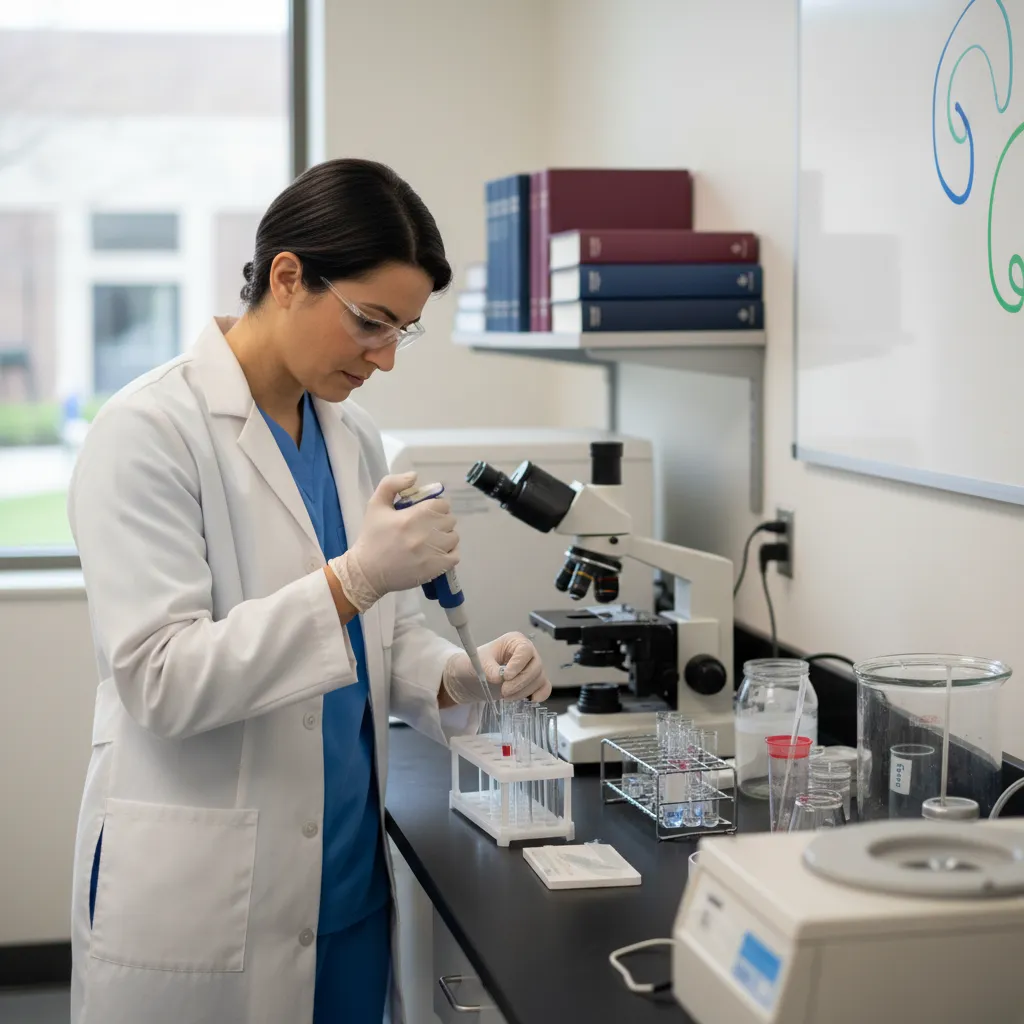

The MLT Role in Clinical Context
Medical laboratory technician responsibilities sit at the intersection of science and patient care in a way that's often invisible but always essential. The CBC that confirms a patient has leukemia, the blood culture that identifies the bacteria causing sepsis, the crossmatch that ensures a safe blood transfusion — an MLT performed each of those tests.
For candidates preparing for the certification exam, grounding your study in the real-world context of each technique makes the content more meaningful and easier to retain. The exam is testing whether you understand the full responsibility of the role, not just the mechanics of running an analyzer.
Build your preparation around understanding why procedures exist, what happens when they fail, and how you'd respond in realistic lab scenarios. That depth of understanding is what the ASCP exam measures — and it's exactly what makes an MLT valuable in clinical practice.
About the Author
Medical Laboratory Scientist & Clinical Certification Expert
Johns Hopkins UniversityDr. Sandra Kim holds a PhD in Clinical Laboratory Science from Johns Hopkins University and is certified as a Medical Technologist (MT) and Medical Laboratory Scientist (MLS) through ASCP. With 16 years of clinical laboratory experience spanning hematology, microbiology, and molecular diagnostics, she prepares candidates for ASCP board exams, MLT, MLS, and specialist certification tests.
Join the Discussion
Connect with other students preparing for this exam. Share tips, ask questions, and get advice from people who have been there.
View discussion (4 replies)