
Medical Laboratory Technician License: Requirements & Steps 2026 October
Get ready for your Medical Laboratory Technician License: 🏆 certification. Practice questions with step-by-step answer explanations and instant scoring.

What Is a Medical Laboratory Technician License?
A medical laboratory technician (MLT) license is the state-level authorization to work as a laboratory technician in clinical and diagnostic settings. It's separate from national certification — though in most states, earning national certification is required before the state will issue a license. The two are connected, but they're not the same thing.
National certification comes from organizations like ASCP (American Society for Clinical Pathology), AMT (American Medical Technologists), or AAB (American Association of Bioanalysts). State licensure is issued by your state's Department of Health or equivalent regulatory body. Some states require both; others accept national certification alone as sufficient to practice.
The specific requirements for an MLT license vary considerably by state. Some have detailed licensure processes with their own applications and fees; others have no state licensure requirement at all, relying entirely on national certification standards. Knowing what your state requires is the first step.
States With MLT Licensure Requirements
Not all states license medical laboratory technicians. The states with the most defined MLT licensure requirements include:
- California: Requires state licensure through CDPH (California Department of Public Health). MLTs must have an approved degree and pass a licensure examination.
- New York: Requires a state-issued Clinical Laboratory Technician (CLT) license. New York has its own examination requirements separate from national certification in some cases.
- Florida: Requires state licensure and uses the ASCP or similar national exam as part of the process.
- Georgia: Requires licensure with documentation of both education and examination.
- Tennessee: State licensure required, with national certification as an accepted examination pathway.
States without formal MLT licensure requirements (including Texas, Ohio, and many others) still typically require that laboratory workers meet CLIA standards — meaning labs must employ personnel who meet education and training requirements even if the state doesn't issue individual licenses. In these states, national certification is the de facto standard for employment even without a formal license mandate.
Education Requirements for MLT Licensure
The standard educational path to MLT certification and licensure is an associate degree in medical laboratory technology or clinical laboratory science from a program accredited by NAACLS (National Accrediting Agency for Clinical Laboratory Sciences).
NAACLS-accredited associate programs are typically two years in length and include both classroom instruction and supervised clinical laboratory experience. Clinical rotations at affiliated hospitals or reference labs are usually built into the curriculum — you can't complete the program without hands-on laboratory training.
Some candidates enter with a bachelor's degree in biology, chemistry, or another natural science and complete an MLT certification pathway through a formal training program (sometimes called a "categorical" or "transitional" program). This route is available through some hospital-based programs and is accepted by ASCP and other certification bodies, though it requires documentation of sufficient clinical training hours.
ASCP's pathway for candidates with non-MLT degrees requires:
- An associate's or higher degree with specific science coursework
- Completion of an approved clinical laboratory training program
- Documentation of clinical hours in each required lab discipline
The specific coursework and clinical hour requirements are detailed on ASCP's website and vary by certification pathway. Always verify current requirements directly with the certifying body and your state health department before beginning a program.
The medical laboratory technician certification resources available on this site include practice questions covering the major lab disciplines that appear on the ASCP MLT exam and similar national certification tests.
The National Certification Exam: ASCP MLT
The ASCP MLT (Medical Laboratory Technician) certification exam is the most widely recognized national credential and the most commonly used examination pathway for state licensure. It's a computer-based test with 100 questions administered at Pearson VUE testing centers.
The exam covers six major content areas:
- Blood banking (20%): ABO/Rh typing, compatibility testing, antibody identification, transfusion reactions
- Chemistry (24%): Routine chemistries, electrolytes, enzymes, therapeutic drug monitoring, point-of-care testing
- Hematology (24%): Cell morphology, CBC interpretation, coagulation testing, hemostasis
- Microbiology (22%): Culture and sensitivity, organism identification, specimen handling, infection control
- Immunology/Urinalysis/Body Fluids (10%): Serology, UA interpretation, body fluid analysis
The passing score is set using a scaled scoring methodology — ASCP doesn't publish a single numeric cutoff, but candidates typically need roughly 70–75% correct to pass. Questions are a mix of straightforward knowledge recall and case-based scenario questions requiring application of laboratory procedures to clinical situations.
How to Apply for an MLT License After Passing Certification
Once you've passed your national certification exam, the state licensure application process typically involves:
- Complete the state application: Download the MLT or CLT license application from your state health department's website. Applications vary significantly — some are short and primarily require documentation of your certification; others involve detailed work history, education verification, and character references.
- Submit documentation: Required documents typically include official transcripts from your MLT program, proof of national certification (a copy of your ASCP certificate or official verification from the certifying body), and government-issued ID.
- Background check: Most states require a criminal background check as part of the licensure process. Some require fingerprinting through a state-approved vendor.
- Pay the fee: State licensure fees typically range from $50 to $150 depending on the state and whether it's an initial or renewal application.
- Wait for processing: Processing times vary from a few days (for states with online systems) to several weeks (for states with paper-based processes).
In most states, you can work as an MLT in a supervised capacity while your licensure application is pending, as long as your national certification is active. Check your state's specific rules on provisional practice before assuming this applies to you.
Maintaining Your MLT License and Certification
Both national certification and state licensure require ongoing maintenance. For ASCP certification, recertification is required every three years through completion of continuing education (CE) credits. The CE requirement is 36 credits over three years, with credits available through ASCP's online education platform, approved conferences, and journal-based learning.
State license renewal timelines and requirements vary. Most states require renewal every one or two years, with documentation that your national certification remains active and, in some cases, completion of state-specific CE requirements.
Keep track of your renewal deadlines separately for certification and licensure — they don't always align. A lapsed national certification can trigger a problem with your state license renewal, so setting calendar reminders well in advance of both expiration dates prevents avoidable gaps in your credentials.
For candidates preparing for the certification exam, the medical laboratory technician salary and career information available on this site provides context on what the credential unlocks — both the earning potential and the practice settings where MLTs work.
- +Validates your knowledge and skills objectively
- +Increases job market competitiveness
- +Provides structured learning goals
- +Networking opportunities with other certified professionals
- −Study materials can be expensive
- −Exam anxiety can affect performance
- −Requires dedicated preparation time
- −Retake fees apply if you don't pass
Pros and Cons at a Glance
| Pros | Cons |
|---|---|
| Validates your knowledge and skills objectively | Study materials can be expensive |
| Increases job market competitiveness | Exam anxiety can affect performance |
| Provides structured learning goals | Requires dedicated preparation time |
| Networking opportunities with other certified professionals | Retake fees apply if you don't pass |
Sample Medical Laboratory Technician Exam Practice Questions
Try these questions from our free Medical Laboratory Technician Exam practice tests. The correct answer and an explanation follow each question.
A medical laboratory technician accidentally drops and breaks a culture plate of Mycobacterium tuberculosis on the floor outside of a biological safety cabinet. What is the FIRST and most critical action to take?
- A. Immediately cover the spill with paper towels.
- B. Pour a 10% bleach solution directly onto the spill.
- C. Evacuate the room and notify the supervisor.
- D. Begin cleaning the spill with a tuberculocidal disinfectant.
Answer: C. Evacuate the room and notify the supervisor.
The primary hazard from a Mycobacterium tuberculosis spill is the generation of infectious aerosols. The most critical first step is to remove all personnel from the area to prevent inhalation. The room should be closed off and the supervisor notified so that proper BSL-3 spill response procedures can be initiated, which includes allowing aerosols to settle for at least 30 minutes before re-entry and cleanup.
Which laboratory document defines the specific steps for performing a test, including specimen requirements, reagents, and result interpretation?
- A. Quality assurance plan
- B. Standard operating procedure (SOP)
- C. Proficiency testing report
- D. Laboratory compliance manual
Answer: B. Standard operating procedure (SOP)
A standard operating procedure (SOP) provides detailed, step-by-step instructions for performing a specific laboratory test.
A laboratory technician notices a false-negative agglutination result in a patient sample despite known antibody presence. Repeating the test after diluting the serum gives a positive result. This finding is most consistent with which phenomenon?
- A. Hook effect (high-dose hook)
- B. Prozone phenomenon
- C. Postzone phenomenon
- D. Complement fixation inhibition
Answer: B. Prozone phenomenon
The prozone phenomenon occurs when excess antibody relative to antigen saturates all available antigenic sites, preventing the cross-linking (lattice formation) needed for visible agglutination. Diluting the serum reduces antibody excess and allows lattice formation, producing a positive result.
A laboratory technician prepares to centrifuge a sample and notices a small crack in the centrifuge tube. What is the correct action?
- A. Reinforce the crack with laboratory tape before centrifuging
- B. Reduce centrifuge speed by 50% to minimize stress on the tube
- C. Replace the cracked tube with an intact tube before centrifuging
- D. Proceed only if the crack is less than 2 mm in length
Answer: C. Replace the cracked tube with an intact tube before centrifuging
A cracked centrifuge tube must be discarded and replaced before use. Centrifugation generates enormous mechanical forces; a cracked tube can shatter, creating an aerosol of potentially infectious or hazardous material and damaging the centrifuge rotor.
Take the full Medical Laboratory Technician Exam practice test



MLT Careers After Licensure: What the Credential Opens Up
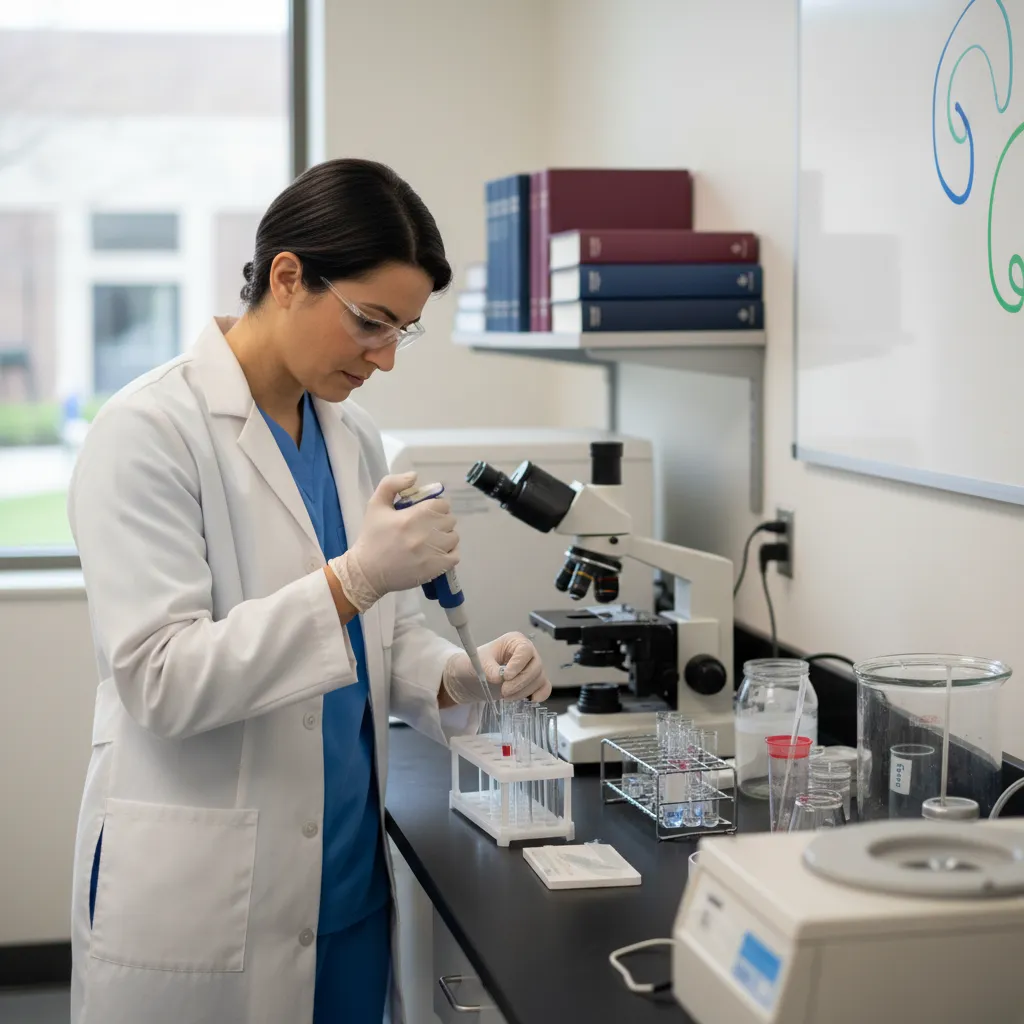
Once you're licensed and certified, the work settings available to you are broader than many candidates realize going in. Hospital laboratories are the most obvious path, but MLTs also work in:
- Reference laboratories (LabCorp, Quest Diagnostics, and regional reference labs) — high-volume testing environments with specialized equipment
- Physician office laboratories — smaller-scale testing closer to patient care
- Public health laboratories — state and county labs doing infectious disease surveillance and environmental testing
- Blood banks and transfusion services — specialized settings focusing on blood banking procedures
- Veterinary laboratories — applying similar techniques to animal diagnostics
- Forensic laboratories — toxicology and trace evidence analysis (often requires additional training beyond standard MLT scope)
Starting salaries for MLTs typically run $45,000–$60,000 depending on geography and setting, with hospital and reference lab positions often paying more than physician office settings. States with high cost of living (California, New York) have higher absolute salaries but the net difference when adjusted for living costs is variable.
Many MLTs eventually pursue bachelor's completion programs to advance to MLS/MT status, which opens supervisory and specialty positions with higher earning potential. Several universities offer online bachelor's completion programs specifically designed for practicing MLTs — you can typically complete the degree while working full time in 18–24 months.
The MLT credential is a solid entry point into laboratory medicine — strong job security, consistent demand, and a clear advancement pathway for those who want to grow. The medical laboratory technician field is one where your initial certification investment pays returns for decades.
About the Author

Medical Laboratory Scientist & Clinical Certification Expert
Johns Hopkins UniversityDr. Sandra Kim holds a PhD in Clinical Laboratory Science from Johns Hopkins University and is certified as a Medical Technologist (MT) and Medical Laboratory Scientist (MLS) through ASCP. With 16 years of clinical laboratory experience spanning hematology, microbiology, and molecular diagnostics, she prepares candidates for ASCP board exams, MLT, MLS, and specialist certification tests.
Join the Discussion
Connect with other students preparing for this exam. Share tips, ask questions, and get advice from people who have been there.
View discussion (4 replies)