
IELTS Exam Fee 2026 October — Registration Cost, What Is Included, and Fee Waivers
✍🏼 Pass your IELTS exam on the first attempt. Practice questions with detailed answer explanations, hints, and instant scoring.

IELTS Exam Fee — What's Included and What Affects the Price
The IELTS exam fee is set locally by each authorized test centre, so there is no single official figure — the amount you pay depends on your country, city, and whether you book through IDP or the British Council. Both IELTS Academic and IELTS General Training are priced the same at a given centre. The IELTS for UKVI (United Kingdom Visas and Immigration) and Life Skills versions are priced separately by each centre — IELTS for UKVI is typically somewhat higher due to the additional biometric processing and UK government-approved centre requirements.
Test centres in high cost-of-living cities may charge at the higher end of their local range. Test centres at universities or community organizations may occasionally offer reduced fees. Always verify the exact current fee at your specific test centre when registering — fees are periodically adjusted by each centre.
IELTS Computer-Delivered vs Paper-Based: Both formats cost the same registration fee at a given centre. Computer-delivered IELTS results usually arrive in 1–2 days (paper-based IELTS is being phased out, with paper testing ending in mid-2026). If you need results quickly, computer-delivered is the better choice at the same price.
Late registration fees: Unlike some standardized tests, IELTS does not typically charge a standard late registration fee. However, test dates fill up quickly and availability at your preferred centre may be limited for later registrations. Register as early as possible — popular test dates can book out 4–6 weeks in advance.
Rescheduling fees: Cancellation more than 5 weeks before the test date generally earns a partial refund (a majority of the registration fee, set by the centre's policy). Changes or cancellations within 5 weeks of the test date typically do not qualify for a refund. Rescheduling to a different date within the allowed window may incur an administrative fee set by your test centre.

IELTS Exam Fee by Country — Why It Varies
IELTS does not publish one global fee. Fees are set independently by each local test centre, so the amount you pay depends on your country, currency, and whether you book through IDP or the British Council. As a rule of thumb, fees tend to track local economic conditions and currency — always confirm the exact current fee for your country and city directly on ielts.org or britishcouncil.org, or by contacting your nearest test centre, before you register.
In countries where the IELTS fee is high relative to local income, IDP and British Council occasionally offer scholarship programs and discounts through educational partnerships — check with your local test centre or British Council office for current offers.
IELTS Academic vs IELTS General Training — Fee Difference
IELTS Academic and IELTS General Training are priced identically at a given test centre. The two versions differ in their Reading and Writing sections (not Listening or Speaking), and are used for different purposes:
- IELTS Academic: Required for undergraduate and postgraduate university admissions, and for many professional registration programs (medical, nursing, pharmacy licensing in the UK, Australia, Canada). The Reading section uses complex academic texts; the Writing Task 1 requires describing a visual data set (graph, chart, table, diagram).
- IELTS General Training: Used for work visas, immigration (Australia, Canada, UK), and some vocational/secondary education programs. The Reading section uses everyday texts (workplace, social); Writing Task 1 requires writing a formal or semi-formal letter.
If you are applying for both university admission and immigration, you may need to take IELTS twice (once Academic, once General Training) — both at the full registration cost set by your test centre. Plan your timeline and budget accordingly.
Prepare for your exam with our IELTS practice test before registration, and use our IELTS practice tests library for full-section preparation. Also review our how to pass the IELTS exam guide for targeted strategies. Our IELTS Listening Comprehension practice resources will help you maximize your score on the most immediately improvable section.
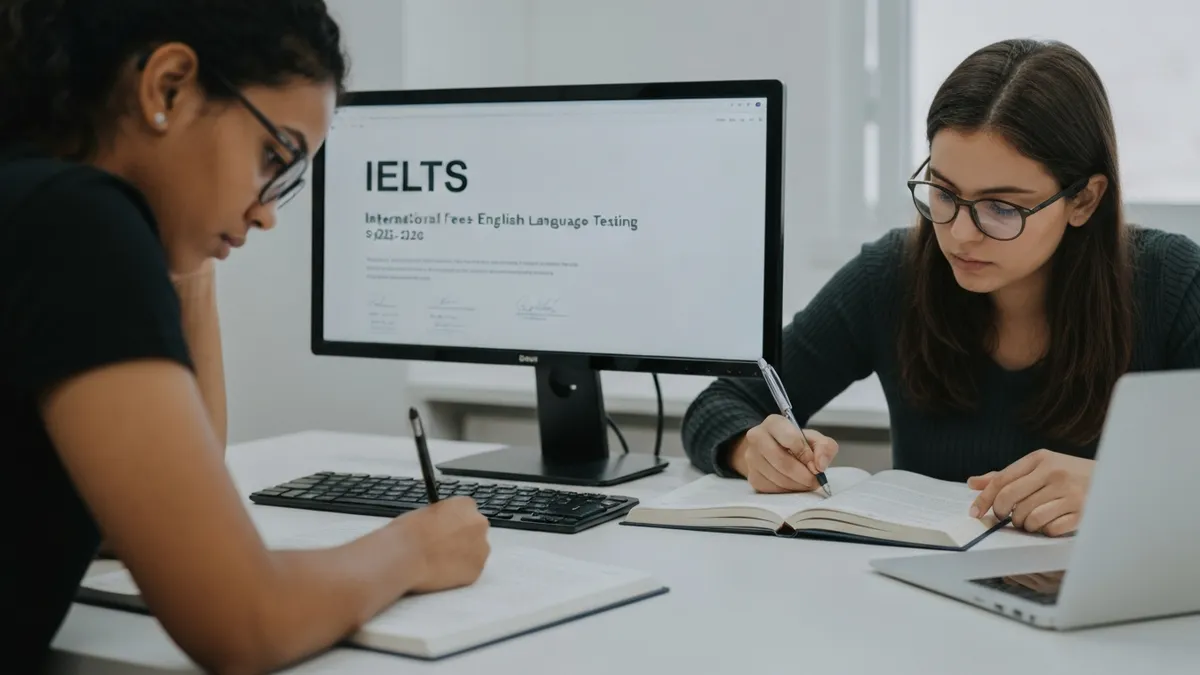
IELTS Registration Preparation Checklist
- ✓Verify which IELTS version you need: Academic (university/professional registration) vs General Training (immigration/work visa) — taking the wrong version means paying again
- ✓IELTS is computer-delivered (paper-based IELTS is being discontinued from mid-2026; a Writing on Paper option exists in some markets) — confirm any format requirement with your institution before registering
- ✓Register at ielts.org (IDP) or britishcouncil.org — both are official and offer the same exam; check which has better dates and locations near you
- ✓Designate your 5 free score recipient institutions at registration — this saves you an extra per-institution fee for additional score sends later
- ✓Check the refund and rescheduling policy of your specific test center — policies vary; cancellation within 5 weeks typically forfeits the fee
- ✓Budget for the full fee upfront — there is no partial payment option, and IELTS does not typically offer installment plans
- ✓If applying to UK institutions or visas, confirm whether you need IELTS Academic, IELTS for UKVI, or IELTS Life Skills — these are different tests with different fees
- ✓Take at least 1 full-length practice test before registering to estimate your current band score and realistic preparation timeline
- +Industry-recognized credential boosts your resume
- +Higher earning potential (10-20% salary increase on average)
- +Demonstrates commitment to professional development
- +Opens doors to advanced career opportunities
- −Exam preparation requires significant time investment (4-8 weeks)
- −Test fees are set by each test centre and are non-refundable if you miss your date
- −May require continuing education to maintain
- −Some employers may not require certification
Pros and Cons at a Glance
| Pros | Cons |
|---|---|
| Industry-recognized credential boosts your resume | Test fees are set by each test centre and are non-refundable if you miss your date |
| Demonstrates commitment to professional development | May require continuing education to maintain |
| Opens doors to advanced career opportunities | Some employers may not require certification |
Sample IELTS Practice Questions
Try these questions from our free IELTS practice tests. The correct answer and an explanation follow each question.
In IELTS Academic Writing Task 1, what is the minimum word requirement?
- A. 100 words
- B. 120 words
- C. 150 words
- D. 200 words
Answer: C. 150 words
IELTS Writing Task 1 (both Academic and General Training) requires a minimum of 150 words.
What does an IELTS Speaking Part 1 examiner primarily assess?
- A. The accuracy of factual information the candidate provides.
- B. Fluency, coherence, lexical resource, grammatical range, and pronunciation.
- C. The length of each answer in number of words.
- D. Whether the candidate agrees with the examiner's implied opinion.
Answer: B. Fluency, coherence, lexical resource, grammatical range, and pronunciation.
The four IELTS speaking criteria are fluency and coherence, lexical resource, grammatical range and accuracy, and pronunciation.
In an IELTS Reading 'Matching Headings' task, what is the primary skill being tested?
- A. Identifying specific details and dates within a paragraph.
- B. Understanding the main idea or topic of a paragraph.
- C. Recognizing the author's opinion or bias.
- D. Defining vocabulary words found in the text.
Answer: B. Understanding the main idea or topic of a paragraph.
The 'Matching Headings' task is designed to assess a test taker's ability to identify the central theme or main idea of a paragraph and distinguish it from supporting details. Each heading represents a summary of a paragraph.
What does Band 7 in IELTS represent?
- A. Basic user — limited understanding
- B. Competent user — generally effective command with some inaccuracies
- C. Good user — handles complex language well, with occasional inaccuracies
- D. Expert user — full operational command
Answer: C. Good user — handles complex language well, with occasional inaccuracies
Band 7 is described as a 'Good user' — generally handles complex language well with occasional errors.
IELTS Exam Fee Questions and Answers
More IELTS Resources
Join the Discussion
Connect with other students preparing for this exam. Share tips, ask questions, and get advice from people who have been there.
View discussion (8 replies)