
HHA Training Programs — Duration, Cost & State Requirements 2026 October
🎯 Boost your HHA Training Programs exam score with practice questions and detailed answer explanations. Track progress with instant feedback.
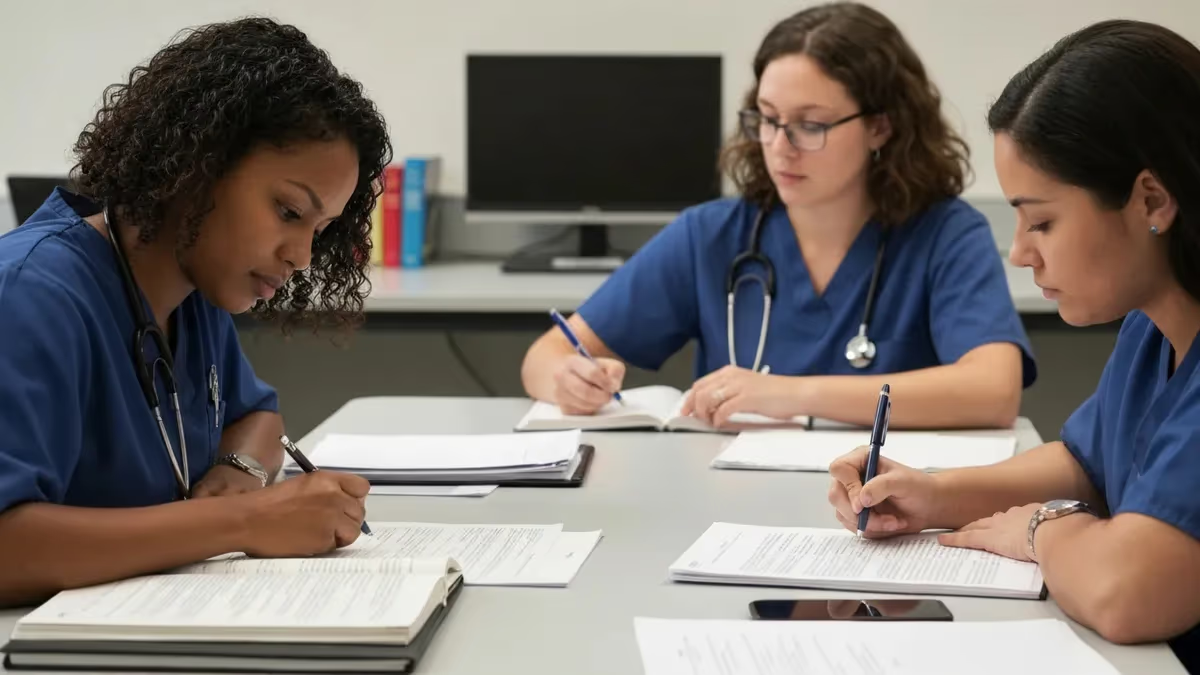
Most people looking into home health aide training programs don't realize how much the rules vary from one state to another. Some states mandate 75 hours of classroom and clinical instruction. Others require 40. A handful let you finish entirely online — though clinical hours still need an in-person component. The point is: there's no single national standard, and that catches a lot of first-time candidates off guard.
HHA training programs generally fall into three buckets. Community colleges run semester-length courses with financial aid eligibility. Vocational schools offer accelerated options — sometimes as short as two weeks. And home health agencies themselves sometimes train you on the job, covering the cost entirely if you commit to working for them afterward. Each path has trade-offs in time, money, and scheduling flexibility.
What you'll spend depends on where you live and who's running the program. Tuition at a community college might run $500 to $1,200 for the full course. Private vocational schools charge more — $800 to $2,000 on average. Agency-sponsored training? Often free. But you're locked into that employer for six months to a year. Worth it for some. Not for everyone.
This guide breaks down hha training programs by state requirements, typical costs, program length, and how to find options that fit your situation. Whether you're comparing a 40-hour certificate program to a longer clinical track, or you just want to know what's available in your state — the details below cover it.

Federal law sets a floor: 75 hours of training, including at least 16 hours of supervised clinical experience. That applies to any home health aide working for a Medicare-certified agency. But here's the catch — many hha training programs exceed that minimum because individual states stack their own requirements on top. California requires 120 hours. New York mandates 76. Florida sits right at the federal minimum of 75.
The 40 hour home health aide training programs you see advertised are typically designed for states with lower requirements or for aides who won't be working under Medicare. Some agencies in Texas and Georgia accept 40-hour certificates for private-pay clients. If you're planning to work for a Medicare-certified agency, though, you'll need the full 75 hours regardless of what your state says. Always check both — your state's requirement and the agency's.
Clinical hours trip people up the most. You can't fake bedside care. Programs that promise "100% online" still require you to show up somewhere — a nursing facility, a partner clinic, a simulation lab — for the hands-on portion. The classroom theory can absolutely happen on a screen. The patient transfers, vital sign checks, and hygiene assistance? Those need a real human body and a real instructor watching you do it.
Don't assume that more hours means a better program, either. A well-structured 75-hour course with experienced instructors and actual patient contact often produces more competent aides than a bloated 120-hour program where half the time is spent on PowerPoint slides nobody reads.
Free hha training programs exist — and they're more common than you'd think. The biggest source? Home health agencies that train their own staff. Companies like Bayada, Amedisys, and local agencies across the country run free programs in exchange for a work commitment. Usually six months to a year. You get trained, certified, and employed in one shot. No tuition. No textbooks to buy.
State workforce development programs are another avenue. Many states fund HHA training through their departments of labor, especially when there's a nursing shortage — which, in 2026, is basically everywhere. Check your state's workforce development website or visit a local American Job Center. They can connect you with 40 hour home health aide training programs that are fully subsidized.
Community organizations and nonprofits also offer free or reduced-cost training. The Red Cross runs HHA programs in several states. Some faith-based organizations partner with healthcare facilities to provide training for underserved communities. If you're searching for home health aide training programs near me, widen your search beyond colleges and trade schools — the free options often don't show up on the first page of Google.
One thing to watch: "free" sometimes means "free if you pass." A few programs require you to cover the cost upfront and reimburse you after completion. Others are genuinely no-cost from day one. Read the fine print before you sign anything.
Training Format Comparison
Duration: 8–16 weeks (one semester). Covers the full 75+ hours with structured classroom lectures, lab work, and clinical rotations at partner facilities. Tuition runs $500–$1,200 depending on residency status. Financial aid (Pell Grant, state grants) often covers the entire cost. You'll earn a certificate recognized by Medicare-certified agencies statewide. Best for students who want a structured schedule and access to career counseling, job placement services, and possible articulation into CNA or LPN programs.
If you're searching for hha training programs near me, start with your state's health department website. Every state maintains a list of approved training providers. Some states — like Florida — make it easy, with a searchable database organized by county. Others bury the information three clicks deep. Either way, it's the most reliable source because only programs on the state's approved list will qualify you for certification.
Home health aide training programs in florida follow the federal 75-hour minimum. The Florida Board of Nursing oversees HHA certification, and the state requires training from an approved provider. Programs are available in every major metro — Miami, Tampa, Orlando, Jacksonville — and most rural counties have at least one option through a community college or vocational school. Costs in Florida tend to run lower than the national average, with community college programs often under $600.
Florida also allows a competency evaluation as an alternative to formal training if you already have healthcare experience. Registered nurses and licensed practical nurses can challenge the exam without completing a separate HHA program. That shortcut saves weeks of time. But it only applies if you already hold an active nursing license.
Don't rely solely on Google when searching for programs near you. Call local home health agencies directly and ask if they run training programs or have partnerships with local schools. Many of the best opportunities aren't advertised online. Word of mouth matters in this industry — especially in smaller communities where the local agency IS the training program.
Free training programs for home health aide certification have expanded significantly since 2020. The pandemic exposed a massive shortage of home care workers, and both federal and state governments responded with funding. Workforce Innovation and Opportunity Act (WIOA) grants now cover HHA training in most states. If you qualify — typically based on income, employment status, or veteran status — the program is completely free, including textbooks and scrubs.
Home health aide training programs online have grown rapidly, but you need to know their limits. The classroom portion — anatomy basics, medical terminology, nutrition, infection control, documentation — works perfectly fine over Zoom or a learning management system. Some free hha training programs are entirely self-paced, letting you finish the theory portion on your own schedule before booking clinical hours.
The catch is always clinical hours. No state accepts fully online HHA certification. You'll need to complete supervised hands-on training at an approved site. Hybrid programs handle this by scheduling two to four days of in-person clinicals after you finish the online coursework. That's the model that works best for most adult learners — especially parents, people working other jobs, or anyone without reliable transportation to attend class five days a week.
If budget is your main concern, don't overlook Medicaid waiver programs. Several states use Medicaid funding to train family members as home health aides for their own relatives. You get certified, your family member gets care, and the state pays you. It's not available everywhere, but states like California, Oregon, Washington, and New York all have versions of this program.
Pros and Cons of HHA Training Programs
- +Free agency-sponsored options eliminate tuition costs entirely
- +Short program duration — many programs finish in 2 to 6 weeks
- +High job placement rates due to ongoing demand for home health aides
- +Flexible scheduling with evening, weekend, and hybrid online options
- +Financial aid and workforce grants cover costs for qualifying students
- +Training transfers across employers — your certification is portable
- −Clinical hours require in-person attendance regardless of online format
- −State requirements vary widely — a certificate from one state may not transfer
- −Agency-sponsored programs lock you into one employer for 6 to 12 months
- −Private vocational schools charge $800 to $2,000 with limited financial aid
- −Program quality varies — some approved providers offer minimal hands-on time
- −Renewal and continuing education requirements add ongoing time and cost
CNA and hha training programs overlap more than most people realize. Both cover personal care, vital signs, infection control, and patient communication. The difference is scope and setting. CNA programs are longer — typically 120 to 160 hours — and include clinical rotations in nursing facilities. HHA programs focus specifically on home-based care and are shorter. But here's what matters: if you already have a CNA certification, most states let you skip the HHA training entirely. You're considered qualified by default.
Home health aide training programs in nj follow the federal 75-hour standard, but New Jersey adds its own twist. The state requires training from a program approved by the New Jersey Board of Nursing, and the clinical component must take place at a state-licensed facility. NJ also requires a competency evaluation after training — a skills test plus a written exam. Programs run throughout the state, concentrated in Newark, Jersey City, Trenton, and the suburban counties around Philadelphia.
If you're weighing CNA versus HHA, think about where you want to work. CNA certification opens doors to hospitals and nursing homes — settings with higher pay but more physically demanding work. HHA certification keeps you in private homes — one client at a time, more independence, more scheduling flexibility. Many aides get both certifications over time, starting with whichever program fits their budget and timeline first.
New Jersey's job market for home health aides is particularly strong. The state's aging population and high cost of institutional care have pushed demand for home-based services through the roof. Completion rates for NJ-approved programs run above 85%, and most graduates find employment within 30 days.
HHA Training Enrollment Checklist
- ✓Verify your state's minimum training hour requirement (40, 75, or 120 hours)
- ✓Confirm the program is on your state health department's approved provider list
- ✓Check whether the program includes the clinical hours or if those are separate
- ✓Ask about total cost including textbooks, scrubs, background check, and TB test
- ✓Apply for financial aid — Pell Grant, WIOA funding, or state workforce grants
- ✓Confirm the schedule works — daytime, evening, weekend, or hybrid online
- ✓Verify the program provides a competency evaluation or state exam prep
- ✓Ask about job placement rates and employer partnerships
- ✓Check if the certification transfers to other states (reciprocity agreements)
- ✓Read the refund policy in case you need to withdraw before completing the program
Home health aide training programs in philadelphia cluster around the city's community colleges and vocational schools. Community College of Philadelphia runs one of the most established programs — affordable, well-regarded, and connected to major home health agencies throughout the region. Temple University's continuing education division also offers an HHA certificate program with evening options.
Home health aide training programs in brooklyn follow New York State's 76-hour requirement. Brooklyn has dozens of approved programs — many operated by small private schools in neighborhoods like Flatbush, Crown Heights, and Sunset Park. Costs range from free (agency-sponsored or grant-funded) to about $1,000 at private providers. The home health aide training programs near me search in Brooklyn typically returns more results than almost any other metro area in the country because of the borough's dense concentration of training schools.
Philly-area programs tend to offer more clinical site variety than many other cities. Students rotate through home health agencies, assisted living facilities, and sometimes hospice care settings. That breadth of exposure matters — you'll see the full spectrum of home care before you're on your own with a client. Brooklyn programs, by contrast, often partner with a single clinical site, which can limit your experience but streamlines scheduling.
Both cities have strong job markets for newly certified HHA workers. Philadelphia's aging population in the surrounding counties — Montgomery, Delaware, Bucks — drives consistent demand. Brooklyn benefits from New York City's massive home care infrastructure and Medicaid-funded personal care programs that employ tens of thousands of aides across the five boroughs.
Free home health aide training programs in nyc are surprisingly accessible. The city's Human Resources Administration (HRA) partners with home care agencies to fund training for public assistance recipients. The 1199SEIU Training and Employment Fund — the union representing most NYC home care workers — runs its own programs for members and prospective members. And several community-based organizations in every borough offer free training, particularly targeting immigrant communities and career changers.
Free home health aide training programs in the bronx specifically tend to be run by community organizations like BronxWorks and the Bronx Community Health Network. These programs often include wraparound services — help with childcare, transportation, and ESL support — that make them more accessible than traditional classroom programs. The Bronx has one of the highest concentrations of home health aides per capita in the country, and the training pipeline reflects that demand.
NYC's Medicaid-funded Consumer Directed Personal Assistance Program (CDPAP) has also created a parallel training ecosystem. Under CDPAP, family members and friends can be trained and paid to provide home care — and the training is free. It's different from traditional HHA certification, but it serves a similar function and has become a major entry point into the home care field, especially in the Bronx, Brooklyn, and Queens.
If you're in NYC and money is tight, don't start with Google. Call 311. The city's 311 service can connect you directly to free training programs in your borough, filtered by language, schedule, and eligibility. It's faster than searching online and more likely to surface programs that aren't well-advertised.
Not every advertised HHA program leads to valid certification. Some private schools operate without state approval — meaning your certificate won't be recognized by Medicare-certified agencies. Before paying tuition or signing an enrollment agreement, confirm the program appears on your state health department's approved provider list. If it's not listed, walk away.
Home health aide training programs in ct follow Connecticut's requirement of 75 hours — the federal minimum. Connecticut's Department of Public Health maintains the list of approved programs, and training is available through community colleges (like Housatonic, Capital, and Gateway), private vocational schools, and some home health agencies. The Connecticut Home Care Program for Elders (CHCPE) also funds training for aides who will serve elderly clients receiving state-funded care.
Home health aide training programs in dc operate under the District of Columbia's own regulatory framework. DC requires 75 hours of training from a program approved by the DC Department of Health. Programs are available through the University of the District of Columbia Community College, several private providers, and agency-sponsored options through companies like Maxim Healthcare and Home Instead. DC's compact geography means most programs are accessible by Metro — a real advantage for students without cars.
Connecticut and DC share a common challenge: higher cost of living translates to higher program costs, but also higher wages once you're certified. HHA pay in Connecticut averages $16–$18 per hour, and DC aides earn $15–$19 per hour — both above the national average. The return on training investment is faster in these markets, especially if you secure a free or subsidized program.
Both regions also have strong continuing education requirements. Connecticut requires annual in-service training of at least 12 hours. DC mandates ongoing competency verification. These aren't just bureaucratic boxes to check — they keep your skills current and your certification active. Factor ongoing education costs and time into your decision when comparing programs across states.
HHA Practice Test Questions
Prepare for the HHA - Home Health Aide exam with our free practice test modules. Each quiz covers key topics to help you pass on your first try.
HHA Basic Care and Comfort
HHA Exam Questions covering Basic Care and Comfort. Master HHA Test concepts for certification prep.
HHA Basic Care and Comfort Questions and A...
Free HHA Practice Test featuring Basic Care and Comfort Questions and Answers. Improve your HHA Exam score with mock test prep.
HHA Communication and Interpersonal Skills
HHA Mock Exam on Communication and Interpersonal Skills. HHA Study Guide questions to pass on your first try.
HHA Communication and Interpersonal Skills...
HHA Test Prep for Communication and Interpersonal Skills Questions and Answers. Practice HHA Quiz questions and boost your score.
HHA Infection Control and Safety
HHA Questions and Answers on Infection Control and Safety. Free HHA practice for exam readiness.
HHA Infection Control and Safety Questions...
HHA Mock Test covering Infection Control and Safety Questions and Answers. Online HHA Test practice with instant feedback.
HHA Mental and Emotional Support
Free HHA Quiz on Mental and Emotional Support. HHA Exam prep questions with detailed explanations.
HHA Mental and Emotional Support Questions...
HHA Practice Questions for Mental and Emotional Support Questions and Answers. Build confidence for your HHA certification exam.
HHA Mobility and Transfer Techniques
HHA Test Online for Mobility and Transfer Techniques. Free practice with instant results and feedback.
HHA Mobility and Transfer Techniques Quest...
HHA Study Material on Mobility and Transfer Techniques Questions and Answers. Prepare effectively with real exam-style questions.
HHA Nutrition and Hydration
Free HHA Test covering Nutrition and Hydration. Practice and track your HHA exam readiness.
HHA Nutrition and Hydration Questions and ...
HHA Exam Questions covering Nutrition and Hydration Questions and Answers. Master HHA Test concepts for certification prep.
HHA Observation and Reporting
Free HHA Practice Test featuring Observation and Reporting. Improve your HHA Exam score with mock test prep.
HHA Observation and Reporting Questions an...
HHA Mock Exam on Observation and Reporting Questions and Answers. HHA Study Guide questions to pass on your first try.
HHA Patient Rights and Ethics
HHA Test Prep for Patient Rights and Ethics. Practice HHA Quiz questions and boost your score.
HHA Patient Rights and Ethics Questions an...
HHA Questions and Answers on Patient Rights and Ethics Questions and Answers. Free HHA practice for exam readiness.
HHA Personal Care and Hygiene
HHA Mock Test covering Personal Care and Hygiene. Online HHA Test practice with instant feedback.
HHA Personal Care and Hygiene Questions an...
Free HHA Quiz on Personal Care and Hygiene Questions and Answers. HHA Exam prep questions with detailed explanations.
HHA Home Health Aide Certification Practic...
HHA Practice Questions for Home Health Aide Certification Practice Test. Build confidence for your HHA certification exam.
HHA Home Health Aide Certification Practic...
HHA Test Online for Home Health Aide Certification Practice Test #1. Free practice with instant results and feedback.
HHA Home Health Aide Certification Practic...
HHA Study Material on Home Health Aide Certification Practice Test #2. Prepare effectively with real exam-style questions.
HHA Home Health Aide Certification Practic...
Free HHA Test covering Home Health Aide Certification Practice Test #3. Practice and track your HHA exam readiness.
HHA Home Health Aide Certification Practic...
HHA Exam Questions covering Home Health Aide Certification Practice Test #4. Master HHA Test concepts for certification prep.
HHA HOME HEALTH AIDE COMPETENCY TEST
Free HHA Practice Test featuring HOME HEALTH AIDE COMPETENCY TEST. Improve your HHA Exam score with mock test prep.
HHA HOME HEALTH AIDE COMPETENCY TEST #1
HHA Mock Exam on HOME HEALTH AIDE COMPETENCY TEST #1. HHA Study Guide questions to pass on your first try.
HHA Home Health Aide Competency Test
HHA Test Prep for Home Health Aide Competency Test. Practice HHA Quiz questions and boost your score.
HHA Home Health Aide Competency Test #2
HHA Questions and Answers on Home Health Aide Competency Test #2. Free HHA practice for exam readiness.
Home health aide training programs ct — whether in Hartford, New Haven, Bridgeport, or the smaller towns — share the same 75-hour state requirement, but they differ in how they deliver it. Bridgeport's Housatonic Community College runs a popular evening program that works for students with daytime jobs. Capital Community College in Hartford offers a weekend-intensive format. Private schools throughout the state tend to charge $700 to $1,500, while community colleges keep costs under $800 with financial aid often reducing that to zero.
One Connecticut-specific detail worth knowing: the state recently expanded its Paid Family Medical Leave (PFML) program to cover time spent in approved training programs under certain circumstances. If you're currently employed and transitioning into healthcare, check whether your situation qualifies. It won't cover tuition, but it might offset lost wages while you're in class.
The Hartford and New Haven metro areas have the highest concentration of programs, but even rural Litchfield and Windham counties have at least one approved provider each — typically through a local community college satellite campus or a regional home health agency. If you're in eastern Connecticut, you might also consider programs across the border in Rhode Island. RI accepts 75-hour certificates and has reciprocity-friendly policies for neighboring states.
No matter which Connecticut program you choose, verify three things before enrolling: state approval, clinical site location, and job placement support. The programs with the highest post-completion employment rates are the ones connected to local agencies through formal partnerships — not just general career services pointing you toward Indeed.
HHA Questions and Answers
About the Author

Registered Nurse & Healthcare Educator
Johns Hopkins University School of NursingDr. Sarah Mitchell is a board-certified registered nurse with over 15 years of clinical and academic experience. She completed her PhD in Nursing Science at Johns Hopkins University and has taught NCLEX preparation and clinical skills courses for nursing students across the United States. Her research focuses on evidence-based exam preparation strategies for healthcare certification candidates.
Join the Discussion
Connect with other students preparing for this exam. Share tips, ask questions, and get advice from people who have been there.
View discussion (8 replies)