

GCOR Practice Test
Updated for October 2026The GCOR is the standard rulebook used by most major U.S. railroads west of the Mississippi River, including BNSF and Union Pacific. Mastering these regulations is non-negotiable for employment and safety. Transportation and safety professionals may also benefit from our G60 torch use certification practice test.
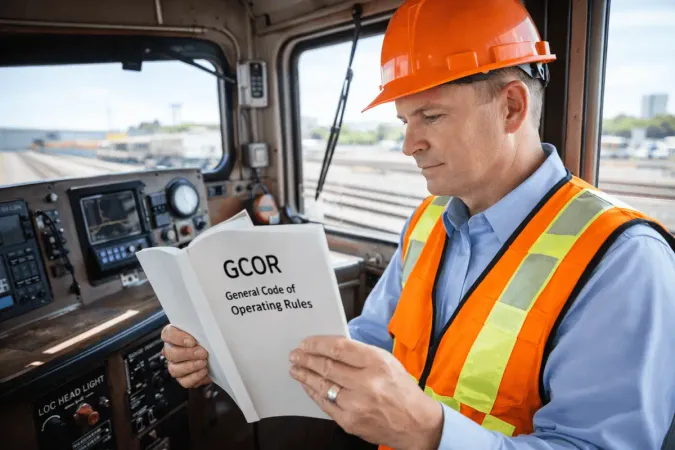
GCOR Practice Test Questions
Prepare for the GCOR - General Code of Operating Rules exam with our free practice test modules. Each quiz covers key topics to help you pass on your first try.
GCOR Railroad Operations
GCOR Exam Questions covering Railroad Operations. Master GCOR Test concepts for certification prep.
GCOR Safety Rules and Procedures
Free GCOR Practice Test featuring Safety Rules and Procedures. Improve your GCOR Exam score with mock test prep.
GCOR - General Code of Operating Rules Eme...
GCOR Mock Exam on GCOR - General Code of Operating Rules Emergency Procedures and Incident Response. GCOR Study Guide questions to pass on your first try.
GCOR - General Code of Operating Rules Tra...
GCOR Test Prep for GCOR - General Code of Operating Rules Train Handling and Speed Restrictions. Practice GCOR Quiz questions and boost your score.
GCOR - General Code of Operating Rules Aut...
GCOR Questions and Answers on - General Code of Operating Rules Authorities for Movement. Free GCOR practice for exam readiness.
GCOR - General Code of Operating Rules Blo...
GCOR Mock Test covering - General Code of Operating Rules Block System and CTC Rules. Online GCOR Test practice with instant feedback.
GCOR - General Code of Operating Rules Gen...
Free GCOR Quiz on - General Code of Operating Rules General Responsibilities and Safety. GCOR Exam prep questions with detailed explanations.
GCOR - General Code of Operating Rules Han...
GCOR Practice Questions for - General Code of Operating Rules Handling Switches and Derails. Build confidence for your GCOR certification exam.
GCOR - General Code of Operating Rules Pro...
GCOR Test Online for - General Code of Operating Rules Protection of Roadway Workers. Free practice with instant results and feedback.
GCOR - General Code of Operating Rules Rad...
GCOR Study Material on - General Code of Operating Rules Radio and Communication Procedures. Prepare effectively with real exam-style questions.
GCOR - General Code of Operating Rules Sec...
Free GCOR Test covering - General Code of Operating Rules Securing Unattended Equipment. Practice and track your GCOR exam readiness.
GCOR - General Code of Operating Rules Sig...
GCOR Exam Questions covering - General Code of Operating Rules Signals and Their Indications. Master GCOR Test concepts for certification prep.
GCOR - General Code of Operating Rules Swi...
Free GCOR Practice Test featuring - General Code of Operating Rules Switching and Terminal Operations. Improve your GCOR Exam score with mock test prep.
GCOR Exam Flashcards
Flip the cards to test your knowledge of key GCOR rules and terms.
🚦What is "Restricted Speed" under GCOR rules?
A speed that allows stopping within half the range of vision, short of any train, obstruction, or switch not properly lined, and not exceeding 20 MPH.
REVIEW GCOR RULES🔵What does a blue signal signify on a track?
It signifies that workers are on, under, or between rolling equipment and that the equipment must not be moved or coupled to.
PRACTICE GCOR SAFETY🟨What is the main purpose of a "Track Warrant Control" (TWC)?
To authorize train movements on main tracks in non-signaled territory, providing authority limits and instructions from the train dispatcher.
⚠️What are the three points of contact that must be maintained when mounting or dismounting equipment?
Always maintaining contact with two hands and one foot, or one hand and two feet, to prevent falls and ensure stability.
REVIEW GCOR SAFETY RULES🛑A red flag or light displayed between the rails of a track indicates what?
It indicates that the track is out of service and must not be passed. It's a stop signal that requires permission from the employee in charge to proceed.
PRACTICE GCOR SIGNALS📅What is a "Job Briefing" according to GCOR?
A communication between crew members before starting any task to discuss the plan, potential hazards, and safety precautions.
GCOR Study Guide
Our comprehensive GCOR Study Guide breaks down the essential rules into manageable topics. Use these tables to review key information about the GCOR test, registration, and scoring procedures to ensure you are fully prepared.
GCOR Practice Test Score Calculator
Total Scored Questions
150
105 out of 150 correct
70%
Required to Pass: ~70% (Estimated)
Your primary investment is your time and commitment to studying. The railroad covers the financial costs, viewing your GCOR training as an investment in a safe and competent employee. Transportation and safety professionals may also benefit from our G60 torch use certification practice test.
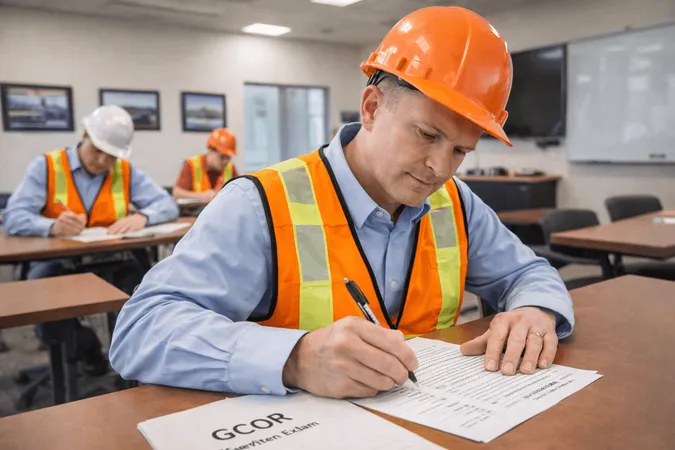
GCOR Exam Day Checklist
- ✓Get a good night's sleep.
- ✓Eat a healthy breakfast.
- ✓Review key rules and definitions one last time.
- ✓Arrive at the training center early.
- ✓Bring required ID and any allowed materials.
- ✓Listen carefully to the instructor's directions.
- ✓Read every question carefully before answering.
- ✓Manage your time effectively.
Ready to Pass Your GCOR Test?
Start preparing today with our free, comprehensive GCOR practice questions and study materials. Build the confidence and knowledge you need to launch your railroad career.
GCOR Renewal and Recertification
Frequency Every
2-3 Years
Method Classroom
& Exam
Passing Score
85% or Higher
Recertification is managed by your employer and is a mandatory part of maintaining your qualification. It ensures that every crew member is up-to-date on the latest operating rules and safety procedures.
- +Industry-recognized credential boosts your resume
- +Higher earning potential (10-20% salary increase on average)
- +Demonstrates commitment to professional development
- +Opens doors to advanced career opportunities
- −Exam preparation requires significant time investment (4-8 weeks)
- −Certification fees can be $100-$400+
- −May require continuing education to maintain
- −Some employers may not require certification
Sample GCOR - General Code of Operating Rules Practice Questions
Try these questions from our free GCOR - General Code of Operating Rules practice tests. The correct answer and an explanation follow each question.
A train is operating in CTC territory and stops at a control point with an absolute signal displaying 'Stop'. The crew needs to make a reverse movement just inside the block they came from to set out a car. According to GCOR, what is the first required action?
- A. Obtain permission from the control operator before making any reverse movement.
- B. Immediately begin the reverse movement at restricted speed, as it's within the same block.
- C. Proceed through the stop signal, then initiate the reverse movement.
- D. Wait for a more favorable signal indication before reversing.
Answer: A. Obtain permission from the control operator before making any reverse movement.
GCOR Rule 6.4.2 states that if a movement stops while the trailing end is between the outer opposing absolute signals of a control point, it must not change direction without permission from the control operator. Since the train is at a control point, permission is mandatory before reversing, even if the movement is within the same signaled block.
Before operating a locomotive, what must crew members do according to GCOR requirements?
- A. Inspect the locomotive and report any defects to the proper authority
- B. Obtain written permission from the dispatcher before boarding
- C. Test the locomotive at full throttle for a minimum of five minutes
- D. Sign a daily release form confirming the locomotive is fit for service
Answer: A. Inspect the locomotive and report any defects to the proper authority
GCOR requires crew members to inspect the locomotive before operation and report any defects to the proper authority to ensure safe operation.
According to GCOR, what must occur before a train exceeds 49 mph when operating with a distributed power unit (DPU)?
- A. The DPU must be disconnected
- B. Communication and control of the DPU must be verified as operational
- C. Written authority must be obtained from the dispatcher
- D. The train must reduce to 49 mph permanently
Answer: B. Communication and control of the DPU must be verified as operational
Before exceeding 49 mph with a DPU, GCOR requires verification that communication and control of the distributed power unit are fully operational.
When operating a locomotive with a defective sand system, what restriction applies under GCOR?
- A. No restriction applies if the train tonnage is within rating
- B. The locomotive must be the rear unit in the consist
- C. Speed must be reduced to account for potentially reduced adhesion
- D. The locomotive may not be used as the lead unit on grades exceeding 1%
Answer: C. Speed must be reduced to account for potentially reduced adhesion
A defective sand system reduces wheel-rail adhesion capability, requiring a speed reduction to account for the increased risk of wheel slip or slide.
Take the full GCOR - General Code of Operating Rules practice test
GCOR Questions and Answers
About the Author

Manufacturing Engineer & Quality Certification Expert
Purdue University School of Industrial EngineeringDr. James Park is a licensed Professional Engineer and Six Sigma Black Belt with a Master of Science in Industrial Engineering from Purdue University. He has 17 years of manufacturing operations and quality management experience across automotive and aerospace industries. Dr. Park coaches manufacturing professionals through Six Sigma, Lean Manufacturing, CPIM, and quality engineering certification exams.
Join the Discussion
Connect with other students preparing for this exam. Share tips, ask questions, and get advice from people who have been there.
View discussion (9 replies)