
FLS (Fundamentals of Laparoscopic Surgery) Test Guide
Ace the FLS exam with our free Fundamentals of Laparoscopic Surgery practice test. Covers laparoscopic principles, surgical skills tasks, camera navigation, peg transfer, intracorporeal knot tying, and FLS scoring.
Key Takeaways
- The FLS (Fundamentals of Laparoscopic Surgery) test checks if you're good at laparoscopic surgery, both with your mind and your hands.
- It has a test on the computer to answer questions and a test in a lab with the FLS Trainer Box to do surgical tasks.
- You have a short time to finish these tests, and you're graded on how well and how fast you do them.
- For surgery students and doctors, it's important to pass the FLS test to show they can do basic laparoscopic suturing and be precise with surgeries.
- Many important medical groups back the FLS program. They say it makes people better at practicing surgery and gets them higher scores in surgery tests.
FLS Practice Test Questions
Prepare for the FLS - Fundamentals of Laparoscopic Surgery exam with our free practice test modules. Each quiz covers key topics to help you pass on your first try.

FLS Anatomy Knowledge
FLS Exam Questions covering Anatomy Knowledge. Master FLS Test concepts for certification prep.
Start FREE Test
FLS Complications Management
Free FLS Practice Test featuring Complications Management. Improve your FLS Exam score with mock test prep.
Start FREE Test
FLS Energy Devices
FLS Mock Exam on Energy Devices. FLS Study Guide questions to pass on your first try.
Start FREE Test
FLS Ergonomics and Setup
FLS Test Prep for Ergonomics and Setup. Practice FLS Quiz questions and boost your score.
Start FREE Test
FLS Extracorporeal Suturing
FLS Questions and Answers on Extracorporeal Suturing. Free FLS practice for exam readiness.
Start FREE Test
FLS Camera Navigation and Optics
FLS Mock Test covering FLS Camera Navigation and Optics. Online FLS Test practice with instant feedback.
Start FREE Test
FLS Pneumoperitoneum and Insufflation
Free FLS Quiz on FLS Pneumoperitoneum and Insufflation. FLS Exam prep questions with detailed explanations.
Start FREE Test
FLS Intracorporeal Suturing
FLS Practice Questions for Intracorporeal Suturing. Build confidence for your FLS certification exam.
Start FREE Test
FLS Ligating Loop Placement
FLS Test Online for Ligating Loop Placement. Free practice with instant results and feedback.
Start FREE Test
FLS Pattern Cutting
FLS Study Material on Pattern Cutting. Prepare effectively with real exam-style questions.
Start FREE Test
FLS Peg Transfer Skills
Free FLS Test covering Peg Transfer Skills. Practice and track your FLS exam readiness.
Start FREE Test
FLS Trocar Placement
FLS Exam Questions covering Trocar Placement. Master FLS Test concepts for certification prep.
Start FREE Test
FLS Care and Patient Safety
Free FLS Practice Test featuring Care and Patient Safety. Improve your FLS Exam score with mock test prep.
Start FREE Test
FLS Instrumentation and Physiologic Princi...
FLS Mock Exam on Instrumentation and Physiologic Principles. FLS Study Guide questions to pass on your first try.
Start FREE TestFLS Program Components
What is the FLS Test?
The FLS (Fundamentals of Laparoscopic Surgery) test assesses knowledge and skills for basic laparoscopic surgery training. It has two parts: a written test and a test of surgical skills assessment. Both parts test potential surgeons on what they know and can do.
The FLS program has two parts: education and assessment. The education part has a 13-chapter web course. It teaches about tools, getting ready for surgery, and caring for patients after. This helps candidates learn the cognitive skills assessment needed for the exam.
Assessment Tool
The assessment part tests know-how and decisions surgeons need. It has an online multiple-choice test and a hands-on test. The hands-on test uses the FLS laparoscopic box trainer. By doing well in both parts, candidates show they're ready for minimally invasive surgery certification and the FLS exam preparation.

Written Component
FLS (Fundamentals of Laparoscopic Surgery) Test Components
The FLS test looks at two main areas. It looks at a surgeon's knowledge and skills with simple laparoscopic surgeries. These areas combine to check if a surgeon has the key abilities for safe and good laparoscopic surgery.
The written part of the test has 80 multiple-choice questions and is on a computer. It looks at how well a surgeon understands basic laparoscopic surgery. This covers the tools, getting the patient ready, and what to do after the surgery. It checks how well the candidate can solve problems and make choices in different surgery situations.
Manual Skills Component
In the manual skills section, surgeons show how well they can do basic laparoscopic jobs. They use the FLS Laparoscopic Trainer Box for this part. Surgeons do things like moving pegs, cutting with precision, and tying knots both inside and outside the body. Their speed and accuracy in these tasks show how skilled they are at laparoscopic surgery.

This test checks both the knowledge and the practical skills needed in laparoscopic surgery. Passing it shows a surgeon knows the key points and ways to do these surgeries well.
Review FLS Modules
Preparing for the FLS Test
To pass the FLS (Fundamentals of Laparoscopic Surgery) test, surgical residents and laparoscopic surgeons need to study the FLS modules and practice certain manual skills. The FLS training aims at making sure trainees can do laparoscopic surgery safely and effectively. They must reach certain skill levels.
The FLS Program has 14 web-based modules. These cover different parts of laparoscopic surgery like the equipment and what happens before and after the surgery. Candidates should study these modules well. The exam checks their knowledge and decision-making. Knowing the material helps trainees show they can do laparoscopic surgery right.
Practice Manual Skills
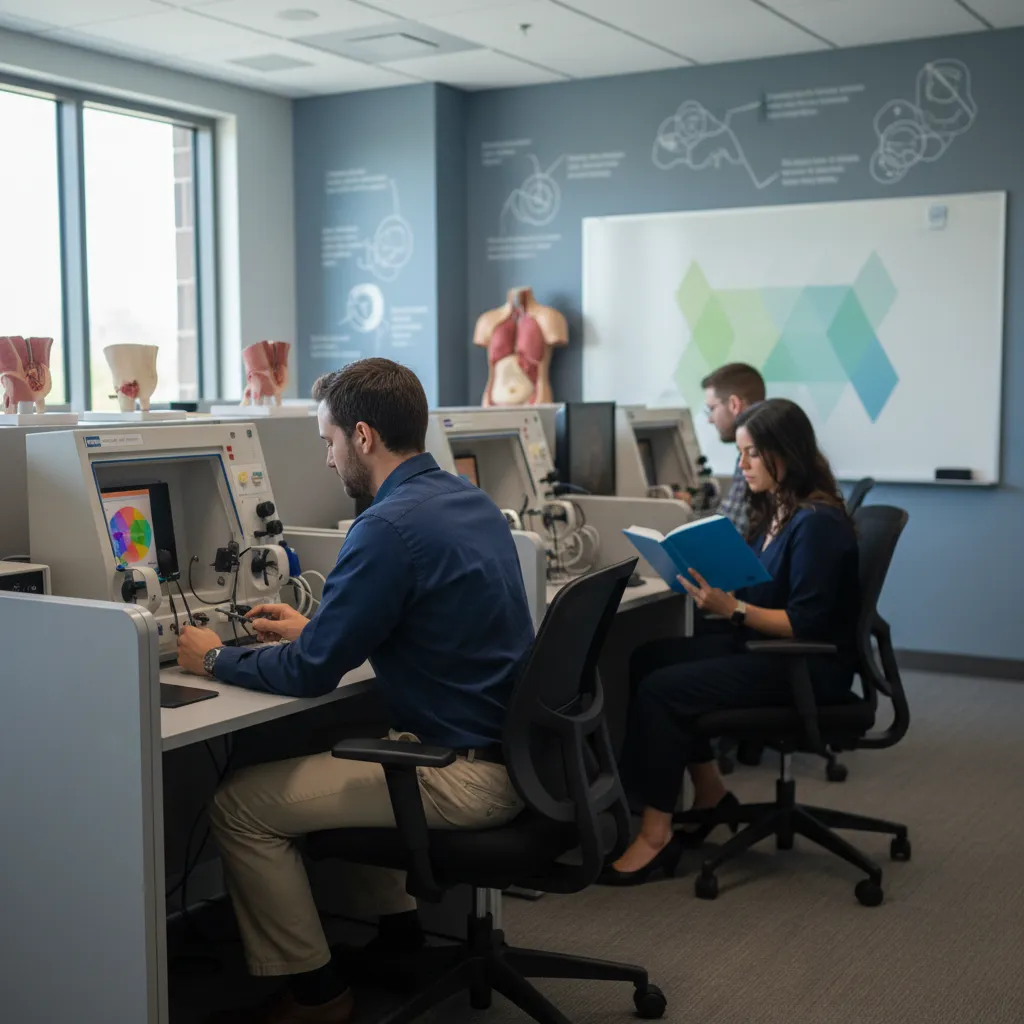
In the FLS exam, candidates must show how well they can do certain tasks quickly and accurately. This is tested using the FLS Laparoscopic Trainer Box. Trainees need to get good at tasks like moving the camera, handling objects, and sewing inside the body. Following the training helps them reach the level they need to pass the FLS exam.
| FLS Exam Requirement | Details |
|---|---|
| FLS Score Requirements | The training program's standards come from how well experts did after five tries at each task. Following this program, all trainees passed the skills part of the FLS exam. |
| Surgical Residency Requirements | Before the end of their third year of training, PGY 3 surgical residents must pass the FLS exam. Passing lets them move on to the next year of their training. |
| Laparoscopic Simulation Training | The FLS training is made for residency programs. It helps trainees reach the level of experts. It suggests using video tutorials for self-training to save on resources. |
| Endoscopic Technical Proficiency | The FLS exam tests how well surgeons can move quickly and accurately in a simulated surgery. It includes tasks like using the camera and sewing that are vital for laparoscopic surgery. |
By deeply studying the FLS modules and practicing manual skills, surgical residents and future laparoscopic surgeons can get ready for the FLS test. Passing this test is key in their surgical training and becoming certified in laparoscopic skills.
FLS Questions and Answers
About the Author
Registered Nurse & Healthcare Educator
Johns Hopkins University School of NursingDr. Sarah Mitchell is a board-certified registered nurse with over 15 years of clinical and academic experience. She completed her PhD in Nursing Science at Johns Hopkins University and has taught NCLEX preparation and clinical skills courses for nursing students across the United States. Her research focuses on evidence-based exam preparation strategies for healthcare certification candidates.