
Free FAA Practice Test 2026 October Federal Aviation Administration
Free FAA practice test with questions and answer explanations. 🧠 Prepare for the 2026 October exam with instant scoring.

- You must first obtain your student pilot certificate and FAA medical certificate. Apply for it by electronically completing your application at the FAA MedXPress system. You can then schedule your appointment with an FAA-approved medical examiner. You’ll have to pass the FAA medical exam to be able to move on to the next steps in getting your license.
- After getting your third-class medical certificate, you must be ready for the cost of training. Most often than not, aspiring pilots go to flight schools.
- You must also get your ground-school training. It will help you learn the FAA rules and regulations.
- After knowing more about the flight rules, you must also take flight training. You need to learn the basics, and as you get a handle on it, you can then learn the more complex maneuvers.
- You are now ready to take the FAA knowledge test. You must be able to pass this written test to be able to do the second one, which is the practical test, also called a check ride.
- If you pass the two tests, you can now hold a private pilot license.
| TEST CODE | TEST NAME | NUMBER OF QUESTIONS | AGE | ALLOTTED TIME | PASSING SCORE |
| PAR | Private Pilot Airplane | 60 | 15 | 2.5 | 70 |
| PAT | Private Pilot Airplane/Recreational Pilot - Transition | 30 | 15 | 1.5 | 70 |
| PBG | Private Pilot Balloon - Gas | 60 | 14 | 2.5 | 70 |
| PBH | Private Pilot Balloon - Hot Air | 60 | 14 | 2.5 | 70 |
| PCH | Private Pilot Helicopter Canadian Conversion | 40 | 16 | 2.0 | 70 |
| PCP | Private Pilot Airplane Canadian Conversion | 40 | 16 | 2.0 | 70 |
| PGL | Private Pilot Glider | 60 | 14 | 2.5 | 70 |
| PGT | Private Pilot Gyroplane/Recreational Pilot - Transition | 30 | 15 | 1.5 | 70 |
| PHT | Private Pilot Helicopter/Recreational Pilot - Transition | 30 | 15 | 1.5 | 70 |
| PLA | Private Pilot Airship | 60 | 15 | 2.5 | 70 |
| PPP | Private Pilot Powered Parachute | 60 | 15 | 2.5 | 70 |
| PRG | Private Pilot Gyroplane | 60 | 15 | 2.5 | 70 |
| PRH | Private Pilot Helicopter | 60 | 15 | 2.5 | 70 |
| PWS | Private Pilot Weight-Shift-Control | 60 | 15 | 2.5 | 70 |
| RPA | Recreational Pilot Airplane | 50 | 15 | 2.0 | 70 |
| RPG | Recreational Pilot Gyroplane | 50 | 15 | 2.0 | 70 |
| RPH | Recreational Pilot Helicopter | 50 | 15 | 2.0 | 70 |
| Aeronautical Knowledge |
|
|
|
|
|
|
|
|
|
|
|
|
|
FAA Registration, Costs and Policies
- graduation certificate from an FAA-approved pilot school or a statement of accomplishment that certifies completion of the ground school portion of a course
- graduation certificate from an FAA-approved pilot school or a statement of accomplishment that certifies completion of the ground school portion of a course from an agency. Examples are colleges, high schools, education programs, Civil Air Patrol, ROTC Flight Training School or the U.S. Armed Forces
- authorized instructor’s written statement or logbook endorsement that certifies that you have completed a ground training or home study course for the applicable rating needed. Also, he/she certifies that you are ready for the knowledge test.
- If you need to retake it, you must bring your unsatisfactory Airman Knowledge Written Test Report (it can either be a failed one or an expired one), or an Aiman Knowledge Computer Test Report.
What are the eligibility requirements for private pilots?
- You must be at least 17 years old for a rating in aircraft other than gliders or balloons.
- You must be at least 16 years old for a rating in gliders or balloons.
- You must be able to speak, write, read, and comprehend the English language. If you are unable to meet these requirements because of medical reasons, the FAA Administrator may be able to place your limitations on your pilot’s certificate. It is required for your safe operation of the aircraft.
- You must obtain a logbook endorsement from your authorized instructor who:
- Supervised your training and reviewed your understanding of the Aeronautical Knowledge areas in Part 61.105 of the Code of Federal Regulations (CFR). It must apply for the aircraft rating needed.
- Certified that you are prepared for the knowledge test.
- You must pass a knowledge test on the Aeronautical Knowledge areas of Part 61. 105 of the CFR.
- You must obtain flight training and a logbook endorsement from your authorized instructor who:
- Supervised your training in the areas of operation in Part 61.107 of the Code of Federal Regulations (CFR). It must apply for the aircraft rating needed.
- Certified that you are prepared for the practical test.
- You must have the requirements for the aeronautical experience. It must apply to the aircraft rating needed before applying for the practical test.
- You must pass the practical test on the areas of operation in Part 61.107 of the CFR.
- You must comply with the proper sections that apply to the class rating and aircraft category needed.
- You must have a U.S. student pilot, sport pilot, or recreational pilot certificate.
3 Things You Should Know to Get Your Private Pilot License
- Enroll yourself in a ground school course. In FAA-certified flight schools, you must always listen to your instructors. You are provided with so many opportunities, and through classroom instruction, you’ll be able to understand better the many topics that comprise the exam.
- If you can’t enroll yourself in a pilot school, then self-study is appropriate too. You can make use of so many study materials. You can prepare for the test with the help of FAA practice tests or FAA private pilot practice tests. With these resources at hand, you’ll be able to figure out which subject matter needs more emphasis.
Practice tests on this site include explanations tied to the FAA's official Airman Certification Standards (ACS) codes, so you can see exactly which knowledge area each question covers.
Many readers pair this guide with the faa practice test to check their readiness before exam day.
Many readers pair this guide with the faa written practice test to check their readiness before exam day.
The FAA exam uses a multiple-choice format with questions covering all major domains. Most versions allow 2-3 hours for completion.
Questions test both knowledge recall and application skills. A score of 70-75% is typically required to pass.

What exactly is the FAA, and what is its function?
The Federal Aviation Administration (FAA) is the U.S. Department of Transportation agency responsible for regulating and overseeing civil aviation in the United States. Its core functions include certifying pilots, aircraft, and mechanics; setting and enforcing safety standards; operating the national air traffic control system; and issuing the regulations (14 CFR) that govern how airplanes, drones, and pilots operate in U.S. airspace.
How to become a certified drone pilot?
To fly a drone commercially (or for most non-recreational purposes) in the U.S., you generally need an FAA Part 107 Remote Pilot Certificate. The process is: be at least 16 years old and able to read, speak, and understand English; register in the FAA's IACRA system; pass the FAA Part 107 Unmanned Aircraft General - Small (UAG) Aeronautical Knowledge Test at an approved testing center; and pass a TSA background check. Purely recreational drone flyers instead take the free, non-graded TRUST (The Recreational UAS Safety Test) and must register any drone over 0.55 lbs with the FAA.
How long is a private pilot written exam good for?
An FAA Airman Knowledge Test report is valid for 24 calendar months from the date you pass it. You must complete the related practical test (checkride) within that 24-month window using that knowledge test report; if it expires first, you'll need to retake the knowledge test.
Is it illegal to fly a drone without FAA registration?
Yes. The FAA requires most drones weighing between 0.55 lbs (250g) and 55 lbs to be registered, whether you fly recreationally or commercially. Recreational flyers register their drone(s) once through FAADroneZone; Part 107 commercial operators register each aircraft individually. Flying a drone that's required to be registered without doing so can result in civil penalties and, in some cases, criminal penalties.
Where can you take the knowledge test for a private pilot license?
FAA Airman Knowledge Tests are administered at FAA-approved, third-party computer testing centers rather than at FAA offices directly. You schedule and pay for your test through the approved testing provider network; your flight school or CFI can point you to the nearest test center. Bring photo ID and your instructor endorsement (or other required authorization) to the appointment.
Is it easy to get FAA approval for drones?
It depends on how you plan to fly. Recreational flyers face a low bar: register the drone and pass the free TRUST safety test. Commercial/Part 107 operation requires more preparation: you must pass a paid, proctored FAA knowledge test covering airspace, regulations, weather, and operations, plus a TSA background check. Neither path is difficult with proper study, but Part 107 does require real preparation, not just registration.
If you fail the knowledge test, will you be able to know which areas need to be studied more for your retest?
Yes. Your Airman Knowledge Test Report breaks down performance by subject-matter code (the same ACS/PLT codes referenced in FAA test question banks), so you can see exactly which knowledge areas you missed and target those before retesting. There is no fixed national waiting period to retest in most cases, but you will need a new instructor endorsement confirming additional study before you can retest.
FAA Practice Test Questions
Prepare for the FAA - Federal Aviation Administration exam with our free practice test modules. Each quiz covers key topics to help you pass on your first try.
FAA Aviation Flight Instrument Rating Exam
FAA Exam Questions covering Aviation Flight Instrument Rating Exam. Master FAA Test concepts for certification prep.
FAA 107 Drone Pilot Test
Free FAA Practice Test featuring 107 Drone Pilot Test. Improve your FAA Exam score with mock test prep.
FAA Aircraft Performance Test
FAA Mock Exam on Aircraft Performance Test. FAA Study Guide questions to pass on your first try.
FAA Airspace and Weather Minimums Test
FAA Test Prep for Airspace and Weather Minimums Test. Practice FAA Quiz questions and boost your score.
FAA Communications and Radar Services
FAA Questions and Answers on Communications and Radar Services. Free FAA practice for exam readiness.
FAA Cross-Country Planning Test
FAA Mock Test covering Cross-Country Planning Test. Online FAA Test practice with instant feedback.
FAA Electronic Navigation Exam
Free FAA Quiz on Electronic Navigation Exam. FAA Exam prep questions with detailed explanations.
FAA Federal Aviation Regulations Test
FAA Practice Questions for Federal Aviation Regulations Test. Build confidence for your FAA certification exam.
FAA Flight Instrument Test
FAA Test Online for Flight Instrument Test. Free practice with instant results and feedback.
FAA Flight Operations Test
FAA Study Material on Flight Operations Test. Prepare effectively with real exam-style questions.
FAA Private Pilot Exam
Free FAA Test covering Private Pilot Exam. Practice and track your FAA exam readiness.
FAA Private Pilot Weather Test
FAA Exam Questions covering Private Pilot Weather Test. Master FAA Test concepts for certification prep.
FAA: Pros and Cons
- +FAA exam preparation strengthens your knowledge across all domains
- +Passing the exam proves competency to employers and clients
- +Study materials and practice tests are widely available
- +Exam-based credentials are portable across states and employers
- +Clear exam objectives help focus your study plan effectively
- −Exam anxiety can affect performance — practice tests help reduce it
- −Registration fees are non-refundable if you miss your test date
- −Limited retake opportunities may apply with waiting periods
- −Exam content updates periodically — use current study materials
- −Testing center availability may require advance scheduling
Sample FAA Practice Questions
Try these questions from our free FAA practice tests. The correct answer and an explanation follow each question.
Small unmanned aircraft systems are subject to registration requirements. When must a person register a small UA with the Federal Aviation Administration, according to 14 CFR part 48?
- A. All civilian small UAS weighing greater than .55 pounds must be registered regardless of its intended use.
- B. Only when the operator will be paid for commercial services.
- C. When the small UA is used for any purpose other than as a model aircraft.
Answer: A. All civilian small UAS weighing greater than .55 pounds must be registered regardless of its intended use.
According to 14 CFR Part 48, any small unmanned aircraft (sUAS) weighing 0.55 pounds (250 grams) or more must be registered with the FAA. This requirement applies to all civilian operators, whether the drone is used for recreational purposes or commercial operations. The registration ensures accountability and helps the FAA maintain a record of drones operating in the national airspace.
What should pilots state when telephoning a weather briefing facility for preflight weather information?
- A. The intended route of flight radio frequencies.
- B. The intended route of flight and destination.
- C. The address of the pilot in command.
Answer: B. The intended route of flight and destination.
When telephoning a weather briefing facility for preflight weather information, pilots should clearly state their intended route of flight and destination. This crucial information allows the briefer to provide the most relevant and accurate weather data, including en route conditions, destination forecasts, and any pertinent advisories or NOTAMs along the planned path. Providing this context ensures a comprehensive and tailored briefing.
When departing behind a heavy aircraft, the pilot should avoid wake turbulence by maneuvering the aircraft
- A. below and downwind from the heavy aircraft.
- B. above and upwind from the heavy aircraft.
- C. below and upwind from the heavy aircraft.
Answer: B. above and upwind from the heavy aircraft.
To avoid wake turbulence, which sinks and moves with the wind, a pilot should maneuver their aircraft above and upwind from the heavy aircraft's flight path. This strategy places the aircraft clear of the descending and drifting vortices, minimizing the risk of encountering hazardous turbulence.
A pilot can expect a wind-shear zone in a temperature inversion whenever the windspeed at 2,000 to 4,000 feet above the surface is at least
- A. 10 knots.
- B. 15 knots.
- C. 25 knots.
Answer: C. 25 knots.
FAA guidelines indicate that a wind shear zone can be expected in a temperature inversion when the wind speed at 2,000 to 4,000 feet above the surface is at least 25 knots. This significant difference in wind speed across the stable inversion layer creates strong shear forces. Such conditions pose a hazard to aircraft due to abrupt changes in airspeed and attitude.
FAA Questions and Answers
About the Author
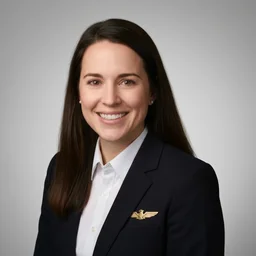
Commercial Pilot & FAA Certification Specialist
Embry-Riddle Aeronautical UniversityCaptain Jennifer Walsh graduated with honors in Aerospace Engineering from Embry-Riddle Aeronautical University and holds FAA Airframe & Powerplant and Airline Transport Pilot certificates. With 11 years of commercial aviation experience and 6 years as a ground school instructor, she guides aviation mechanics and student pilots through FAA written exams and practical tests.
Join the Discussion
Connect with other students preparing for this exam. Share tips, ask questions, and get advice from people who have been there.
View discussion (9 replies)