
F80 Test — Complete Guide 2026 October
Prepare for the F80 certification. 📗 Practice questions with answer explanations covering all exam domains.

What Is the F80 Firefighter Test?
The F80 is an entry-level firefighter written examination used by municipal and county fire departments during their hiring process. It is published by fire service testing organizations and assesses the cognitive aptitudes and applied reasoning skills most predictive of success in firefighter training programs and on-the-job performance.
The F80 is a cognitive ability and applied reasoning test — it does not require prior firefighting experience or technical fire suppression knowledge. Instead, it measures the mental skills that allow firefighters to learn quickly, reason clearly under pressure, read and follow written instructions, and make sound judgments in emergency scenarios.
Key characteristics:
- Multiple choice written examination
- Timed — administered in a standardized testing session
- Tests reading comprehension, math, logical reasoning, and situational judgment
- No prior firefighting knowledge required
- Scores used to rank candidates on an eligibility list
Practice with our f80 practice test resources covering all F80 cognitive sections in the exam format used by fire departments.
F80 Test — Sections Explained
The F80 firefighter test typically covers these cognitive aptitude areas:
1. Reading Comprehension:
You will be given written passages — similar to fire department standard operating procedures (SOPs), safety guidelines, or training materials — and asked to answer questions based on the text. This tests your ability to accurately read and understand complex written information: a critical firefighter skill for following orders, understanding incident command communications, and reading hazmat placards. Answer only based on what the passage states.
2. Applied Mathematics:
Arithmetic operations, fractions and percentages, measurement conversions, area and volume calculations, and ratio/proportion problems. Many questions use applied scenarios (e.g., calculating hose lengths, water flow rates, or ladder positions). Math operations at the pre-algebra level are sufficient — the test does not require calculus or advanced mathematics.
3. Logical and Mechanical Reasoning:
Tests your ability to identify patterns, follow sequences, and apply logical rules — including some spatial reasoning items. Mechanical reasoning questions assess basic understanding of levers, pulleys, gears, and physical force — relevant to operating firefighting equipment.
4. Situational Judgment / Firefighter Judgment:
Scenario-based questions that assess how you would respond in realistic firefighter situations — how you prioritize competing demands, follow the chain of command, and handle interpersonal situations in a fire station or on scene. These questions test values and judgment alignment with fire service standards. For section practice, see our f80 practice test and our firefighter exam preparation guide.
For a fuller set of questions on this topic, see our f80 practice test resource.

F80 Test Preparation Checklist
- ✓Practice reading comprehension with complex written passages — answer only based on what the text states, not outside knowledge
- ✓Review arithmetic: percentages, fractions, ratios, measurement conversions, area and volume
- ✓Study basic mechanical concepts: levers, pulleys, gears, force, and pressure
- ✓Practice logical reasoning and pattern recognition under timed conditions
- ✓Study firefighter situational judgment: chain of command, prioritizing life safety, teamwork and communication principles
- ✓Take full-length timed practice tests under realistic testing conditions
- ✓Aim for 85%+ on practice exams to give yourself a strong performance buffer above the passing threshold
- ✓Check your specific department's F80 announcement — some departments weight sections differently or add department-specific questions
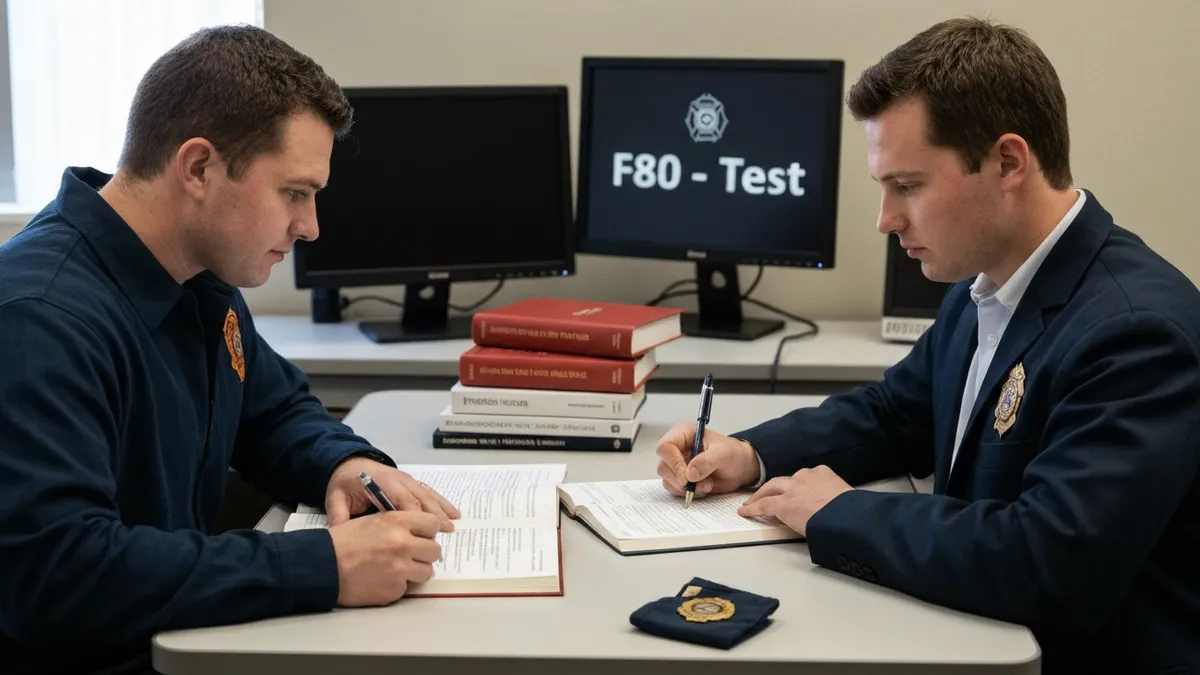
F80 Test Pros and Cons
- +F80 has a defined, publicly available content blueprint — candidates know exactly what to prepare for
- +Multiple preparation pathways (self-study, courses, coaching) accommodate different learning styles and schedules
- +A growing ecosystem of study resources means candidates at any budget level can access quality preparation materials
- +Clear score reporting allows candidates to identify specific strengths and weaknesses for targeted remediation
- +Professional recognition associated with strong performance provides tangible career and academic benefits
- −The scope of tested content requires substantial preparation time that competes with existing professional or academic commitments
- −No single resource covers the full content scope — candidates typically need multiple study tools for comprehensive preparation
- −Test anxiety and exam-day performance variability mean preparation effort does not always translate linearly to scores
- −Registration, preparation, and potential retake costs accumulate into a significant financial investment
- −Content and format can change between exam versions, making older preparation materials less reliable
Pros and Cons at a Glance
| Pros | Cons |
|---|---|
| Multiple preparation pathways (self-study, courses, coaching) accommodate different learning styles and schedules | The scope of tested content requires substantial preparation time that competes with existing professional or academic commitments |
| A growing ecosystem of study resources means candidates at any budget level can access quality preparation materials | No single resource covers the full content scope — candidates typically need multiple study tools for comprehensive preparation |
| Clear score reporting allows candidates to identify specific strengths and weaknesses for targeted remediation | Test anxiety and exam-day performance variability mean preparation effort does not always translate linearly to scores |
| Professional recognition associated with strong performance provides tangible career and academic benefits | Registration, preparation, and potential retake costs accumulate into a significant financial investment |
Sample F80 Practice Questions
Try these questions from our free F80 practice tests. The correct answer and an explanation follow each question.
Which type of sprinkler head activates only at the individual head directly exposed to sufficient heat?
- A. Deluge open-head sprinkler
- B. Pre-action system head
- C. Closed-head sprinkler with a fusible link or glass bulb
- D. Foam-water sprinkler head
Answer: C. Closed-head sprinkler with a fusible link or glass bulb
Closed-head sprinklers activate individually only when their fusible link or glass bulb is exposed to enough heat, limiting water discharge to the fire area.
During a lockdown emergency, what is the correct protocol when someone knocks on the locked door?
- A. Open the door only if the person identifies themselves verbally
- B. Do not open the door until an all-clear is given by official authority
- C. Open the door if a known employee is visible through the window
- D. Open the door if two or more people are requesting entry
Answer: B. Do not open the door until an all-clear is given by official authority
Once lockdown is initiated, doors must remain locked until official all-clear is communicated — even for seemingly familiar individuals.
What does the NEC require regarding arc-fault circuit interrupter (AFCI) protection in a newly constructed single-family dwelling?
- A. AFCI protection is required for kitchen circuits only
- B. AFCI protection is required for all 120-volt, 15- and 20-ampere branch circuits in all rooms
- C. AFCI protection is required only for bedroom circuits
- D. AFCI protection is optional in single-family dwellings
Answer: B. AFCI protection is required for all 120-volt, 15- and 20-ampere branch circuits in all rooms
NEC 210.12(A) now requires combination-type AFCI protection for all 120-volt, 15- and 20-ampere branch circuits throughout dwelling units.
When activating an emergency operations plan, which step should be taken FIRST?
- A. Deploy all available resources immediately
- B. Notify the incident commander and establish command
- C. Begin evacuating the affected area
- D. Contact media for public announcements
Answer: B. Notify the incident commander and establish command
Establishing incident command and notifying the incident commander is the first step, as all subsequent actions are coordinated through the command structure.
F80 Test Questions and Answers



About the Author

Educational Psychologist & Academic Test Preparation Expert
Columbia University Teachers CollegeDr. Lisa Patel holds a Doctorate in Education from Columbia University Teachers College and has spent 17 years researching standardized test design and academic assessment. She has developed preparation programs for SAT, ACT, GRE, LSAT, UCAT, and numerous professional licensing exams, helping students of all backgrounds achieve their target scores.