
Theory Test Questions: Complete DVSA Guide to Passing First Time 2026 October
Master DVSA theory test questions with our complete guide. Practice all 14 topics, learn the format, and pass first time with proven study tactics. 📝
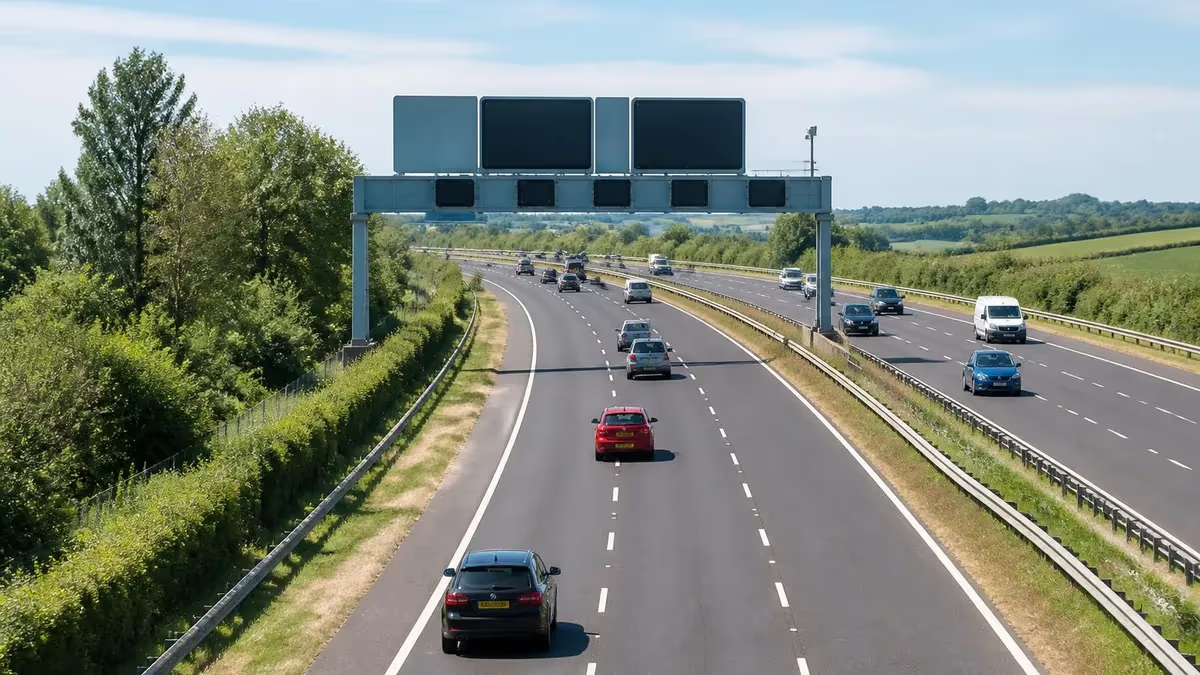
Theory test questions are the cornerstone of UK driving certification, and mastering them is the first major hurdle every learner must clear before booking a practical test. The Driver and Vehicle Standards Agency (DVSA) draws from a bank of around 1,000 multiple-choice questions, covering everything from road signs and safety margins to vehicle handling and environmental driving. Understanding how these questions are structured, why they are asked, and what the examiner expects from your answers transforms revision from a memory exercise into a genuine understanding of safer roads.
The current theory test has two distinct parts: a multiple-choice section with 50 questions, and a hazard perception section featuring 14 video clips. Candidates must score at least 43 out of 50 on the multiple-choice and 44 out of 75 on the hazard perception to pass overall. Both elements are taken in one sitting at an official DVSA test centre, and the total time allowed is around 57 minutes for multiple-choice plus a hazard perception section that runs roughly 20 minutes including instruction.
What makes theory test questions particularly challenging is the breadth of the syllabus. You can be asked about anti-lock braking systems, the typical stopping distance at 60 mph in wet weather, how to react if a tyre blows out, or what specific road markings on a motorway slip road mean. The questions are deliberately mixed across topics within a single test, so you cannot rely on revising one category and ignoring the others. Comprehensive preparation across all 14 subject areas is the only reliable route to a confident pass.
Despite the breadth, the test is absolutely passable with structured revision. The official DVSA pass rate for the theory test hovers around 47-50% nationally, which sounds low until you discover that the majority of failures come from under-preparation rather than the test being unfair. Learners who study for at least 20-25 hours, practise mock tests regularly, and review their wrong answers tend to pass on their first attempt. Choosing a good Driving School UK: How to Choose, Costs, and What to Expect can complement self-study with structured teaching.
This guide walks you through everything you need to know about theory test questions: the format, the topics, how to revise, what the marking criteria are, what to do on test day, and the most common mistakes that catch out otherwise well-prepared candidates. We have also included practical study schedules, mock exam strategies, and FAQ answers to the questions DVSA learners ask most often. Whether you are starting from zero or revising for a retake, this is your single-source playbook.
The reason the DVSA theory test exists is not bureaucratic. Modern roads demand drivers who understand the rules and can predict how other road users will behave. Hazard perception in particular is designed to test something that cannot be learned by rote: anticipation. A driver who can spot a developing hazard half a second sooner is statistically far less likely to be involved in a serious collision. So while the test feels like a hoop to jump through, it is genuinely teaching skills that will save lives, including your own.
Throughout this article, you will find practice quiz tiles linking to free DVSA-style mock tests covering specific topics. Use them as you read — answering five or ten questions on a topic immediately after revising it locks in retention far more effectively than passive reading alone. Bookmark this page and revisit each section as you progress through your revision timeline.
DVSA Theory Test by the Numbers
Key Facts at a Glance
| Item | Value | Details |
|---|---|---|
| Multiple-Choice Questions | 50 | 43 needed to pass |
| Time Allowed | 57 min | For multiple-choice section |
| Test Fee | £23 | Cars and motorcycles |
How the Theory Test Is Structured
50 questions drawn from the DVSA question bank covering 14 topic areas. You have 57 minutes, can flag questions to revisit, and need at least 43 correct to pass this section.
14 video clips of real driving scenarios, each containing at least one developing hazard. You score 0-5 points per clip depending on how early you click, with a maximum 75 points available.
Between the two sections you get an optional break of up to three minutes. Use it to clear your head, drink some water, and reset focus before the hazard perception clips begin.
Your result is printed at the test centre within minutes of finishing. Pass and you receive a theory test pass certificate valid for two years. Fail and you can rebook after three working days.
Your theory pass certificate is valid for exactly 24 months. If you have not passed your practical test within that window, you must sit the theory test again before continuing.
The 14 official DVSA topic areas form the syllabus that every theory test question is built from. They are: alertness, attitude, safety and your vehicle, safety margins, hazard awareness, vulnerable road users, other types of vehicle, vehicle handling, motorway rules, rules of the road, road and traffic signs, documents, incidents accidents and first aid, and vehicle loading. Each topic contributes roughly proportionally to the multiple-choice section, although signs and hazard awareness tend to appear slightly more frequently than the rest.
Alertness focuses on concentration, observation, and avoiding distraction. Questions typically test whether you understand how fatigue, mobile phones, eating, or in-car entertainment affect reaction time. You will be asked about mirror checks, blind spots, and the lifesaver glance over the shoulder before manoeuvres. Attitude questions explore courtesy and patience: how to respond to aggressive drivers, when to use your horn, why you should never tailgate, and how to handle being overtaken on a single carriageway.
Safety and your vehicle is heavy on mechanical knowledge. Expect questions about tyre tread depth (1.6 mm minimum across the central three-quarters), brake fluid, engine oil, tyre pressures, and basic fault diagnosis. Safety margins covers stopping distances at different speeds, weather effects on grip, and following distances. Memorising the typical stopping distances at 20, 30, 40, 50, 60 and 70 mph is essential because these numbers appear in multiple question variants throughout the bank.
Hazard awareness teaches anticipation: recognising clues that something might happen before it does. A parked van with its hazard lights on near a school, a ball rolling into the road, a cyclist looking over their shoulder — these are all developing hazards you must learn to interpret. This topic overlaps directly with the hazard perception video section, so revising it twice pays off. The Hazard Perception Test: Complete DVSA Guide to Passing First Time guide goes deeper into the video clip element specifically.
Vulnerable road users focuses on pedestrians, cyclists, motorcyclists, horse riders, and elderly or disabled people. Questions test how much room to give, when to expect them, and how to predict their behaviour. Other types of vehicle covers buses, lorries, trams, and emergency vehicles. You need to understand why a lorry needs more room to turn left, why you should never undertake a bus pulling away from a stop, and how to react to a tram emerging from a side road.
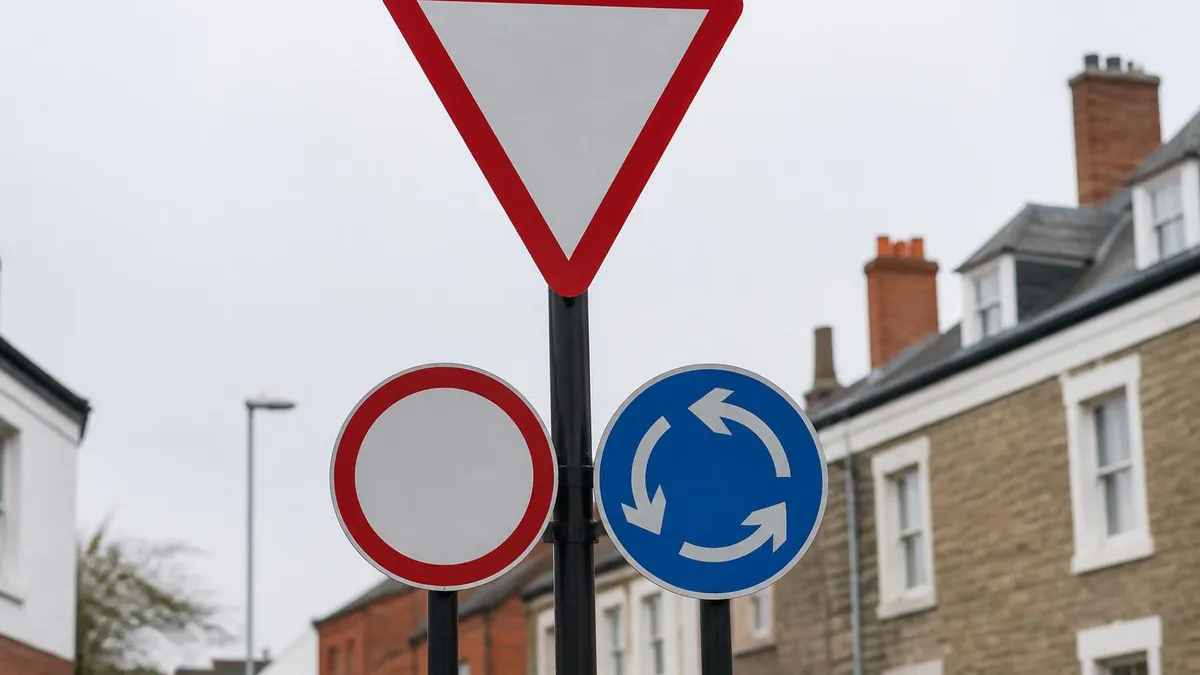
Vehicle handling is about controlling the car in different conditions: skids, aquaplaning, hill starts, parking on slopes, and driving in fog or snow. Motorway rules test your knowledge of lane discipline, joining and leaving the motorway, hard shoulder use, smart motorway gantry signals, and emergency procedures. Rules of the road covers speed limits, parking restrictions, box junctions, level crossings, and right of way. Road and traffic signs is the largest single topic with around 130 signs you must recognise instantly.
Documents covers licences, insurance, MOT, V5C and vehicle tax. You must know what a provisional licence allows, the difference between third-party and comprehensive insurance, and the penalties for driving without valid documents. Incidents accidents and first aid teaches what to do at a crash scene: warning other traffic, helping casualties, the recovery position, and when to move an injured person (the answer is almost always never, unless there is fire). Vehicle loading covers towing, roof racks, securing loads, and the licence requirements for trailers.
DVSA Practice Test Questions
Prepare for the DVSA - UK Driving Theory Test exam with our free practice test modules. Each quiz covers key topics to help you pass on your first try.
DVSA Eco-Friendly Driving and Vehicle Loading
DVSA Exam Questions covering Eco-Friendly Driving and Vehicle Loading. Master DVSA Test concepts for certification prep.
DVSA Hazard Awareness
Free DVSA Practice Test featuring Hazard Awareness. Improve your DVSA Exam score with mock test prep.
DVSA Incidents, Accidents and First Aid
DVSA Mock Exam on Incidents, Accidents and First Aid. DVSA Study Guide questions to pass on your first try.
DVSA Motorway Rules and Smart Motorways
DVSA Test Prep for Motorway Rules and Smart Motorways. Practice DVSA Quiz questions and boost your score.
DVSA Rules of the Road (Highway Code)
DVSA Questions and Answers on Rules of the Road (Highway Code). Free DVSA practice for exam readiness.
DVSA - UK Driving Theory Hazard Awareness ...
DVSA Mock Test covering - UK Driving Theory Hazard Awareness and Perception. Online DVSA Test practice with instant feedback.
DVSA - UK Driving Theory Motorway Rules an...
Free DVSA Quiz on - UK Driving Theory Motorway Rules and Regulations. DVSA Exam prep questions with detailed explanations.
DVSA - UK Driving Theory Road and Traffic ...
DVSA Practice Questions for - UK Driving Theory Road and Traffic Signs. Build confidence for your DVSA certification exam.
DVSA - UK Driving Theory Rules of the Road
DVSA Test Online for - UK Driving Theory Rules of the Road. Free practice with instant results and feedback.
Theory Test Question Types Explained
The most common question type asks for one correct answer from four options. You will see a question, four possible answers, and a radio button next to each. Only one is correct, and choosing more than one is impossible because the format prevents it. These questions test factual recall: speed limits, signage meanings, document validity periods, and similar concrete facts.
Single-answer questions reward precise knowledge. There is no partial credit, so reading every option carefully matters. Examiners often place a plausible-but-wrong distractor first to catch rushed candidates. Always read all four options before clicking, and use the flag function to come back to anything you are not sure about. About 80 per cent of the multiple-choice section uses this format.
Self-Study vs Driving School Theory Prep
- +Self-study with the official DVSA app is significantly cheaper than instructor-led theory sessions
- +You can revise at your own pace and fit study around work or school
- +The official DVSA revision app uses the exact question bank you will see in the test
- +Mock tests provide instant feedback so you learn which topics need more work
- +You can repeat hazard perception clips unlimited times until you spot patterns
- +Most learners pass first time using only self-study materials and free practice apps
- −Self-discipline is required to stick to a revision schedule without external accountability
- −Some learners struggle to interpret complex signage questions without a teacher to explain
- −Hazard perception scoring is hard to self-diagnose without instructor feedback on timing
- −Anxious test-takers may benefit from the structure a driving school provides
- −Difficult mechanical questions on tyre wear or ABS can be confusing without practical demonstration
- −No one is checking your weak topics — you have to be honest with yourself about gaps
Theory Test Revision Checklist
- ✓Download the official DVSA Theory Test Kit app or buy the printed Highway Code
- ✓Read every page of the Highway Code at least once before starting mock tests
- ✓Memorise all stopping distances from 20 mph to 70 mph in dry conditions
- ✓Learn every warning, regulatory, and information road sign by heart
- ✓Take a full mock test at least once a week leading up to your booking
- ✓Review every incorrect answer and read the explanation, not just the right answer
- ✓Practise hazard perception clips on at least three separate study sessions
- ✓Score consistently above 45 out of 50 on mock tests before booking the real exam
- ✓Know your test centre location and plan to arrive 15 minutes early
- ✓Bring your provisional driving licence on test day — no licence, no test
Quality beats quantity every time
Candidates who score 47+ on mock tests for three consecutive sessions pass the real exam over 90 per cent of the time. Do not book your test until you are consistently passing mocks comfortably — the £23 fee plus the wait for a retake is a false economy if you book too early.
The most common mistakes on theory test questions are not about knowledge gaps but about technique and mindset. Many candidates know the material reasonably well yet still fail because they rush, panic, or misread questions. Understanding the patterns of failure is half the battle. By recognising the traps in advance, you give yourself a significant advantage over the candidate who simply revises facts in isolation. This section walks through the errors examiners and instructors see again and again.
Misreading questions is the number one cause of lost marks. Examiners deliberately use precise wording, and a single word change can flip the correct answer. The classic example is the difference between you should and you must. Should is advisory; must indicates a legal requirement. Confusing the two leads to wrong answers on questions about overtaking, parking, and signage. Always read the question stem twice, paying particular attention to negative phrasing like which of these is NOT a sign of fatigue.
Panicking under time pressure is another major source of failure. The 57-minute multiple-choice section actually allows generous time — roughly 68 seconds per question on average. Yet candidates frequently rush and finish in 25 minutes, then sit nervously. Use the time. Read every question carefully, flag anything uncertain, and review flagged questions at the end. There is no reward for finishing fast, only for finishing correctly. Aim to spend the full hour if needed.
Over-relying on memorisation without understanding causes problems too. Some learners memorise individual practice questions and their answers verbatim. When the real test rephrases the same concept slightly, they freeze because the wording is unfamiliar. The DVSA constantly refreshes question wording precisely to prevent this. Focus on understanding why an answer is correct, not just what the answer is. If you understand the principle, you can answer any variant of the question.
Ignoring hazard perception practice until the last minute is a frequent and costly error. Some candidates spend weeks on the multiple-choice section then sit hazard perception cold. The two sections are equally important — fail either one and you fail the whole test. Hazard perception is a skill that needs developing over time. Watching 20 or 30 official-style clips with a pause to reflect on timing each time builds the instinct examiners are looking for. Start practising hazard perception in week one.
Booking the test too early is the most expensive mistake. Some learners book the exam before they have even started revising, hoping the deadline will motivate them. It rarely does. Instead it creates anxiety, often leads to a fail, and costs another £23 to rebook plus weeks of waiting. Book only when your mock test scores are consistently above 45 out of 50. The Free Theory Test resources are perfect for confirming you are ready.
Finally, neglecting sleep and food before the test is surprisingly common. The theory test is mentally demanding — you are concentrating hard for around 80 minutes total. A tired, hungry, or dehydrated brain makes more mistakes. Sleep at least seven hours the night before. Eat a balanced meal beforehand, avoiding too much caffeine which can spike anxiety. Bring a bottle of water for the three-minute break between sections. Small physical preparations have outsized effects on performance.
Some websites and apps claim to publish the exact questions from the live test. This is not legal and the DVSA actively refreshes the bank to neutralise leaked content. Stick to the official DVSA Theory Test Kit app and reputable practice providers. Using cheat sheets risks giving you outdated questions and undermines real understanding.
Test day strategy starts the evening before. Lay out your provisional licence, confirmation email, and any glasses or contact lenses you need. Plan your route to the test centre and add 20 minutes to your estimated journey time as a buffer for traffic or parking. Most centres are in town centres or business parks with limited parking, so arriving early is essential. If you are unfamiliar with the area, drive past the centre a day or two earlier so you know exactly where to go on the morning of the test.
On the morning itself, eat a balanced breakfast — eggs, porridge, fruit — to maintain steady blood sugar. Avoid heavy carbohydrates that cause an energy dip. Drink water but not so much that you need the toilet halfway through. Arrive at the centre at least 15 minutes before your slot. You will be checked in, asked to leave bags in a locker, photographed for security, and signed in at the test workstation. The whole check-in process takes around ten minutes.
Once seated at the workstation, you have an optional 15-minute practice session with sample questions. Take this. It familiarises you with the touchscreen interface, the flag function, and the layout of the answer buttons. The practice does not count toward your result but settles your nerves and removes one source of confusion. When the real test begins, the screen will tell you clearly that scoring has started. The 57-minute timer starts at that point.
Pace yourself by aiming to finish all 50 questions within 45 minutes, leaving 12 minutes to review flagged questions. After reaching question 50, the system shows your flagged list so you can revisit each one. Do not change answers without good reason — your first instinct is usually correct unless you spot a clear reading error. When you are satisfied, submit and move to the optional three-minute break. Use it to stretch, breathe deeply, and drink water before the hazard perception begins.
The hazard perception section starts with a short tutorial video that explains the scoring. Watch it carefully even if you have practised at home, because the instructions are sometimes phrased slightly differently. You will then see 14 clips. Click the mouse button once you see a developing hazard — something that would cause you to take action. Click again if the hazard worsens or another hazard appears. Do not click randomly or repeatedly, as this triggers anti-cheat detection and zeroes your score for that clip.
One of the 14 clips contains two scoring hazards instead of one. This is the only clip where five points per hazard is possible — meaning that single clip is worth more attention. You are not told which clip it is, so treat every clip as if it could be the double-scorer. After all 14 clips finish, the test is over. You will be directed back to reception where your overall result is printed. Pass certificates are issued instantly and valid for two years.
If you fail, do not despair. The result printout tells you which section let you down and which topic areas you scored lowest on. Use this diagnostic to target your re-revision. You must wait at least three working days before retaking the test, and most candidates who fail first time pass on their second attempt with focused revision.
Keep practising with mock tests until your scores are consistently strong, and book the retake only when you are genuinely ready. Combining theory revision with structured Driving Theory Test Practice: How to Study and Pass First Time sessions gives you the best chance of clearing it on the next attempt.
Final preparation in the last week before your test should focus on consolidation rather than learning new material. By this point you should have covered all 14 topics at least twice and taken several full mock papers. The goal of the final week is to plug remaining gaps and build confidence. Identify the two or three topics where you have scored lowest in mock tests and dedicate an hour each to revisiting them. Avoid the temptation to start a new study book — last-minute new information tends to confuse rather than help.
Sleep is your secret weapon. Memory consolidation happens during deep sleep, particularly in the days immediately before recall is needed. Aim for at least seven hours of sleep every night in the final week. Avoid late-night cramming sessions, which research consistently shows damage rather than improve performance. A well-rested brain processes question wording faster, spots negative phrasing more reliably, and panics less when faced with an unfamiliar question variation. Treat sleep as part of your revision plan, not a luxury.
Use spaced repetition for the final review. Instead of re-reading entire topics, take a 50-question mock test each day for the final five days. After each mock, spend 20 minutes reviewing only the questions you got wrong and the ones you guessed correctly. This focuses your mind on weak points without exhausting you. Aim to score 47+ on each mock by the day before the test. If you are still scoring below 45 the day before, consider rescheduling — better a small fee to move the date than wasting an attempt.
Hazard perception requires its own focused finish. Watch at least ten clips in the final three days, ideally five per session. Pause after each clip and reflect on when you clicked. Were you too early, anticipating a hazard before it actually developed? Or too late, only clicking once the hazard was obvious?
The scoring window opens when the hazard is just beginning to develop. Clicking too early gives zero points; clicking too late also gives reduced points. The sweet spot is roughly half a second after you would naturally start to react in real driving. Daily Hazard Perception Practice: Pass the DVSA HPT First Time sessions sharpen this instinct dramatically.
Mental rehearsal is underrated. The night before, spend ten minutes visualising the test centre, sitting at the workstation, reading questions calmly, flagging uncertain ones, and finishing with time to review. Sports psychologists call this performance imagery and it measurably reduces test-day anxiety. The brain finds it easier to perform a task it has already imagined performing successfully. Pair this with slow breathing — four seconds in, six seconds out, for two minutes — to lower your resting heart rate before bed.
On the morning itself, avoid screens until you arrive at the test centre. Scrolling social media or checking emails fragments your attention before you need it most. Eat breakfast, drink water, walk to the car or station, and listen to calm music on the journey. Some candidates like to play a final 20-question mock on the way to the centre to warm up; others find this raises anxiety. Know yourself. Whatever pre-test routine works for you, repeat it. Familiarity reduces stress and lets you focus on the questions rather than your environment.
When the test is finished and the pass certificate is in your hand, the practical test booking opens immediately. The two-year clock starts ticking on your theory pass, so book the practical as soon as you can. Many learners leave a small gap to take a few practical lessons covering manoeuvres and the show me, tell me questions, but extended delays are risky because your theory knowledge fades.
Aim to take the practical within six months of passing the theory while everything is still fresh. Good luck — with the preparation outlined in this guide, you have every chance of passing first time.
DVSA Questions and Answers
About the Author

Licensed Driving Instructor & DMV Test Specialist
Penn State UniversityRobert J. Williams graduated from Penn State University with a degree in Transportation Management and has spent 20 years as a certified driving instructor and DMV examiner consultant. He has personally coached thousands of applicants through written knowledge tests, skills assessments, and commercial driver licensing programs across more than 30 states.