
Gov Show Me Tell Me Questions: The Complete DVSA Guide for 2026 June
Master gov show me tell me questions for your practical driving test. Full list, expert tips & free practice. ✅ Updated for 2026 June.
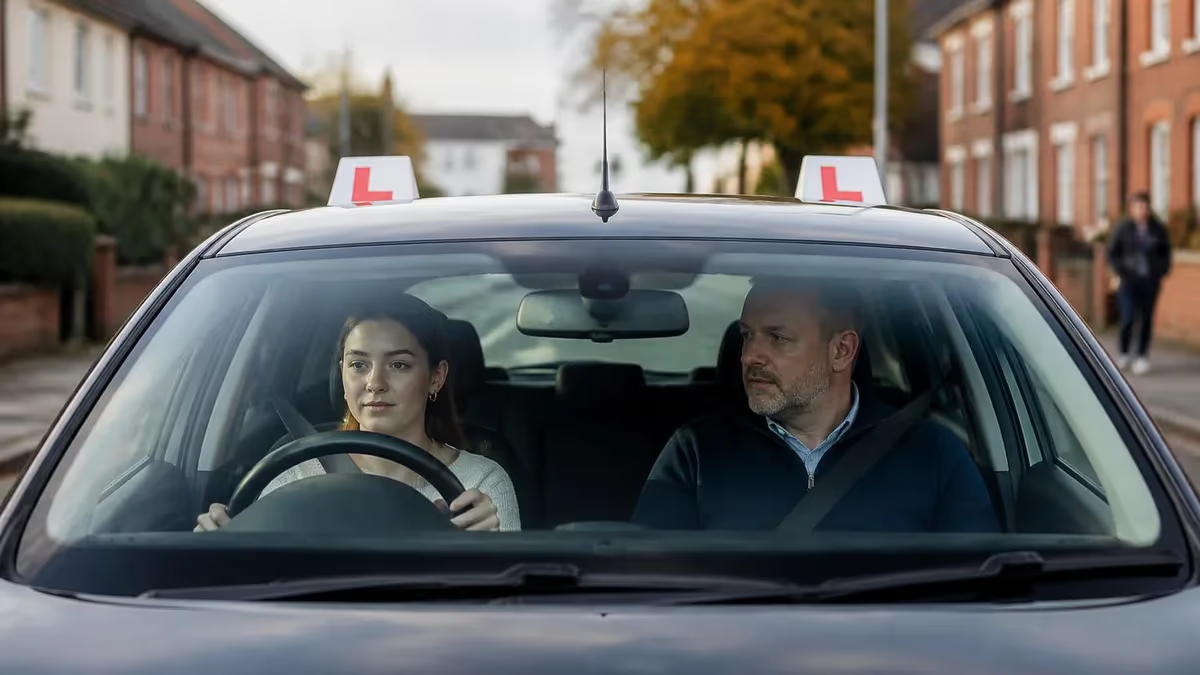
The gov show me tell me questions are a compulsory part of every DVSA practical driving test in the UK, and understanding them thoroughly can mean the difference between a first-time pass and an unnecessary failure. These questions are asked by your examiner at the very beginning of your test, before you have driven a single metre. The 'tell me' question is answered verbally while you are still stationary, and the 'show me' question is demonstrated while you drive during the test itself. Both test your ability to carry out basic vehicle safety checks that any responsible driver should know.
Introduced to ensure that new drivers have genuine knowledge of vehicle maintenance and safety, the show me tell me questions cover areas such as engine oil levels, tyre pressure, headlights, brake fluid, and power-assisted steering. The DVSA updates the official question bank periodically, and as of 2026, there are 19 tell me questions and 19 show me questions — giving 361 possible combinations that an examiner can draw from. Knowing all of them is the safest strategy, but understanding the principles behind vehicle safety will make every answer feel natural and logical rather than rote-learned.
Many learner drivers underestimate this portion of the test because it is not a separate exam — it takes up only a few minutes of the overall assessment. However, a wrong answer to the 'tell me' question counts as one driving fault, and a wrong answer to the 'show me' question also counts as one driving fault.
If you answer both incorrectly, you immediately begin your test with two driving faults already recorded. That may not end your test outright, but it creates pressure and leaves less room for any minor errors during the drive itself, so arriving fully prepared is absolutely essential.
Preparation for these questions should begin well before test day. Most driving instructors will run through the full list during lessons, but self-study using the official DVSA materials and reliable online resources can dramatically accelerate your confidence.
Flashcard-style revision works particularly well because the questions follow a consistent format, and repetition is the most effective method for memorising what to look for under the bonnet or in the driver's cockpit. Practical hands-on practice — actually opening the bonnet and identifying the dipstick, the coolant reservoir, and the brake fluid cap — reinforces the verbal answers far more effectively than reading alone.
It is also worth understanding the context behind each question. The DVSA designs them to reflect the everyday responsibilities of a licensed driver. Checking your oil before a long journey, ensuring your tyres are at the correct pressure, and knowing how to identify a brake fluid warning light are not just test requirements — they are skills that keep you and other road users safe throughout your driving life. Framing your revision around this practical purpose makes the material more engaging and helps answers come naturally under the pressure of the test environment.
If you are currently preparing for your practical driving test and are looking for ways to structure your revision, you will find it helpful to explore our show me tell me questions resource alongside wider DVSA theory practice. Combining question-specific revision with broader hazard awareness and road safety knowledge gives you a well-rounded preparation plan that covers every element the examiner will assess on test day.
This guide covers every aspect of the show me tell me questions — from the complete official list and how each question is marked, to tips for passing on your first attempt, common mistakes to avoid, and the specific vehicle systems you need to understand. Whether you are just starting your driving lessons or you have a test booked in the next few weeks, the information here will help you walk into that test centre with genuine confidence and a clear, systematic knowledge of what to expect.
Show Me Tell Me Questions by the Numbers
The Official Show Me Tell Me Question Categories
Questions covering engine oil level, coolant level, brake fluid, and power steering fluid. You will need to locate the correct reservoir under the bonnet and explain the safe level indicators. These are among the most frequently asked questions on the practical test.
Tyre condition, tread depth (legal minimum 1.6mm across the central three-quarters), and tyre pressure questions feature regularly. Brake questions may ask you to demonstrate that the brakes are working as you pull away — a common show me task.
Headlights, tail lights, brake lights, fog lights, and indicators all fall into this category. Examiners often ask how to check that all lights are functioning when you cannot see them directly, and the correct answer involves using reflections or asking someone to assist.
Questions on the windscreen washer reservoir, wiper blade condition, and demisting the windscreen appear regularly. You may be asked to turn on rear demisters or use front-screen washers while driving — a typical show me demonstration during the test drive.
Identifying warning lights — including the engine management light, oil pressure warning, and brake system alert — is tested in the tell me format. Knowing the meaning of each symbol and the correct response demonstrates the everyday safety awareness the DVSA expects.
Understanding exactly how the show me tell me questions are marked is crucial because it directly affects your test strategy. The examiner will ask one tell me question before you start the engine. You answer verbally, explaining what you would check, how you would check it, and what you would be looking for. There is no time limit imposed, so you can take a breath and give a thorough, structured answer. Rushing is never necessary, and a calm, methodical response creates a positive impression even if the precise technical detail takes a moment to recall.
The tell me question is marked as either satisfactory or a driving fault. There is no 'serious fault' or 'dangerous fault' category for these questions, which means a wrong tell me answer adds one minor fault to your score but cannot cause an instant test failure on its own.
However, you must understand that the total number of minor driving faults allowed across your entire test is 15. Any fault beyond that threshold results in a test failure. Arriving at the driving portion of your test with one or two faults already recorded from the show me tell me section therefore narrows your margin for the rest of the assessment considerably.
The show me question is asked during the drive, typically within the first few minutes. The examiner will say something like, 'When it is safe to do so, please show me how you would wash and clear the rear windscreen.' You respond by performing the action at a suitable moment — for example, when stopped at traffic lights or parked up briefly. The key phrase is 'when it is safe to do so', which means you should not attempt the demonstration if it would distract you dangerously. Examiners are watching for safe, controlled execution, not speed.
The marking principle for the show me question is identical — a wrong demonstration or failure to complete it adds one driving fault. If you completely forget or refuse to demonstrate, that also counts as a fault. Some candidates worry that performing the show me action while driving is complicated, but the tasks are designed to be simple enough that an experienced driver would complete them without significant distraction. Opening the bonnet or checking beneath the car is never required during the driving portion — those are exclusively tell me territory.
From a practical standpoint, examiners are looking for three core elements in every answer: identification of the correct component, explanation of the checking process, and the correct safe or legal standard to aim for. For example, for the engine oil question you should identify the dipstick, explain that you pull it out, wipe it, reinsert it, and then check that the oil level sits between the minimum and maximum markers. Simply saying 'I'd check the oil' without these details would likely be marked as unsatisfactory.
It is also worth noting that the DVSA publishes the full official list of show me tell me questions on its website, and there are no hidden surprises — examiners are only permitted to draw from that published bank. This means complete preparation is genuinely achievable. If you have learned and practised all 38 questions, you are statistically very unlikely to be caught off guard. The randomness only concerns which specific combination of one tell me and one show me question you will face on the day, not what subject area will be covered.
Candidates who sit their test without adequate preparation for this section often report that the pressure of being watched by the examiner in those opening moments creates anxiety that affects their performance for the rest of the drive. Conversely, candidates who know the material confidently tend to feel a psychological boost after delivering a clear, accurate answer — it sets a calm, competent tone for the entire test. This is one reason why deliberate, structured preparation for the show me tell me questions pays dividends well beyond the two marks they represent.
Revision Strategies for Show Me Tell Me Questions
Opening the bonnet of the car you practise in is the single most effective revision technique for the engine-based tell me questions. Physically locating the oil dipstick, the coolant reservoir cap, the brake fluid reservoir, and the windscreen washer tank — and reading the labels on each — transforms abstract descriptions into concrete, tactile memories. Many learners find that once they have actually touched and identified each component, they can describe it effortlessly without needing to recall memorised text.
Supplementing hands-on practice with labelled diagrams and YouTube walkthroughs of different engine layouts is also highly effective, particularly if your driving instructor uses a car with a different engine configuration than the vehicle your family owns. DVSA revision apps often include interactive engine diagrams, making it easy to quiz yourself on component identification during spare moments throughout the day — on the bus, during lunch, or just before bed.
Show Me Tell Me: Preparation vs. Winging It on Test Day
- +Starting the test with zero faults gives you maximum margin for the driving section
- +Confident answers in the opening minutes set a calm, positive tone for the rest of the assessment
- +Knowledge of vehicle safety checks remains genuinely useful throughout your entire driving life
- +The official question bank is published, so complete preparation with no surprises is achievable
- +Hands-on bonnet practice builds mechanical confidence that transfers to real-world car ownership
- +Structured revision using spaced repetition takes only 10–15 minutes per day over several weeks
- −Learning 38 questions in detail takes deliberate time investment that some candidates underestimate
- −The practical show me tasks require access to the right vehicle — not always easy to arrange
- −Anxiety in the opening moments can cause even well-prepared candidates to blank temporarily
- −Engine layouts vary between car models, so identifying components in an unfamiliar car can be confusing
- −Some questions require understanding of legal standards (e.g., tyre tread depth) that need accurate memorisation
- −Poor preparation means even one fault here reduces the 15-fault allowance for the entire drive, increasing pressure
Show Me Tell Me Test Day Checklist
- ✓Revise all 19 tell me questions verbally at least once the evening before your test.
- ✓Practise locating every under-bonnet component on your instructor's car before the test date.
- ✓Confirm you can identify the oil dipstick, coolant reservoir, brake fluid cap, and washer bottle without hesitation.
- ✓Know the legal tyre tread depth minimum: 1.6mm across the central three-quarters of the tyre width.
- ✓Practise the dashboard warning light symbols, especially oil pressure, brake system, and engine management lights.
- ✓Rehearse the show me tasks — rear demister, washers, horn — in a safe, stationary environment beforehand.
- ✓When the examiner asks the tell me question, take a breath and structure your answer: identify, check, safe standard.
- ✓For the show me question, wait for a genuinely safe moment before demonstrating — do not rush.
- ✓If you are unsure of an answer, give the most detailed response you can rather than saying nothing.
- ✓Remember that one or even two wrong answers here does not end your test — stay calm and drive confidently.
The Official Question Bank Is Fully Published — Use It
Unlike many parts of the driving test, the show me tell me questions are drawn entirely from a published DVSA list of 38 questions. There are no hidden or surprise questions. This means that any learner driver who systematically works through the full list — and practises hands-on with the actual vehicle — can approach this section with near-total confidence. Complete preparation is not just possible; it is straightforward with a few weeks of consistent revision.
Common mistakes in the show me tell me section follow predictable patterns, and understanding them in advance allows you to sidestep the errors that catch out a significant proportion of test candidates every year. The most frequent mistake is giving an incomplete answer to the tell me question — candidates often correctly identify the component but fail to explain the checking process or forget to state the safe standard they are looking for. An examiner marking for completeness will record this as a fault even if the candidate clearly knows roughly what they are talking about.
A second very common error involves confusing the coolant reservoir with the oil reservoir, or the brake fluid cap with the power steering fluid cap. Engine bays differ considerably between car manufacturers and models, and if you have only ever seen one particular layout during your lessons, you may be momentarily thrown by an unfamiliar arrangement. The solution is simple: practise on more than one car if at all possible, and focus on reading the labels printed on reservoir caps rather than relying solely on physical position, as labels remain consistent even when positions vary.
Many candidates also make the mistake of attempting the show me demonstration at an unsafe moment — for example, reaching to turn on the rear demister while navigating a busy junction. Examiners fully expect you to wait for a safe opportunity, such as a red traffic light or a brief pause in traffic. Performing the action at an unsafe moment can escalate what would otherwise be a minor fault into a more serious one, depending on the degree of distraction it creates. Always prioritise safe driving over completing the demonstration quickly.
Another pattern worth noting is the tendency to over-apologise or self-correct excessively when uncertain. If you start an answer and realise it is heading in the wrong direction, it is perfectly acceptable to pause, correct yourself calmly, and continue. Excessive flustering or repeated apologies, however, can unsettle your own concentration and project a lack of confidence to the examiner. Practise recovering calmly from mistakes during your revision sessions so that the skill becomes automatic under pressure.
Some candidates confuse the tell me format — verbal response only — with the show me format, and attempt to physically demonstrate an answer when they have been asked to explain it verbally. While this is not necessarily penalised if the explanation is accurate, it can waste time and create unnecessary anxiety. Listen carefully to the exact wording: 'Tell me how you would check...' means explain verbally; 'Show me how you would check...' or 'Show me how you would use...' means demonstrate during the drive.
The question about checking tyre pressures is also frequently answered incompletely. Candidates correctly state that they would use a pressure gauge or visit a petrol station, but forget to mention consulting the vehicle handbook for the correct pressure values, which differ between tyre sizes and whether the car is fully loaded. The DVSA expects reference to the handbook because it reinforces the habit of checking the correct specification rather than guessing, which is genuinely important for road safety and tyre longevity.
Finally, a mistake that affects a smaller but notable group of candidates is simply not revising at all for this portion of the test on the assumption that their driving instructor will have covered everything in lessons. While most instructors do address the show me tell me questions, the depth of coverage varies considerably.
Taking personal responsibility for this portion of your revision — using the official DVSA list, hands-on practice, and verbal rehearsal — ensures you are not reliant on hope. The few hours invested in focused preparation for these 38 questions represent one of the highest-return revision investments available to any learner driver.

If you answer both the tell me and the show me question incorrectly, you begin the driving portion of your test with two minor driving faults already recorded. The total allowed across the entire test is 15 — so two faults before you have moved the car significantly narrows your safety margin. Candidates in this situation often report heightened anxiety during the drive, which can itself lead to further errors. Preparing thoroughly for the show me tell me section is one of the most cost-effective investments you can make in your overall test outcome.
Passing the show me tell me section first time is not merely about memorising answers — it is about building the kind of genuine vehicle knowledge that makes your responses feel authoritative and confident rather than hesitant and recited. The most effective way to achieve this is to connect each question to a real-world scenario.
For example, the engine oil question is not just a test requirement — it reflects the fact that driving with insufficient oil causes catastrophic engine damage within minutes. Understanding why you check it, and what happens if you do not, makes the answer far easier to recall and far more convincing to deliver.
Booking regular bonnet-open sessions with your driving instructor is one of the best uses of lesson time in the weeks before your test. Most instructors are happy to spend 10 to 15 minutes at the start or end of a lesson running through the physical checks. If your instructor's car has a different engine layout to any vehicle you have seen before, ask them to walk you through it specifically. Point to components, read the labels aloud, and describe what you are looking for in your own words. This active engagement is far more effective than passively watching a video.
For the show me tasks performed during the drive, the key preparation is practising the physical actions until they require minimal conscious thought. Turning on the rear windscreen demister, operating the washers, checking the horn, and adjusting mirrors are all actions you will have performed many times during your lessons. The difference on test day is that you are asked to do them on command while simultaneously managing the car's speed, position, and observation. Regular practice ensures the physical element feels natural, freeing your cognitive attention for the driving itself.
Time management during revision matters. Spreading your show me tell me preparation over several weeks rather than cramming it into the last few days produces significantly better retention. A simple strategy is to learn five questions per day across a week, review the previous day's questions at the start of each new session, and do a full run-through of all 38 questions at the weekend. By the time your test arrives, you will have reviewed each question multiple times and the answers will feel instinctive rather than recalled under pressure.
Many candidates find it helpful to group questions by theme during revision — all engine fluid questions together, all tyre questions together, all lights questions together. This thematic grouping reveals the underlying logic that connects related questions and makes it easier to construct answers from first principles if you momentarily forget a specific detail. For instance, grouping all fluid checks together highlights that the structure of every answer is the same: locate the relevant reservoir, describe the checking method, and state what a safe level looks like.
It is also worth considering how the show me tell me section fits into the broader narrative of your practical test. Examiners are assessing your readiness to drive safely and responsibly on public roads without supervision. The vehicle safety checks covered in these questions are things you will be expected to do throughout your driving life — before long journeys, when a warning light appears, or when your car's handling feels unusual. Approaching your revision with this perspective transforms the questions from arbitrary hoops to jump through into genuinely useful knowledge that will serve you for decades.
If your test is approaching and you want to make the most of every remaining revision session, consider using our structured practice resources alongside hands-on vehicle study. Pairing digital quiz practice for the theory knowledge elements with real bonnet-open sessions for the practical components gives you the most comprehensive preparation possible. You can also explore guidance on managing your test booking and preparation timeline — including what to do if you need to reschedule — through the full range of DVSA resources available at PracticeTestGeeks.
The final days before your practical test are best used for consolidation rather than intensive new learning. By this stage, you should have worked through the full show me tell me question bank multiple times and have a clear picture of which questions feel completely secure and which still require a little more thought.
Focus your final revision sessions on the latter group — the questions you hesitate on, even briefly. A quick daily run-through of just those uncertain questions in the 72 hours before your test will cement them without creating the fatigue that comes from revising material you already know confidently.
On the morning of your test, do a brief verbal rehearsal of your five least-certain questions, then put your notes away. Over-studying in the final hour before a test tends to increase anxiety rather than improve performance. Instead, use the time to ensure you have your provisional licence and any other required documents, arrive at the test centre with time to spare, and compose yourself mentally. A calm, rested candidate who has prepared thoroughly over several weeks will always outperform an exhausted candidate who crammed the night before, regardless of the raw number of hours invested.
When the examiner meets you and begins the assessment, remember that they are not looking for perfection — they are looking for competence and safety awareness. If your answer is clear, accurate, and demonstrates that you understand the purpose of the check, it will be marked as satisfactory. You do not need to use specific technical terminology or deliver a textbook definition. Speaking naturally and confidently in plain English, while covering the key components of the answer, is entirely sufficient and often more impressive than a robotic recitation.
The show me task during the drive should be treated as simply another element of controlled, aware driving. When the examiner issues the instruction, acknowledge it briefly ('Yes, I'll do that when it's safe') and continue driving normally until a genuinely safe opportunity presents itself — typically a red traffic light, a give-way hold, or a brief pause in a quiet residential road. Perform the action smoothly, without rushing, and return your full attention to the drive. The examiner will note completion and move on. The whole process takes seconds when executed calmly.
After your test, whether you pass or need to retest, the vehicle knowledge you have built during show me tell me preparation becomes part of your permanent driving toolkit. Drivers who genuinely understand their car's safety systems are more likely to catch problems early, less likely to experience breakdowns or tyre blowouts, and better equipped to make safe decisions in unusual situations. The DVSA designed these questions to create more capable, responsible drivers — and with thorough preparation, that is precisely what you will become.
For candidates who do not pass first time, the show me tell me feedback from your examiner's report is particularly useful because it pinpoints exactly which question caused a fault and what element of the answer was insufficient. Use that specific feedback to target your revision before rebooking, rather than repeating the full 38-question cycle from scratch. Most candidates who fail the show me tell me section do so on one consistent weakness — identifying and fixing that single gap is a quick and high-value revision task.
Whatever stage of your learning journey you are at, building solid show me tell me knowledge early — rather than leaving it until the week before your test — makes the entire preparation process smoother. It removes one area of uncertainty from an already demanding assessment, freeing your mental energy for the aspects of driving that require more complex, real-time decision-making. Start your vehicle safety revision today, practise consistently, and approach your test with the confidence that comes from knowing you are fully prepared for every question the examiner can ask.
DVSA Questions and Answers
Cancel Driving Test UK: Complete DVSA Guide to Refunds, Rebooking & Avoiding Lost Fees in 2026
UK Theory Test Pass Mark: Car, Bike, LGV, PCV & ADI Scores

Free Theory Test App: The Complete UK Guide to Choosing, Using and Passing With Mobile Practice in 2026

Cancelling Driving Test: The Complete UK Guide to Refunds, Rebooking and Avoiding Lost Fees in 2026
Book Practical Driving Test: How to Pass Your DVSA Exam First Time
About the Author
Licensed Driving Instructor & DMV Test Specialist
Penn State UniversityRobert J. Williams graduated from Penn State University with a degree in Transportation Management and has spent 20 years as a certified driving instructor and DMV examiner consultant. He has personally coached thousands of applicants through written knowledge tests, skills assessments, and commercial driver licensing programs across more than 30 states.