
Test Genius CritiCall: Your Complete Criticall Practice Test Guide for 2026 July
Master the CritiCall exam with free criticall practice tests, real question formats, and proven study strategies. Start your prep today! 🎯
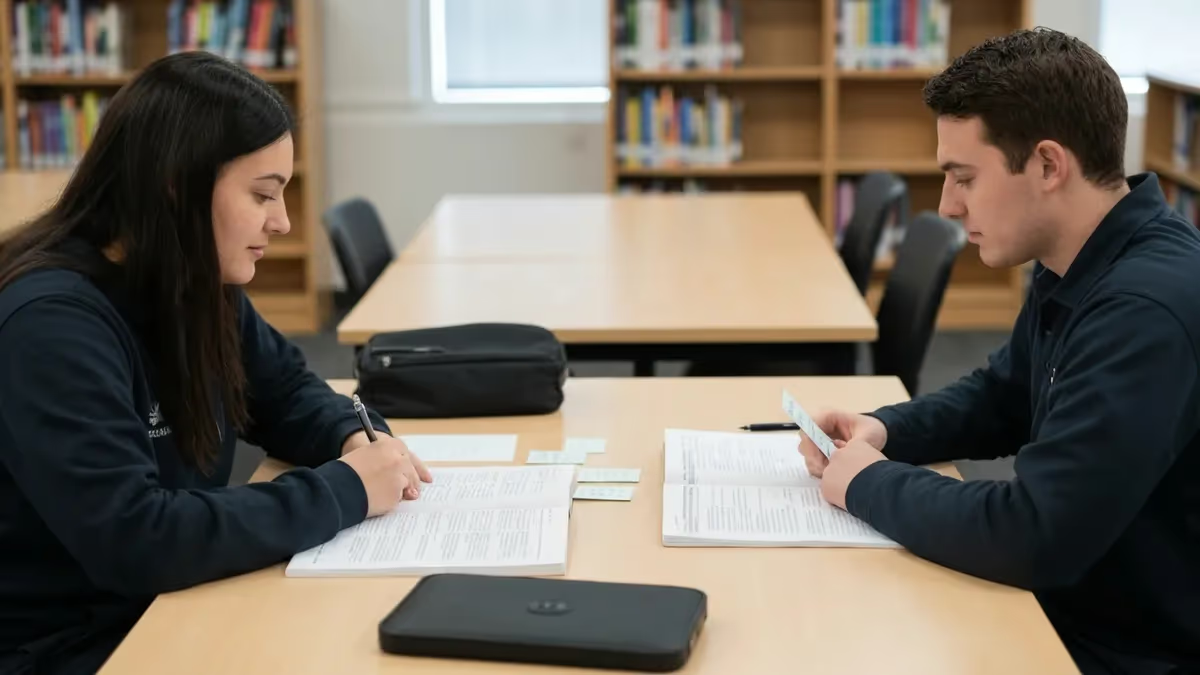
The test genius CritiCall assessment is one of the most demanding pre-employment exams in public safety, designed to screen candidates for 911 dispatcher and emergency communications officer roles across the United States. Unlike standard job tests, the CritiCall exam evaluates real-time multitasking, data entry speed, decision-making under pressure, and call-handling accuracy — all skills that directly reflect the demands of a live dispatch center. Taking a structured criticall practice test before your exam date is the single most effective way to close skill gaps and build the confidence you need to succeed.
Thousands of candidates face the CritiCall exam each year, yet many underestimate how different it feels from a traditional written test. The assessment is computer-based, timed in segments, and often includes audio components where you must listen to simulated 911 calls while simultaneously entering information into fields on screen. Multitasking is not optional — it is the entire point of the test. Candidates who walk in without targeted practice frequently report feeling blindsided by the pace and format, even when they have years of customer service or data entry experience.
The criticall practice test format covered in this guide mirrors the real exam as closely as possible. You will encounter questions and exercises covering data entry accuracy, call prioritization, map reading, spelling, reading comprehension, and memory recall. Each subtask is scored independently, and agencies use your subtest results to determine whether you meet their minimum proficiency thresholds. Some agencies require a minimum typing speed of 35 words per minute, while others set the bar at 45 WPM or higher, so knowing the specific requirements of your target agency matters enormously.
Preparation timelines vary by individual, but most experts recommend starting your CritiCall study plan at least four to six weeks before your scheduled exam date. Candidates who practice daily for 30 to 45 minutes consistently outperform those who cram in the days before the test. This is especially true for the data entry and typing components, where muscle memory and speed develop only through repetition over time. Spreading your practice across multiple sessions also helps simulate the sustained focus required on exam day.
This guide covers everything you need to know about the criticall exam: what subtests to expect, how they are scored, which skills matter most, and how to build an effective study plan using free and paid resources. Whether you are preparing for a county sheriff's dispatch role, a city police communications center, or a state emergency services agency, the fundamentals of the CritiCall assessment remain largely consistent. The platform is used by more than 500 public safety agencies nationwide, making it the industry standard for dispatcher pre-employment screening.
You will also find a curated set of free practice quizzes embedded throughout this guide, organized by subtest type. These quizzes are built to replicate the question styles, time constraints, and decision points that appear on the actual exam. Working through them systematically — not just once, but repeatedly until you hit consistent accuracy — is the core of a test genius CritiCall approach. The goal is not just to pass the exam but to perform at a level that makes you a competitive hire in a field where agencies often have limited openings and dozens of qualified applicants.
By the end of this guide, you will have a clear picture of what the criticall test demands, where most candidates lose points, and exactly how to structure your remaining prep time for maximum score improvement. Let's start by looking at the key facts and figures that define the CritiCall landscape for 2026.
CritiCall Exam by the Numbers

CritiCall Exam Format Overview
| Section | Questions | Time | Weight | Notes |
|---|---|---|---|---|
| Data Entry | 1 | 15–20 min | High | Accuracy and speed scored separately |
| Spelling | 1 | 10 min | Moderate | Common dispatch terminology |
| Reading Comprehension | 1 | 15 min | Moderate | Policy and procedure passages |
| Map Reading | 1 | 10–15 min | Moderate | Directional and routing tasks |
| Call Prioritization | 1 | 15 min | High | Triage emergency vs. non-emergency |
| Memory Recall | 1 | 10 min | High | Audio and visual recall tasks |
| Multitasking (Dual-task) | 1 | 20 min | Very High | Simultaneous data entry and listening |
| Total | 14 | 2–3 hours | 100% |
Understanding what each CritiCall subtest actually measures is the foundation of smart preparation. The data entry subtest is typically the highest-weighted component and evaluates both your typing speed in words per minute and your keystroke accuracy rate. You will be asked to enter names, addresses, license plate numbers, and incident codes from a displayed source into blank fields — sometimes while listening to audio. A single transposed digit in an address can mean the difference between a passing and failing score on this subtest, so accuracy matters as much as raw speed.
The spelling subtest goes beyond basic grammar and targets vocabulary that dispatchers encounter daily: medical terminology, street suffix abbreviations, law enforcement codes, and phonetic alphabet usage. Candidates who have not worked in emergency services are often surprised by how specialized the word lists are. Studying common dispatch terms — words like "hemorrhage," "defibrillator," "misdemeanor," and "perpetrator" — in advance gives you a meaningful edge. The test presents misspelled words and asks you to identify the correct version, so pattern recognition through repeated exposure is the most effective preparation method.
Reading comprehension on the CritiCall exam uses passages that simulate agency policies, call-handling protocols, and standard operating procedures. Unlike a general reading test, you must extract specific procedural details quickly, because the passages are written in the dense, directive style of actual government documents. Practicing with real public safety SOPs — many of which are publicly available online — trains your eye to locate key decision points and exception clauses that frequently appear as question targets. Time management is critical here; do not spend too long on any single passage.
The map reading subtest requires you to navigate a street grid, identify the fastest route between two points, and determine compass directions relative to a given location. This subtest trips up many urban candidates who rely on GPS navigation in daily life and have not practiced reading traditional grid maps. The key skill is orienting yourself to the map's north indicator and tracing routes methodically rather than visually guessing. Practice with printed city maps or online grid simulators before your exam, focusing on tasks that require you to count blocks and identify intersection names accurately.
Call prioritization is arguably the most consequential subtest because it directly mirrors the judgment calls dispatchers make dozens of times per shift. You will be presented with multiple simultaneous incident reports and asked to rank them by urgency. The correct priority hierarchy generally follows the principle of life-safety first, property second, and quality-of-life concerns third.
However, the test introduces nuanced scenarios — a caller reporting a suicidal individual versus a caller reporting a house fire with no occupants — that require you to apply the framework thoughtfully rather than mechanically. Taking criticall practice tests that focus specifically on call prioritization scenarios will sharpen this judgment significantly.
Memory recall subtests present information — a name, a description, a series of numbers — and then ask you to reproduce it after a delay during which you complete other tasks. This simulates the dispatcher's need to hold partial call information in working memory while managing a second incoming call. The subtest is designed to be challenging even for candidates with strong general memory, because the interference task in the middle disrupts rehearsal strategies. Practicing deliberate encoding techniques, such as grouping digits into familiar chunks or associating names with visual images, can substantially improve your recall scores.
The multitasking or dual-task subtest is where many otherwise-strong candidates fall short. It combines two or more of the above skills — typically data entry and audio recall — and requires you to perform them simultaneously within a fixed time window. Your brain must switch rapidly between the listening channel and the typing channel without losing information from either.
The only reliable way to improve this skill is through repeated practice that gradually increases the complexity of the simultaneous tasks. Starting with simpler dual-task exercises and building up to full exam complexity over several weeks produces the most durable skill gains.
Criticall Practice Test Strategies by Skill Area
Data entry accuracy is the single highest-impact skill you can improve before the criticall exam. Set a daily practice target of 20 minutes on a typing tutor platform, focusing specifically on numeric keypad drills and mixed alphanumeric strings that mirror license plate and address formats. Track your words per minute and error rate separately — many candidates hit their speed target but fail on accuracy because they never measured it independently.
To simulate real exam conditions, practice entering data while a recording plays in the background. Start with simple audio — a podcast or radio broadcast — and gradually move to more information-dense content like police scanner feeds available on public websites. This builds the divided-attention capacity the dual-task subtest demands. Aim for fewer than two errors per 100 keystrokes before your exam date, as most agencies set accuracy thresholds at 97% or higher for the data entry component.

Is the CritiCall Exam Right for Your Career Path?
- +High starting salaries averaging $40,000–$55,000 with rapid advancement potential
- +Strong job security driven by mandatory public safety staffing requirements in every U.S. county
- +Standardized exam format means targeted preparation produces reliable score improvements
- +Performance on each subtest gives you clear, actionable feedback on which skills to develop
- +Passing creates eligibility for multiple agencies simultaneously, maximizing your hiring opportunities
- +The career offers meaningful daily impact — dispatchers directly save lives on every shift
- −The exam is genuinely difficult and has a significant first-attempt failure rate for unprepared candidates
- −Some subtests, especially multitasking and memory recall, require weeks of dedicated practice to improve
- −Agencies set their own passing thresholds, so a score that passes at one agency may fail at another
- −The exam is timed and computer-based, which disadvantages candidates unfamiliar with keyboard data entry
- −Physical exam centers may be limited in rural areas, requiring travel and logistical planning
- −Emotional demands of the dispatcher role extend beyond the exam — the work environment is high-stress
Criticall Exam Preparation Checklist
- ✓Confirm your target agency's specific subtest list and minimum passing scores before starting your study plan.
- ✓Complete a baseline typing speed test and record your WPM and accuracy rate on day one.
- ✓Practice data entry drills daily for at least 20 minutes, tracking improvement in a simple log.
- ✓Study 20 common dispatch and emergency services spelling words every three days.
- ✓Work through at least two full call prioritization scenario sets per week.
- ✓Practice map reading using printed street grids, not GPS apps, to build directional orientation skills.
- ✓Complete memory recall drills with interference tasks to build working memory capacity under pressure.
- ✓Take at least one full simulated CritiCall practice exam under timed, distraction-free conditions.
- ✓Review every question you missed and understand why the correct answer is correct — not just what it is.
- ✓Prepare your exam day logistics one week in advance: location, ID requirements, and arrival time.

Accuracy Beats Speed on Every CritiCall Subtest
Most candidates who fail the CritiCall data entry subtest fail on accuracy, not speed. A typing rate of 38 WPM with 99% accuracy will outscore 52 WPM with 94% accuracy on most agency scoring rubrics, because transposition errors in addresses and case numbers carry disproportionate deductions. Slow down by 10% in your final week of practice and measure your error rate — you may find your overall score goes up, not down.
Scoring on the CritiCall exam works differently from most standardized tests, and understanding the mechanics can help you allocate your preparation time more strategically. The exam does not produce a single overall score. Instead, each subtest generates an independent result, and agencies apply their own minimum thresholds to each one. This means you can score in the 90th percentile on five subtests and still fail the exam if your data entry accuracy falls below the agency's floor. Knowing this, targeted practice on your weakest subtests is always a higher-return investment than general review.
Most agencies that use CritiCall set their minimum passing thresholds somewhere between 60% and 75% per subtest, but competitive agencies in high-demand markets sometimes require 80% or above. The hiring agency typically receives a detailed score report that breaks down your performance by subtest category, which means your scores on specific dimensions — not just your pass/fail outcome — may influence where you rank in the candidate pool. Strong performance across all subtests creates a competitive profile even when everyone in the pool has technically passed.
The criticall exam scoring for the typing and data entry components uses a formula that penalizes errors more heavily than it rewards raw speed. The standard formula calculates a net words per minute score, which subtracts a penalty for each error from the gross WPM count. Some agencies apply a multiplier to the error penalty, which means a single mistyped field can cost more than the time saved by typing faster. Candidates who understand this formula tend to adopt a more deliberate pacing strategy that prioritizes field-by-field verification over maximum throughput.
Time management across the full exam is another dimension of scoring strategy. The CritiCall platform is adaptive in some configurations, meaning the difficulty of items you encounter can adjust based on your running performance. However, many agency implementations use fixed item sets with fixed time windows. In either case, you should never leave items blank when guessing is permitted — partial credit or a random guess is always better than a zero. Review the exam instructions carefully at the start to confirm whether unanswered items receive automatic point deductions.
One frequently overlooked aspect of CritiCall scoring is the role of the call simulation subtest in agencies that include it. This subtest places you in a simulated dispatch interface and requires you to handle multiple calls in real time, entering information, prioritizing incidents, and generating dispatch assignments. It is scored holistically rather than per-item, with evaluators assessing your overall decision quality, accuracy rate, and response time. Candidates who have practiced with realistic call simulation tools consistently earn higher scores on this component than those who rely only on traditional study materials.
Post-exam, many agencies provide score feedback sessions where a hiring coordinator walks you through your subtest results and explains whether you are eligible to retest and when. If you do not pass on your first attempt, this session is invaluable for shaping your retake preparation strategy.
Most agencies impose a waiting period of 90 to 180 days before a retest, which gives you time to address specific weaknesses if you approach the interim period with a structured plan. Treating a first-attempt failure as a diagnostic — not a judgment — is the mindset shift that most often leads to a successful retake.
Competitive scoring also depends on understanding how agencies weight different subtests in their overall candidate ranking. Some agencies prioritize the multitasking and dual-task components above all others, treating them as the best predictors of on-the-job performance. Others weight reading comprehension more heavily because of the volume of written SOPs and policy updates that dispatchers must absorb during training. If you can find out from the hiring coordinator which subtests carry the most weight in your target agency's scoring model, you can further optimize your preparation for maximum competitive impact.
If you do not pass the CritiCall exam on your first attempt, most agencies enforce a mandatory waiting period before you can retest — commonly 90 to 180 days. Some agencies limit the total number of attempts allowed within a 12-month window. Confirm your target agency's retest policy before your exam date so you can plan accordingly, and request a score breakdown after any failed attempt to guide your next preparation cycle.
Common mistakes on the CritiCall exam follow predictable patterns, and awareness of these patterns is one of the fastest ways to improve your score without additional hours of practice. The most frequent error is losing focus during the audio components. Candidates who have not practiced listening-while-doing activities find that their attention drifts to the audio stream at the expense of the simultaneous data entry task, or vice versa. The result is degraded performance on both channels simultaneously — the worst possible outcome on a dual-task subtest.
A second common mistake is misreading map orientation. Many candidates interpret the top of the map as north without checking the compass indicator, which can lead to completely reversed direction responses. On the CritiCall map reading subtest, always locate the north arrow before answering any directional question. This five-second habit prevents a category of errors that consistently costs candidates three to five points on an otherwise strong map performance. Reviewing compass rose conventions as part of your preparation takes less than an hour and pays dividends on test day.
Overconfidence in spelling is another trap, particularly for candidates who read frequently and consider themselves strong writers. Dispatcher-specific vocabulary includes medical, legal, and technical terms that differ from standard written English, and the exam targets these precisely because they are where errors cluster in real dispatch logs. Spending two or three practice sessions specifically on a curated list of dispatcher terminology — rather than general spelling lists — addresses this gap far more efficiently than broad vocabulary review.
Candidates also frequently underestimate the fatigue factor of a two-to-three hour computer-based exam. By the time they reach the final subtests, their accuracy rates drop measurably compared to their opening performance. Simulating exam-length practice sessions — including short breaks between subtests that mirror the real exam's structure — builds the mental endurance needed to maintain performance through the end of the assessment. Candidates who have completed two or more full-length practice exams before their real test date consistently report feeling less fatigued and more composed during the actual assessment.
The criticall exam also catches candidates who skip the instruction screens at the start of each subtest. Each subtest on the CritiCall platform begins with a brief tutorial screen that explains the format, controls, and scoring rules for that specific task.
Candidates who click through these screens quickly to save time often misunderstand a key mechanic — such as whether they should use the Tab key or click to advance between fields — and lose points on the first several items while figuring out the interface mid-task. Reading every instruction screen fully is always worth the 30 to 45 seconds it costs.
Insufficient preparation on the memory recall subtest is perhaps the most recoverable mistake, because the skills tested are highly trainable with the right exercises. Candidates who dismiss this subtest as testing innate memory ability — something you either have or you don't — miss the opportunity to improve through working memory training. Research consistently shows that working memory capacity is malleable, especially when training focuses on tasks that closely match the target performance. Dispatcher-style memory drills, where you recall information after an interference task, transfer more directly to exam performance than general memory games.
Finally, many candidates make the logistical mistake of arriving at the exam center without having confirmed the identification requirements in advance. The CritiCall exam is administered under strict proctored conditions, and candidates who arrive without acceptable government-issued ID are typically turned away and required to reschedule. Some testing centers also have device policies that prohibit smartwatches, earbuds, or specific types of bags. Confirming these requirements with the hiring agency or testing center at least 48 hours before your appointment eliminates an entirely preventable source of test-day stress.
Building a practical, week-by-week study plan is the bridge between knowing what the criticall exam covers and actually being ready to pass it. The most effective plans share three characteristics: they start with a diagnostic assessment to identify your personal weak areas, they concentrate practice time on subtests with the highest agency weight, and they include at least one full-length simulated exam in the final week before the real test. Cookie-cutter schedules are a starting point, but personalizing based on your baseline performance is what separates passing candidates from repeat testers.
In weeks one and two, focus almost entirely on establishing baselines and closing the most glaring skill gaps. Take a timed typing test on day one, a map reading exercise on day two, and a call prioritization set on day three. Use the scores from these diagnostics to rank your subtests from weakest to strongest, then allocate practice time in inverse proportion to your current skill level. Your weakest subtest should receive the most daily attention during the early phase of preparation, while your strongest subtest needs only maintenance-level practice.
Weeks three and four are where speed and accuracy gains on data entry should accelerate most noticeably. By this point, daily practice has established basic muscle memory for keystroke patterns, and you can shift your focus from mechanical accuracy to applying that accuracy under time pressure. Introduce timed data entry sets — 10 minutes of continuous entry against a clock — and track your error rate closely. If your error rate increases significantly under time pressure, reduce the speed target until accuracy stabilizes, then gradually rebuild pace while maintaining the accuracy floor.
In weeks five and six — assuming a six-week preparation timeline — shift your emphasis to integration practice. Rather than working on individual subtests in isolation, practice scenarios that combine multiple skill demands simultaneously. A useful integration drill pairs a recorded audio description of a simulated incident with a data entry task that requires you to log the information you hear. Another effective drill presents a map reading task immediately followed by a spelling exercise, with only a 90-second transition between them, simulating the rapid context switching of a real CritiCall exam.
The week before your exam should include one complete simulated full-length test under as close to real conditions as possible: timed, distraction-free, using a keyboard and monitor rather than a laptop trackpad, and without access to notes or reference materials. After the simulated exam, score your performance on each subtest and identify any remaining weak spots.
The final week is too late for significant skill building, but it is the right time for targeted review of specific error patterns — particular word types you misspelled, types of map directions where you made mistakes, or specific priority scenarios where your ranking differed from the correct answer.
Rest and physical preparation matter more than many candidates realize in the final 48 hours before the exam. Sleep deprivation measurably degrades working memory and divided-attention performance — the two capacities most central to the CritiCall exam. Getting seven to eight hours of sleep the night before your exam is a legitimate performance intervention, not just wellness advice. Similarly, eating a balanced meal before the exam and staying hydrated during the test session supports the sustained cognitive focus that a two-to-three hour exam demands.
On exam day, arrive at the testing center at least 15 minutes early, complete your check-in process without rushing, and take a few slow breaths before the first subtest begins. Candidates who enter the exam in a calm, prepared state perform measurably better than those who arrive flustered or late. Trust the preparation you have done, apply the strategies covered in this guide, and remember that the CritiCall exam is ultimately a measure of trainable skills — every one of which you have had the opportunity to develop through deliberate practice.
Criticall Questions and Answers

CritiCall Typing Test: Complete Practice Guide for 2026

CritiCall Exam Prep 2026: Complete Study Guide to Pass Your Dispatcher Test

CritiCall Dispatcher Test: Complete Career and Exam Overview for 2026
CritiCall Practice Test PDF (Free Printable 2026)

CritiCall 911 Practice Test 2026: Free Questions, Study Guide & Tips
About the Author
Educational Psychologist & Academic Test Preparation Expert
Columbia University Teachers CollegeDr. Lisa Patel holds a Doctorate in Education from Columbia University Teachers College and has spent 17 years researching standardized test design and academic assessment. She has developed preparation programs for SAT, ACT, GRE, LSAT, UCAT, and numerous professional licensing exams, helping students of all backgrounds achieve their target scores.