
CDL Practice Test — Free Questions & Answers (2026 October)
Free CDL practice test with questions and answer explanations. ✏️ Covers general knowledge, air brakes, combination vehicles, and all endorsements for 2026 October.
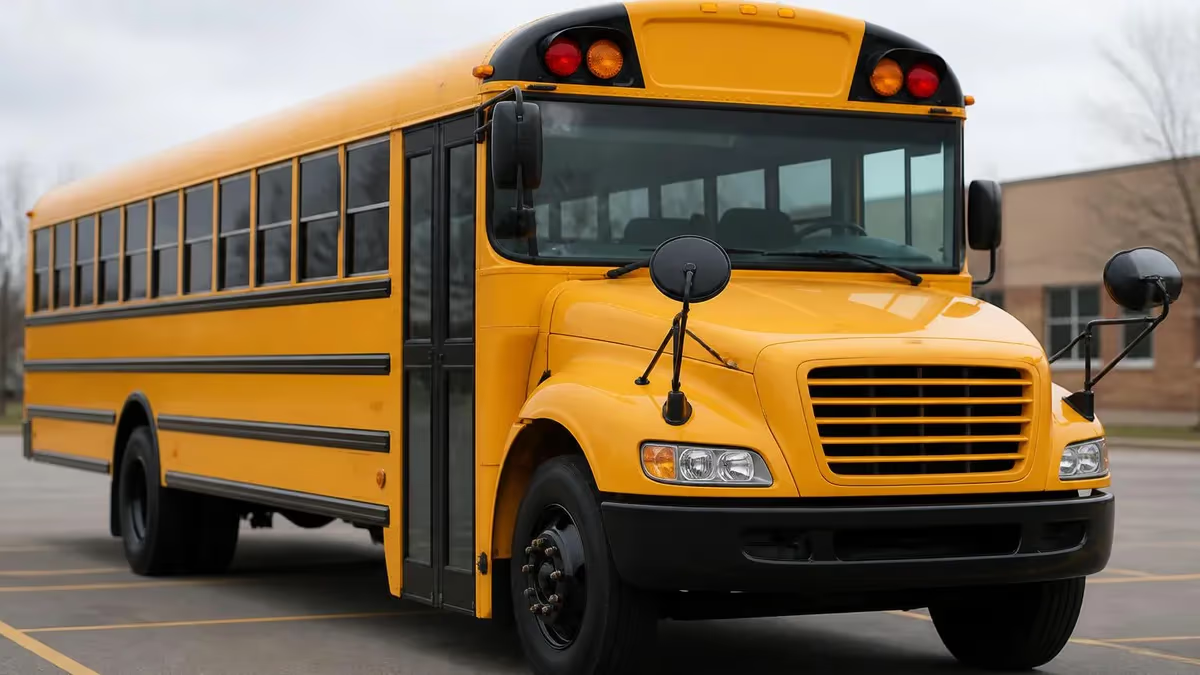
Free CDL Practice Test
Our free CDL practice test covers all sections of the CDL knowledge exam including general knowledge, air brakes, combination vehicles, and every endorsement. Each question includes detailed explanations based on the official CDL manual.
Why CDL Practice Tests Matter
The CDL knowledge test is the first hurdle to getting your Commercial Learner's Permit (CLP). You must pass the general knowledge test plus any applicable endorsement tests before you can begin behind-the-wheel training.
- General Knowledge: 50 questions, must pass to get any CLP
- Air Brakes: 25 questions, required for vehicles with air brake systems
- Combination Vehicles: 20 questions, required for Class A CDL
- Passing score: 80% on each section

CDL Test Sections
General Knowledge (Required for All CDL Classes)
50 questions covering vehicle inspection, basic control, safe driving, cargo handling, and regulations. This is the foundation — every CDL applicant must pass it.
Air Brakes
25 questions on air brake system components, inspection, and operation. Required if your test vehicle has air brakes (most Class A and B vehicles do).
Combination Vehicles (Class A Only)
20 questions on coupling/uncoupling, jackknife prevention, and combination vehicle operation. Required for tractor-trailer combinations.
If you want more targeted practice, the printable cdl practice test page covers the same material with additional questions and explanations.
If you want more targeted practice, the air brakes practice test page covers the same material with additional questions and explanations.
Endorsement Tests
- HazMat (H): 30 questions on hazardous materials handling, placards, and shipping papers
- Tanker (N): 20 questions on liquid/gas tank operation and safety
- Doubles/Triples (T): 20 questions on multiple trailer operation
- Passenger (P): 20 questions on passenger transportation safety
- School Bus (S): 20 questions on school bus operation and student safety

CDL Practice Test Study Tips
- Study the CDL manual — Your state's CDL manual is the primary source material for all test questions
- Take section-specific practice tests — Master general knowledge before moving to endorsements
- Focus on numbers — Memorize stopping distances, weight limits, tank capacity rules, and inspection intervals
- Learn the air brake system — Understanding how air brakes work (not just memorizing) helps with tricky questions
- Practice daily — 30-50 questions per day for 1-2 weeks is more effective than cramming
- Score 90%+ on practice tests — The real test may have harder questions than practice, so aim higher than 80%
CDL Quick Review
What is the minimum tread depth for front tires?
4/32 inch for front (steer) tires. 2/32 inch for all other tires. Check with a tread depth gauge or the Lincoln penny test.
At what PSI should you stop and fix an air brake leak?
Air loss rate should not exceed 3 PSI per minute for a single vehicle, or 4 PSI per minute for a combination vehicle with the engine off and brakes released.
Following distance for a 60-foot vehicle at 40 mph?
One second per 10 feet of vehicle length + 1 second over 40 mph = 7 seconds. At 60 feet and 40 mph: 6 + 1 = 7 seconds following distance.
What must you check during a pre-trip inspection?
Engine compartment, cab interior, external walk-around (tires, lights, brakes, coupling), signal check. Takes 30-45 minutes for a thorough inspection.
CDL: Pros and Cons
- +cdl — cDL exam preparation strengthens your knowledge across all domains
- +Passing the exam proves competency to employers and clients
- +Study materials and practice tests are widely available
- +Exam-based credentials are portable across states and employers
- +Clear exam objectives help focus your study plan effectively
- −Exam anxiety can affect performance — practice tests help reduce it
- −Registration fees are non-refundable if you miss your test date
- −Limited retake opportunities may apply with waiting periods
- −Exam content updates periodically — use current study materials
- −Testing center availability may require advance scheduling
Pros and Cons at a Glance
| Pros | Cons |
|---|---|
| cdl — cDL exam preparation strengthens your knowledge across all domains | Exam anxiety can affect performance — practice tests help reduce it |
| Passing the exam proves competency to employers and clients | Registration fees are non-refundable if you miss your test date |
| Study materials and practice tests are widely available | Limited retake opportunities may apply with waiting periods |
| Exam-based credentials are portable across states and employers | Exam content updates periodically — use current study materials |
| Clear exam objectives help focus your study plan effectively | Testing center availability may require advance scheduling |
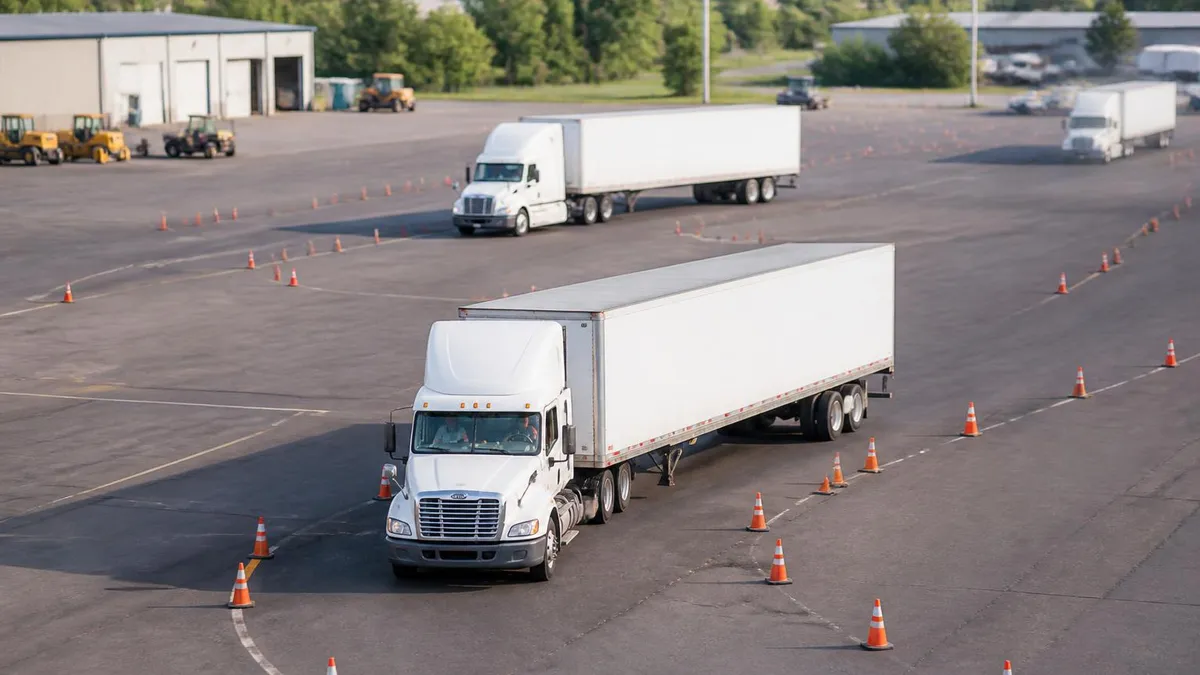
Sample CDL Practice Questions
Try these questions from our free CDL practice tests. The correct answer and an explanation follow each question.
Which of the following is a necessary step to test your service brakes?
- A. Release the parking brake.
- B. Move the vehicle forward slowly.
- C. All of the listed answers.
- D. Wait for normal air pressure.
Answer: C. All of the listed answers.
Testing your service brakes involves several critical steps to ensure they are functioning correctly. You must first wait for normal air pressure to build up, then release the parking brake. Finally, move the vehicle forward slowly and apply the brakes to check for proper stopping action, ensuring the vehicle stops smoothly and in a straight line.
While driving a bus, it's good practice to stop, at minimum, how many feet before a drawbridge?
- A. 100 ft.
- B. 200 ft.
- C. 50 ft.
- D. 150 ft.
Answer: C. 50 ft.
When approaching a drawbridge, bus drivers are required to stop a safe distance away to ensure the bridge is safe to cross or to wait for it to open and close. The standard safety regulation for buses specifies stopping at least 50 feet before the drawbridge. This distance provides adequate space for observation and reaction time, preventing the bus from being caught on the bridge if it begins to open or if there's an unforeseen issue.
Which of the following is NOT included on a Class A Pre-trip inspection test?
- A. An inspection of the coupling system.
- B. All of the listed answers are included on a Class A Pre-trip Inspection Test.
- C. An in-cab inspection.
- D. An engine start.
Answer: B. All of the listed answers are included on a Class A Pre-trip Inspection Test.
A Class A Pre-trip Inspection Test is comprehensive and covers all critical components of a combination vehicle. This includes a detailed inspection of the coupling system (for trailers), a thorough in-cab inspection of controls and gauges, and an engine start to check for proper operation and air system build-up. Therefore, all the listed items are essential parts of the required inspection.
To test your vehicle's hydraulic brakes you should pump the brake pedal three times. Then apply firm pressure to the pedal and hold for five seconds. If the pedal moves this indicates _______.
- A. There may be a problem but it doesn't need to be fixed immediately.
- B. The hydraulic brakes are working.
- C. You are a very good driver.
- D. There may be a leak or other problem.
Answer: D. There may be a leak or other problem.
When testing hydraulic brakes, pumping the pedal three times and then holding firm pressure for five seconds should result in a pedal that remains firm. If the pedal moves or continues to sink during this test, it indicates a potential leak in the hydraulic system or another problem, such as air in the lines. This condition requires immediate repair as it compromises braking effectiveness and safety.


Official Resources
- FMCSA (Federal Motor Carrier Safety Administration) — the U.S. federal agency that sets the national CDL knowledge-test standards, endorsement rules, and the 80% passing requirement all states follow.
- USA.gov State Motor Vehicle Services — the official federal portal to locate your state DMV, where you take the actual CDL knowledge and skills tests in person.
About the Author

Licensed Driving Instructor & DMV Test Specialist
Penn State UniversityRobert J. Williams graduated from Penn State University with a degree in Transportation Management and has spent 20 years as a certified driving instructor and DMV examiner consultant. He has personally coached thousands of applicants through written knowledge tests, skills assessments, and commercial driver licensing programs across more than 30 states.
Join the Discussion
Connect with other students preparing for this exam. Share tips, ask questions, and get advice from people who have been there.
View discussion (7 replies)