
CDA Portfolio 2026 October: How to Build Your Professional Portfolio
Free CDA Portfolio : How to Build Your practice test with instant feedback and detailed answer explanations. Prepare for your exam. 🎯


The CDA Professional Portfolio is a physical or digital binder you submit to your PD Specialist (Professional Development Specialist) at least two weeks before your verification visit. The Council for Professional Recognition reviews your portfolio to assess whether you demonstrate competency across all 13 Functional Areas of child development.
The portfolio is not graded with a score — it is evaluated as acceptable or needing improvement. If your portfolio needs improvement, your PD Specialist will give you feedback and you may revise before the final verification visit. Once accepted, along with a passing written exam (60 questions, 95 minutes), your CDA credential is issued.
There are four core sections to every CDA portfolio:
- Section 1: Professional Philosophy Statement
- Section 2: Resource Collection (17+ items)
- Section 3: Competency Goal Statements (6 goals, 13 functional areas)
- Section 4: Family Questionnaires (6 completed forms)
The portfolio format has evolved — the Council now accepts digital submissions (PDF binder or Google Drive folder), but a printed, organized binder remains the most common and recommended format for in-person verification visits.

Resource Collection: What to Include
The Resource Collection is the largest section of your portfolio. The Council requires at least 17 specific items organized by the 6 Competency Goals. Each item should demonstrate your professional knowledge and practical application. Required items include:
- Statement of ethical commitments (based on NAEYC Code of Ethics)
- Documentation of 480 professional experience hours
- Documentation of 120 training hours across all 8 subject areas
- Emergency contact and basic care information form for children in your setting
- Health and safety practices documentation (evacuation plans, handwashing procedures)
- Sample activity plans demonstrating developmentally appropriate practice
- Examples of observation and recording methods used in your setting
- A summary of community resources available to families
- Documentation of your professional development activities
Writing Your Professional Philosophy Statement
- ✓State your core beliefs about child development and early learning (how children learn best)
- ✓Describe your teaching approach and why you chose early childhood education as a career
- ✓Explain how you create a safe, nurturing, and stimulating environment
- ✓Discuss how you support diverse families and communities in your program
- ✓Address your commitment to professional growth and ongoing learning
- ✓Reference at least one recognized theory (e.g., Piaget, Vygotsky, Erikson) to ground your beliefs
- ✓Keep the statement to 1–2 pages, written in first person, professional tone
- ✓Proofread carefully — this is one of the first things your PD Specialist reads
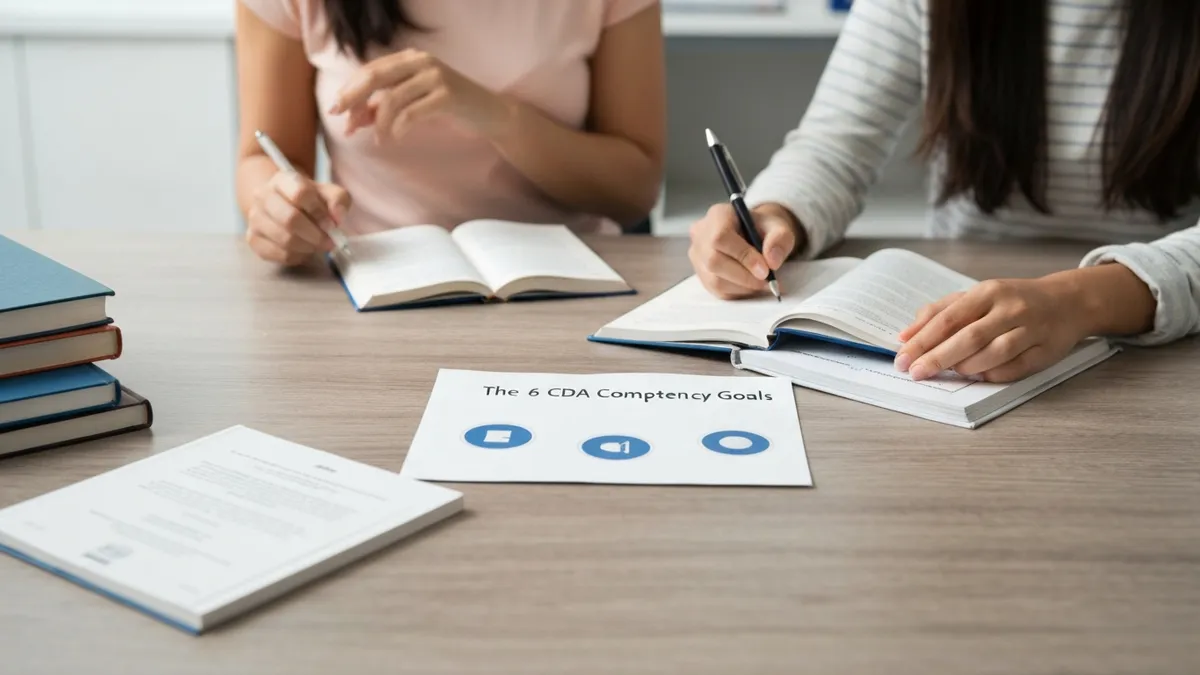
Assembling your CDA portfolio correctly is as important as the content inside it. The Council for Professional Recognition evaluates your portfolio as part of the overall CDA assessment, alongside the formal observation and written exam. Poorly organized portfolios — even with strong content — can delay your verification visit.
The standard submission format is a 3-ring binder, organized with labeled dividers for each of the four portfolio sections. Your cover page should include your full name, your setting type (Infant-Toddler, Preschool, Family Child Care, or Home Visitor), your credential type, and the date of assembly.
For digital submissions via the ProSolutions platform, the Council requires a PDF that mirrors the physical binder structure. Each section should be clearly bookmarked, and file names should be descriptive (e.g., "Section-3-Competency-Goal-1-Safe.pdf"). Digital submissions are reviewed by the PD Specialist before the verification visit, just as physical portfolios are.
Allow yourself at least one full day to organize and review your completed portfolio before submitting. Check your table of contents against the actual documents. Confirm that all 17 required Resource Collection items are present, your 6 Family Questionnaires are included, and each Competency Goal Statement addresses all relevant Functional Areas with specific observable examples from your practice.
Tips for a Strong CDA Portfolio
- ✓Start collecting Family Questionnaires on Day 1 of portfolio building — they are hardest to gather
- ✓Use specific, observable examples in Competency Goal Statements (not general statements like 'I support children')
- ✓Align your Resource Collection items to the specific Competency Goal they demonstrate
- ✓Ask a colleague or mentor to review your Philosophy Statement before submission
- ✓Keep a running log of your 480 experience hours from the first day — don't reconstruct from memory
- ✓Reference the NAEYC Code of Ethics in your Philosophy Statement to show professional awareness
- ✓Include photographs of your learning environment to strengthen your resource collection (with written family permission)
- ✓Use the Council's official digital submission platform (ProSolutions) if submitting electronically
- ✓Practice discussing your portfolio aloud — your PD Specialist may ask you to walk through it during the visit
- ✓Do not include children's full names, photos without permission, or any HIPAA-protected health information
CDA Portfolio: Worth the Effort?
Key advantages and challenges for early childhood professionals building the CDA portfolio.
- +Forces you to document and reflect on your actual teaching practice — not just memorize content
- +Competency Goal Statements become a professional development tool you can reuse for job applications
- +Resource Collection gives you a permanent reference library for early childhood best practices
- +Portfolio process helps you identify gaps in your knowledge before the written exam
- +PD Specialist feedback during verification is a free professional development session
- +Strong portfolios are accepted on first submission — no retake fee required
- −Most candidates underestimate the time — allow 20–40 hours, not a single weekend
- −Family Questionnaire collection depends on family cooperation — start early
- −Competency Goal Statements require specific, observable examples — general statements are flagged
- −Portfolio submission must be physical or properly formatted digital — informal folders are rejected
- −Missing even one of the 17 required resource items means revision before acceptance
Pros and Cons at a Glance
| Pros | Cons |
|---|---|
| Forces you to document and reflect on your actual teaching practice — not just memorize content | Family Questionnaire collection depends on family cooperation — start early |
| Competency Goal Statements become a professional development tool you can reuse for job applications | Competency Goal Statements require specific, observable examples — general statements are flagged |
| Resource Collection gives you a permanent reference library for early childhood best practices | Portfolio submission must be physical or properly formatted digital — informal folders are rejected |
The Council for Professional Recognition is the nonprofit organization that administers the CDA credential. Founded in 1975, the Council has issued more than 600,000 CDA credentials to early childhood professionals across the United States and internationally. The Council is based in Washington, DC, and sets all standards for portfolio requirements, exam content, and PD Specialist qualifications.
The Council reviews and updates CDA requirements periodically. The current portfolio structure — with 4 sections, 6 Competency Goals, and 17 required resource items — reflects the most recent revision. Always download the current CDA Candidate Handbook from cdacouncil.org before starting your portfolio to ensure you are working from the most up-to-date requirements.
The Council also offers a child development associate certification and resources to help candidates prepare for both the portfolio and the written exam. For candidates in early childhood education programs, many community colleges and training providers offer structured courses that guide you through portfolio assembly as part of the 120-hour training requirement — making the process more manageable for first-time candidates.
If you are working toward the CDA credential, practicing your knowledge with cda practice test practice questions and cda practice exam questions can reinforce the concepts you will articulate in your Competency Goal Statements.
Related CDA Resources
Sample Child Development Associate Practice Questions
Try these questions from our free Child Development Associate practice tests. The correct answer and an explanation follow each question.
A child in your care frequently arrives with unexplained bruises in various stages of healing. What should a CDA professional do first?
- A. Confront the parents directly about the bruises
- B. Document the observations and report concerns to the appropriate authority
- C. Wait to see if the bruising pattern continues before taking action
- D. Ask other staff to confirm your suspicions before reporting
Answer: B. Document the observations and report concerns to the appropriate authority
CDA professionals must document observations objectively and report suspected abuse to the appropriate child protective services or mandated authority immediately.
Continuing professional development is important for CDA professionals because:
- A. It satisfies credential renewal requirements only
- B. It ensures educators stay current with research, best practices, and evolving standards
- C. It is required only for educators who are struggling
- D. It replaces the need for supervision
Answer: B. It ensures educators stay current with research, best practices, and evolving standards
Ongoing professional development keeps educators current with research-based practices, new standards, and evolving understanding of child development.
Which of the following is a key principle of maintaining professional confidentiality?
- A. Discussing a child's behavior with other parents to get advice.
- B. Sharing information about a child only with colleagues who work directly with them.
- C. Posting vague but positive updates about a specific child on social media.
- D. Talking about a child's challenges with your own family at home.
Answer: B. Sharing information about a child only with colleagues who work directly with them.
Confidentiality is a critical ethical responsibility. Information about a child or family should only be shared with colleagues or specialists who have a direct and legitimate need to know for the purpose of supporting the child's well-being and development.
Which of the following demonstrates professional behavior in the workplace?
- A. Discussing confidential family information with colleagues during lunch
- B. Maintaining confidentiality of all child and family information
- C. Venting about a child's behavior on personal social media
- D. Sharing family contact information with other parents
Answer: B. Maintaining confidentiality of all child and family information
Maintaining confidentiality is a core professional obligation that protects families' privacy and builds trust.
CDA Portfolio Questions and Answers
About the Author

Registered Sanitarian & Food Safety Certification Expert
Cornell University College of Agriculture and Life SciencesThomas Wright is a Registered Sanitarian and HACCP-certified food safety professional with a Bachelor of Science in Food Science from Cornell University. He has 17 years of experience in food safety auditing, regulatory compliance, and foodservice management training. Thomas prepares food industry professionals for ServSafe Manager, HACCP certification, and state food handler examinations.