
CCDS IBHRE Exam: Complete Practice Test Guide for Certification Success
Master the CCDS exam with free IBHRE practice tests, study tips & exam breakdowns. 🎯 Boost your certified clinical documentation specialist score today.
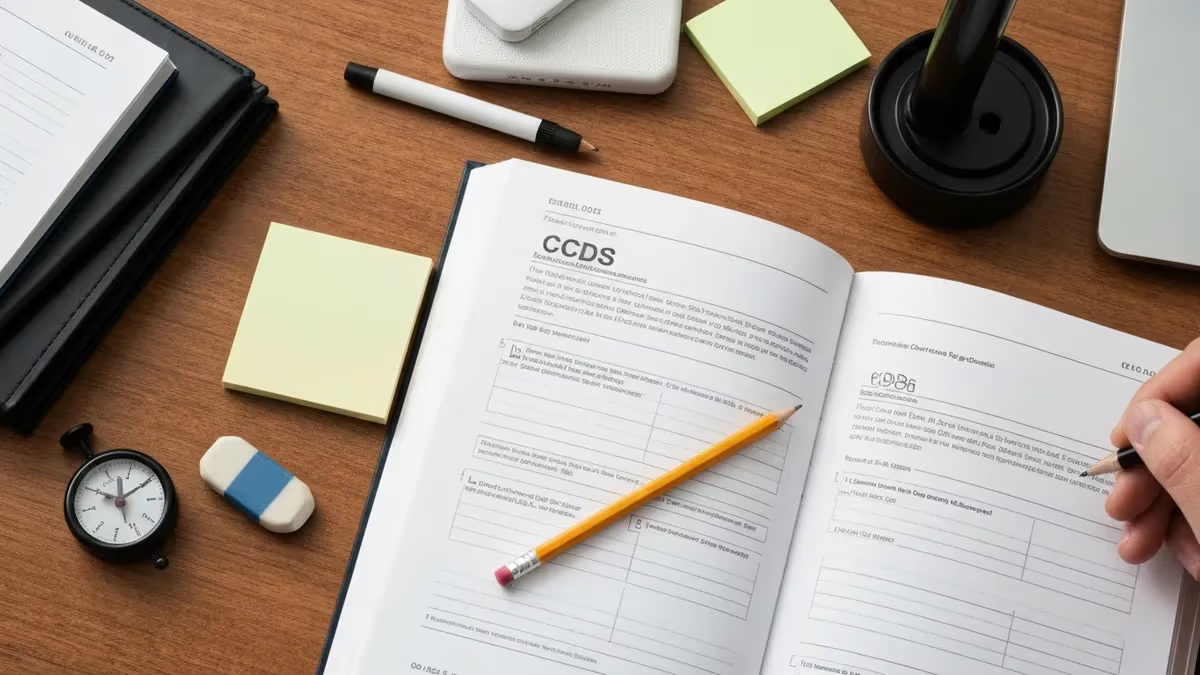
The CCDS IBHRE exam is one of the most respected credentialing pathways for health information professionals in the United States, and understanding how to prepare effectively can mean the difference between passing on your first attempt and spending months retaking it.
The Certified Clinical Documentation Specialist credential — administered through the Association of Clinical Documentation Integrity Specialists (ACDIS) — validates that a professional can accurately review, query, and improve the integrity of clinical documentation within hospital and outpatient settings. Whether you are just learning what ccds stands for or are deep in your study schedule, this guide offers actionable preparation strategies built around the actual exam blueprint.
The IBHRE — International Board of Heart Rhythm Examiners — is a separate credentialing body focused on cardiac electrophysiology, but the term is sometimes searched alongside the CCDS because many CDS professionals work in cardiology-heavy environments where documentation of arrhythmias, device therapy, and electrophysiology procedures is a core daily responsibility. Both credentials demand rigorous preparation, and the overlap in documentation skills — especially around cardiac conditions, acute kidney injury, and complication capture — makes cross-credential study a smart strategy for many professionals.
Most candidates who fail the CCDS exam report being surprised by the depth of clinical knowledge required. Unlike a basic coding exam, the CCDS test requires you to understand pathophysiology well enough to recognize when a physician's note is clinically incomplete or when a query is warranted. That means knowing the difference between acute kidney injury stages, understanding when sepsis criteria are met, and recognizing how heart failure type affects DRG assignment — all without crossing into practicing medicine yourself.
Practice questions are the single most effective tool for closing the gap between passive study and exam-ready performance. Reading a textbook tells you what the guidelines say; answering a timed practice question forces you to apply that knowledge under pressure. Our free CCDS IBHRE practice quizzes on PracticeTestGeeks.com mirror the style, depth, and clinical complexity of real exam items, so every question you complete here is a direct investment in your pass rate.
The exam itself covers a broad scope of topics organized around the ACDIS exam blueprint, including documentation improvement queries, coding and reimbursement principles, regulatory compliance, clinical conditions, and program management. Each of these domains appears on the exam in proportion to its real-world importance in a CDS role, which means clinical knowledge questions — the ones tied to specific diagnoses like AKI, pneumonia, sepsis, and cardiac conditions — carry significant weight and deserve focused attention.
Across the country, CCDS candidates from cities like Charlotte, Cincinnati, and beyond are using structured online practice to shorten their preparation timelines. The availability of flexible, web-based practice tools has transformed how professionals study, allowing nurses, coders, and HIM directors to fit exam prep around demanding shift schedules. This guide walks you through everything from exam format to study timelines to topic-by-topic practice strategies so you can approach test day with confidence.
Whether you are a registered nurse transitioning into a CDS role, an experienced inpatient coder looking to formalize your documentation skills, or a program manager building a team of specialists, the CCDS credential signals a level of expertise that employers across the country actively seek. Let this guide serve as your roadmap from registration to certification success.
CCDS Certification by the Numbers
Key Facts at a Glance
| Item | Value | Details |
|---|---|---|
| Scored Exam Questions | 120 | Plus 20 unscored pilot items |
| Exam Time Limit | 3 hrs | Computer-based testing |
| Renewal Cycle | 2 yrs | 20 CEUs required |

CCDS Exam Format & Blueprint
| Section | Questions | Time | Weight | Notes |
|---|---|---|---|---|
| Clinical Conditions & Documentation | 40 | ~50 min | 29% | AKI, sepsis, cardiac, respiratory, and more |
| Coding & Reimbursement Principles | 35 | ~44 min | 25% | ICD-10-CM/PCS, MS-DRGs, APR-DRGs |
| Documentation Improvement Queries | 30 | ~38 min | 21% | Query format, compliance, and communication |
| Regulatory Compliance & Quality | 25 | ~31 min | 18% | CMS rules, quality indicators, HACs |
| Program Management | 10 | ~17 min | 7% | Team operations, metrics, and education |
| Total | 140 | 3 hours | 100% |
Building an effective study plan for the CCDS certification exam starts with honestly assessing where you stand clinically and coding-wise before you crack open a single review book. Most successful candidates spend between 10 and 16 weeks preparing, dedicating 8 to 12 hours per week across reading, practice questions, and case review. If you have a strong nursing background but limited coding exposure, you will want to front-load the coding and reimbursement domain. If you are an experienced inpatient coder, the clinical conditions domain will demand more of your time.
The ACDIS CCDS exam prep book, often called the study guide, is the foundational resource for most candidates and provides a comprehensive breakdown of all five exam domains. Supplement that with the ACDIS CDI Practice Standards and the official ICD-10-CM Official Guidelines, which the exam expects you to have internalized — not just referenced. The guidelines are particularly important for sepsis, AKI, heart failure, and respiratory failure, all of which carry significant exam weight and appear in the most challenging question clusters.
Practice testing is where preparation accelerates. Passive reading creates familiarity; active recall under timed conditions builds the exam-specific cognitive speed you need. Schedule two or three 25-question timed sessions per week starting in week three or four of your study plan. After each session, spend as much time reviewing wrong answers as you spent answering questions — that review phase is where learning actually happens and where most candidates underinvest their time.
A powerful but often overlooked study strategy is building your own case vignettes. Take a real (de-identified) or fictional patient scenario, write a documentation gap, and practice crafting a compliant physician query. This mirrors exactly what the exam asks you to do in its higher-order questions, and it forces you to integrate clinical knowledge, query standards, and compliance awareness simultaneously — which is the mental load the CCDS exam is designed to measure.
Study groups can dramatically accelerate preparation, especially when group members have complementary backgrounds. A nurse, a coder, and an HIM professional studying together will surface different perspectives on the same clinical scenario — the nurse spotting the clinical detail, the coder catching the ICD-10 specificity gap, the HIM professional flagging the compliance risk. That kind of cross-functional discussion closely mirrors the collaborative environment CDS professionals work in every day.
Resources like the ccds certification study guide on PracticeTestGeeks.com offer structured domain-by-domain review with embedded practice questions, making it easy to focus a single study session on one topic area without losing sight of the integrated whole. Use our topic-specific quizzes for AKI, cardiac conditions, sepsis, and respiratory failure to build depth before you tackle full-length mixed-domain practice tests.
In the final two weeks before your exam, shift from learning mode to review and simulation mode. Take two or three full-length timed practice tests under realistic conditions — quiet room, no phone, 180 minutes on the clock. After each simulation, analyze your results by domain to spot any late-breaking weak spots. Then spend your last two or three days doing light review only, prioritizing sleep and confidence-building over cramming new content that will not consolidate in time to help you on test day.
CCDS Certification: Domain Deep Dives
The clinical conditions domain is the largest single section of the CCDS exam, representing nearly 30% of scored questions. This domain tests your ability to recognize when documentation fails to capture a clinically present condition — such as acute kidney injury, sepsis, heart failure with reduced ejection fraction, or respiratory failure — and to formulate the appropriate query. Expect questions that present a partial patient record and ask what additional clinical indicator should prompt a physician query, what the most specific diagnosis code would be if the physician responds affirmatively, and how that response affects DRG assignment and quality metrics.
Preparing for this domain requires you to study clinical criteria systematically: Sepsis-3 definitions, KDIGO staging for AKI, NYHA and ACC/AHA heart failure classifications, and Berlin criteria for ARDS are all fair game. The exam expects you to know these criteria not just by name but well enough to apply them to ambiguous clinical vignettes. A strong strategy is to create a reference card for each major condition listing the clinical indicators, documentation requirements, and the specific ICD-10-CM coding guidance — then practice until you can recall that information under timed pressure without referring to the card.

Is the CCDS Certification Worth It? Benefits vs. Challenges
- +Nationally recognized credential that validates clinical documentation expertise
- +Salary premium: CCDS-credentialed specialists earn 10-20% more on average than non-credentialed peers
- +Opens doors to senior CDI specialist, program manager, and director roles
- +Strengthens interdisciplinary communication skills with physicians, coders, and quality teams
- +Provides a structured knowledge framework covering clinical, coding, and compliance domains
- +Demonstrates commitment to documentation integrity and patient care quality
- −Exam fee of $299–$399 is a significant upfront investment before studying costs
- −Requires 2 years of eligible work experience, limiting entry for newer professionals
- −Study time commitment of 80–150 hours is substantial alongside full-time clinical work
- −Clinical conditions domain demands pathophysiology knowledge beyond typical HIM training
- −Renewal requires 20 CEUs every 2 years, adding ongoing time and cost obligations
- −Limited testing windows and locations in some regions may complicate scheduling
CCDS Exam Preparation Checklist
- ✓Confirm eligibility: verify you meet the 2-year experience and training hour requirements before applying
- ✓Register through the ACDIS website and schedule your Prometric testing appointment at least 4 weeks out
- ✓Download and study the official CCDS exam content outline and blueprint from ACDIS
- ✓Complete the ACDIS CCDS Exam Prep book, focusing on your two weakest domains first
- ✓Review the ACDIS/AHIMA joint practice brief on clinical documentation improvement queries
- ✓Study ICD-10-CM Official Guidelines chapters most relevant to CDI: sepsis, AKI, heart failure, pneumonia
- ✓Complete at least 300 practice questions across all five exam domains before test day
- ✓Run two or three full-length timed simulation tests in the final two weeks of preparation
- ✓Build a clinical criteria reference card for the top 10 conditions most queried in CDI practice
- ✓Arrange test-day logistics: arrive 30 minutes early, bring valid government-issued photo ID

Practice Questions Predict Pass Rate Better Than Reading Hours
Research on professional certification exam preparation consistently shows that candidates who complete 250 or more practice questions before their exam date pass at significantly higher rates than those who rely primarily on passive reading. On PracticeTestGeeks.com, candidates who complete all six CCDS topic quizzes report feeling substantially more confident on exam day — and confidence under time pressure translates directly into score points.
Passing the CCDS IBHRE exam on your first attempt requires more than content knowledge — it requires a test-taking strategy calibrated to the specific demands of this credential. The exam is designed to measure the judgment of an experienced clinical documentation specialist, which means many questions will not have an obviously wrong answer. Two or three options will be defensible, and your job is to identify the most correct answer in the context of the official guidelines and standards the exam is built on.
The most important time-management rule on the CCDS exam is to keep moving. With 140 questions in 180 minutes, you have roughly 77 seconds per question — enough time to read carefully and think, but not enough to agonize. If a question stumps you after 90 seconds, make your best choice, flag it for review, and move on. You can return to flagged questions if time permits, but you are far better off answering every question than leaving items blank because you spent seven minutes on a single difficult case vignette.
For clinical scenario questions — the most common format on the CCDS exam — read the question stem first, before you read the clinical vignette. Knowing what the question is asking tells you which details in the patient record to pay attention to and which to ignore. This top-down reading approach can save 15 to 20 seconds per question, which adds up to 30 to 40 extra minutes of effective thinking time across the full exam.
When answering query-related questions, always ask yourself whether the query option presented is compliant with the ACDIS/AHIMA joint practice brief. The exam frequently presents a correct clinical answer embedded in a noncompliant query format, testing whether you can distinguish between accurate clinical content and compliant process. A query that captures the right diagnosis via a leading or coercive format is still wrong on the exam — and in real CDI practice.
For coding and reimbursement questions, resist the temptation to rely on pattern recognition from your day-to-day coding experience. The exam tests the official guidelines, not common practice, and those two things sometimes diverge — particularly around sequencing rules for sepsis with organ dysfunction, complication of care versus patient condition, and principal diagnosis selection when multiple conditions equally meet the definition. Always anchor your answer to the official ICD-10-CM guideline language, even if your instinct from practice points elsewhere.
One strategy that separates high scorers from average scorers is active elimination. On any question where you are not immediately certain of the answer, eliminate the one or two options you can confidently rule out, then choose from the remaining options. Even reducing a four-option question to a two-option choice doubles your baseline probability of a correct guess — and on a 140-question exam, that math matters more than most candidates realize.
Finally, manage your anxiety proactively. Test anxiety is real and measurable: improved stress hormones narrow working memory, slow recall, and increase error rates. In the days before your exam, prioritize sleep over last-minute studying. Use the two minutes before your test begins to take slow diaphragmatic breaths — a technique with demonstrated efficacy in reducing acute performance anxiety. Enter the testing room having decided that you are ready, because by the time you sit down, preparation is behind you and execution is what counts.
The CCDS exam requires candidates to have a minimum of two years of clinical documentation improvement experience and completion of the ACDIS CDI Boot Camp or equivalent training. Applying without meeting these requirements will result in a rejected application and forfeited fees. Review the full eligibility criteria on the ACDIS website before submitting your application, and keep documentation of your qualifying experience ready to submit with your application packet.
Earning the CCDS credential is a significant professional achievement, but it is not the end of the road — it is the beginning of a career chapter defined by ongoing growth, leadership opportunity, and expanding scope of practice. ACDIS requires 20 continuing education units every two years to maintain the CCDS credential, and those CEUs are most valuable when they push you into areas adjacent to your current expertise rather than simply reinforcing what you already know well.
Many CCDS-credentialed professionals choose to deepen their expertise in specialty documentation areas — oncology, trauma, behavioral health, and pediatrics are four domains where CDI programs are rapidly expanding, and where documentation specialists with clinical knowledge can have an outsized quality and revenue integrity impact. If your hospital has a service line with high documentation complexity, consider positioning yourself as the CDI expert for that line and building your CEU portfolio around it.
Leadership development is another natural trajectory for experienced CCDS holders. CDI program managers and directors are in high demand, and the credential is increasingly a baseline requirement for senior CDI roles at large health systems. If management interests you, seek out ACDIS leadership workshops, mentor relationships with current CDI directors, and opportunities to lead physician education sessions within your current organization — all of which build the leadership portfolio that positions you for promotion.
Technology fluency is becoming non-negotiable in CDI. Natural language processing tools, AI-assisted query engines, and computer-assisted CDI (CACDI) platforms are transforming how CDI programs identify documentation opportunities and track query outcomes. CCDS professionals who understand how these tools work — including their limitations and the compliance guardrails around AI-generated queries — will be far more valuable to their organizations than those who remain dependent on manual chart review alone.
Candidates who passed the exam in cities like ccds charlotte or Cincinnati often note that the credential immediately changed how physicians, quality officers, and revenue cycle leaders perceived them. The three letters after your name signal to clinicians that you understand their world — that your queries come from clinical reasoning, not just coding opportunity — and that shift in perception fundamentally changes the effectiveness of the CDI program you support.
Staying connected to the ACDIS community is one of the highest-return investments a credentialed CCDS professional can make. The ACDIS annual conference, regional chapters, and online forums are where the field's standards evolve — where the implications of new Coding Clinic guidance, new CMS quality metrics, and new documentation integrity regulations get worked out by practitioners. Candidates who attend regularly report not just meeting their CEU requirements more easily but also gaining early awareness of changes that affect their day-to-day practice.
Finally, consider giving back by mentoring candidates who are where you were before you passed. Teaching is one of the most effective ways to deepen your own mastery — explaining AKI staging criteria or compliant query construction to a newer colleague forces you to organize and articulate knowledge in ways that pure study never does. And for the CDI profession as a whole, every CCDS credential earned by a new specialist raises the standard of documentation quality across U.S. healthcare — which ultimately means better data, better care decisions, and better patient outcomes.
With your study plan in place, your practice tests scheduled, and your understanding of the exam blueprint solid, the final preparation phase is about executing consistently and staying focused on process over outcome. Many candidates make the mistake of fixating on their practice test scores in the final weeks rather than on the quality of their review sessions — but a 72% on a hard practice exam reviewed carefully is more valuable than a 85% on an easy one glossed over quickly. Depth of learning, not score inflation, is what transfers to the real exam.
The morning of your exam, eat a balanced meal, arrive at the Prometric testing center at least 30 minutes early, and bring two forms of acceptable identification as required by the testing center. Leave your phone in the car — testing centers prohibit personal electronic devices in the exam room, and the last thing you need is the cognitive friction of worrying about compliance logistics when you should be focused on your first question.
During the exam, use the provided scratch paper or dry-erase board (depending on your testing center) to jot notes on complex case vignettes. Externalizing key data points — admission diagnoses, lab values mentioned in a scenario, query options under consideration — reduces working memory load and keeps your analysis organized. This is especially useful for multi-part questions that present a long clinical scenario and then ask two or three related questions about it.
If you encounter a question where every answer seems plausible, use the ACDIS practice standards as your tiebreaker. The exam is built on those standards, and when in doubt, the answer that most closely aligns with official ACDIS and AHIMA guidance will be correct more often than your clinical intuition alone. This is not an exam that rewards creative interpretation — it rewards precise knowledge of established CDI practice standards.
After the exam, regardless of how it went, take a day to decompress before reviewing any content. If you passed — congratulations; your credential will be issued within a few weeks and you can begin using the CCDS designation immediately upon receipt of your official notification. If you did not pass on this attempt, request your score report immediately, identify the domains where you were weakest, and build a targeted 6 to 8 week remediation plan focused exclusively on those areas before retesting.
The ccds login portal on the ACDIS website allows you to access your score report, manage your CEU tracking, and update your credential status — bookmark it and check it regularly in the months following your exam, both to confirm your credential status and to stay current on any ACDIS announcements about exam updates or content blueprint revisions.
The CCDS designation represents the culmination of clinical experience, dedicated study, and professional commitment. Every question you answer on PracticeTestGeeks.com, every case vignette you work through, and every query template you evaluate against compliance standards is building the expertise that this credential is designed to validate. The exam is challenging by design — because the role it certifies is challenging by nature, and the patients whose care depends on accurate documentation deserve specialists who have truly earned that credential.
Sample CCDS - Certified Clinical Documentation Specialist Practice Questions
Try these questions from our free CCDS - Certified Clinical Documentation Specialist practice tests. The correct answer and an explanation follow each question.
Which approach BEST supports CDI success in capturing malnutrition documentation?
- A. Querying only when the patient has a BMI below 18
- B. Collaborating with dietitians to identify patients meeting malnutrition criteria and then querying the physician
- C. Coding malnutrition based on low albumin levels alone without a query
- D. Waiting until discharge to query the physician about nutritional status
Answer: B. Collaborating with dietitians to identify patients meeting malnutrition criteria and then querying the physician
Interdisciplinary collaboration with dietitians helps CDI specialists identify malnutrition criteria (per ASPEN guidelines) and support timely, evidence-based physician queries.
During a CDI review, a patient is noted to have a tracheostomy placed on day 4 of mechanical ventilation. What CDI consideration applies?
- A. Tracheostomy placement resets the mechanical ventilation duration clock
- B. The pre-tracheostomy ventilator hours and post-tracheostomy hours are combined for duration coding
- C. Only hours after tracheostomy count toward ventilation duration
- D. Tracheostomy eliminates the need for ventilation duration coding
Answer: B. The pre-tracheostomy ventilator hours and post-tracheostomy hours are combined for duration coding
ICD-10-PCS guidelines require totaling all hours of continuous mechanical ventilation, including time before and after tracheostomy, to determine duration code selection.
Which statistical measure is most appropriate for describing the central tendency of a skewed distribution of patient length-of-stay data?
- A. Mean
- B. Median
- C. Mode
- D. Range
Answer: B. Median
The median is preferred over the mean for skewed distributions because it is not distorted by extreme outliers.
A CDI specialist notes that a physician used 'SIRS due to non-infectious cause' in the chart. Under Sepsis-3, how should this be treated for coding?
- A. Code as sepsis because SIRS and sepsis are equivalent
- B. Code the specific non-infectious condition; SIRS due to non-infectious cause is not coded in ICD-10-CM
- C. Code R65.10 (SIRS of non-infectious origin without acute organ dysfunction)
- D. Query the physician to change the terminology to sepsis
Answer: C. Code R65.10 (SIRS of non-infectious origin without acute organ dysfunction)
ICD-10-CM retains R65.1x codes for SIRS of non-infectious origin, which is coded separately from sepsis (A40-A41 range).
Take the full CCDS - Certified Clinical Documentation Specialist practice test
CCDS Questions and Answers



About the Author

Educational Psychologist & Academic Test Preparation Expert
Columbia University Teachers CollegeDr. Lisa Patel holds a Doctorate in Education from Columbia University Teachers College and has spent 17 years researching standardized test design and academic assessment. She has developed preparation programs for SAT, ACT, GRE, LSAT, UCAT, and numerous professional licensing exams, helping students of all backgrounds achieve their target scores.