
How Long Does a Drivers Test Take? Complete Guide to DMV Written Test Timing and Preparation
Find out how long a drivers test takes, what's on the DMV written test, and how to prepare with practice questions to pass on your first try. ❓

If you're wondering how long does a drivers test take, you're not alone — it's one of the most common questions first-time test takers ask before heading to the BMV or DMV office. The DMV written test typically takes between 20 and 45 minutes to complete, though the actual time can vary based on your state, the format of the exam, and how quickly you work through each question. Understanding what to expect in terms of timing helps you plan your appointment and arrive calm and prepared.
The DMV knowledge test is designed to measure your understanding of state-specific traffic laws, road signs and markings, and safe driving practices. Most states require you to answer between 20 and 50 multiple-choice questions, and you'll need to score at least 70 to 80 percent to pass. Indiana's BMV test, for example, consists of 34 questions drawn from the state driver's manual, covering everything from speed limits to right-of-way rules and vehicle equipment requirements.
Many test-takers underestimate the preparation time required for the driver license test, focusing only on how long the exam itself lasts rather than investing adequate study time beforehand. The written portion is just one part of the full licensing process, but it's a critical gateway. Without passing the knowledge exam, you cannot move on to the in-car skills test. Giving yourself at least two to three weeks of structured study time dramatically improves your chances of passing on the first attempt.
One factor that has changed significantly in recent years is the availability of a DMV test online or online dmv permit test option in many states. Some states now allow you to take the knowledge test from a computer at home or via an approved third-party testing center. The online format typically mirrors the in-person exam in terms of length and question count, but may include time limits per question rather than a single overall countdown clock.
For Indiana residents specifically, the BMV knowledge test covers four major topic areas: traffic laws, road signs, safe driving practices, and vehicle operation. Each section tests practical knowledge that you'll use every day behind the wheel. The driving knowledge test is not designed to trick you — it tests whether you have genuinely absorbed the material in the Indiana Driver's Manual, which you should read cover to cover at least once before sitting for the exam.
If you are preparing for your learner's permit or full driver's license, taking a driving knowledge test practice session online is one of the most effective ways to gauge your readiness. Practice tests simulate the real exam format, expose you to the types of questions that appear most frequently, and help you identify weak areas where you need additional review before test day arrives.
This guide will walk you through everything you need to know about the DMV written test — how long it takes, what topics it covers, how to prepare effectively, what happens if you fail, and how to use practice resources to maximize your score. Whether you're a teenager getting your first license or an adult moving to Indiana and needing to transfer your out-of-state license, the information here will help you approach the test with confidence.
DMV Written Test by the Numbers
Key Facts at a Glance
| Item | Value | Details |
|---|---|---|
| Typical Test Duration | 20–45 min | Varies by state |
| Questions on Most State Tests | 20–50 | Indiana: 34 questions |
| Minimum Passing Score | 70–80% | Varies by state |
| Recommended Study Time | 2–3 weeks | For first-time test takers |
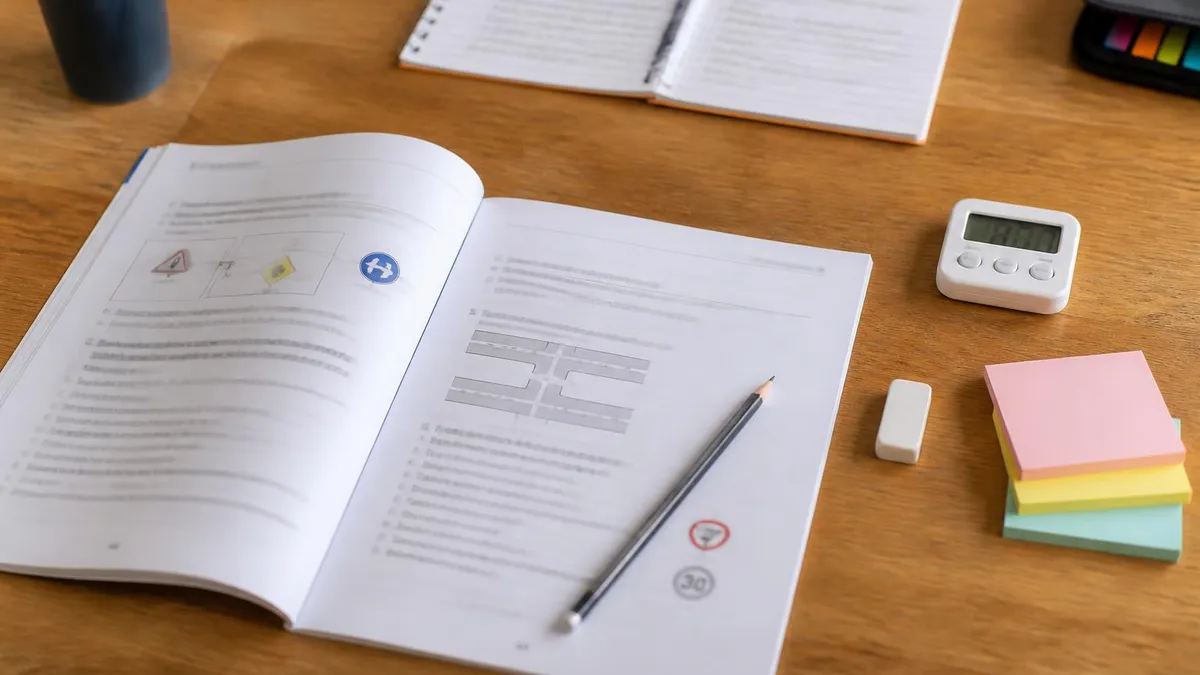
What Happens During the BMV Knowledge Test
Check In at the BMV Counter
Sit Down at the Testing Terminal
Answer All 34 Knowledge Questions
Submit Your Answers and Receive Results
Proceed to Next Steps
The DMV knowledge test is structured around the content of your state's official driver's manual, and understanding what topics are covered gives you a clear roadmap for studying. In Indiana, the BMV knowledge test draws questions from four primary subject areas: traffic laws and regulations, road signs and markings, safe driving practices, and vehicle operation and equipment. Each of these categories carries roughly equal weight on the exam, so you cannot afford to skip any section of the manual during your preparation.
Traffic laws form the backbone of the knowledge test and tend to be the area where test-takers make the most mistakes. This section covers speed limits in different zones, right-of-way rules at intersections and crosswalks, passing and merging procedures, and regulations specific to school buses, emergency vehicles, and construction zones. Many of these rules have nuances — for example, when exactly you must yield to a pedestrian versus when you have the right of way — and the exam questions are designed to test whether you understand those distinctions, not just the general rule.
Road signs and markings represent a substantial portion of the knowledge test, and they're also an area where consistent practice pays off quickly. The exam tests recognition of regulatory signs (which tell you what you must or must not do), warning signs (which alert you to hazards ahead), and guide signs (which provide directional and informational information). Colors and shapes carry meaning — a red octagon always means stop, a yellow diamond always means warning — and memorizing these conventions helps you answer sign questions even when you haven't seen a specific sign before.
Safe driving practices on the BMV test go beyond simply knowing the rules — they test your judgment in real driving scenarios. Questions may ask what you should do when approaching a flooded roadway, how to handle a tire blowout at highway speed, what the proper following distance is under various weather conditions, and how to share the road safely with motorcycles, cyclists, and large commercial trucks. These situational questions require you to apply knowledge rather than just recall it, making active practice more valuable than passive reading.
Vehicle operation questions cover practical mechanics that every driver needs to understand: when and how to use headlights, how to check your mirrors correctly, what to do if your brakes fail, and the rules around vehicle registration and inspection requirements. While these questions may seem straightforward compared to traffic law scenarios, they often trip up test-takers who focused their study time on road signs and forgot about the equipment and operation sections entirely.
To understand the full drivers test length in terms of preparation — not just exam minutes — it helps to think about how the topics layer together. Road signs are mostly memorization. Traffic laws require comprehension. Safe driving practices demand judgment. Vehicle operation needs practical familiarity. A well-rounded study approach addresses all four layers and uses practice tests to confirm that knowledge has stuck before you sit down at the terminal.
One commonly overlooked aspect of knowledge test preparation is reviewing the specific rules that differ between states. If you recently moved to Indiana from another state, you may find that certain speed limits, right-of-way conventions, or cell phone use regulations differ from what you're used to. The Indiana Driver's Manual is the authoritative source, and even experienced drivers from other states should read it carefully rather than assuming their existing knowledge covers everything on the Indiana BMV test.
DMV Written Test Study Strategies by Learning Style
Visual learners retain information best through diagrams, charts, and image-based flashcards. For the DMV written test, this means studying road sign shapes and colors using visual flashcard apps, drawing intersection diagrams to understand right-of-way rules, and watching video explanations of complex traffic scenarios. Creating a color-coded summary sheet of sign categories — red for regulatory, yellow for warning, green for guide — gives your brain a spatial anchor for each category and dramatically improves recall speed during the actual exam.
When reviewing the Indiana Driver's Manual, visual learners should highlight key rules in different colors and sketch simple diagrams next to scenario-based rules like merging, yielding, and lane-change procedures. Online practice tests that display actual road sign images rather than just text descriptions are especially valuable. Aim to complete at least three full visual-format practice exams before test day, paying close attention to the signs and markings you consistently get wrong and creating a personal reference sheet for those specific items.

Taking the DMV Knowledge Test Online vs. In-Person: What to Consider
- +Online testing eliminates travel time and allows you to test from a comfortable, familiar environment
- +Many online platforms offer flexible scheduling including evenings and weekends not available at BMV offices
- +Computer-based formats allow you to flag and review questions before final submission
- +Instant digital results mean you can immediately begin planning your next licensing steps
- +Online DMV permit test options are ideal for test-takers with transportation barriers or busy schedules
- +Some online testing centers provide accessibility accommodations not always available at standard BMV locations
- −Not all states offer a fully remote online DMV test — many still require in-person visits for identity verification
- −Technical issues like internet outages or browser incompatibility can disrupt an online test session
- −In-person testing staff can answer procedural questions; online sessions offer no such live support
- −Some third-party online testing centers charge additional convenience fees on top of standard BMV fees
- −Test environment distractions at home can be harder to control than a dedicated BMV testing room
- −Identity verification requirements for online tests can be more complex, requiring additional documentation steps
Test Day Preparation Checklist for the DMV Written Test
- ✓Bring your original proof of identity — a U.S. passport, birth certificate, or permanent resident card is required.
- ✓Carry your Social Security card or a document showing your full Social Security number for verification.
- ✓Bring two documents proving Indiana residency, such as a utility bill and a bank statement dated within 60 days.
- ✓Arrive at the BMV at least 30 minutes before your appointment or the office closes to allow time for check-in.
- ✓Get at least seven to eight hours of sleep the night before — fatigue measurably reduces reading comprehension and recall speed.
- ✓Eat a full meal before your appointment so hunger does not distract you during the exam.
- ✓Complete one final full-length practice test the evening before to confirm your readiness without cramming new material.
- ✓Review your personal list of missed questions from previous practice sessions for a focused last-minute refresher.
- ✓Bring the correct fee amount in an accepted payment form — check your BMV's website for current accepted payment methods.
- ✓Turn off your phone or set it to silent before entering the testing area — phone use during the exam results in immediate disqualification.
Time Management Tip: Don't Rush, But Don't Stall
Most BMV knowledge test failures are not caused by running out of time — they're caused by second-guessing correct first instincts. Research on multiple-choice testing consistently shows that your first answer is correct more often than any change you make afterward. If a question genuinely stumps you, use the flag-and-review feature, move on, and return with fresh eyes rather than spending five minutes on a single question and disrupting your mental flow for the rest of the exam.
Failing the DMV written test on your first attempt is more common than most people realize — nationally, roughly 49 percent of first-time test-takers do not pass. Understanding what happens when you fail, how long you must wait before retesting, and how to use that waiting period strategically can mean the difference between passing on your second attempt and continuing to struggle through repeated failures. Indiana's BMV has specific rules governing retake eligibility that you need to know before you walk out the door empty-handed.
In Indiana, if you fail the knowledge test, you must wait one day before attempting it again. There is no limit on the total number of attempts, but each attempt requires paying the applicable testing fee. This means repeated failures can become costly in addition to being time-consuming. Most BMV counselors recommend taking at least one additional week of focused study before returning for a second attempt, even though you are technically eligible to retest the following day. Returning too quickly without addressing your knowledge gaps almost always results in another failure.
When you receive your score after a failed attempt, the results will typically indicate which topic areas you missed the most questions in. This breakdown is an extremely valuable diagnostic tool. If you missed five questions on road signs but only one on traffic laws, you know exactly where to concentrate your review time. Many test-takers make the mistake of studying all topics equally after a failure when they should be targeting their specific weak areas with intensive focused practice.
Using an online DMV practice test platform after a failure is one of the most efficient retake preparation strategies available. These platforms allow you to take category-specific quizzes — testing only on road signs one session, only on traffic laws the next — which is far more efficient than re-reading the entire driver's manual from cover to cover. After spending two to three sessions on your weak categories, take a full simulated exam to confirm your overall readiness before booking your retake appointment.
One pattern that study data reveals is that test-takers who fail tend to have studied the manual passively — reading without actively testing themselves — during their initial preparation. The solution is not just more time with the manual but a different study method altogether. Active recall, the practice of trying to remember information before checking the answer, is significantly more effective than passive re-reading for building the kind of durable knowledge that holds up under exam conditions.
It is also worth noting that the questions on each BMV knowledge test attempt are drawn from a larger question bank, so the exact questions you see on your second attempt will differ from your first. This means you cannot simply memorize the specific questions you saw before. You need genuine conceptual understanding of each topic area, which is why understanding the why behind each traffic rule — not just the what — produces better retake results than attempting to memorize individual question-answer pairs.
Finally, some test-takers benefit from finding a study partner or small group for their retake preparation. Explaining a traffic rule to another person requires a level of mastery that solo study does not, and peer accountability helps maintain a consistent study schedule in the days leading up to the retake. If an in-person study partner is not available, online study forums and communities focused on the DMV knowledge test can serve a similar function, offering explanations from people who recently passed the exam in your state.

Indiana requires learner's permit applicants to be at least 15 years old and to have a signed parental consent form if under 18. You must pass the knowledge test before a learner's permit is issued, and the permit requires you to hold it for a minimum of 180 days before you can take the driving skills test. Missing this holding period requirement will delay your full license even if you pass the knowledge exam immediately.
The rise of online DMV test options has fundamentally changed how many drivers prepare for and take their knowledge exams. Several states now offer legitimate remote testing options through approved third-party providers, and understanding the difference between an official online DMV permit test and an unofficial practice platform is critical for avoiding confusion on licensing timelines. Not every website offering a driving test online is an official testing provider — many are practice platforms, which are valuable for preparation but do not count toward your actual licensing requirement.
In Indiana, the BMV currently administers the knowledge test at its branch offices using computerized terminals. While the exam is computer-based, it is not yet available as a fully remote at-home test in Indiana as of 2026. Residents must appear in person at a BMV branch to complete the official knowledge test. However, the availability of high-quality online practice platforms means you can do the vast majority of your preparation from home and arrive at the office ready to pass on your first visit.
When selecting an online practice platform, look for providers that base their question banks on your specific state's driver's manual rather than a generic national question set. State-specific questions matter because traffic laws, speed limit defaults, and specific sign regulations vary between states. A practice platform using questions calibrated to Indiana's BMV exam will prepare you far more effectively than a generic national test that includes questions about laws that don't apply in Indiana at all.
Several features distinguish high-quality online practice test platforms from lower-quality alternatives. The best platforms offer full-length simulated exams that mirror the exact question count and passing threshold of the real BMV test, category-specific quizzes for targeted practice, detailed explanations for every answer rather than just right/wrong indicators, and score tracking over multiple sessions so you can see your improvement over time. Platforms that shuffle questions randomly each session are especially valuable because they prevent score inflation from pattern memorization.
The distinction between DMV test online practice and the official exam also matters when it comes to interpreting your practice scores. Scoring 95 percent on a practice test the day before your appointment is encouraging, but it does not guarantee a pass on the real exam because practice test question banks differ from the official BMV question bank.
A more reliable readiness indicator is consistently scoring above 85 percent across five or more different full-length practice sessions using questions you have not seen before — that level of consistent performance suggests genuine knowledge mastery rather than familiarity with a specific question set.
For younger applicants taking the online dmv permit test for the first time, it can help to think of practice tests not as a measure of current readiness but as a diagnostic tool that reveals exactly what still needs to be learned. Early practice test scores in the 50 to 60 percent range are completely normal and should not be discouraging. The value is in identifying which specific questions you missed, understanding why the correct answer is correct, and returning to those topics in the driver's manual for deeper review before attempting another full practice exam.
For drivers looking for the most comprehensive preparation approach, combining driver's manual reading, category-specific practice quizzes, full-length simulated exams, and a review of any state-specific rule updates for 2026 represents the gold standard. Indiana periodically updates its driver's manual to reflect new legislation — changes to cell phone laws, updated speed limits in construction zones, or revised rules for new vehicle technologies may appear on the current exam but not in older study materials. Always verify you are studying the most current version of the Indiana Driver's Manual before your test date.
With a clear understanding of what the BMV knowledge test covers and how long it takes, the most valuable thing you can do in the weeks before your exam is build a consistent daily study habit. Research on learning and memory consistently shows that short, frequent study sessions spread over several weeks produce far better retention than long cramming sessions the night before an exam. Aim for 20 to 30 minutes of active practice each day for two to three weeks before your test date rather than a marathon study session the day before your appointment.
Start your preparation by reading the Indiana Driver's Manual in full before attempting any practice questions. This first read-through gives you a mental framework for all four topic areas and helps you understand how the rules connect to each other. Many test-takers jump straight to practice questions and then struggle because they lack the conceptual foundation to understand why certain answers are correct. The manual read-through takes most people two to three hours spread across two or three sessions — a worthwhile investment that pays dividends on every practice test you take afterward.
After your first manual read-through, begin targeted practice using category-specific quizzes. Spend your first practice week focusing on road signs and markings, since this is a heavily tested category where consistent practice produces rapid score improvement. In your second week, shift to traffic laws and right-of-way scenarios, which require more comprehension-based understanding. In the days immediately before your test, take two or three full-length simulated exams under realistic conditions — timed, uninterrupted, without looking up answers — to simulate actual test-day conditions as closely as possible.
Pay special attention to the topics that most commonly appear on the Indiana BMV test based on the structure of the official question bank. Right-of-way at intersections, school bus stopping requirements, blood alcohol content laws and their consequences, speed limits in different zones, and the meaning of specific road signs consistently appear on the exam. These high-frequency topics deserve additional review time regardless of your overall practice test performance in other categories.
On the day of your test, your preparation strategy should shift from acquisition to consolidation. Do not try to cram new information on test day — instead, spend 15 minutes reviewing your personal list of previously missed questions and confirming your understanding of any rules you found confusing during practice. Then spend the remaining time relaxing and ensuring you have everything you need for your BMV appointment. A well-rested, well-fed test-taker with solid preparation will consistently outperform an exhausted one who studied all night.
During the actual exam, read each question slowly and carefully before looking at the answer choices. The phrasing of BMV questions sometimes includes critical qualifiers — words like always, never, when, unless — that completely change the correct answer. Rushing through questions and missing these qualifiers is a common source of avoidable errors. If a question is genuinely unclear, use the flag feature to mark it and continue; returning to flagged questions with fresh perspective often makes the correct answer obvious on a second read.
After you pass your knowledge test and receive your learner's permit or driver's license, the learning does not stop. Indiana requires new drivers under 18 to log at least 50 hours of supervised driving practice — including 10 hours at night — before they can take the driving skills test. The knowledge you demonstrated on the BMV written test becomes the foundation for developing real behind-the-wheel competence, and the safe driving practices and traffic laws you studied will guide every decision you make as a licensed driver for years to come.
Sample BMV Practice Questions
Try these questions from our free BMV practice tests. The correct answer and an explanation follow each question.
Approximately how long does the body take to process one standard drink of alcohol?
- A. 15–20 minutes
- B. 30 minutes
- C. About one hour
- D. Two hours
Answer: C. About one hour
The liver processes approximately one standard drink per hour; no amount of coffee, food, or water speeds up this process.
How far ahead should a driver ideally scan the road for hazards?
- A. 10 to 15 seconds
- B. 1 to 2 seconds
- C. 3 seconds
- D. 30 seconds
Answer: A. 10 to 15 seconds
Scanning 10 to 15 seconds ahead gives you time to identify and react to hazards.
What are graduated licensing restrictions for new teen drivers?
- A. Nighttime driving restrictions, passenger limitations, and mandatory supervised driving hours
- B. No restrictions apply to teen drivers
- C. Only a written test is required
- D. Restrictions only apply for the first week
Answer: A. Nighttime driving restrictions, passenger limitations, and mandatory supervised driving hours
Graduated Driver Licensing (GDL) programs typically include a learner's permit phase with supervised driving requirements, followed by intermediate license with nighttime and passenger restrictions before full licensure.
What does a solid yellow line next to a broken yellow line mean for the driver on the broken-line side?
- A. Passing is allowed when safe
- B. Passing is never allowed
- C. The road is closed ahead
- D. You must reduce speed by half
Answer: A. Passing is allowed when safe
A driver on the broken-line side may pass when it is safe to do so.
BMV Questions and Answers
DMV Driver's License Written Test Questions: Complete Study Guide and Practice Strategy for 2026
Georgia Permit Test Practice: Complete 2026 Guide to Passing Your DDS Knowledge Exam on the First Try

Ohio BMV License Renewal: Online, In-Person, and Cost Guide

Drivers Ed Practice Test: Prepare for Your Knowledge Exam

Permit Test Questions: What to Expect, Sample Questions, and How to Pass First Try
About the Author

Licensed Driving Instructor & DMV Test Specialist
Penn State UniversityRobert J. Williams graduated from Penn State University with a degree in Transportation Management and has spent 20 years as a certified driving instructor and DMV examiner consultant. He has personally coached thousands of applicants through written knowledge tests, skills assessments, and commercial driver licensing programs across more than 30 states.
Join the Discussion
Connect with other students preparing for this exam. Share tips, ask questions, and get advice from people who have been there.
View discussion (9 replies)