
What Is the Knowledge Test for Driving? Complete Guide to the BMV Written Exam
🎓 What is the knowledge test for driving? Learn the format, topics, scoring, and proven study strategies to pass your BMV written exam the first time.

If you have ever wondered what is the knowledge test for driving, you are in the right place. The driving knowledge test is the written portion of the licensing process administered by your state Bureau of Motor Vehicles, and it measures whether you understand the traffic laws, road signs, signals, and safe-driving practices required to operate a vehicle legally. Almost every new driver in the United States must pass this exam before they can take a behind-the-wheel road test or receive a learner permit.
The format varies slightly by state, but the underlying purpose is identical everywhere: confirm that you have the baseline knowledge to share the road without endangering yourself or others. Most knowledge tests contain between 25 and 50 multiple-choice questions drawn directly from the official driver handbook. Topics range from speed limits and right-of-way rules to alcohol laws, sign recognition, and emergency procedures. Passing scores typically fall between 70 and 85 percent depending on jurisdiction.
Many first-time test takers underestimate the exam because it sounds simple on paper. In reality, the average first-time pass rate hovers around 50 percent across the country, with some states reporting fail rates above 60 percent for unprepared applicants. The questions can be surprisingly tricky, especially those involving stopping distances, blood alcohol concentration limits, and unusual sign meanings. Reading the handbook once is rarely enough — repeated practice with realistic questions is what separates passers from re-takers.
The knowledge test is administered in several formats: computer-based testing at most modern BMV branches, paper-and-pencil exams at smaller offices, and in some states an online version that can be completed from home under proctored conditions. Each format counts equally toward your licensing requirement. You will need to bring identification, proof of residency, your application paperwork, and the testing fee — usually somewhere between five and forty dollars depending on the state.
One reason the test feels intimidating is that you cannot study from a single universal source. Each state publishes its own driver manual that reflects local laws, signage variations, and licensing procedures. Indiana's manual differs from Ohio's, which differs from California's. That said, roughly 70 percent of the material overlaps across all states because the federal Manual on Uniform Traffic Control Devices standardizes most signs and signals nationwide. Strong general preparation transfers well even if you later move.
This guide breaks down everything you need to know: what the test covers, how it is scored, how to prepare efficiently, what to expect on exam day, and how to handle a retake if needed. We will also point you to free practice question banks so you can gauge your readiness before scheduling your appointment. By the end, you will know exactly what to study, how long to study, and what to do when you walk into the BMV.
Whether you are a teen driver getting your first permit, an adult returning to driving after years away, or a new resident transferring an out-of-state license, the knowledge test is the same gateway. Treat it seriously, prepare with intent, and you can pass on your first attempt with confidence.
The Driving Knowledge Test by the Numbers
Key Facts at a Glance
| Item | Value | Details |
|---|---|---|
| Questions per Exam | 25-50 | Multiple-choice format |
| Typical Passing Score | 80% | Varies by state 70-85% |
| Test Fee Range | $5-$40 | Depends on your state BMV |

How the Knowledge Test Is Structured
Roughly 30-40% of questions cover state-specific traffic laws including speed limits, right-of-way rules, lane usage, parking regulations, and required equipment for your vehicle.
Approximately 20-25% test your ability to recognize regulatory, warning, guide, and construction signs by shape, color, and meaning, including signs without text.
Around 25% focus on defensive driving, following distance, weather conditions, emergency maneuvers, and how to share the road with pedestrians, cyclists, and motorcycles.
About 10-15% cover BAC limits, implied consent, zero-tolerance rules for minors, penalties for DUI, and the effects of prescription and over-the-counter medications.
The remaining 5-10% address license classes, registration, insurance minimums, accident reporting procedures, and the consequences of point accumulation on your record.
Understanding what topics the knowledge test covers gives you a focused roadmap for studying. The bulk of any BMV written exam is drawn from four major content areas, and knowing the relative weight of each helps you allocate study time intelligently. State traffic laws form the foundation, accounting for roughly a third of every test. Within this section you will see questions about speed limits in school zones, residential areas, highways, and rural roads — and remember that limits vary widely by state, so memorize your local numbers carefully.
Road sign recognition is the second-largest category. The Federal Highway Administration standardizes signs by shape and color so drivers can identify them at a glance even before reading the text. Octagons always mean stop. Triangles pointed downward always mean yield. Diamonds warn of hazards ahead. Pentagons mark school zones. Horizontal rectangles provide guidance, while vertical rectangles convey regulations. Knowing the shape-color-meaning relationship lets you answer dozens of questions correctly even when the sign image is partial or stylized.
Right-of-way questions trip up more applicants than any other category. Who proceeds first at a four-way stop when all vehicles arrive simultaneously? The driver on the right. Who yields when two cars meet at a T-intersection without signals? The driver on the terminating road yields to traffic on the through road. Pedestrians in marked or unmarked crosswalks always have priority. Emergency vehicles with active lights and sirens override all other right-of-way rules and require you to pull to the right edge and stop.
Alcohol and impaired-driving questions form a critical block of the exam, and many states dedicate entire question banks to this topic. The standard adult BAC limit nationwide is 0.08 percent, though commercial drivers face 0.04 percent and drivers under 21 are subject to zero-tolerance laws ranging from 0.00 to 0.02 percent. Implied consent means that by accepting a driver license, you have already agreed to submit to chemical testing if lawfully arrested for suspected impaired driving — refusing triggers automatic license suspension.
Defensive driving and following distance questions reward students who understand the three-second rule. Pick a fixed object ahead, watch the car in front pass it, then count one-thousand-one, one-thousand-two, one-thousand-three. If you reach the object before finishing, you are following too closely. Add a second for rain, two for snow, and additional seconds for night driving, towing, or driving an unfamiliar vehicle. Stopping distance combines reaction distance plus braking distance and roughly quadruples when speed doubles.
Sharing the road with vulnerable users is another favorite test topic. Most states require drivers to give cyclists a minimum of three feet when passing, and some require five. Motorcycles deserve full lane width and extra following distance because they can stop more quickly than cars. School buses with flashing red lights require all traffic in both directions to stop on undivided roads, with very narrow exceptions for divided highways with physical median barriers — exceptions that are themselves common exam questions.
Finally, expect a handful of questions about administrative topics: how long you have to report an accident, when you must notify the BMV of an address change, what to carry in your vehicle (registration and insurance proof), and how the point system works in your state. These items are easy to memorize from the manual and represent guaranteed points if you read carefully.
BMV Practice Test Questions
Prepare for the BMV - Test exam with our free practice test modules. Each quiz covers key topics to help you pass on your first try.
BMV Basic BMV Practice
BMV Exam Questions covering Basic BMV Practice. Master BMV Test concepts for certification prep.
BMV Alcohol, Drugs, and Impaired Driving Laws
Free BMV Practice Test featuring Alcohol, Drugs, and Impaired Driving Laws. Improve your BMV Exam score with mock test prep.
BMV Licensing Requirements
BMV Mock Exam on BMV Licensing Requirements. BMV Study Guide questions to pass on your first try.
BMV Traffic Laws
BMV Test Prep for BMV Traffic Laws. Practice BMV Quiz questions and boost your score.
BMV Vehicle Operations
BMV Questions and Answers on BMV Vehicle Operations. Free BMV practice for exam readiness.
BMV Parking, Right-of-Way, and Intersections
BMV Mock Test covering Parking, Right-of-Way, and Intersections. Online BMV Test practice with instant feedback.
BMV Road Signs and Markings
Free BMV Quiz on Road Signs and Markings. BMV Exam prep questions with detailed explanations.
BMV Safe Driving and Hazard Awareness
BMV Practice Questions for Safe Driving and Hazard Awareness. Build confidence for your BMV certification exam.
Knowledge Test Subjects Broken Down
Road signs and signals make up roughly a quarter of every knowledge test. You will need to recognize regulatory signs like stop, yield, and do-not-enter, as well as warning signs marking curves, intersections, and railroad crossings. Memorize the color code: red prohibits, yellow warns, green guides, blue provides services, brown marks recreation areas, and orange signals construction zones.
Traffic signals are equally important. Solid red means stop completely. Flashing red functions as a stop sign. Solid yellow warns of an imminent red. Flashing yellow means proceed with caution. Green arrows give protected turn rights, while green balls allow movement with yielding obligations. Pavement markings like solid versus dashed lines tell you whether passing is permitted, and yellow versus white lines indicate traffic direction relationships.

Computer-Based vs Paper Knowledge Tests: Which Format Wins?
- +Computer tests provide immediate scoring so you know results before leaving
- +On-screen images of signs are clearer than printed booklets in many cases
- +Computer interfaces allow you to flag questions and return to them
- +Most computerized exams end as soon as you reach the passing threshold
- +Touch-screen navigation reduces the chance of marking errors
- +Digital tests are available in 20+ languages at most modern BMV branches
- +Results sync immediately with your application so road test booking is faster
- −Computer screens can cause eye strain during a 30-minute exam
- −Some test takers find the timer pressure more visible and stressful
- −Touch screens occasionally misread inputs requiring re-taps
- −Paper tests allow easier review of all questions at once
- −Older test-takers may prefer the familiarity of pencil and paper
- −Not every BMV branch has enough computers, causing wait times
Pre-Test Preparation Checklist for the Driving Knowledge Test
- ✓Download and read your state driver manual cover to cover at least once
- ✓Complete a minimum of 200 practice questions before scheduling your exam
- ✓Memorize all eight standard sign shapes and their color meanings
- ✓Learn the specific BAC limits for adults, commercial drivers, and minors in your state
- ✓Practice right-of-way scenarios at four-way stops, T-intersections, and roundabouts
- ✓Memorize stopping distances at 20, 40, and 60 miles per hour
- ✓Review school bus stopping rules including divided-highway exceptions
- ✓Bring required documents: ID, proof of residency, Social Security card, and application form
- ✓Confirm payment method — cash, check, or card accepted at your branch
- ✓Get a full night of sleep and eat breakfast before your appointment time
Take at least five practice tests in the 48 hours before your exam
Research from licensing data shows applicants who complete five or more timed practice tests in the two days before their exam pass at a rate of 84 percent, compared to 47 percent for those who studied only the handbook. Recent practice activates the same retrieval pathways you'll use under exam pressure.
Knowing what to expect on test day removes most of the anxiety that derails otherwise prepared applicants. Plan to arrive at your BMV branch at least 30 minutes before your appointment time. Most modern branches handle knowledge testing on a walk-in or scheduled basis, but appointments typically get priority and shorter wait times. Bring every document on your state's list — missing paperwork is the most common reason applicants are turned away before they ever sit down for the exam.
When you arrive, you will check in at the front desk, present your identification, pay the application fee, and have your photograph taken. A clerk will verify your eligibility, confirm you meet age and residency requirements, and may administer a quick vision screening before the written exam begins. The vision test typically requires you to read letters from a standardized chart and identify the colors of traffic signals. Most states require 20/40 corrected vision in at least one eye to pass.
After eligibility verification, you will be directed to a testing station — usually a small carrel with a touchscreen computer in modern offices or a desk with a paper booklet in smaller branches. The clerk will explain the rules: no phones, no notes, no talking, no leaving the testing area without permission. Most states give you 30 minutes to complete the exam, though the average passer finishes in 15 to 20. There is no bonus for finishing quickly, so pace yourself.
Read every question completely before looking at the answer choices. Test writers love to use words like never, always, must, may, and except to flip the meaning of otherwise familiar questions. A question asking when you must yield reads very differently from one asking when you may yield. Distractor answers often contain partially correct information designed to confuse hasty readers. Cover the choices with your hand on paper exams, or look away from the screen on computer tests, and predict the answer before reading the options.
If you encounter a question you cannot answer with confidence, flag it on a computer exam or circle the question number on paper, then move on. Spending five minutes wrestling with one question while easier ones remain is a classic failure pattern. Answer everything you know first, then return to the flagged items with the time you have left. Eliminate obviously wrong choices to improve your guessing odds — most questions have at least one or two distractors that any prepared student can rule out.
When you finish, computer-based tests typically display your result on screen within seconds. Paper tests are graded by hand or scanned by the clerk and results come within a few minutes. If you pass, congratulations — you will be directed back to the licensing counter to complete the next phase, whether that is receiving your learner permit or scheduling your road skills test. If you fail, the clerk will inform you of your state's retake policy, which may require a waiting period.
Most BMV branches offer a same-day retake in some states, while others impose waiting periods of one to seven days between attempts. You will pay the testing fee again for each retake. Use the time between attempts productively: identify which question categories tripped you up, focus your study there, and return ready to pass. A first-attempt fail is not a permanent setback — many drivers pass on the second or third try with no lasting record of the earlier attempts.

Every state BMV strictly prohibits cell phones, smartwatches, and any internet-connected device in the testing area. Being caught with a phone — even powered off — usually results in automatic failure, immediate dismissal, and in some states a 30-day ban on retesting. Lock your phone in your car or leave it with a friend before entering the building.
If you do not pass on your first attempt, the most important thing is to avoid retaking the test too quickly. Same-day retakes feel tempting because you are already at the BMV and want to move on, but data consistently shows that immediate retakes have lower pass rates than attempts taken after focused review. The same questions that confused you the first time will likely confuse you again unless you actively study the material between attempts. A few hours of targeted practice can dramatically change your second-attempt odds.
Start by identifying which question categories caused your failure. The test result printout typically breaks your score down by topic — traffic laws, signs, right of way, alcohol laws, and so on. The category where you missed the most questions is your priority study area. If you got 90 percent of sign questions right but only 40 percent of right-of-way questions, dedicate the next 72 hours almost exclusively to right-of-way practice. Targeted study beats general review every time.
Use realistic practice tests, not just flash cards or chapter summaries. The format and phrasing of practice questions should mirror the actual BMV exam as closely as possible. Look for question banks that include detailed explanations for both correct and incorrect answers, because understanding why a wrong answer is wrong reinforces the correct rule in your memory. Free BMV practice resources provide hundreds of questions you can cycle through repeatedly until correct answers feel automatic.
Beyond practice questions, consider supplementing with video resources. Many state BMVs publish free instructional videos covering common test topics, and YouTube channels run by certified driving instructors break down the trickiest concepts visually. Sign recognition in particular benefits from video review because seeing signs in context — including unusual or weathered examples — prepares you for the variation you may encounter on the test and on real roads.
Once you have studied your weak areas and taken several full-length practice exams scoring above 85 percent consistently, schedule your retake. Treat the second attempt with the same seriousness as the first. Arrive early, bring all paperwork including the original application receipt, and pay the retake fee. Some states require you to update or reverify your application after multiple failures, so check your state's specific policy before returning to the branch.
After passing, you typically receive a learner permit immediately or by mail within two weeks. The permit allows you to practice driving under specific conditions — usually with a licensed adult 21 or older in the passenger seat, with restrictions on nighttime driving, freeway use, and passenger counts. Your state may require a minimum holding period before you can take the road skills test, often six months for first-time licensed teens but shorter or none for adults. Review the requirements at the time of your appointment with the help of bmv appointments to make sure you arrive prepared.
The knowledge test is the first of several milestones toward a full driver license, but it is a meaningful one. Passing demonstrates that you understand the rules that keep everyone on the road safe. Take it seriously, prepare thoroughly, and use any failures as feedback rather than discouragement. Tens of millions of Americans pass this exam every year, and you can too with the right preparation strategy and a clear understanding of what to expect.
The final week before your knowledge test is where smart preparation pays off most. Build a simple daily routine: 30 minutes of handbook review in the morning, 30 minutes of practice questions in the evening, and one full-length timed test every other day. This rhythm builds both recall and stamina without burning you out. Avoid cramming the night before — sleep is the single most underappreciated tool for memory consolidation, and applicants who sleep less than six hours the night before consistently underperform.
Pay special attention to numerical facts because they appear on nearly every knowledge test and they are easy points if memorized cleanly. Speed limits in school zones, residential areas, business districts, rural highways, and interstates. BAC thresholds for adults, commercial drivers, and minors. Stopping distances at various speeds. Following distances measured in seconds. Reporting deadlines for accidents and address changes. Make a one-page cheat sheet of every number you need to know, then review it daily until you can recite it without looking.
Sign recognition deserves dedicated drill time. Create digital or paper flash cards covering every regulatory, warning, guide, and construction sign in your state manual. Shuffle them, time yourself, and aim for one-second recognition on each card. The actual test often shows signs without text, requiring you to identify them by shape and color alone. Workers ahead, lane reduction, slippery when wet, sharp curve, no passing zone — these warnings recur often and reward fast recognition.
Practice in test-realistic conditions whenever possible. Sit at a desk, set a 30-minute timer, take a full-length practice test in one sitting without checking answers until the end. This simulates the focus and pacing of the real exam better than casual studying. After scoring, review every missed question and write a one-sentence explanation in your own words for why the correct answer is right. Active recall and self-explanation outperform passive re-reading by a wide margin.
On exam day morning, eat a balanced breakfast with protein and complex carbs to maintain focus. Avoid high-sugar foods that cause energy crashes mid-test. Drink water but not excessively — you cannot leave the testing area for restroom breaks without forfeiting your attempt in some states. Wear comfortable clothing and dress in layers because testing areas are often kept cooler than waiting rooms. Arrive 30 minutes early to handle paperwork without rushing.
Inside the testing room, take three deep breaths before starting. Read the on-screen instructions carefully even if you have seen them in practice. Note the time limit, the passing score, and whether you can review flagged questions at the end. Work through questions at a steady pace — roughly 45 seconds each on a 30-question test gives you a few minutes at the end to review. Trust your preparation and resist the urge to change answers unless you have a clear reason. First instincts are usually right when you have studied properly.
If you would like additional hands-on practice with vehicle-related procedures, consider reviewing the driver test car rental for road-test preparation tips that complement your written knowledge prep. After your written exam, you will need to demonstrate practical driving skills, and understanding the road test format early helps you set realistic expectations for the entire licensing journey. The knowledge test is the start — passing it puts you on the path to full driving privileges and the freedom that comes with them.
Sample BMV Practice Questions
Try these questions from our free BMV practice tests. The correct answer and an explanation follow each question.
Which of the following can impair driving ability as much as alcohol?
- A. Chewing gum
- B. Listening to music
- C. Certain prescription and over-the-counter medications
- D. Drinking water
Answer: C. Certain prescription and over-the-counter medications
Many prescription and OTC medications, including antihistamines, sleep aids, and painkillers, can impair reaction time and judgment as much as alcohol.
How long must a teen hold a temporary permit before taking the driving test?
- A. 30 days
- B. 3 months
- C. 6 months
- D. 12 months
Answer: C. 6 months
Teens under 18 must hold the permit for at least six months before the road test.
When driving in a construction zone with workers present, what should you typically do with your speed?
- A. Maintain your current speed to avoid disrupting traffic flow
- B. Reduce speed and obey posted reduced speed limit signs
- C. Speed up to pass through quickly
- D. Slow to 10 mph regardless of posted signs
Answer: B. Reduce speed and obey posted reduced speed limit signs
Construction zones post reduced speed limits to protect workers, and fines are often doubled for violations there.
When driving in fog, you should use your:
- A. Low-beam headlights
- B. High-beam headlights
- C. Parking lights only
- D. Hazard lights while moving
Answer: A. Low-beam headlights
Low beams reduce glare and give better visibility in fog than high beams.
BMV Questions and Answers
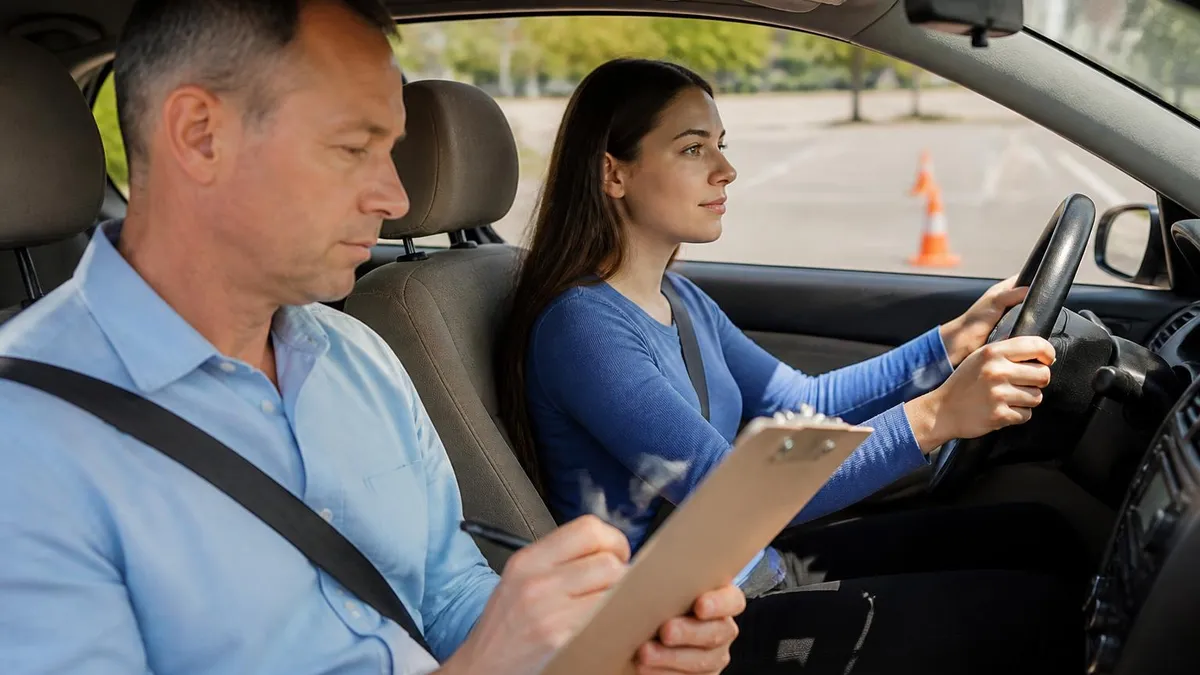
Driver Test Car Rental in Gastonia, NC: Complete BMV Road Test Vehicle Guide

Ohio BMV Driving Test: Maneuverability, Road and Pass Tips
DMV Testing Area No Cell Phones Allowed: Complete Rules Guide for Your Driving Exam
Hours of Ohio BMV: Complete Guide to Office Hours, Locations, and Visit Planning

BMV Appointment Guide: How to Schedule, Prepare, and Pass Your Visit on the First Try
About the Author

Licensed Driving Instructor & DMV Test Specialist
Penn State UniversityRobert J. Williams graduated from Penn State University with a degree in Transportation Management and has spent 20 years as a certified driving instructor and DMV examiner consultant. He has personally coached thousands of applicants through written knowledge tests, skills assessments, and commercial driver licensing programs across more than 30 states.
Join the Discussion
Connect with other students preparing for this exam. Share tips, ask questions, and get advice from people who have been there.
View discussion (9 replies)